
Key takeaways
- Compare programmable DC bench power supplies for prototype testing, with stable output, set resolution, USB, LAN and RS232 control for repeatable tests.
What's inside
As an Amazon Associate I earn from qualifying purchases. This post may contain affiliate links at no extra cost to you.
Prototype testing puts a different demand on a bench supply than occasional repair work. A prototype changes state, draws current in bursts, and needs the same rail voltage every time a test repeats, so a small drift or a coarse adjustment can hide a real fault or create one that does not exist. The decision is therefore not only about maximum voltage and current, but about how precisely the supply can be set, how steadily it holds that setting under load, and how easily a test script can change it without someone turning a knob by hand.
This guide is for engineers, makers, and students who build and test prototype boards and want repeatable power during bring-up, firmware testing, and fault finding. Each supply below is a programmable DC bench power supply with a listing on Amazon, and the specifications in this article come from the Amazon listing for that exact model. The focus throughout is accuracy and stability, because those two qualities decide whether a prototype test result can be trusted the second time it runs.
Quick Picks
As an Amazon Associate we earn from qualifying purchases
| Product | Best for | Key spec from title |
|---|---|---|
| Siglent SPD3303X-E Programmable DC Power Supply | Powering analog and logic rails at the same time | Triple output, two 32 V, 3.2 A channels plus a 2.5, 3.3, 5 V rail |
| Rigol DP832A Programmable DC Power Supply | Logging small current changes during prototype tests | Triple output, 195 W, with 0.1 mV and 0.1 mA readback |
| Korad KA3005P Programmable DC Power Supply | Repeatable single-rail tests on a compact bench | Single output, 30 V, 5 A, with USB and RS232 control |
How to Choose
Match voltage and current headroom to the prototype
Start from the highest rail the prototype needs, then add headroom for inrush current and for the next revision of the board. A supply that sits at its maximum output all day runs hotter and leaves no room for a motor start, a radio burst, or a capacitor bank charging at power-on. Check the current limit separately for each rail, because a triple-output supply may share a total power limit across channels. A board with a 12 V motor rail and a 3.3 V logic rail needs two genuinely independent outputs, not one output split by a regulator on the bench. Write down the worst-case draw for every rail before comparing models, and treat a supply that only just meets those numbers as too small.
Read resolution and stability, not just the headline range
Two supplies can both claim a 30 V range and behave very differently during a sensitive test. Set resolution decides how close the output can be placed to the intended value, while readback resolution decides how small a change the display or the script can actually see. Stability matters just as much, because a rail that wanders while a prototype wakes from sleep can look like a firmware problem. Ripple and noise matter most on analog rails, sensor supplies, and audio paths, where a noisy rail feeds straight into the measurement. Look for the resolution and stability figures on the listing, and give them the same weight as the headline voltage and current.
Choose the programming interface your test setup already uses
A programmable supply only saves time when it talks to the computer that runs the test. USB is the simplest choice for a single bench and a short script, while LAN suits a shared lab where the supply sits on a network and several benches reach it. RS232 still appears on older test rigs and on industrial controllers, and it can be the right pick when the existing harness already uses serial commands. Check whether the listing states SCPI support or a vendor command set, because that decides how much work the script needs and whether standard test software can drive the supply. Confirm the cable and the software are included or available before ordering, so the supply does not arrive as a manual-only instrument.
Check protection and memory before a long test run
Prototype testing often runs unattended, with a board cycling through power states while the script logs results. Overvoltage protection and overcurrent protection turn a wiring mistake into a stopped test instead of a damaged prototype, so confirm both are stated on the listing and learn how the limits are set. Memory presets save the voltage and current combinations used most often, which removes a manual setup step and cuts the chance of typing a wrong value before a repeated test. An output on and off switch, a clear display of set and measured values, and a temperature-controlled fan all help during long sessions. Read the protection and memory details as part of the purchase decision, not as an afterthought once the supply is on the bench.
The 3 Best Options
Siglent SPD3303X-E Programmable DC Power Supply
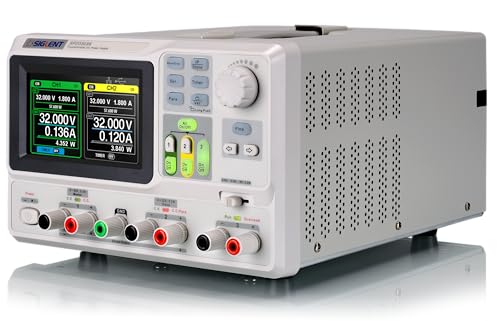
The Siglent SPD3303X-E suits prototype benches where one board needs more than one rail at the same time. Its two adjustable channels can feed an analog section and a digital section independently, while the third rail covers common logic levels, so a mixed-signal prototype can be powered in one setup instead of borrowing a second supply. The linear design keeps output noise low, which matters when the prototype includes sensors or analog front ends. USB and LAN interfaces let a script set voltages, switch channels, and read back values during a test sequence, and the series and parallel channel modes add flexibility when a later prototype needs a higher voltage or more current from the same unit.
Specs
- Output: two adjustable channels, 0 to 32 V and 0 to 3.2 A each, plus a selectable 2.5 V, 3.3 V, or 5 V rail at 3.2 A
- Total power: 220 W
- Channels: 3, with independent, series, and parallel operation
- Set resolution: 10 mV and 10 mA
- Programming interfaces: USB and LAN, with SCPI support
- Type: linear DC power supply
Best for: Mixed-signal prototypes that need analog, digital, and logic rails powered together during bring-up and testing.
Watch out for: The third channel is a selectable fixed-voltage rail rather than a fully adjustable channel, so confirm it matches the logic level the prototype needs before relying on it.
Rigol DP832A Programmable DC Power Supply
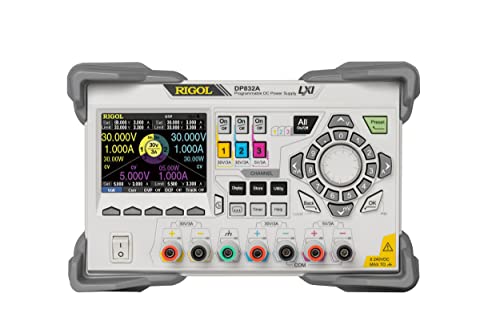
The Rigol DP832A suits prototype testing where measurement matters as much as power delivery. Its fine readback resolution makes small current changes visible, so a sleep-current test or a wake-up sequence shows the difference between one state and the next instead of rounding it away. Two 30 V channels plus a 5 V channel cover the common combination of a main rail, an auxiliary rail, and a logic supply on one bench. USB, LAN, and RS232 interfaces give the test setup several ways to connect, and SCPI support lets standard test software drive the supply. The display shows set and measured values for each channel, which helps when a prototype misbehaves and the first question is whether the rail actually did what the script asked.
Specs
- Output: two adjustable channels, 0 to 30 V and 0 to 3 A each, plus a 5 V channel at 3 A
- Total power: 195 W
- Channels: 3
- Programming resolution: 1 mV and 1 mA, with readback resolution of 0.1 mV and 0.1 mA
- Programming interfaces: USB, LAN, and RS232, with SCPI and LXI support
- Type: linear programmable DC power supply
Best for: Prototype tests that log current draw, compare power states, or need fine readback to spot small changes in behaviour.
Watch out for: Do not confuse this model with the plain Rigol DP832, which has a different interface set, so check the exact model name and the listed interfaces on the Amazon listing before ordering.
Korad KA3005P Programmable DC Power Supply

The Korad KA3005P suits a bench where one rail does most of the work and the priority is a repeatable setting at a lower cost than a triple-output instrument. Its single 30 V, 5 A channel covers a wide range of prototype boards, from 3.3 V logic to 24 V industrial inputs, and the linear output keeps ripple low for analog measurements. Four memory presets store the voltage and current combinations used most often, so switching between a microcontroller test and a higher-voltage test takes one button press instead of a full manual setup. USB and RS232 interfaces let a script set the output and read it back, which is enough to automate a simple repeated test without the cost and bench space of a larger supply.
Specs
- Output: single channel, 0 to 30 V and 0 to 5 A
- Total power: 150 W
- Channels: 1
- Set resolution: 10 mV and 1 mA
- Programming interfaces: USB and RS232, with remote control software included
- Protection: overvoltage protection and overcurrent protection
- Memory: 4 presets
- Type: linear programmable DC power supply
Best for: Single-rail prototype testing, repair benches, and first scripted test setups where one stable output is enough.
Watch out for: It uses the vendor command set rather than SCPI, apart from the standard identification query, so check that the test software or script can speak that command set before buying.
Which One Fits Your Situation
You test a board with analog and logic rails at once
Choose the Siglent SPD3303X-E. Its two adjustable channels plus the selectable logic rail power a mixed-signal prototype in one setup, and the linear output keeps noise low on the analog side. The USB and LAN interfaces let the test script change rails in sequence, so bring-up can step through power states without manual adjustment between steps.
You need to log small current changes
Choose the Rigol DP832A. Its fine readback resolution shows small differences in current draw between sleep, idle, and active states, which is exactly the detail a power-consumption test needs. The three channels also let the main rail, an auxiliary rail, and the logic supply run together while the script records each one.
You run repeated single-rail tests on a compact bench
Choose the Korad KA3005P. One 30 V, 5 A channel covers most prototype rails, the four memory presets make repeated setups fast, and the smaller single-channel box leaves bench space for the prototype, the scope, and the test leads. USB and RS232 control is enough to script a simple repeated test.
You are building a first scripted test setup
Choose the Korad KA3005P if the budget is tight and the test needs one rail, or the Siglent SPD3303X-E if the prototype already needs several rails. In both cases, write the script around the stated interface and command set first, confirm the software is available, and run the script against a dummy load before connecting the real prototype.
Common Mistakes
- Buying on maximum voltage alone and forgetting the current limit on each rail, so the supply trips or sags when the prototype draws a burst of current.
- Assuming every adjustable supply is programmable, then finding the chosen model has no USB, LAN, or RS232 interface for a test script.
- Skipping the readback resolution and discovering too late that the supply cannot show the small current change the test was meant to measure.
- Setting a current limit above what the prototype can survive, so a wiring fault damages the board before the protection has a chance to help.
- Saving a preset with the wrong voltage and reusing it across prototypes, which repeats the same overvoltage mistake on every board that follows.
Frequently Asked Questions
What makes a bench supply programmable rather than just adjustable?
A programmable supply accepts voltage and current settings from a computer or a script through an interface such as USB, LAN, or RS232, and it reports measured values back the same way. An adjustable supply only changes when someone turns a knob or presses a front-panel button. For prototype testing, the programmable link is what lets a test repeat the same power sequence every time without manual steps.
How much current headroom should a prototype test supply have?
Allow headroom above the highest current the prototype draws during start-up, not just during steady operation. Inrush current, radio bursts, and motors can draw several times the steady current for a short moment. If the supply sits near its limit during those peaks, the rail can sag and the test can fail for a power reason rather than a prototype fault.
Is a triple-output supply always better than a single-output supply?
Not always, because the right choice depends on how many rails the prototype needs at the same time. A triple-output supply saves bench space and setup time when a board needs analog, digital, and logic rails together. A single-output supply is simpler, cheaper, and easier to place when the prototype runs from one rail and the other channels would sit unused.
Can a test script damage a prototype through the power supply?
Yes, when the script sets a voltage above the prototype rating or a current limit above what the board can survive. Always set overvoltage and overcurrent limits before the script runs, test the script against a dummy load first, and keep the output off while the prototype is being wired. A careful first run protects the board and proves the script behaves as intended.
Related guides
More from Amazon
Programs that pair well with the guide above. Offers and eligibility are set by Amazon and may change.
Free shipping on eligible items, Prime Video and more. Eligible new members can start with a free trial.
Start a Prime free trialAudiobooks and podcasts to listen to on the go. Eligible new members can start with a free trial.
Try Audible freeAd-free music streaming. Eligible new subscribers can start with a free trial.
Try Music Unlimited freeA free business account with business pricing and bulk-buying tools for work, shop or home office.
Create a business accountAs an Amazon Associate we earn from qualifying purchases.










Write Your Review
No reviews yet. Be the first to share your experience!