
Key takeaways
- Compare five programmable DC bench power supplies for electronics labs, from triple-output units to compact single-channel models with USB and LAN control.
What's inside
As an Amazon Associate I earn from qualifying purchases. This post may contain affiliate links at no extra cost to you.
A programmable DC bench power supply is one of the few instruments a laboratory buys once and then relies on every day, so the real decision is not which unit looks best on a bench. It is how many rails you need at the same time, how the supply talks to your computer, and whether its output stays clean and stable through years of daily use. A supply that cannot be scripted will slow down repetitive testing, and one with too few channels will force you to share a rail between circuits that should stay separate.
This guide is written for electronics laboratory staff, design engineers, and educators who set up benches for circuit development, repair, and long test runs. Each model below was selected from its name and specifications on its Amazon listing, with attention to channel count, output range, programming interface, and protection features that matter when a supply runs for hours at a time.
Quick Picks
As an Amazon Associate we earn from qualifying purchases
| Product | Best for | Key spec from title |
|---|---|---|
| Rigol DP832A | A shared lab bench that needs fine readback and three rails | 3-channel programmable DC supply, 195 W |
| Siglent SPD3303X-E | A lab that automates tests over LAN and USB | Triple-output programmable DC supply, 220 W |
| Siglent SPD3303X | Characterisation work that needs finer setting resolution | Triple-output programmable DC supply, 1 mV resolution |
| Korad KA3005P | A compact single-rail bench with PC control | Programmable linear DC supply, 30 V, 5 A |
| Tekpower TP3005P | A straightforward single-channel lab supply | Programmable linear DC supply, 30 V, 5 A |
How to Choose
Count the rails before you count the watts
Most laboratory circuits need more than one voltage at once, so start by listing the rails a typical board requires. A microcontroller board often wants a logic rail and a separate analogue rail, while a radio or sensor board may add a third. A triple-output supply covers that combination in one box, with each channel switched independently. A single-channel supply suits a bench that powers one circuit at a time, but it cannot run a mixed-voltage board without a second unit. Check whether the channels are isolated and independently controlled, because that decides whether you can stack them in series for a higher voltage or wire them in parallel for more current.
Match the programming interface to your test setup
Programmable means more than a digital display. A laboratory supply should accept commands from a computer, so look at the ports on the rear panel and the command set the listing describes. USB and LAN cover most automated benches, with LAN letting one computer reach several instruments across a room. RS232 still appears on many established models and suits older test rigs. Just as important is the protocol: supplies that accept SCPI commands work with common test software and scripts, while models with a proprietary command set may need vendor software. Confirm the interface before ordering, because it cannot be added later.
Weigh resolution and output quality against the work
Setting resolution decides how precisely you can dial in a voltage, and readback resolution decides how small a change you can actually see. A supply with 1 mV and 1 mA resolution suits characterisation work such as measuring sleep current or tracing a regulator dropout curve. A supply with 10 mV resolution is fine for powering boards and running functional tests. Linear supplies generally produce a quieter output with less ripple than switching supplies, which matters for analogue circuits, audio stages, and sensitive sensor front ends. If the listing states ripple figures or regulation, compare them rather than relying on the size of the display.
Check protection and durability for daily lab use
A laboratory supply will be connected to prototypes that sometimes have faults, so over-voltage and over-current protection are not optional extras. Look for a listing that states over-voltage protection, over-current protection, or short-circuit protection, and check whether the limits can be set before the output is switched on. A temperature-controlled fan, a solid metal case, and clearly labelled binding posts all help a unit survive years on a shared bench. Also consider the depth and weight of the unit, since deep supplies can overhang a shallow bench, and a heavy linear supply is awkward to move between benches.
The 5 Best Options
Rigol DP832A
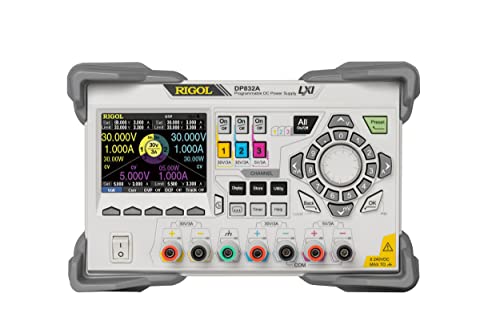
The Rigol DP832A is the most complete triple-output unit in this group, and it fits a shared laboratory bench where several engineers use the same supply across different projects. Two variable channels cover the usual analogue and digital rails, while the fixed 5 V channel powers logic without tying up a variable output. Its finer readback resolution makes it useful when a test needs to confirm small changes in current draw, such as checking a board in a low-power state. The large display shows all three channels at once, so nobody has to guess which rail is live.
Specs
- Three independently controlled channels: two at 30 V and 3 A, one at 5 V and 3 A
- Total output power of 195 W
- Programming resolution of 1 mV and 1 mA, with readback resolution of 0.1 mV and 0.1 mA
- Interfaces: USB, LAN, and RS232, with SCPI command support
- Linear design for low-noise output
Best for: A shared electronics laboratory that needs three rails, fine readback, and computer control in one unit.
Watch out for: The unit is deep and heavy for its class, so measure bench depth and leave clearance behind it for cables and airflow.
Siglent SPD3303X-E
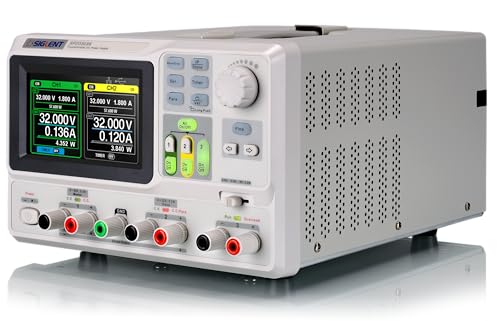
The Siglent SPD3303X-E is a strong choice for a laboratory that runs scripted tests, because its LAN and USB ports work with standard SCPI commands and common test software. Two variable channels deliver up to 32 V each, and the third channel switches between the common logic voltages, so one box can power a whole prototype. Series and parallel modes extend the range when a test needs a higher voltage or more current than a single channel provides. The timer function adds another automation option, letting the supply step through a sequence of outputs without constant attention.
Specs
- Three outputs: two at 32 V and 3.2 A, one selectable at 2.5 V, 3.3 V, or 5 V and 3.2 A
- Total output power of 220 W
- Setting resolution of 10 mV and 10 mA
- Interfaces: USB and LAN, with SCPI command support
- Independent, series, and parallel output modes, plus a timer function
Best for: A laboratory that automates power sequences and measurements from a computer over a network.
Watch out for: Its 10 mV setting resolution is coarser than the finer models here, so it is less suited to characterisation work that needs very small voltage steps.
Siglent SPD3303X
The Siglent SPD3303X shares its channel layout with the SPD3303X-E, but its finer setting resolution sets it apart for measurement-led work. The 1 mV and 1 mA resolution makes it easier to step a voltage in small increments and to watch a circuit respond, which matters when tracing regulator behaviour or checking a board near its operating limits. It keeps the same triple-output arrangement, the same timer and waveform display functions, and the same combination of USB and LAN control. For a laboratory that already plans around the SPD3303X-E, this is the version to choose when precision matters more than the lower setting step of its sibling.
Specs
- Three outputs: two at 32 V and 3.2 A, one selectable at 2.5 V, 3.3 V, or 5 V and 3.2 A
- Total output power of 220 W
- Setting resolution of 1 mV and 1 mA
- Interfaces: USB and LAN, with SCPI command support
- Independent, series, and parallel output modes, plus a timer function
Best for: A laboratory that characterises circuits and needs finer voltage and current steps than the SPD3303X-E offers.
Watch out for: Check the listing carefully against the SPD3303X-E before ordering, because the two models look identical and differ mainly in resolution.
Korad KA3005P

The Korad KA3005P is a compact single-channel linear supply that brings programmable control to a smaller bench. Its 30 V and 5 A range covers a wide span of everyday laboratory work, from powering microcontroller boards to driving small motors and analogue stages. Four memory locations store frequently used voltage and current settings, so a recurring test can be recalled without re-entering numbers. USB and RS232 ports allow a computer to set the output and read it back, which makes the unit usable in simple automated setups even though it has only one channel.
Specs
- Single output: 0 to 30 V, 0 to 5 A
- Total output power of 150 W
- Setup resolution of 10 mV and 1 mA
- Interfaces: USB and RS232 for programmable control
- Four memory locations for stored settings, with over-voltage and over-current protection
Best for: A compact bench that needs one clean, programmable rail with PC control.
Watch out for: It uses a proprietary command set rather than SCPI, so confirm your software can drive it before planning a scripted test around it.
Tekpower TP3005P
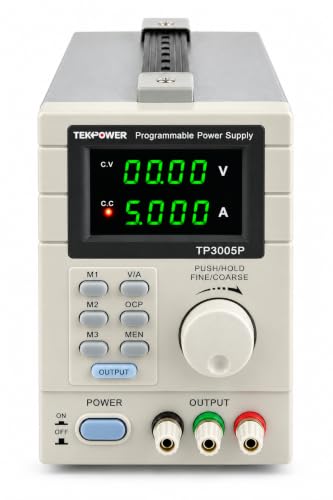
The Tekpower TP3005P is a straightforward single-channel programmable linear supply for a laboratory that wants reliable power without a multi-channel instrument. Its 30 V and 5 A output covers most bench work, and the linear design keeps output noise low for analogue circuits. The front panel gives direct control of voltage and current with a clear digital display, while the programmable interface lets a computer take over for repetitive tasks. It is a practical pick for a second bench, a repair station, or a teaching laboratory where each station needs its own dedicated supply.
Specs
- Single output: 0 to 30 V, 0 to 5 A
- Total output power of 150 W
- Linear design for low-noise output
- Programmable control via USB and RS232
- Constant voltage and constant current operating modes
Best for: A second bench, a repair station, or a teaching laboratory that needs a dedicated single-rail supply.
Watch out for: With only one channel, it cannot power a mixed-voltage board on its own, so plan for a second supply if your circuits need more than one rail.
Which One Fits Your Situation
A shared bench serving analogue and digital work
Choose the Rigol DP832A when several people use one bench for different projects. Its three channels cover analogue and logic rails together, the fixed 5 V output frees a variable channel, and the fine readback helps when someone needs to confirm a small current change. The combination of USB, LAN, and RS232 also means it fits into most existing test setups without an adapter hunt.
A laboratory that automates tests from a computer
Choose the Siglent SPD3303X-E when scripts and scheduled test sequences drive the bench. LAN control lets one computer reach the supply across the room, SCPI support works with standard test software, and the timer function steps through output sequences on its own. Pick the SPD3303X instead when the same automated setup needs finer voltage steps for characterisation.
A small bench or a single-rail test station
Choose the Korad KA3005P or the Tekpower TP3005P when the bench powers one circuit at a time. Both deliver 30 V at 5 A from a compact linear unit, and both accept computer control. The Korad adds four memory presets for recurring settings, while the Tekpower suits a station where the supply is set by hand most of the day.
A teaching laboratory with many stations
Choose the Tekpower TP3005P or the Korad KA3005P when equipping several identical stations. A single-channel supply is easier for students to understand, each station gets its own dedicated rail, and the programmable interface still lets an instructor demonstrate computer-controlled testing. Keep one triple-output unit such as the Siglent SPD3303X-E on a central bench for projects that need more rails.
Common Mistakes
- Buying a fixed or non-programmable supply by mistake: check that the listing states programmable control and names a computer interface, because many similar-looking bench supplies have no PC port at all.
- Choosing a supply by voltage alone: a 30 V rating means little if the current limit is too low for the circuit, so check the current rating of each channel before ordering.
- Ignoring the command protocol: a supply with a proprietary command set may not work with your existing test software, while an SCPI supply usually slots straight into a scripted setup.
- Leaving protection limits unset: set over-voltage and over-current limits before switching the output on, especially when the circuit under test is a new prototype.
- Sharing one channel across rails that should stay separate: analogue and digital sections can interfere with each other, so use independent channels or a second supply when isolation matters.
Frequently Asked Questions
What does programmable mean for a DC bench power supply?
A programmable supply accepts voltage and current settings from a computer through an interface such as USB, LAN, or RS232, instead of only from its front panel knobs. That lets a test script set outputs, read back measurements, and step through a sequence automatically. It also allows settings to be stored and recalled, which keeps repeated tests consistent from one run to the next.
How many channels does an electronics laboratory need?
Most laboratories benefit from three channels, because a typical prototype needs a logic rail, an analogue rail, and sometimes a separate rail for a sensor or a radio module. A triple-output supply covers that combination in one box. A single-channel supply is enough for a bench that tests one circuit at a time, but it cannot power a mixed-voltage board without a second unit.
Is USB enough, or should a lab supply have LAN?
USB is enough when the supply sits next to the computer that controls it. LAN becomes useful when the supply is on a shared bench, in a rack, or in another room, because the controlling computer does not need a direct cable. LAN also makes it easier for several instruments to share one test network. Check the protocol as well as the port, since SCPI support matters more than the connector.
Can one supply power analogue and digital circuits at the same time?
Yes, when the supply has independently controlled and isolated channels. Assign one channel to the analogue section and another to the digital section, and each rail can be set and limited on its own. That separation also keeps digital switching noise away from sensitive analogue stages. A single-channel supply cannot do this, so use a multi-channel unit or add a second supply.
Related guides
More from Amazon
Programs that pair well with the guide above. Offers and eligibility are set by Amazon and may change.
Free shipping on eligible items, Prime Video and more. Eligible new members can start with a free trial.
Start a Prime free trialAudiobooks and podcasts to listen to on the go. Eligible new members can start with a free trial.
Try Audible freeAd-free music streaming. Eligible new subscribers can start with a free trial.
Try Music Unlimited freeA free business account with business pricing and bulk-buying tools for work, shop or home office.
Create a business accountAs an Amazon Associate we earn from qualifying purchases.










Write Your Review
No reviews yet. Be the first to share your experience!