
Key takeaways
- Compare five programmable DC bench power supplies for quality control, chosen for stable output, fine resolution, and logging for repeatable checks.
What's inside
As an Amazon Associate I earn from qualifying purchases. This post may contain affiliate links at no extra cost to you.
A quality control check is only as trustworthy as the power behind it. When a bench supply drifts from one run to the next, a board that passed on Monday can fail on Friday without anything changing in the design, and the team is left chasing a fault that lives in the test setup rather than the product. The real decision here is not about buying the strongest supply on the shelf. It is about buying one whose output stays put, whose set steps are fine enough for the tolerance being proved, and whose readings can be recorded and repeated by the next person on the bench.
This guide serves quality control technicians, small production teams, and repair benches that validate boards in batches. Each supply below was chosen from its name and specifications on its Amazon listing, with attention to output range, resolution, channel count, and the programming interface that carries measurements back to a computer.
Quick Picks
As an Amazon Associate we earn from qualifying purchases.
| Product | Best for | Key spec from title |
|---|---|---|
| Siglent SPD3303X-E | Three-rail board checks from one box | Triple-output programmable DC supply, 220 W total |
| Siglent SPD3303X | Fine-step voltage checks on sensitive circuits | 1 mV and 1 mA resolution, triple output, 220 W |
| Rigol DP832A | Logging small current changes during a check | 0.1 mV and 0.1 mA readback, 195 W total |
| Rigol DP832 | Everyday three-channel checks on a busy bench | Triple-output programmable DC supply, 195 W total |
| Korad KA3005P | Single-rail checks where bench space is tight | Single-channel programmable supply, 30 V and 5 A |
How to Choose
Match the voltage and current range to the device under test
Start from the highest rail the board needs, then add headroom for inrush current at switch-on. A supply rated for 30 V and 5 A covers most logic and motor-driver boards, while a 60 V unit suits higher-voltage assemblies. Check the current limit on each channel separately, because a triple-output unit can still starve one rail while the total wattage looks generous. A shortfall here shows up as brownouts during the check, which look exactly like a failing board. Write down the worst-case draw of the device, add a margin, and only then compare models.
Look for resolution and stability that fit the tolerance you must prove
Resolution decides how finely the output can be set and read back. A 10 mV step is fine for a 12 V rail with a wide tolerance, yet it is too coarse for proving a regulator that must hold within a few millivolts. Linear supplies tend to give cleaner output with less ripple, which matters when the device under test is an analog front end or a low-noise amplifier. Ask what the check actually has to prove, then pick the smallest set step and the quietest output that the job demands, rather than paying for precision the procedure never uses.
Check the programming interface and logging path before you buy
A programmable supply earns its place in quality control when a script can set the voltage, step through a sequence, and record the readings without someone watching the display. USB suits a bench beside a laptop, LAN suits a shared test rack, and RS232 suits older automated fixtures. Confirm that the interface is standard on the exact model, since some versions list LAN and RS232 as options rather than included features. Also confirm the command set, because one brand may speak SCPI while another uses its own protocol, and that choice decides how much work the logging software needs.
Plan for repeatability with presets, protection, and channel count
Repeatability comes from removing decisions from the operator. Memory presets store the exact voltage and current limit for a check, so the same setup loads with one button press instead of a knob turn and a glance at the display. Over-voltage and over-current protection guard the device under test when a lead slips or a setting is mistyped. Channel count matters just as much: a board with analog, digital, and logic rails needs three outputs, while a single-rail module wastes money on channels that stay dark. Count the rails first, then match the supply to that number.
The 5 Best Options
Siglent SPD3303X-E
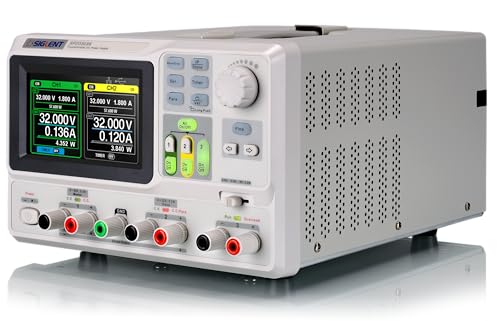
The SPD3303X-E covers the most common quality control situation in one box: a board that needs two adjustable rails plus a logic rail, all switched on together. Its two main channels run independently or combine in series and parallel modes, so a split-rail analog stage and a separate digital rail can be powered from a single instrument. Timing output and stored settings support scripted sequences, and the LAN and USB interfaces let a computer drive the check and collect readings. For a bench that validates mixed-signal boards day after day, this is the most flexible starting point.
Specs
- Three channels: two adjustable 0 to 32 V at 3.2 A, plus a selectable 2.5, 3.3, or 5 V channel at 3.2 A
- Total output power of 220 W
- Setting resolution of 10 mV and 10 mA
- USB and LAN interfaces with SCPI programming
- Independent, series, and parallel output modes
- Timing output function and five stored setting groups
Best for: validating mixed-signal boards that need two adjustable rails and one logic rail at the same time.
Watch out for: the third channel only offers fixed selectable voltages, so confirm the board never needs an odd logic level before relying on it.
Siglent SPD3303X
The SPD3303X shares the same channel layout as its E variant, yet it steps voltage and current in much finer increments, which is exactly what a tight tolerance check needs. A regulator dropout measurement or a threshold sweep becomes meaningful when each step moves the output by a single millivolt instead of ten. The 4.3-inch display shows voltage and current together, and the remote programming support carries the same sequences a quality control script would run on the E model. It suits benches where the check itself is the hard part, not the wiring.
Specs
- Three channels: two adjustable 0 to 32 V at 3.2 A, plus a selectable 2.5, 3.3, or 5 V channel at 3.2 A
- Total output power of 220 W
- Setting and readback resolution of 1 mV and 1 mA
- USB and LAN interfaces with SCPI programming
- Independent, series, and parallel output modes, with series output up to 60 V
- 4.3-inch TFT-LCD display with real-time waveform display
Best for: proving tight voltage tolerances and sweeping thresholds in small steps.
Watch out for: availability can vary between sellers, so confirm the listing shows the SPD3303X itself and not the E variant before ordering.
Rigol DP832A
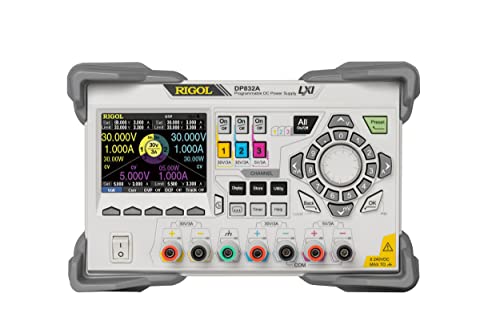
The DP832A is built for checks where the measurement matters as much as the power. Its readback resolves down to a tenth of a millivolt and a tenth of a milliamp, so a sleep-current test can tell 1.2 mA apart from 1.3 mA instead of rounding both to the same number. LAN and RS232 arrive as standard interfaces alongside USB, which keeps the supply usable on a shared test rack as well as beside a laptop. Three channels cover the usual analog, digital, and logic rails, and the low ripple output keeps sensitive circuits quiet during the check.
Specs
- Three channels: two adjustable 0 to 30 V at 3 A, plus a 5 V channel at 3 A
- Total output power of 195 W
- Programming resolution of 1 mV and 1 mA, with readback resolution of 0.1 mV and 0.1 mA
- USB, LAN, and RS232 interfaces as standard, with SCPI programming
- Ripple and noise of less than 350 uVrms
- Over-voltage, over-current, and over-temperature protection
Best for: logging small current changes and proving low-power behaviour during quality control.
Watch out for: the unit is deep and heavy for its class, so measure the bench and the rack shelf before it arrives.
Rigol DP832

The DP832 gives a quality control bench the same three-channel layout as the A model with a simpler interface set, which suits teams that drive the supply from a computer over USB. Its two 30 V channels handle analog and digital rails while the fixed 5 V channel feeds logic, and the linear output stays clean enough for most board-level checks. Stored settings and a clear display keep the daily routine short: load the preset, connect the board, run the sequence. It is the practical pick when the check needs three rails and a steady output, without the finer readback of its sibling.
Specs
- Three channels: two adjustable 0 to 30 V at 3 A, plus a 5 V channel at 3 A
- Total output power of 195 W
- Setting resolution of 10 mV and 10 mA
- USB interface as standard, with SCPI programming
- LAN and RS232 listed as options on this model
- Linear DC output with over-voltage, over-current, and over-temperature protection
Best for: routine three-channel checks driven from a computer over USB.
Watch out for: LAN and RS232 are options rather than standard on the base DP832, so confirm the exact listing includes them if the test rack needs a network connection.
Korad KA3005P

The KA3005P is the single-channel answer for benches that check one rail at a time and want computer control without a large instrument. Its linear output runs from 0 to 30 V at up to 5 A, which covers a wide span of modules, chargers, and control boards. Four memory presets store common combinations, so switching from a 5 V logic check to a 12 V driver check takes one button press. USB and RS232 interfaces carry remote commands, and the compact case leaves room on a crowded bench for the device under test and its test leads.
Specs
- Single channel: 0 to 30 V at 0 to 5 A
- Total output power of 150 W
- Linear DC output with 10 mV and 1 mA setting resolution
- USB and RS232 remote control interfaces
- Four memory presets for stored voltage and current combinations
- Over-voltage and over-current protection
Best for: single-rail checks on a small bench where one programmable channel is enough.
Watch out for: it speaks the Korad command set rather than SCPI, so confirm the logging software supports that protocol before building a script around it.
Which One Fits Your Situation
You run the same pass-fail check on every unit in a batch
Pick the Siglent SPD3303X-E when the board needs three rails, or the Korad KA3005P when it needs one. Both store the check as a preset, so each unit sees the same voltage and current limit, and the operator cannot drift the setup between units. Scripted control over USB or LAN adds a log for every unit, which turns a pile of passed boards into a traceable record.
You need to prove a tight voltage tolerance on paper
Pick the Siglent SPD3303X or the Rigol DP832A, because both resolve their output far more finely than the usual bench supply. The SPD3303X steps in single millivolts across three channels, while the DP832A reads back in tenths of a millivolt for current-hungry low-power checks. Either one lets the recorded numbers support the tolerance claim instead of hiding behind a coarse display step.
You check boards that need several rails at once
Pick the Siglent SPD3303X-E for mixed-signal boards, since its two adjustable channels plus a logic rail cover analog, digital, and logic in one instrument. The Rigol DP832A is the alternative when the rails are 30 V and below and the log needs fine readback. Both keep all rails under one script, so a sequencing fault shows up in the same record as the rail that caused it.
You have one rail to verify and a small bench
Pick the Korad KA3005P. A single 30 V and 5 A channel handles most module checks, the linear output stays quiet, and the small case leaves the bench free for fixtures and probes. Skip the triple-output units here, because their extra channels add size, weight, and cost to a job that only ever uses one rail.
Common Mistakes
- Buying a fixed-output supply for checks that need several voltages, then working around it with extra regulators that add their own drift.
- Choosing on total wattage alone while one channel runs out of current, which starves a rail and looks like a failing board.
- Assuming LAN or RS232 is included, when some models list those interfaces as options rather than standard features.
- Setting the voltage but leaving the current limit wide open, so a shorted board draws far more than the check intended.
- Writing the pass result on paper instead of logging the supply readings, which leaves nothing to compare when a later batch behaves differently.
Frequently Asked Questions
Can a programmable bench supply replace a fixed supply in quality control?
Yes, and it usually does the job better. A programmable unit sets the exact voltage and current limit for each check, stores that setup as a preset, and can step through a sequence without manual adjustment. A fixed supply cannot change rails between checks, so it forces the bench to keep several units around for work one programmable supply could cover.
What resolution do I need for quality control checks?
It depends on the tolerance the check must prove. A 10 mV step suits wide-tolerance rails such as 12 V motor drivers, while a 1 mV step suits regulator and threshold checks where a few millivolts decide pass or fail. Readback resolution matters just as much, because a coarse display can hide a drift that the recorded log would otherwise catch.
Do I need LAN, or is USB enough for logging?
USB is enough for a single bench beside a laptop, and most logging scripts start there. LAN becomes worth having when the supply sits in a shared rack, when several benches share one test computer, or when the check runs unattended. Before ordering, confirm the exact model includes the interface the rack uses, since some versions charge extra for it.
How do I keep results repeatable between operators?
Store the check as a preset or a script, and lock the procedure to that stored setup rather than to knob positions. Set the current limit every time, use the same lead length and connection points, and log voltage and current readings for each unit. When the next operator loads the same preset and runs the same script, the numbers should match the previous run.
Related guides
More from Amazon
Programs that pair well with the guide above. Offers and eligibility are set by Amazon and may change.
Free shipping on eligible items, Prime Video and more. Eligible new members can start with a free trial.
Start a Prime free trialAudiobooks and podcasts to listen to on the go. Eligible new members can start with a free trial.
Try Audible freeAd-free music streaming. Eligible new subscribers can start with a free trial.
Try Music Unlimited freeA free business account with business pricing and bulk-buying tools for work, shop or home office.
Create a business accountAs an Amazon Associate we earn from qualifying purchases.










Write Your Review
No reviews yet. Be the first to share your experience!