
Key takeaways
- Five desktop DACs with balanced XLR or 4.4mm line outputs, verified from their Amazon listings — from a dual-chip flagship to a minimalist US-made pick.
What's inside
As an Amazon Associate I earn from qualifying purchases. This post may contain affiliate links at no extra cost to you.
The real decision behind a balanced desktop DAC is not the DAC chip. It is whether your amplifier, headphone amp or powered speakers actually accept a balanced feed, and whether the DAC you are eyeing delivers one as a proper line output. A true balanced connection carries the signal on two opposed legs, so interference picked up along the cable cancels at the input, and the output level usually doubles compared with RCA. That matters on longer runs and in RF-noisy rooms. It matters much less across a half-metre of desk cable, which is why the output type, level and volume arrangement should drive the shortlist.
This hub guide is for desktop listeners stepping up from onboard audio, owners of balanced headphone or speaker amplifiers who need a matching source, and small-studio users who want XLR feeds without studio money. Sibling guides on this site narrow the same field by use case; here the whole verified field is covered side by side. Every pick below publishes balanced analog outputs in its own Amazon listing, and the specs quoted come from those product pages.
Quick Picks
As an Amazon Associate we earn from qualifying purchases
| Product | Best for | Key spec from title |
|---|---|---|
| Topping D90 III Sabre | A flagship source for a balanced amp or active monitors | Dual ES9039SPRO chips |
| SMSL SU-9n | Balanced output plus a display and full remote | ES9038PRO with XLR output |
| SMSL DO100 Pro | One DAC serving both a TV and a computer desk | 2x ES9039Q2M, HDMI ARC input |
| Schiit Modius E | A simple fixed-output DAC for an amp stack | Unison USB, balanced XLR out |
| iFi Zen DAC 3 | Headphone-first desks that also feed other gear | 4.4mm balanced line output |
How to Choose
XLR or 4.4mm: Match the Balanced Socket to Your Amplifier
XLR is the default balanced connector on speaker amplifiers, studio gear and active monitors, and four of the five DACs here offer it. The 4.4mm Pentaconn socket shows up on compact designs such as the Zen DAC 3, where it does double duty across the front and rear panels. Electrically the two carry the same kind of signal; what differs is the cable you need and how rugged the connection feels. Before ordering, confirm your amplifier’s balanced input type, and remember that a balanced headphone jack on the front panel is not automatically a line output. The Zen DAC 3 qualifies here only because its rear 4.4mm socket is a dedicated line out.
Output Level and Volume Control Shape the Whole System
Balanced outputs run hot: the listings here quote XLR levels from 4.0 Vrms on the Modius E up to 5.2 Vrms on the DO100 Pro, against roughly 2 to 2.5 Vrms from their RCA sockets. That extra level is useful headroom, but it can overdrive sensitive amp inputs, so a selectable output level, like the D90 III Sabre’s 4V or 5V XLR setting, is worth having. The bigger question is volume. DACs with a variable or preamp mode can drive a power amplifier or active speakers directly. A fixed-output DAC such as the Modius E cannot, so your amplifier must supply the volume control.
Inputs and Format Ceilings: USB, DSD, Bluetooth and ARC
USB is where the format race happens. The Topping, both SMSL models and the iFi all decode PCM up to 32-bit/768kHz and native DSD512 over USB, while optical and coaxial inputs on the same units stop at 192kHz and DoP64. Bluetooth 5.1 with LDAC appears on the D90 III Sabre and the DO100 Pro for phone streaming, the DO100 Pro adds an HDMI ARC input for television sound, and the Modius E counters with an AES input that studio sources use. At the other extreme, the Zen DAC 3 offers USB-C and nothing else. List the sources you actually own before paying for decoding you will never feed.
Where Cheaper Balanced DACs Cut Corners
Measured performance has largely converged: even the least expensive DAC here, the Modius E, publishes a signal-to-noise ratio above 118 dB and distortion at 0.0003%, figures past the point of audibility in most rooms. What the lower-priced models surrender is everything around the conversion. There is no display, no remote, no volume control and no DSD on the Schiit, while the Zen DAC 3 drops every input except USB-C. Dual-chip designs, regulated low-noise supplies and machined cases are what the flagship money buys. Decide which of those omissions your setup can live with, because the sound itself is rarely the compromise.
The 5 Best Options
Topping D90 III Sabre

Topping’s flagship is the completeness pick: two ES9039SPRO chips, one dedicated to each channel, behind a fully balanced output stage with its own new I/V conversion circuit and CPLD clock processing. It doubles as a digital preamp, takes a Bluetooth remote, and offers a 12V trigger so a matching amplifier wakes with it. Buyers assembling a serious balanced chain, whether that ends in a headphone amplifier or a pair of active monitors, get the widest input set and the strongest published measurements in this group, with nothing important left on the options list.
Specs
- DAC chips: 2 x ESS ES9039SPRO
- USB interface: XMOS XU316
- Inputs: USB, coaxial, optical, AES, I2S (HDMI), Bluetooth 5.1
- Outputs: balanced XLR, single-ended RCA
- USB formats: PCM up to 32-bit/768kHz, native DSD512, MQA decoding
- THD+N: less than 0.000045% (XLR)
- Signal-to-noise ratio: 135 dB (XLR)
- Output levels: XLR 4V or 5V, RCA 2V or 2.5V (selectable)
- Bluetooth: QCC5125 with LDAC and aptX Adaptive
- Extras: preamp mode, Bluetooth remote control, 12V trigger
Best for: the last DAC purchase in a high-end balanced desktop or speaker system.
Watch out for: black and silver versions sell under separate listings, so confirm the colour and seller on the page; also set the XLR output level to the value your amplifier’s input stage is built for.
ASIN: B0CQJVDTRH
SMSL SU-9n
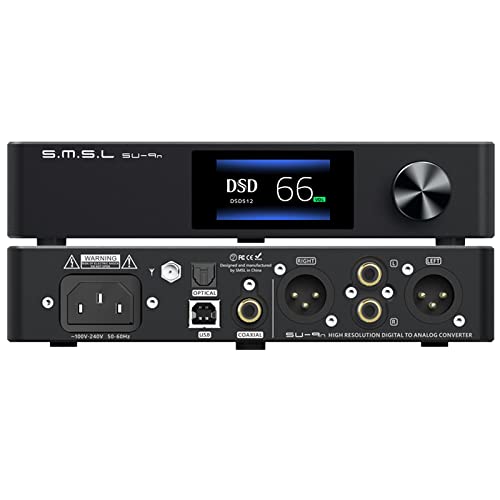
The SU-9n takes ESS’s former flagship ES9038PRO, feeds it with the matching ES9311 low-noise supply chip, and wraps the result in the friendliest hardware here: a 1.9-inch colour display and a full-function remote. An XMOS XU-208 front end handles PCM to 768kHz and DSD512, and the menu exposes PCM and DSD filter choices plus sound-colour settings for listeners who like to fine-tune. It is the balanced all-rounder for a desk that also gets used from the sofa, where reaching the volume knob is not an option.
Specs
- DAC chip: ESS ES9038PRO with ES9311 supply chip
- USB processor: XMOS XU-208
- Inputs: USB, optical, coaxial, Bluetooth
- Outputs: RCA, XLR
- USB formats: PCM up to 32-bit/768kHz, DSD512 (native and DoP)
- THD+N: 0.00006%
- Display: 1.9-inch TFT colour display
- Control: full-function remote control included
- Dimensions: 187.5 x 154 x 40 mm
- Weight: 0.79 kg
Best for: buyers who want flagship-chip conversion with a screen and remote for arm’s-length control.
Watch out for: the “n” trades away MQA decoding, so listeners with MQA libraries should look at the DO100 Pro or the D90 III Sabre instead.
ASIN: B09JC6BQ21
SMSL DO100 Pro

Two ES9039Q2M chips and a third-generation XMOS XU-316 give the DO100 Pro decoding headroom that matches units well above its station, but its signature trick sits around the back: an HDMI ARC input. That makes it the one DAC here that can take television audio and computer audio into the same balanced amplifier without a receiver in between. A Qualcomm Bluetooth 5.1 receiver with LDAC, a remote control and a preamp mode round out a feature list aimed at mixed-use desks, and the switchable USB 1.1 mode keeps games consoles working without drivers.
Specs
- DAC chips: 2 x ESS ES9039Q2M
- USB processor: XMOS XU-316
- Inputs: USB, optical, coaxial, Bluetooth 5.1, HDMI ARC
- Outputs: XLR balanced, RCA single-ended
- Line output amplitude: XLR 5.2 Vrms, RCA 2.5 Vrms
- USB formats: PCM up to 32-bit/768kHz, DSD512, MQA decoding
- THD+N: 0.00005%
- Dynamic range: 131 dB (XLR)
- Op-amps: 6 x OPA1612
- Dimensions: 189 x 186 x 45 mm
- Weight: 1.45 kg
Best for: a combined TV and computer desk where one DAC feeds a balanced amp or active speakers.
Watch out for: this model sells through several storefront listings, so check the seller name and box contents on the page; and use USB 2.0 mode with a computer, since the 1.1 console mode lowers the format ceiling.
ASIN: B0CZ9CS93M
Schiit Modius E

Schiit strips the balanced DAC back to the signal path. An ESS ES9028 converts, a fully differential LME49724 stage drives the XLR outputs, and Schiit’s own Unison USB receiver handles the computer connection. There is no display, no remote and no volume knob, because the Modius E assumes a headphone amp or preamp downstream already does those jobs. What it keeps is surprising at this level: an AES input alongside USB, optical and coaxial, plus simultaneous balanced and single-ended outputs. For a tidy stack that wants balanced XLR without paying for a second control surface, it is the honest minimum.
Specs
- DAC chip: ESS ES9028
- USB interface: Schiit Unison USB
- Inputs: USB, Toslink optical, coaxial, AES
- Outputs: XLR balanced, RCA single-ended
- Output level: 4.0 Vrms balanced, 2.0 Vrms single-ended
- Sample rates: 16-bit/44.1kHz to 24-bit/192kHz
- Signal-to-noise ratio: over 118 dB
- THD+N: 0.0003%
- Analog stage: LME49724 (balanced), OPA1656 (single-ended)
- In the box: USB micro cable, 5V wall-wart
Best for: a minimalist amp stack where volume already lives downstream and balanced XLR is the missing piece.
Watch out for: output is fixed and there is no DSD support or remote, so it cannot drive a power amplifier on its own and its 24-bit/192kHz ceiling is permanent.
ASIN: B0B36QGLWR
iFi Zen DAC 3

The Zen DAC 3 is a DAC and headphone amplifier in one curved palm-sized box, and it earns its place here through the rear panel: a 4.4mm balanced line output sits beside the RCA sockets, switchable between fixed and variable, so the same unit can feed a balanced amplifier or active speakers when headphones come off. Conversion is Burr-Brown True Native silicon with full MQA decoding, and iFi’s analogue XBass+ and PowerMatch controls add genuinely useful adjustment for sensitive earphones. It is the compact, characterful option rather than the measurement chaser of the group.
Specs
- DAC chip: Burr-Brown True Native
- Input: USB-C only
- Formats: PCM up to 768kHz, DSD512, full MQA decoding
- Line outputs: 4.4mm balanced, RCA single-ended (fixed or variable)
- Headphone outputs: 4.4mm balanced, 6.3mm single-ended
- Headphone output power: up to 390 mW (balanced)
- Analogue features: XBass+, PowerMatch
- Dimensions: 158 x 115 x 35 mm
- Weight: 456 g
Best for: headphone-first desks that also want a balanced line feed to an amplifier or active speakers.
Watch out for: USB-C is the only digital input, so a TV or CD transport cannot connect; feeding XLR inputs also means buying a 4.4mm-to-dual-XLR cable, which is not in the box.
ASIN: B0D1QWKTQ5
Which One Fits Your Situation
Your Amplifier or Active Speakers Sit Across the Room on XLR
Long balanced runs are where this connection type earns its keep, and both flagship SMSL and Topping models publish the output level to exploit it. Choose the D90 III Sabre if you also want the 12V trigger and selectable XLR level, or the SU-9n if a remote matters more than the last decimal of measured performance.
One Desk Has to Handle the Television and the Computer
Only the DO100 Pro takes HDMI ARC, so it is the automatic pick when TV sound and PC sound must share one balanced amplifier. Its USB input still decodes up to DSD512 for music sessions, and the remote covers input switching from the sofa. Set the television to stereo PCM output and the pairing is painless.
Your Headphone Amp Already Has a Volume Knob You Like
A fixed-output DAC is the cleanest partner here, and the Modius E is built for exactly that stack: balanced XLR into your amp, no duplicated controls, no display glow. If the amp also needs a single-ended source for a second input, the Modius E’s RCA outputs run at the same time as the XLR pair.
Headphones Come First and Speakers Get the Same Box
The Zen DAC 3 is the only pick designed around that order of priorities. Its balanced headphone output handles the daily listening, PowerMatch tames sensitive earphones, and the rear 4.4mm line output takes over when you switch to an amplifier or active speakers. Just remember the source has to arrive over USB-C.
Common Mistakes
- Assuming any 4.4mm socket is a line output. On many DAC/amps it only drives headphones; check that the listing describes a separate balanced line output, as the Zen DAC 3’s rear socket is, before planning a speaker setup around it.
- Plugging XLR outputs into RCA inputs through passive adapters and expecting balanced noise rejection. The benefit disappears the moment the signal becomes single-ended, so use the DAC’s RCA outputs for RCA inputs.
- Ending up with two volume controls or none. A variable-output DAC feeding an amplifier is fine; a fixed-output DAC feeding a power amplifier directly leaves you with full volume and no way down.
- Paying for DSD512 and MQA decoding while skipping the input you actually need, such as HDMI ARC for a television or AES for studio sources.
- Ignoring output level. A 5.2 Vrms XLR feed can overload amplifier inputs designed around 4 Vrms, so confirm the level, or pick a DAC with a selectable output setting.
Frequently Asked Questions
Do balanced outputs sound better than RCA on a desktop?
Across a short desk run, usually not in any way you can reliably hear, because both outputs of a good DAC measure cleanly. The balanced connection earns its place over distance and in noisy environments, where its interference rejection works, and its higher output level can help amplifiers with low input sensitivity. Buy it for the system fit first.
Can I connect one of these DACs to an amplifier that only has RCA inputs?
Yes. Every DAC in this guide also provides RCA outputs, so use those and keep the balanced pair for later upgrades. Avoid XLR-to-RCA adapter cables for this job: they collapse the balanced signal into a single-ended one, can unbalance the output stage, and deliver none of the noise rejection the format exists for.
Do I still need a preamp if the DAC has a volume control?
Not necessarily. The D90 III Sabre, SU-9n, DO100 Pro and Zen DAC 3 all offer variable output modes that can drive a power amplifier or active speakers directly, which removes a box from the chain. The Modius E is the exception: its outputs are fixed, so it always needs a preamp, integrated amp or headphone amp to set listening level.
Is a 4.4mm balanced line output as good as XLR?
Electrically, yes: both carry a differential signal with the same noise-rejection behaviour, and the 4.4mm connector simply packages it for compact gear. The practical differences are mechanical. XLR locks and survives studio handling, while 4.4mm needs a purpose-built cable to reach XLR inputs. Confirm the socket is specified as a line output rather than a headphone-only jack.
Related guides
More from Amazon
Programs that pair well with the guide above. Offers and eligibility are set by Amazon and may change.
Free shipping on eligible items, Prime Video and more. Eligible new members can start with a free trial.
Start a Prime free trialAudiobooks and podcasts to listen to on the go. Eligible new members can start with a free trial.
Try Audible freeAd-free music streaming. Eligible new subscribers can start with a free trial.
Try Music Unlimited freeA free business account with business pricing and bulk-buying tools for work, shop or home office.
Create a business accountAs an Amazon Associate we earn from qualifying purchases.










Write Your Review
No reviews yet. Be the first to share your experience!