
Key takeaways
- Find the best programmable DC bench power supplies for technical training, with clear controls, current limits and protection for classroom benches.
What's inside
As an Amazon Associate I earn from qualifying purchases. This post may contain affiliate links at no extra cost to you.
A training bench is a place where mistakes are supposed to happen, and the power supply is the one instrument that decides whether a wiring error becomes a lesson or a damaged board. Instructors need a supply that caps voltage and current before a student can push them too far, shows exactly what each channel is doing, and lets a preset be recalled in seconds when the next exercise starts. A programmable DC bench supply does all of that, and it also lets a teacher demonstrate the same setup repeatedly without re-dialing every value by hand.
This guide is written for technical training instructors, lab managers equipping a classroom, and students building a first serious bench. Every supply below is a programmable DC bench unit sold on Amazon, chosen from the voltage range, channel count, interface, and protection details stated on its Amazon listing. The focus throughout is safety and ease of use in a learning environment, not raw output power alone.
Quick Picks
As an Amazon Associate we earn from qualifying purchases
| Product | Best for | Key spec from title |
|---|---|---|
| Siglent SPD3303X-E | A full classroom bench with analog and logic rails | Triple output, two 32 V, 3.2 A channels plus a fixed 2.5, 3.3, or 5 V channel |
| Siglent SPD3303X | Fine adjustment work on sensitive training circuits | Triple output with 1 mV and 1 mA setting resolution |
| Rigol DP832 | Mixed analog and digital exercises on one bench | Triple output, 195 W, two 30 V, 3 A channels plus a 5 V, 3 A channel |
| Korad KA3005P | A first programmable supply for a student bench | Single output, 30 V, 5 A, programmable through USB or RS232 |
| Siglent SPD1305X | One clean channel for focused circuit exercises | Single output, 30 V, 5 A, 150 W, with USB and LAN control |
How to Choose
Match the voltage and current range to the curriculum
Most training exercises run on 3.3 V and 5 V logic, 12 V and 24 V control circuits, and op-amp rails near 15 V, so a supply that reaches 30 V or 32 V covers nearly everything a course will ask for. Current matters just as much: a 3 A channel handles small motors, relay banks, and microcontroller projects, while a 5 A channel adds headroom for power electronics exercises and larger loads. Before choosing, list the highest voltage and the highest current any planned exercise needs, then pick a supply that clears both with room to spare. A unit that only just reaches the required values will run hot and leave no margin for the next module.
Put protection where students can see it
Overvoltage protection and overcurrent protection are the two features that matter most in a room full of learners, because they turn a wrong connection into a quiet shutdown instead of smoke. Look for a supply whose listing names overvoltage and overcurrent protection, and check whether the limits can be set before the output is switched on. A separate output on and off switch for each channel is just as important, since it lets an instructor energize one rail at a time and confirm the wiring before the whole circuit goes live. Clear CV and CC indicators help students connect what they see on the display with the theory they just learned.
Judge the display and controls like a teaching tool
A training supply is read from across a bench, often by a student standing beside it, so a large display with separate voltage and current readouts for each channel is worth more than a compact panel. A rotary knob plus numeric keys lets an instructor type an exact value during a demonstration, while memory presets let a class recall the same setup at the start of every session. A key lock is useful when a group shares one bench, because it stops an accidental bump from changing a carefully set voltage. If the panel looks crowded or the channel labels are hard to read at a glance, the supply will slow every lesson down.
Decide how much remote control the course needs
Programmable supplies can be driven from a computer through USB, LAN, or RS232, and that changes what a course can teach. A USB or LAN link lets an instructor run a scripted voltage sweep, log measurements, or reset every bench from the front of the room. LAN control is especially handy in a classroom because it works over the existing network and avoids a tangle of USB cables. A single-channel supply with a simple USB link is enough for basic programming exercises, while a multi-channel unit with LAN support suits courses that automate sequences or demonstrate remote monitoring. Buy the interface the syllabus will actually use, not the one that sounds impressive on a spec sheet.
The 5 Best Options
Siglent SPD3303X-E
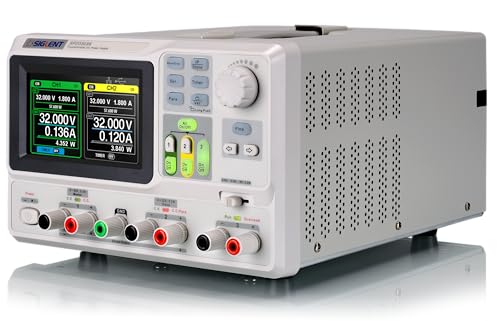
The SPD3303X-E is the most classroom-ready supply in this group because its three channels match the way training circuits are built: two adjustable channels for analog and control rails, plus a fixed channel that can be switched between 2.5 V, 3.3 V, and 5 V for logic. An instructor can power a microcontroller, its sensors, and an op-amp stage from one box, and the large color display keeps every channel visible. Its timer function and five stored setting groups let a teacher prepare a sequence and recall it for every class, while LAN and USB links support computer-controlled demonstrations.
Specs
- Triple output: two channels at 0 to 32 V and 0 to 3.2 A, one fixed channel at 2.5, 3.3, or 5 V and 3.2 A
- Total output power of 220 W
- Setting resolution of 10 mV and 10 mA
- Interfaces: LAN and USB
- Timer function with five stored setting groups
- Independent, series, and parallel output modes
- 4.3 inch color TFT display
Best for: A training lab that needs analog rails and a logic rail from one supply with a display the whole group can read.
Watch out for: The third channel is fixed at one of three logic voltages, so it cannot serve as a third adjustable rail. Confirm the channel layout matches the exercises before ordering.
Siglent SPD3303X
The SPD3303X shares the same triple-output layout as the E model, but it tightens the setting resolution to 1 mV and 1 mA, which makes it the better pick when a course covers precision topics such as regulator dropout, sensor biasing, or low-current measurements. Students can nudge a voltage by a single millivolt and watch the circuit respond, and the five-digit voltage and four-digit current readouts make small changes easy to see. The three isolated channels, the timer function, and the waveform display give instructors room to build demonstrations around slowly changing outputs, and the LAN and USB links support scripted exercises.
Specs
- Triple output: two channels at 0 to 32 V and 0 to 3.2 A, one fixed channel at 2.5, 3.3, or 5 V and 3.2 A
- Total output power of 220 W
- Setting resolution of 1 mV and 1 mA
- Interfaces: LAN and USB
- Timer function and waveform display
- Independent, series, and parallel output modes
- 4.3 inch color TFT display
Best for: Precision exercises where students need to set and read very small voltage and current steps.
Watch out for: The finer resolution is only useful if the course actually teaches precision measurement, so a general class may not need it. The fixed third channel has the same limitation as on the E model.
Rigol DP832

The Rigol DP832 appeals to training labs with three channels, a clear display, and remote control through USB, LAN, and RS232. Two 30 V, 3 A channels cover most analog and power work, while the dedicated 5 V, 3 A channel powers logic circuits. The listing describes user-defined programming through SCPI commands, which lets an instructor write simple scripts that step a voltage, hold it, and record the result. Overvoltage and overcurrent protection are built in, and each channel can be switched independently, so each rail can be checked before the next goes live.
Specs
- Triple output: two channels at 30 V and 3 A, one channel at 5 V and 3 A
- Total output power of 195 W
- Setting resolution of 10 mV and 10 mA
- Interfaces: USB, LAN, and RS232, with SCPI programming
- Overvoltage and overcurrent protection
- Constant voltage and constant current operation
- Independent channel output control
Best for: A mixed curriculum of analog and digital work where one supply must serve several different exercises.
Watch out for: Several DP832 listings exist on Amazon, so confirm the exact ASIN and the included interface options on the listing before ordering. Check whether the GPIB interface is included or sold separately.
Korad KA3005P

The KA3005P puts a programmable supply on a student bench, and its single 30 V, 5 A channel covers a wide range of introductory exercises, from Ohm law labs to motor and relay work. Four memory presets let students store common settings and recall them with one button, which saves setup time at the start of every session. The listing names overvoltage and overcurrent protection, and the front panel has dedicated buttons for setting those limits, so an instructor can show a class how a limit is configured before the output is enabled. Programming runs through USB or RS232, which is enough for a first automated measurement course.
Specs
- Single output: 0 to 30 V and 0 to 5 A
- Total output power of 150 W
- Programmable through USB or RS232
- Overvoltage and overcurrent protection with dedicated set buttons
- Four memory presets
- Digital display with separate voltage and current readouts
- Constant voltage and constant current modes
Best for: A first programmable supply for a student bench, or a classroom that needs many identical units.
Watch out for: One channel means one rail at a time, so circuits that need several voltages at once will need a second supply. The display is smaller and simpler than the color screens on the multi-channel models.
Siglent SPD1305X
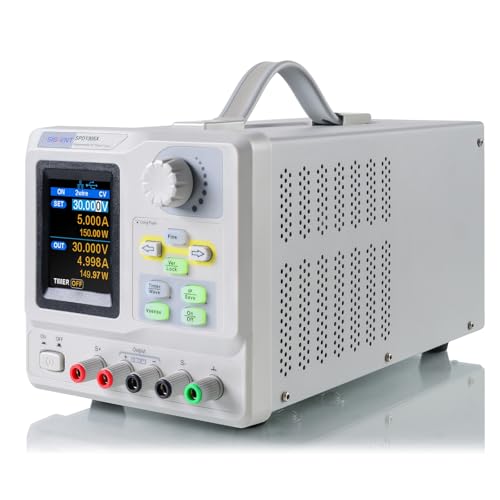
The SPD1305X takes the precision of the larger Siglent supplies and puts it into a single-channel unit, which suits courses that focus on one circuit at a time. Its 30 V, 5 A range handles most training loads, and the 1 mV and 1 mA resolution lets students see fine adjustments. A 2.8 inch color TFT shows voltage and current, and the timer and waveform display turn a simple power exercise into a lesson about how a load behaves over time. USB and LAN interfaces with SCPI support mean the supply can join a computer-controlled bench, and the linear design keeps the output clean.
Specs
- Single output: 0 to 30 V and 0 to 5 A
- Total output power of 150 W
- Setting resolution of 1 mV and 1 mA
- Interfaces: USB and LAN with SCPI control
- Timer function and waveform display
- 2.8 inch color TFT display
- Linear regulation for low output noise
Best for: Focused single-circuit exercises where fine resolution and a clean display matter more than extra channels.
Watch out for: A single channel cannot power a circuit that needs two rails at once, so plan for a second unit or a different supply for dual-rail work. Confirm the included cables on the listing before ordering.
Which One Fits Your Situation
Equipping a whole classroom on a shared syllabus
Pick the Korad KA3005P for most student benches and add one Siglent SPD3303X-E at the front of the room for demonstrations. The Korad units keep every bench identical and affordable, while the triple-output Siglent shows multi-rail circuits during lectures. This split gives students a simple supply to learn on and a capable one to watch.
Teaching analog and digital circuits in the same course
Choose the Rigol DP832 or the Siglent SPD3303X-E, since both provide two adjustable channels plus a logic rail. The Rigol adds RS232 alongside USB and LAN, while the Siglent adds a timer and a larger color display. Either one powers a microcontroller, its sensors, and an analog stage from a single bench.
Running precision and measurement modules
Go with the Siglent SPD3303X or the SPD1305X, because both offer 1 mV and 1 mA resolution. The SPD3303X suits multi-rail precision work, while the SPD1305X fits single-circuit exercises where each student needs the same fine control. Both make small changes visible on the display, so students can connect a tiny adjustment with the change they measure on their meters.
Starting a first bench with a small budget
Start with the Korad KA3005P, which covers the widest range of introductory exercises from one channel. Its memory presets and front-panel protection buttons teach good habits early, and the USB link introduces programmable control without a complex setup. Add a second unit later when dual-rail circuits enter the syllabus, and keep the first one as a spare bench supply.
Common Mistakes
- Buying a fixed-output supply by accident: check that the listing says programmable DC power supply, not just variable or adjustable, before ordering.
- Ignoring the current limit: a supply that reaches the right voltage but not the right current will trip into constant current mode and confuse the whole exercise.
- Leaving protection limits unset: overvoltage and overcurrent limits only help if they are configured before the output is switched on, so make setting them part of the lab routine.
- Choosing one channel for a dual-rail circuit: op-amp and sensor exercises often need a positive and a negative rail, which a single-channel supply cannot provide alone.
- Forgetting the interface: a course that plans computer-controlled exercises needs the USB, LAN, or RS232 link stated on the listing, not assumed from the model name.
Frequently Asked Questions
What makes a bench supply suitable for technical training?
A training supply needs settable voltage and current limits, clear per-channel displays, and a simple way to recall the same settings each session. Protection that shuts the output down on a wiring error matters more than maximum power, because students are still learning. A programmable interface adds value when the course includes scripted or computer-controlled exercises.
Do students need a programmable supply, or is a manual one enough?
A manual supply works for basic exercises, but a programmable one lets an instructor store settings, run repeatable sequences, and demonstrate automated measurement. The memory presets alone save time at the start of every class. For courses that teach automation or data logging, the programming interface becomes part of the lesson itself.
How many channels does a training bench need?
One channel is enough for introductory circuits, motor work, and single-rail projects. Two or three channels become necessary when a course covers op-amps, microcontrollers with sensors, or mixed analog and digital systems. Many labs start with single-channel units on student benches and keep a triple-output supply at the instructor bench.
Should the output be switched on before or after wiring the circuit?
Always wire the circuit first, set the voltage and current limits, and only then switch the output on. This order keeps a wrong connection from drawing current through an unprotected path. Teaching this sequence as a habit is one of the most useful safety lessons a bench supply can support.
Related guides
More from Amazon
Programs that pair well with the guide above. Offers and eligibility are set by Amazon and may change.
Free shipping on eligible items, Prime Video and more. Eligible new members can start with a free trial.
Start a Prime free trialAudiobooks and podcasts to listen to on the go. Eligible new members can start with a free trial.
Try Audible freeAd-free music streaming. Eligible new subscribers can start with a free trial.
Try Music Unlimited freeA free business account with business pricing and bulk-buying tools for work, shop or home office.
Create a business accountAs an Amazon Associate we earn from qualifying purchases.










Write Your Review
No reviews yet. Be the first to share your experience!