
Key takeaways
- Four benchtop DC electronic loads with constant-current mode, compared for research labs on CC range, slew rate, dynamic response and remote interfaces.
What's inside
As an Amazon Associate I earn from qualifying purchases. This post may contain affiliate links at no extra cost to you.
In a research laboratory, a DC electronic load earns its bench space in constant-current mode. CC is the mode behind battery discharge curves, converter load-step tests, LED driver characterisation and charger validation, so the buying decision is rarely about headline wattage alone. What separates a useful lab load from a frustrating one is how finely it sets current at the low end, how fast and how cleanly it slews between two current levels, and whether its CC behaviour stays stable and repeatable across a long experiment.
This guide is written for power-electronics researchers, battery and energy-storage groups, and graduate teaching labs that share instruments across projects. Every pick below is a benchtop DC electronic load whose listing publishes a constant-current mode, and the specifications quoted are taken from the names and published data on the Amazon product pages, so you can cross-check each figure before ordering.
Quick Picks
As an Amazon Associate we earn from qualifying purchases
| Product | Best for | Key spec from title |
|---|---|---|
| Siglent SDL1020X-E | Load-step and transient studies in CC mode | CC dynamic mode up to 25 kHz |
| Rigol DL3021 | Scripted profiles and protection testing | List function with up to 512 steps |
| Korad KEL103 | Networked shared benches needing fine setpoints | 0.1 mV / 0.1 mA resolution |
| East Tester ET5410A+ | High-current discharge and combined-mode work | 400 W input with 0–40 A CC range |
How to Choose
CC range and low-end resolution
A research load spends much of its life far below its maximum current: a sensor front end may draw 80 mA, a sleep-mode study may sit at 2 mA. Check that the CC range is split into low and high spans, because resolution and accuracy are quoted per range. A unit offering 1 mA setting resolution on its high range can still be the wrong tool for milliamp work if its low range starts too high. Compare the smallest settable step and the readback resolution on the range you will actually use, not the brochure maximum.
Slew rate and dynamic CC behaviour
Transient experiments live or die on how the load moves between current levels. Look for an adjustable current slew rate, quoted in A/µs, and a dynamic CC mode with continuous, pulsed or toggled waveforms plus a stated top frequency. A load that slews too slowly rounds off the very step you are trying to apply to a converter, while an uncontrolled fast edge can ring on bench leads and corrupt the measurement. The right figure depends on your device under test: switching regulators usually want fast, programmable edges; battery work rarely does.
Interfaces, list functions and logging
Repeatability is the currency of lab work, and it comes from automation. A list or program function lets the load replay the same current profile next week or next semester, and RS232, USB or LAN interfaces let a PC log voltage and current alongside the rest of the experiment. Before choosing, confirm which interfaces are built in rather than optional modules, whether the command set is documented (SCPI is the common standard), and whether the load can store setups internally for shared-bench use without a computer attached.
Power headroom and protection limits
Size the load for the experiment you have not designed yet. Continuous dissipation near the rated maximum heats the chassis, drifts readings and shortens fan life, so a 300 W or 400 W unit loafing at 120 W is a better research tool than a 200 W unit pinned at its ceiling. Check the protection set as well: over-current, over-voltage, over-power and over-temperature trips, plus reverse-polarity behaviour, are what stand between a wiring mistake and a damaged prototype or a ruined week of data.
The 4 Best Options
Siglent SDL1020X-E

The SDL1020X-E fits laboratories whose experiments live in the transient domain. Its CC dynamic mode reaches 25 kHz with continuous, pulsed and toggled waveforms, so a converter’s response to realistic load steps can be exercised without adding a second instrument. Setting resolution of 1 mV and 1 mA on this E model keeps setpoints honest at modest currents, and the 100-step list function plus RS232, USB and LAN interfaces make scripted runs repeatable across a research group. A built-in battery test mode and four-wire sense compensation help discharge work where lead resistance would otherwise distort low-voltage readings.
Specs
- Input range: 150 V / 30 A, 200 W maximum
- Modes: CC, CV, CR, CP plus dynamic modes
- CC dynamic frequency: up to 25 kHz
- Setting resolution: 1 mV / 1 mA
- Current slew rate: adjustable, 0.001 A/µs to 2.5 A/µs
- Interfaces: RS232, USB, LAN
- Display: 3.5-inch TFT-LCD
- Extra functions: battery test, list function up to 100 steps, 4-wire sense
Best for: transient-response and dynamic CC studies on converters and regulators
Watch out for: the finer 0.1 mV / 0.1 mA readback belongs to the non-E SDL1020X, so confirm this listing’s 1 mV / 1 mA resolution suits your smallest measurements
ASIN: B07RS2B8VT
Rigol DL3021

The DL3021 suits groups that define experiments as sequences rather than single setpoints. Its list function edits as many as 512 steps, and dedicated battery, over-current and over-power test functions are built in, which maps neatly onto charger validation and protection-circuit research. Continuous, pulsed and toggled dynamic modes run up to 15 kHz for load-step work, while the 4.3-inch colour display shows several parameters at once during long runs. Voltage readback resolution of 0.1 mV is useful when logging fine changes along a discharge curve. Labs already running Rigol scopes and supplies will find the interface conventions familiar.
Specs
- Input range: 0–150 V / 0–40 A, 200 W maximum
- Modes: CC, CV, CR, CP; dynamic continuous, pulsed and toggled
- Dynamic frequency range: 0.001 Hz to 15 kHz
- List function: up to 512 steps
- Readback voltage resolution: 0.1 mV
- Display: 4.3-inch TFT LCD
- Test functions: battery test, OCP, OPP, short-circuit
- Interfaces: RS232, USB
Best for: scripted load profiles, battery cycling and protection-threshold research
Watch out for: LAN and digital I/O are paid options on the base DL3021, so check the listing configuration if your lab standardises on Ethernet control
ASIN: B074P7MTSS
Korad KEL103

The KEL103 brings a 300 W ceiling and full remote connectivity — USB, RS232 and LAN — to benches where several instruments get automated on one network, a common pattern in teaching and shared research labs. Its 0.1 mV and 0.1 mA resolution is the finest setpoint granularity in this group, which helps low-current CC work on sensors, small cells and standby-power studies. Dynamic mode runs to 10 kHz, enough for many supply-transient checks, and 100 memory locations store recurring setups so a shared instrument can be returned to a known state quickly between users and projects.
Specs
- Input: 300 W, 0–120 V, 0–30 A
- Modes: CC, CV, CR, CW (constant power)
- Resolution: 0.1 mV / 0.1 mA
- Dynamic mode frequency: up to 10 kHz
- Interfaces: USB, RS232, LAN
- Memory: 100 stored setups
- Dimensions: 15.1 x 8.5 x 4.3 inches
- Weight: 11.4 lb
Best for: networked shared benches and fine low-current CC setpoints
Watch out for: the 120 V input ceiling is lower than the 150 V offered by the other picks, so check it against any high-voltage bus or string testing on your roadmap
ASIN: B07GVNQZQF
East Tester ET5410A+
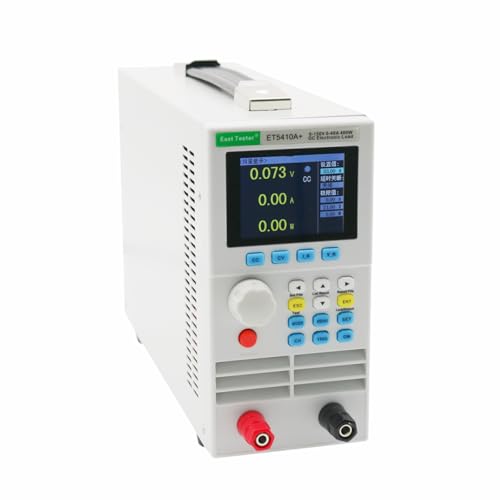
The ET5410A+ is the high-power option in this group, sinking 400 W with a 0–40 A constant-current range in a narrow 90 mm-wide chassis that leaves room on a crowded bench. Beyond the four basic modes it adds combined CC+CV and CR+CV modes, which help when a source must sit at a current limit while its voltage is also constrained — battery and LED-driver research both run into that case. The battery test discharges in CC or CR while logging capacity up to 9999 Ah, and a transient test switches between two current levels for step-response checks.
Specs
- Input: 400 W, 0–150 V, 0–40 A
- Modes: CC, CV, CR, CP, CC+CV, CR+CV
- Resolution: 1 mV / 1 mA
- Display: 2.8-inch TFT LCD, 320 x 240
- Battery test: CC and CR discharge, capacity up to 9999 Ah
- Interface: USB standard (RS232 optional)
- Dimensions: 90 x 190 x 300 mm
- Protections: over-voltage, over-current, over-power, over-temperature
Best for: high-current discharge work and combined-mode battery or driver studies
Watch out for: RS232 is an optional fit on this model rather than standard, so confirm the exact configuration in the listing if your logging setup needs a serial port
ASIN: B0C9LVZ8WK
Which One Fits Your Situation
Characterising a new DC-DC converter design
Pick the Siglent SDL1020X-E. Converter work is dominated by load steps, and its 25 kHz CC dynamic mode with adjustable slew rate applies clean, repeatable current edges while you watch the output respond on a scope. The list function then replays the same profile after each design revision, so comparisons between board spins stay honest.
Running long battery discharge experiments
Choose the East Tester ET5410A+ for its 400 W headroom and dedicated battery test that discharges in CC or CR while accumulating capacity. If your cells are smaller and fine voltage logging matters more than raw power, the Rigol DL3021 is the alternative: its 0.1 mV voltage readback tracks the discharge curve in detail across a 512-step programmable profile.
Automating a shared departmental bench
The Korad KEL103 fits best. Built-in LAN alongside USB and RS232 lets it join an existing instrument network without option modules, and its 100 stored setups mean each group can recall its own configuration instead of re-keying setpoints. The fine 0.1 mA resolution also covers the low-current coursework and sensor projects that share the same bench.
Validating chargers and protection circuits
Go with the Rigol DL3021. Its built-in over-current and over-power test functions are designed to find the exact trip points of a charger or supply, and the battery test mode covers charge-discharge cycling in the same instrument. The 512-step list function lets you script the whole validation sequence once and rerun it on every prototype batch.
Common Mistakes
- Buying on wattage alone and ignoring the low CC range, then discovering the load cannot set or resolve the milliamp currents a sleep-mode study needs.
- Leaving the slew rate at its default during transient tests, so the applied load step is far slower than the real-world load the converter will face.
- Forgetting lead resistance at high current: without remote sense or short, heavy leads, the voltage at the device under test is not the voltage on the display.
- Assuming every interface in the series brochure is fitted to the listed model, when LAN, GPIB or RS232 may be options that must be specified at purchase.
- Running a load at its full rated power for hours without checking airflow, then blaming the instrument for drift that is really thermal.
Frequently Asked Questions
Why does constant-current mode matter more than the other modes for lab work?
Most research questions are framed as “what does the source do at this current?” Battery capacity, converter efficiency curves, charger behaviour and LED operating points are all measured against a controlled current draw. CC mode holds that draw steady while voltage moves, which is exactly the controlled variable those experiments need.
How fast a CC slew rate do I actually need?
Match the edge to the real load. If your converter feeds a processor that steps between sleep and full load in microseconds, you need an adjustable slew rate in the A/µs range and a dynamic mode to match. For battery and thermal work, slow edges are fine and gentler on wiring. Programmable slew matters more than the headline maximum.
Can one load cover both milliamp experiments and high-current work?
Often yes, provided it has split CC ranges. A dual-range load with a low span of a few amps and resolution around 0.1–1 mA can set small currents accurately while still sinking tens of amps on the high range. Check the resolution figure for the low range specifically, because that is the number your small-signal work depends on.
Do I need remote interfaces if I only run manual experiments today?
Probably sooner than you expect. The first time an experiment runs overnight, or a result has to be reproduced for a reviewer, manual knob settings stop being enough. A load with USB or LAN and a documented command set lets you log data and replay profiles exactly. Retrofitting automation later usually means replacing the instrument, not upgrading it.
Related guides
More from Amazon
Programs that pair well with the guide above. Offers and eligibility are set by Amazon and may change.
Free shipping on eligible items, Prime Video and more. Eligible new members can start with a free trial.
Start a Prime free trialAudiobooks and podcasts to listen to on the go. Eligible new members can start with a free trial.
Try Audible freeAd-free music streaming. Eligible new subscribers can start with a free trial.
Try Music Unlimited freeA free business account with business pricing and bulk-buying tools for work, shop or home office.
Create a business accountAs an Amazon Associate we earn from qualifying purchases.










Write Your Review
No reviews yet. Be the first to share your experience!