
Key takeaways
- Four compact benchtop DC electronic loads for small laboratory spaces, compared by listed dimensions, power, modes and interfaces, with real Amazon ASINs.
What's inside
As an Amazon Associate I earn from qualifying purchases. This post may contain affiliate links at no extra cost to you.
The real decision on a small bench is not watts first. It is whether the load physically fits the shelf or the corner of the desk and still leaves room for the device under test, its leads and a soldering station. Compact loads trade depth, power and voltage ceiling against each other, so the right pick depends on which of those your work can afford to give up.
This guide is for home labs, teaching benches and small R&D corners where one instrument has to earn its footprint. Every pick is a benchtop DC electronic load sold on Amazon US, chosen from the dimensions and ratings published on its product page, and the four models span 150 W to 400 W so both low-voltage board work and bigger supply testing are covered.
Quick Picks
As an Amazon Associate we earn from qualifying purchases
| Product | Best for | Key spec from title |
|---|---|---|
| B&K Precision 8540 | The smallest shelf or desk corner | 150 W, 60 V / 30 A |
| iDili ET5410A+ (East Tester) | High power in a narrow case | 400 W, 150 V / 40 A |
| Korad KEL103 | Networked logging on a tight bench | 300 W, 120 V / 30 A |
| Maynuo M9711 | Charger and solar testing in a half-width case | 150 W, 150 V / 30 A |
How to Choose
Start with the tape measure, not the wattage
On a small bench, depth is usually the dimension that breaks a setup. A load that is 15 inches deep leaves little room behind a shallow shelf for its power cord, interface cables and exhaust air, even if its front panel looks narrow. Compare all three published dimensions before anything else. The B&K Precision 8540 below is only 3.5 inches wide and 11.1 inches deep, while the Maynuo M9711 is a half-width case that runs 365 mm front to back. Measure your shelf, allow a few extra inches for cables and airflow, and only then look at ratings.
Match the power ceiling to the supplies you actually test
Wattage decides which devices under test you can load fully. Multiply the highest voltage by the highest current you realistically apply: a 12 V, 5 A supply needs only 60 W, so any load here handles it, while a 24 V, 10 A LED supply needs 240 W and rules out both 150 W models. Small labs that mostly check USB supplies, single-board computer rails and battery packs rarely pass 150 W. If your bench also sees 24 V or 48 V equipment at several amps, the 300 W and 400 W picks earn their slightly larger cases.
Check the voltage ceiling and the low end
The headline current figure means little if the voltage ceiling is wrong for your work. The compact B&K 8540 stops at 60 V, which covers single cells, USB rails and 48 V telecom-style supplies but nothing above. The other three picks reach 120 V or 150 V, leaving room for higher-voltage bricks and series battery strings. At the opposite end, remember that every load needs some voltage across its input to sink full current, so discharging a single low-voltage cell at high current is harder than the headline specification suggests. Check the minimum operating behaviour in the listing before planning cell tests.
Think about heat, fan noise and PC control
In a small room, the load shares air and earshot with you. All four picks are fan-cooled, and fan noise climbs with dissipated power, so a 400 W unit working hard will be audible across a spare-room lab. Intelligent or temperature-controlled fan designs, like the ET5410A+ and the M9711 list, help at light loads. Also decide early whether you will log tests from a PC: the KEL103 builds in USB, RS232 and LAN, the ET5410A+ offers USB only, and the Maynuo’s remote link depends on its adapter and software, so check what is in the box.
The 4 Best Options
B&K Precision 8540

This is the load to measure every other compact pick against. At 3.5 inches wide it takes roughly half the frontage of a typical bench instrument, and its 11.1-inch depth suits shelves that rule out deeper chassis. The trade is scope: the input tops out at 60 V and there is no constant-power mode, so it suits low-voltage work such as single-board computers, USB supplies and battery packs rather than high-voltage bricks. In return you get B&K’s two current ranges, a short mode for simulating faults, and storage for up to 400 instrument settings, which suits repeated checks.
Specs
- Input range: 0-60 V, 1 mA-30 A, 150 W
- Operating modes: constant current, constant voltage, constant resistance
- Measurement resolution: 10 mV / 1 mA
- Stores up to 400 instrument settings
- Short mode for simulating shorts
- Dimensions: 3.5 x 6.9 x 11.1 in (88 x 175 x 282 mm)
- Weight: 6 lbs (2.7 kg)
Best for: A single shelf or desk corner dedicated to low-voltage supply and battery checks.
Watch out for: The 60 V ceiling is firm, so confirm none of your supplies or battery strings exceed it before choosing this over a 150 V model.
ASIN: B07577T6R8
iDili ET5410A+ (East Tester)
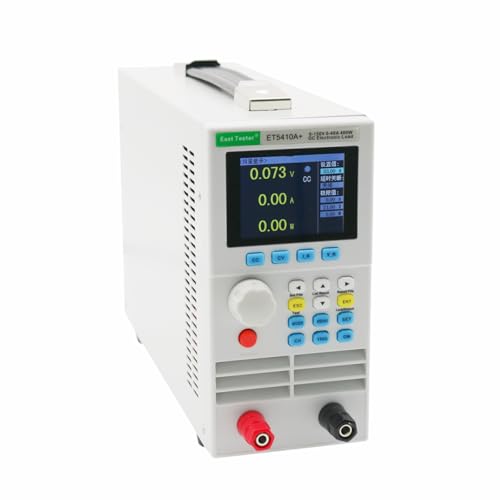
Sold on Amazon under the iDili name, the ET5410A+ packs the highest rating in this guide into a case only about 90 mm wide. Its 400 W, 150 V and 40 A envelope covers the 24 V and 48 V supplies that defeat the 150 W picks, while the narrow frontage keeps it easy to slot between a bench supply and a scope. A 2.8-inch TFT colour display, transient testing and a dedicated battery test function round out a feature set aimed at mixed work. The compromises are a USB-only remote interface and dimensions the listing itself states as approximate.
Specs
- Input range: 0-150 V, 0-40 A, 400 W
- Operating modes: constant current, constant voltage, constant resistance, constant power
- Transient test and battery test functions
- Display: 2.8-inch TFT LCD
- Interface: USB
- Protections: overvoltage, overcurrent, overpower, overtemperature
- Dimensions: approx. 300 x 90 x 190 mm (11.81 x 3.54 x 7.48 in)
- Weight: approx. 4.3 kg (9.48 lbs)
Best for: A narrow bench slot that still has to test 24 V and 48 V supplies at serious current.
Watch out for: The listing gives dimensions as approximate, so leave a small margin on a tight shelf, and note that remote control is USB only, with no serial or LAN option.
ASIN: B0C9LVZ8WK
Korad KEL103

The KEL103 is the pick for a small bench that runs scripted or logged tests. It is the only model here with LAN alongside USB and RS232, so it can sit on a shelf across the room and still stream discharge data to a PC. Its 300 W rating and 120 V ceiling cover most bench supplies, and the published 0.1 mV and 0.1 mA resolution in its low ranges is the finest in this guide. The chassis is about 8.5 inches wide, though at 15.1 inches long it needs a deeper shelf than the B&K. Battery testing and remote sensing are built in.
Specs
- Input range: 0-120 V, 0-30 A, 300 W
- Operating modes: constant current, constant voltage, constant resistance, constant power
- Resolution: 0.1 mV / 0.1 mA
- Dynamic mode up to 10 kHz
- Interfaces: USB, RS232, LAN
- Battery test and remote sensing functions
- Dimensions: 15.1 x 8.5 x 4.3 in
- Weight: 11.4 lbs (5.17 kg)
Best for: A compact bench that logs battery discharges and supply tests over the network.
Watch out for: The rear panel has a switchable 110 V / 220 V mains selector, so set it to your local supply before the first power-on.
ASIN: B07GVNQZQF
Maynuo M9711

The M9711 has been a fixture on small benches for years, and its appeal is the mode list. Beyond the usual constant current, voltage, resistance and power modes, it adds combined CC+CV and CR+CV modes that are genuinely useful for testing battery chargers and solar charge controllers, which the other picks handle less directly. The case is a half-width 214 mm wide and 108 mm tall, though it runs 365 mm deep, so it suits a narrow but deep shelf. A VFD display, a temperature-controlled fan and remote control options through RS-232, RS-485 or USB with the maker’s PC software complete the package.
Specs
- Input range: 0-150 V, 0-30 A, 150 W
- Operating modes: CC, CR, CV, CW plus combined CC+CV and CR+CV
- Display: VFD
- Remote control: RS-232 / RS-485 / USB options with PC software
- Temperature-controlled fan
- Dimensions: 214 x 108 x 365 mm (W x H x D)
Best for: Charger, solar controller and regulator testing on a narrow, deep shelf.
Watch out for: PC logging depends on the maker’s communication adapter and software, so confirm what is included in the box before counting on remote control.
ASIN: B00FJWCVN8
Which One Fits Your Situation
A single shelf above a crowded desk
Choose the B&K Precision 8540. Nothing else here comes close to its 3.5-inch width and 11.1-inch depth, and at 6 lbs it will not strain a wall-mounted shelf. As long as your supplies stay under 60 V, its 150 W rating and stored settings cover the everyday checks a desk-based lab actually runs.
Battery work in a spare-room lab
Pick the Korad KEL103 if you log discharges from a PC in another part of the room, since its LAN port and battery test function are built for unattended runs. If the batteries are large and the runs are manual, the ET5410A+ offers more power headroom at 400 W with its own battery test.
A teaching bench shared by several students
The ET5410A+ fits a teaching corner well: its colour screen is easy to read from standing height, the four basic modes are selected with direct keys, and the built-in overvoltage, overcurrent, overpower and overtemperature protections forgive wiring mistakes. Its narrow case also leaves bench width free for student notebooks and the devices under test.
A small product bench that tests chargers
Take the Maynuo M9711. Its combined CC+CV and CR+CV modes were designed for exactly the charger and solar-controller work that product benches repeat daily, and the half-width case leaves room beside it for the units under test. Budget for the communication adapter if you want those charger tests logged automatically.
Common Mistakes
- Choosing on wattage alone, then discovering the chassis is deeper than the shelf it has to sit on.
- Overlooking a 60 V ceiling when the bench also tests higher-voltage supplies or series battery strings.
- Pushing a compact load flush against a wall or shelf back and blocking the vents it needs to shed heat.
- Planning single-cell discharge tests at high current without checking the load’s minimum operating voltage behaviour.
- Assuming PC logging works out of the box without confirming the interface, adapter and software are included.
Frequently Asked Questions
Will a 150 W load cover a small lab’s testing?
For most small-bench work, yes. USB supplies, router bricks, single-board computer rails and hobby battery packs rarely draw more than 100 W under test. You only outgrow 150 W when you load 24 V or 48 V supplies at several amps, or discharge large packs quickly, which is where the 300 W and 400 W picks in this guide take over.
How much clearance does a compact load need?
Plan for a few inches behind and beside the unit. The fan exhaust, power cord and any interface cables all exit into that space, and a load dissipating a few hundred watts moves a lot of warm air. If your shelf cannot spare that clearance, favour the lowest-power pick that still covers your devices under test.
Can these loads measure a battery’s real capacity?
Yes, within their ratings. All four picks can hold a steady discharge, and the ET5410A+ and KEL103 add dedicated battery test functions with cut-off conditions. Set a sensible end voltage for the chemistry, keep the discharge current within the cell maker’s rating, and let the test stop itself rather than watching the clock.
Is a 60 V load enough, or should I buy 150 V headroom?
It depends on the highest voltage you will ever connect. If your bench only sees single cells, USB power and 48 V rails, the 60 V B&K 8540 is enough and buys you the smallest footprint here. If there is any chance of higher-voltage bricks or series strings, the 150 V models cost you some depth but remove a hard limit.
Related guides
More from Amazon
Programs that pair well with the guide above. Offers and eligibility are set by Amazon and may change.
Free shipping on eligible items, Prime Video and more. Eligible new members can start with a free trial.
Start a Prime free trialAudiobooks and podcasts to listen to on the go. Eligible new members can start with a free trial.
Try Audible freeAd-free music streaming. Eligible new subscribers can start with a free trial.
Try Music Unlimited freeA free business account with business pricing and bulk-buying tools for work, shop or home office.
Create a business accountAs an Amazon Associate we earn from qualifying purchases.










Write Your Review
No reviews yet. Be the first to share your experience!