
Key takeaways
- High-frequency LCR meters for prototype testing compared: 300 kHz bench models, 200 kHz options and a 100 kHz handheld, with fixture and sweep checks.
What's inside
As an Amazon Associate I earn from qualifying purchases. This post may contain affiliate links at no extra cost to you.
A capacitor or inductor rarely behaves at 100 kHz the way it behaves at 1 kHz, and that gap is exactly where prototype surprises hide: a choke drifting toward self-resonance, a ceramic capacitor losing capacitance, or a filter inductor whose losses climb near the switching frequency. Choosing a high-frequency LCR meter therefore starts with one decision: how close to the real operating frequency do you need to measure, and how will you connect small prototype parts once you get there?
This guide serves electronics designers validating RF-adjacent stages, engineers checking magnetics for switching converters, and advanced builders matching components for filters and tuned circuits. Every product below was chosen from the names and specifications printed on its Amazon product page, and each one reaches at least 100 kHz.
Quick Picks
As an Amazon Associate we earn from qualifying purchases.
| Product | Best for | Key spec from title |
|---|---|---|
| GW Instek LCR-6300 Precision LCR Meter | Bench prototypes needing the widest frequency reach here | Bench, 300kHz |
| B&K Precision 891 Benchtop LCR Meter | Adjustable-frequency bench work with bin sorting | Benchtop LCR Meter 300 kHz |
| MATRIX MCR5200 Benchtop LCR Meter | Repeated bench checks with saved, exportable data | 40Hz-200kHz |
| Peak Atlas LCR45 LCR and Impedance Meter | Quick inductor and coil checks close to the board | Test frequency options DC, 1kHz, 15kHz, or 200kHz |
| DER EE DE-5000 Handheld LCR Meter | Portable prototype checks at the classic test points | 100 / 120 / 1k / 10k / 100k Hz test frequency |
How to Choose
Match the Top Test Frequency to Your Circuit
Start from the highest frequency your prototype actually runs at, then look at how a candidate meter gets there. A switching converter stage, an RF-adjacent filter, or a small signal inductor can all change character between 10 kHz and 200 kHz, so a meter that stops at audio frequencies only tells part of the story. Check whether the top frequency is a single fixed point or part of a continuously adjustable range, because placing a measurement just below a resonance or a filter corner often matters more than the headline maximum alone.
Look for Sweeps, Sorting, and Stored Setups
Prototype testing is repetitive: you measure a batch of inductors, swap one part, and measure again. A list sweep that steps through several frequencies in one run shows how a part trends instead of giving one isolated number. Bin sorting helps when you are matching capacitors or chokes into sets for a stereo filter or a multi-phase converter. Stored setups and a handler or computer interface also save time when the same checks return on the next board revision, so weigh these workflow features alongside raw frequency range.
Plan the Fixture Before the Meter
At higher test frequencies, the connection to the part can dominate the reading. Short, direct fixtures and four-terminal Kelvin connections keep lead inductance and contact resistance from swamping a small inductor or a low-value capacitor. Check what the listing includes in the box: some meters ship with a test fixture and Kelvin clips, while others need those accessories bought separately before they are useful on a prototype bench. Also confirm that open and short correction is supported, since compensating the fixture is what makes readings on tiny parts repeatable.
Read the Secondary Parameters, Not Just L, C, and R
Two parts with the same headline inductance can behave very differently in a working prototype. Dissipation factor, quality factor, phase angle, and equivalent series resistance reveal the losses that turn into heat, detuned filters, and disappointing efficiency. For capacitor checks near a converter switching frequency, the loss readings matter as much as capacitance itself. Prefer a meter that displays a primary and secondary parameter together, so each measurement tells you both the value and how lossy that value is at the frequency you selected.
The 5 Best Options
GW Instek LCR-6300 Precision LCR Meter

This bench meter is the natural lead pick for prototype work that pushes upward in frequency, because its listing headline reaches 300 kHz, the widest range in this guide. That headroom suits designers checking power-supply inductors and filter parts whose behavior shifts well above the classic 1 kHz and 10 kHz points. Its bench format fits a fixed prototyping station where the same checks repeat across board revisions, and the listing positions it as a precision instrument rather than a pocket checker, which matches methodical development work.
Specs
- Brand: GW Instek
- Model: LCR-6300
- Part Number: LCR-6300
- Measurement Type: LCR Meter
- Maximum test frequency: 300 kHz, from the listing title
- Item Weight: 4 kg
- Item dimensions: 15.75 x 13.5 x 7.5 inches
- Specification Met: UL 61010-1, IEC 61010-2-030
Best for: Prototype benches that need the highest test frequency in this guide for magnetics and filter development.
Watch out for: Confirm which test fixture and leads are included before ordering, since the listing details focus on the instrument itself.
ASIN: B01BMCT2IA
B&K Precision 891 Benchtop LCR Meter

The 891 covers the same 300 kHz ceiling in a benchtop body, and its Amazon-derived feature list adds the tools that speed up prototype iteration: a fully adjustable test frequency, selectable test levels, and a bin sorting function for grouping parts. A frequency sweep function is also listed, which helps when you want to watch an inductor approach resonance instead of sampling one point. Designers who sort matched components for filters, or who repeat the same checks on every prototype build, get the most from this combination of range and workflow features.
Specs
- Brand: BK
- Model: 891
- Part Number: 891
- Manufacturer: BK PRECISION
- Measurement Type: LCR Meter
- Test frequency range: 20 Hz to 300 kHz
- Selectable test levels: 0.5 Vrms and 1 Vrms
- Minimum Operating Voltage: 0.5 volts of alternating current
- Item Weight: 11 pounds
- Item dimensions: 16.5 x 12.5 x 7.6 inches
- Specification Met: CE, UL 61010-1
Best for: Bench prototyping with matched-part sorting and adjustable test frequency up to 300 kHz.
Watch out for: The listing weight and dimensions describe a full bench instrument, so measure your shelf space before choosing it over a compact model.
ASIN: B016S9GRNK
MATRIX MCR5200 Benchtop LCR Meter

MATRIX builds this benchtop bridge around 41 selectable frequency points running from 40 Hz to 200 kHz, which is a practical spread for following a component from low-frequency sanity checks up toward converter and RF-adjacent territory. The listing highlights a color display, data saving and export over USB and RS232C, and calibration modes that include a quick-clear option. For a prototype bench that documents results as a design evolves, that mix of frequency coverage and data handling is the draw, and the included four-terminal test leads mean it can start work without an accessory hunt.
Specs
- Brand: MATRIX
- Model: MCR5200
- Part Number: MCR-5200
- Style Name: 40Hz-200kHz
- Frequency points: 41, from 40 Hz to 200 kHz
- Display: 4.3-inch TFT, from the listing description
- Interfaces named in the title: USB and RS232C
- Included Components: LCR Meter, 4-terminal test leads, Power Cord, Test Report, Fuse table
- Item Weight: 7.7 pounds
- Item dimensions: 9.45 x 13.08 x 3.94 inches
- Power Source: Corded Electric
Best for: Documented prototype sessions where readings are saved, exported, and compared across design revisions.
Watch out for: Its 41 points are selectable steps rather than a continuously adjustable range, so check that the exact frequencies you need are among them.
ASIN: B07ZCJ1319
Peak Atlas LCR45 LCR and Impedance Meter
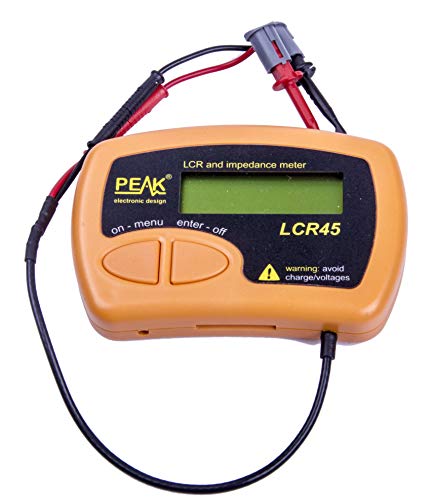
The LCR45 takes the opposite approach to the bench units: it is a compact impedance meter that automatically or manually selects among DC, 1 kHz, 15 kHz, and 200 kHz test frequencies. That top point makes it genuinely useful for small inductors, RF chokes, and coils, where a 1 kHz-only reading can be misleading, and its fine measurement resolution suits distinguishing near-identical parts. It will not replace a bench bridge for sweeps or sorting, but as a quick checker that lives beside the prototyping board and answers in seconds, it earns its place here.
Specs
- Brand: Peak
- Model: LCR45
- Test frequency options: DC, 1kHz, 15kHz, or 200kHz
- Measurement resolution: 0.2uH, 0.2pF, and 0.2 Ohms
- Component type selection: automatic or manual
- Hold function for stable readings
- UPC: 700153222969
Best for: Fast inductor, coil, and impedance spot checks during board bring-up and tuning.
Watch out for: You get four fixed test frequencies rather than an adjustable range, so confirm the 200 kHz point lands close enough to your operating frequency.
ASIN: B00JVT0CSG
DER EE DE-5000 Handheld LCR Meter
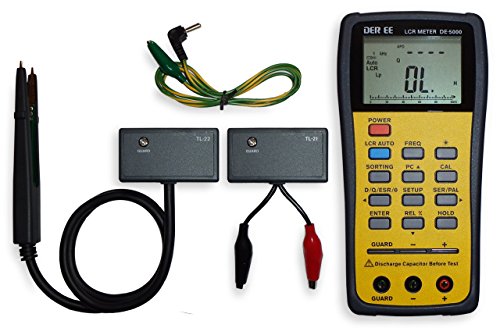
The DE-5000 is the established handheld in this guide, offering the five classic test frequencies up to 100 kHz on a dual display. That ceiling still covers a large share of prototype work: electrolytic and film capacitor checks near many converter switching frequencies, plus inductor screening before a part earns bench time. The listing describes auto ranging, automatic serial and parallel modes, and a component sorting function, which together make it a capable screening tool for incoming parts. Choose it when portability and quick pass-or-fail checks matter more than maximum frequency reach.
Specs
- Brand: DER EE
- Model: DE-5000
- Test frequencies: 100 / 120 / 1k / 10k / 100k Hz
- Display: Dual 19999/1999 counts, with backlight
- Parameters listed: Ls, Lp, Cs, Cp, Rs, Rp, dissipation factor, quality factor, phase angle, ESR
- Auto ranging and auto serial / parallel modes
- Components sorting function
Best for: Portable screening of capacitors and inductors at standard test frequencies during prototype assembly.
Watch out for: The 100 kHz top frequency is the lowest ceiling in this guide, so parts destined for faster stages deserve a final check on a higher-frequency model.
ASIN: B00S298KJO
Which One Fits Your Situation
You Are Characterizing Magnetics for a Switching Converter
Pick the GW Instek LCR-6300 first, since its 300 kHz reach gets closest to the frequencies where converter inductors reveal rising losses and approaching resonance. The B&K Precision 891 is the alternative when you also want bin sorting and selectable test levels in the same bench session. Either way, measure each candidate choke at several frequencies rather than trusting its low-frequency inductance alone.
You Are Matching Parts for Filters and Tuned Stages
The B&K Precision 891 fits this work best, because bin sorting groups capacitors and inductors into matched sets while the adjustable frequency lets you check them near the filter corner. The MATRIX MCR5200 is a sound second choice when you would rather save and export the readings for each set. Matching at the operating frequency, not at a default setting, is what keeps left and right channels aligned.
You Need Quick Answers Beside the Board
Reach for the Peak Atlas LCR45 when the question is simply whether a coil or small capacitor is close to its intended value near working frequency. Its automatic component recognition and 200 kHz point make it fast for bring-up and tuning checks. For a suspect part, follow up on a bench meter afterward, but for the dozens of small decisions during assembly, the compact meter keeps the session moving.
You Are Screening Incoming Parts on a Budget of Bench Space
The DER EE DE-5000 handles screening without claiming bench room: five test frequencies, a dual display, and a sorting function cover most incoming-inspection questions for prototype builds. It is also the easiest meter here to carry between benches or to a supplier visit. If screening later reveals a part that behaves oddly near its limit, promote that part to one of the 200 kHz or 300 kHz bench models for a closer look.
Common Mistakes
- Measuring only at 1 kHz and assuming the value holds at the operating frequency, when inductance and capacitance both drift as frequency rises.
- Using long test leads at high frequencies, so lead inductance and stray capacitance become part of the reading instead of part of the circuit.
- Skipping open and short correction with the actual fixture fitted, which leaves fixture errors baked into every small-part measurement.
- Ignoring loss parameters such as dissipation factor and ESR, then wondering why a filter or converter stage runs hot or off tune.
- Comparing parts measured in different equivalent modes, series for one and parallel for another, and treating the two numbers as interchangeable.
Frequently Asked Questions
Why does test frequency matter so much for prototype work?
Components are not fixed values in practice. Inductor windings carry capacitance that pulls the part toward self-resonance, capacitor dielectrics change with frequency, and core losses rise as frequency climbs. A reading taken far below the operating frequency can look perfect while the part misbehaves in the circuit, so measuring near the real frequency is what makes a prototype check meaningful.
Is 100 kHz enough, or should I insist on 200 kHz or 300 kHz?
It depends on the stage you are building. Many switching converters and audio-frequency filters are well served by checks at 100 kHz, especially for capacitor screening. If your inductors, chokes, or tuned stages work higher, or you want to see trends as frequency rises, a 200 kHz or 300 kHz model gives the extra visibility that prevents surprises later.
Can a handheld meter replace a benchtop LCR bridge for prototypes?
For screening and quick checks, often yes: handhelds here reach 100 kHz or 200 kHz and report the main loss parameters. A benchtop bridge earns its space when you need an adjustable frequency, sweeps across many points, bin sorting for matched sets, or saved setups for repeated checks. Many benches end up using a handheld for triage and a bench meter for decisions.
What should I check before measuring small SMD parts at high frequency?
Fit the shortest, most direct fixture the meter supports, run open and short correction with that fixture in place, and confirm the meter offers a test frequency near your operating point. Handle parts consistently, because finger pressure and lead dress change stray capacitance. Finally, record the equivalent mode used, since series and parallel readings for the same part are not directly interchangeable.
Related guides
More from Amazon
Programs that pair well with the guide above. Offers and eligibility are set by Amazon and may change.
Free shipping on eligible items, Prime Video and more. Eligible new members can start with a free trial.
Start a Prime free trialAudiobooks and podcasts to listen to on the go. Eligible new members can start with a free trial.
Try Audible freeAd-free music streaming. Eligible new subscribers can start with a free trial.
Try Music Unlimited freeA free business account with business pricing and bulk-buying tools for work, shop or home office.
Create a business accountAs an Amazon Associate we earn from qualifying purchases.










Write Your Review
No reviews yet. Be the first to share your experience!