
Key takeaways
- Four benchtop DC electronic loads compared for prototype testing, with programmable modes, dynamic transient tests, battery discharge and PC control.
What's inside
As an Amazon Associate I earn from qualifying purchases. This post may contain affiliate links at no extra cost to you.
A prototype power stage rarely fails at the exact operating point on the datasheet. It fails when the load steps, when the rail sags at start-up, or when a battery pack gives up earlier than the calculations promised. A benchtop DC electronic load is the instrument that exposes those weaknesses before a board spins again: it draws a controlled current, power or resistance from your converter, supply or pack, and lets you repeat the same test after every design change.
This guide is for hardware engineers, technicians and advanced makers who are bringing up DC-DC converters, AC-DC supplies, chargers and battery-powered prototypes. Every pick below is a single-channel benchtop DC electronic load, and the shortlist was built from the product names and published specifications on the Amazon product pages.
Quick Picks
As an Amazon Associate we earn from qualifying purchases
| Product | Best for | Key spec from title |
|---|---|---|
| Siglent SDL1020X-E | All-round prototype bench work | 150 V / 30 A / 200 W |
| Rigol DL3021 | Scripted load profiles and automated tests | 150 V / 40 A / 200 W |
| Korad KEL103 | Networked logging on a budget | 120 V / 30 A / 300 W |
| East Tester ET5410A+ | Higher-power prototypes and big packs | 150 V / 40 A / 400 W |
How to Choose
Match the voltage, current and power envelope to your prototype
The headline wattage is the least useful number on the front panel. A load can only sink its full current at low voltage and its full voltage at low current, and the power limit cuts in between the two. Map the rails you actually develop: a 5 V converter tested at 20 A already needs 100 W, while a 48 V prototype at 5 A needs 240 W. Choose an envelope that covers your highest-voltage and highest-current rails at the same time, with headroom for the next project rather than the current one.
Look at dynamic mode and slew rate for transient testing
Prototype testing is mostly about change: a processor waking up, a radio transmitting, a motor starting. A load with a dynamic or transient mode switches between two current levels at a set frequency, so you can watch the rail dip and recover on an oscilloscope. Check the dynamic frequency range and the adjustable current slew rate, because a load that steps slowly will hide ringing and overshoot that a fast load step would reveal. For converter work, a dynamic mode reaching into the kilohertz range is the practical minimum.
Decide which modes and built-in tests you will actually run
Constant current is the everyday mode for converter and supply testing, constant power mimics a downstream converter, constant resistance behaves like a fixed resistive load, and constant voltage is the mode for chargers and current-limited sources. Beyond the four basics, built-in battery discharge tests with a programmable cut-off voltage save hours when a prototype is battery-powered, and a list or sequence function lets the load step through a whole load profile unattended, which makes regression testing after each board revision far easier.
Check interfaces, remote sense and readback resolution
Repeatability is what turns a load from a space heater into a measuring instrument. Four-wire remote sense removes the voltage drop of the test leads from the reading, which matters every time you measure a low-voltage rail at high current. Readback resolution decides whether you can see a 20 mA change in quiescent draw or only whole amps. For longer development cycles, USB, RS-232 or LAN control with a documented command set lets you script load profiles, log discharge curves overnight and attach the results to your test reports.
The 4 Best Options
Siglent SDL1020X-E

The SDL1020X-E is the balanced choice for a prototype bench that handles a bit of everything: converter bring-up in the morning, a charger check after lunch and a battery discharge in between. Its static modes cover the four basics, the CC dynamic mode runs fast enough to imitate pulsed digital loads, and the built-in battery test with remote sense produces discharge figures you can put in a design review. USB, RS-232 and LAN are all fitted as standard, so scripted testing does not require an interface upgrade later.
Specs
- Rated input: 150 V, 30 A, 200 W, single channel
- Modes: CC, CV, CR, CP plus dynamic mode
- CC dynamic mode up to 25 kHz
- Readback resolution: 1 mV / 1 mA
- Interfaces: USB, RS-232 and LAN
- Battery test, CR-LED mode and short-circuit test functions
- Four-wire remote sense connections
- 3.5-inch TFT-LCD display
Best for: A first serious prototype bench that needs dynamic testing, battery discharge and full PC control in one instrument.
Watch out for: This is the X-E version with 1 mV / 1 mA resolution; the plain SDL1020X resolves 0.1 mV / 0.1 mA, so confirm the exact variant named on the listing before ordering.
ASIN: B07RS2B8VT
Rigol DL3021

The DL3021 suits developers who treat the load as part of an automated test setup rather than a knob they turn by hand. Alongside the four static modes it offers continuous, pulsed and toggled dynamic modes, and its list function can run a programmed sequence of load steps, which is exactly what you want when the same prototype goes through the same checks after every firmware or layout change. Built-in battery, overcurrent-protection and overpower-protection tests cover the protection validation that prototype work demands, and the fine readback resolution helps when comparing efficiency between revisions.
Specs
- Rated input: 150 V, 40 A, 200 W, single channel
- Modes: CC, CV, CR, CP plus continuous, pulsed and toggled dynamic modes
- List function with up to 512 steps
- Built-in battery test, OCP test and OPP test
- Readback resolution: 0.1 mV / 0.1 mA
- Adjustable current slew rate up to 2.5 A/µs
- Interfaces: USB and RS-232
- 4.3-inch TFT LCD display
Best for: Repeatable, scripted load profiles and protection testing during converter and supply development.
Watch out for: LAN and GPIB are optional extras on this series rather than built in, so check the listing configuration carefully if your bench standardises on Ethernet control.
ASIN: B074P7MTSS
Korad KEL103

The KEL103 is the pick for developers who want a networked load without paying for a premium badge. It sinks more power than the 200 W instruments above, which gives welcome headroom on 12 V and 24 V prototypes, and its Ethernet port makes it easy to park the load on the lab network and pull discharge logs from a script at your desk. The four modes cover everyday converter, supply and battery work, and the fine low-range resolution is unusual at this level. The trade-off is a plainer front panel and software experience than the Siglent or Rigol provide.
Specs
- Rated input: 120 V, 30 A, 300 W, single channel
- Modes: CC, CV, CR, CW
- Interfaces: USB, RS-232 and LAN
- Readback resolution: 0.1 mV / 0.1 mA in the low ranges
- Battery discharge test function
- Dynamic test mode for stepped loads
Best for: Battery discharge logging and general prototype testing where a LAN connection matters more than front-panel polish.
Watch out for: The maximum input is 120 V rather than 150 V, so check it against any high-voltage rails on your roadmap before committing.
ASIN: B07GVNQZQF
East Tester ET5410A+
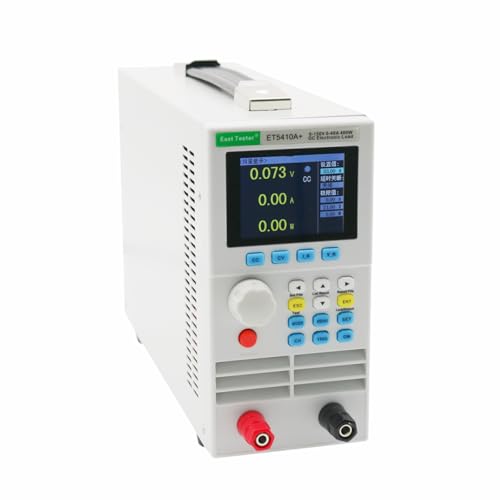
The ET5410A+ brings the largest power envelope in this shortlist to prototypes that outgrow 200 W loads: higher-current 12 V and 24 V supplies, e-bike and power-tool packs, and converters that need a long, hot soak at full output. It covers the four standard modes, adds battery capacity and internal resistance testing that prototype teams use when qualifying cells for a new pack design, and connects to a PC over USB for data logging. The colour display presents voltage, current, power and resistance together, which keeps the bench free of extra meters during long runs.
Specs
- Rated input: 150 V, 40 A, 400 W, single channel
- Modes: CC, CV, CR, CP
- Setting and readback resolution: 1 mV / 1 mA
- Battery capacity and internal resistance test functions
- USB interface for PC software and logging
- Colour LCD display showing voltage, current, power and resistance
Best for: Higher-power prototypes, large battery packs and long full-load soak tests on a development bench.
Watch out for: Make sure the listing is the A+ revision rather than the older ET5410, and plan bench space and airflow for sustained high-power runs, since 400 W of heat has to go somewhere.
ASIN: B0C9LVZ8WK
Which One Fits Your Situation
You are equipping a bench for varied prototype work
Start with the Siglent SDL1020X-E. It combines the four static modes, a fast dynamic mode, a proper battery test and every common interface in one box, so it follows a prototype from first power-up through validation without needing a second instrument. Its 200 W envelope covers most converter, charger and small-pack work comfortably.
Your team reruns the same tests after every revision
Choose the Rigol DL3021. The list function steps through a programmed load profile on its own, and the built-in OCP and OPP tests check protection behaviour the same way every time. That repeatability is what makes results comparable between board revisions, which is the whole point of prototype regression testing.
You test 12 V and 24 V prototypes and log a lot of discharge data
The Korad KEL103 fits this pattern well. Its 300 W rating leaves headroom at the voltages where 200 W loads run out of power first, and the LAN port lets you collect battery discharge curves from a script instead of standing at the bench. It is the pragmatic choice for logging-heavy development work.
Your prototypes are hungry and your packs are large
Take the East Tester ET5410A+. With 400 W on tap it can soak a high-current supply or drain a large pack at a realistic rate without running at its limit all day, and the internal resistance test helps you screen cells before they go into a prototype pack.
Common Mistakes
- Buying on wattage alone and discovering the load cannot reach your rail’s voltage and current at the same time, because the power limit cuts in first.
- Ignoring the minimum operating voltage, then finding the load cannot sink full current from a single cell or a low-voltage rail during our research.
- Skipping remote sense leads, so the voltage drop in long test leads makes a healthy prototype rail look weak at high current.
- Choosing a load without a dynamic mode, leaving no way to check how a converter prototype responds to fast load steps.
- Running a small load at its maximum power for hours without airflow, until thermal protection ends the test early.
Frequently Asked Questions
How much power does a prototype bench load need?
Work out the highest voltage multiplied by the highest current you will test together. A 24 V supply tested at 8 A already needs about 200 W once headroom is included. Most converter and charger prototypes sit comfortably in the 200 W class, while large packs and high-current 12 V or 24 V supplies justify 300 W or 400 W.
Which mode should I use to test a DC-DC converter prototype?
Start in constant current to check regulation, efficiency and thermals at set load points. Then switch to the dynamic mode and step between light and full load while watching the output on an oscilloscope; the size of the voltage dip and the recovery time tell you whether the compensation and output capacitance are right.
Can a benchtop electronic load measure battery capacity for a prototype pack?
Yes. The battery test modes on these loads discharge the pack at a set current or power and stop automatically at the cut-off voltage you program, integrating the charge delivered along the way. Use remote sense where it is fitted so the cut-off is judged at the pack terminals, not at the end of lossy leads.
Do I need remote sense for prototype testing?
It matters most at low voltages and high currents, where even a short pair of leads can drop a few hundred millivolts. That drop appears in your measurements and can make a good regulator look faulty. If your prototypes include 3.3 V or 5 V rails above a few amps, treat four-wire sense as a requirement, not a luxury.
Related guides
More from Amazon
Programs that pair well with the guide above. Offers and eligibility are set by Amazon and may change.
Free shipping on eligible items, Prime Video and more. Eligible new members can start with a free trial.
Start a Prime free trialAudiobooks and podcasts to listen to on the go. Eligible new members can start with a free trial.
Try Audible freeAd-free music streaming. Eligible new subscribers can start with a free trial.
Try Music Unlimited freeA free business account with business pricing and bulk-buying tools for work, shop or home office.
Create a business accountAs an Amazon Associate we earn from qualifying purchases.










Write Your Review
No reviews yet. Be the first to share your experience!