
Key takeaways
- Compare five benchtop DC electronic loads for repeatable quality control testing, with voltage, current, power, modes, and interfaces from Amazon listings.
What's inside
As an Amazon Associate I earn from qualifying purchases. This post may contain affiliate links at no extra cost to you.
A quality control bench lives or dies on repeatability. When the same power supply, battery pack, or charger crosses the bench fifty times in a shift, the load pulling current from it has to behave the same way on the fiftieth run as it did on the first, or the pass and fail labels stop meaning anything. That is the real decision behind this purchase: not which load looks impressive on a datasheet, but which one holds a steady setting, logs a clean result, and lets an operator repeat a test without improvising.
This guide is written for QC technicians running incoming inspection, production line testers checking finished power supplies, and small lab owners who need documented, repeatable discharge and regulation checks. Every load below was chosen from the model name and the voltage, current, power, mode, and interface details shown on its Amazon listing, so you can match the numbers here against the listing before ordering.
Quick Picks
As an Amazon Associate we earn from qualifying purchases
| Product | Best for | Key spec from title |
|---|---|---|
| Siglent SDL1020X-E | Scripted supply and battery checks on a shared bench | Programmable DC Electronic Load, 1 Channel, 150 V, 30 A, 200 W |
| Siglent SDL1030X-E | Higher-power runs at the same voltage and current limits | Programmable DC Electronic Load, 1 Channel, 150 V, 30 A, 300 W |
| Rigol DL3021 | Long stepped test sequences with built-in battery checks | Single Channel Programmable Electronic Load, 200 Watts, USB Communication |
| Korad KEL103 | Networked logging of discharge curves from a PC | Professional Programmable Digital Control DC Load, 300 W, 120 V, 30 A |
| Maynuo M9712 | Straightforward high-power bench testing of supplies and batteries | Programmable DC Electronic Load, 150 V, 30 A, 300 W |
How to Choose
Match the voltage and current envelope to the units you actually test
Start with the worst case your bench will see, not the average. A load rated to 150 V and 30 A covers 48 V telecom supplies, 24 V industrial rails, and 12 V automotive-style units with room to spare, while a 60 V load suits low-voltage boards and single-cell work but rules out higher rails entirely. Current matters just as much: a 5 V supply delivering 30 A needs only 150 W of sinking power, yet a load with a 10 A ceiling cannot run that check at all. Write down the highest voltage, the highest current, and the highest power your QC plan calls for, then pick a load whose three numbers all clear those marks.
Pick load modes that mirror the failure you are hunting
Constant current mode answers the simplest QC question, whether a supply holds its voltage while a fixed current is drawn. Constant voltage mode suits charger and battery work, where the load must draw whatever current keeps the terminal voltage at a set point. Constant resistance mode imitates a real resistive load, and constant power mode keeps the wattage steady while voltage and current trade off against each other. If your test plan only ever uses constant current, a three-mode load is fine. If the plan also checks LED drivers or simulates a changing load, the fourth mode and a dynamic or pulsed mode earn their place.
Treat resolution and readback as part of the measurement
A load that sets current in coarse steps can hide a marginal supply. For low-current checks, such as a sleep-mode draw or a small sensor supply, a 1 mA setting step and a matching readback resolution let the operator see small drifts that a 10 mA step would smooth over. At the other end of the scale, a high-current range with its own finer low range gives the bench two tools in one box. Check the listing for both the setting resolution and the readback resolution, and confirm that the fine range covers the smallest current your QC procedure actually measures.
Plan the interface before the bench fills up
A load with only front-panel controls works when one operator runs one test at a time and writes results down by hand. The moment QC needs logged data, a barcode-driven sequence, or a test that runs unattended, the interface becomes the bottleneck. USB suits a single PC beside the bench, RS-232 fits older test racks, and LAN lets a load sit on the network and feed results to a shared logging script. Choose the interface your logging setup already supports, and confirm the listing names it rather than assuming every programmable load ships with every port.
The 5 Best Options
Siglent SDL1020X-E

The SDL1020X-E earns its place as the general-purpose QC load because it covers the common middle ground without forcing a compromise on control. Its 150 V and 30 A envelope handles most supplies a small QC bench sees, and the combination of four static modes with a fast dynamic mode lets one instrument run steady-state regulation checks and pulsed-load checks in the same session. A battery discharge test and a list function for stepped sequences mean routine checks can follow the same written procedure every time, which is exactly what a quality log needs.
Specs
- Input range of 150 V, 30 A, and 200 W
- Four static modes: CC, CV, CR, and CP
- CC dynamic mode to 25 kHz
- Setting and readback resolution of 1 mV and 1 mA
- Interfaces: USB, RS-232, and LAN
- 3.5 inch TFT-LCD display
- Battery discharge test and list operation function
Best for: A shared bench that runs scripted supply, charger, and battery checks with logged results.
Watch out for: Confirm the 200 W ceiling against your highest-power unit, since a 12 V supply at 30 A already approaches it, and check that the LAN port matches your network setup before relying on remote logging.
Siglent SDL1030X-E
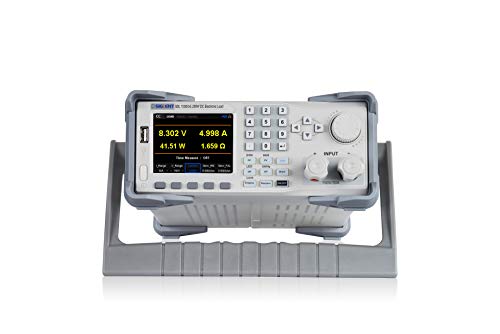
The SDL1030X-E is the same instrument family as the pick above with the power ceiling raised to 300 W, and that single change reshapes which tests it can run. Low-voltage supplies are where the extra headroom shows up first: at 12 V or 24 V, a 200 W load runs out of power long before it runs out of current, while this unit keeps pulling the full 30 A. Everything else carries over, including the four static modes, the dynamic mode, the battery test, and the three built-in interfaces, so a bench that already uses the 200 W model needs no new procedure to adopt it.
Specs
- Input range of 150 V, 30 A, and 300 W
- Four static modes: CC, CV, CR, and CP
- CC dynamic mode to 25 kHz
- Setting and readback resolution of 1 mV and 1 mA
- Interfaces: USB, RS-232, and LAN
- 3.5 inch TFT-LCD display
- Battery discharge test and list operation function
Best for: QC benches that test low-voltage, high-current supplies or discharge larger battery packs.
Watch out for: Check bench ventilation and clearance around the unit, since sustained high-power runs generate heat that a cramped shelf traps, and verify the 300 W rating covers your worst-case unit with margin.
Rigol DL3021

Rigol built the DL3021 around automated sequences, and that focus shows in the features the listing calls out. A list function with up to 512 steps lets a QC procedure walk a supply through a whole load profile without an operator touching the knob between steps, while built-in battery, over-current protection, and over-power protection tests cover the checks that otherwise need separate instruments or manual steps. The 40 A current ceiling gives it an edge over 30 A loads when a low-voltage unit needs a hard pull, and the large colour display keeps voltage, current, and power visible at a glance.
Specs
- Input range of 150 V, 40 A, and 200 W
- Four static modes: CC, CV, CR, and CP
- Dynamic mode to 15 kHz
- List function with up to 512 steps
- Built-in battery test, OCP test, and OPP test
- Interfaces: USB and RS-232
- 4.3 inch TFT LCD display
- Setting and readback resolution of 1 mV and 1 mA
Best for: Production QC that runs long stepped sequences and built-in protection tests without manual intervention.
Watch out for: There is no LAN interface on the listing, so plan for USB or RS-232 logging, and confirm the 200 W power limit before testing high-current, low-voltage units at full draw.
Korad KEL103

The KEL103 stands out in this group for one practical reason: it puts a LAN port on a 300 W bench load. That makes it the natural fit for a QC station where discharge curves are logged from a script on a networked PC rather than read off a display and typed into a sheet. The 120 V and 30 A envelope covers the great majority of bench supplies, and the four modes listed, CC, CV, CR, and CW, cover the standard regulation and power checks. Fine resolution in the low ranges helps when a procedure measures small currents as well as full-load draws.
Specs
- Input range of 120 V, 30 A, and 300 W
- Four modes: CC, CV, CR, and CW
- Interfaces: USB, RS-232, and LAN
- Fine resolution of 0.1 mV and 0.1 mA in the low ranges
- Single-channel programmable DC electronic load
- Digital control with battery tester function
Best for: A networked QC station that logs discharge curves and repeat runs from a PC script.
Watch out for: The 120 V ceiling rules out 150 V rails, so check your highest-voltage unit first, and confirm the control software and drivers suit your operating system before the load becomes part of a daily procedure.
Maynuo M9712

Maynuo has sold the M9712 as a workhorse bench load for years, and its appeal for QC is simplicity rather than novelty. The 150 V, 30 A, and 300 W envelope matches the higher-power Siglent in this guide, and the six-mode set listed for the M97 series, including CC, CV, CR, and CW plus combined CC plus CV and CR plus CV modes, gives a tester room to shape checks around unusual supplies. Battery and short-circuit test functions cover two of the most common QC routines directly, and the bright VFD display stays readable from across a bench.
Specs
- Input range of 0 to 150 V, 0 to 30 A, and 300 W
- Modes: CC, CV, CR, and CW, plus combined CC plus CV and CR plus CV modes
- Battery test function
- Short-circuit test function
- High-luminance VFD display
- Single-channel programmable DC electronic load
Best for: A bench that needs a plain, high-power load for routine supply and battery checks without networked logging.
Watch out for: PC control on this series runs through a serial adapter rather than a built-in USB port on every listing variant, so read the listing carefully and confirm which adapter is included before planning a logged test.
Which One Fits Your Situation
You run one shared bench with many different units
Take the Siglent SDL1020X-E. Its 150 V and 30 A range, four modes, dynamic mode, and three interfaces cover the widest spread of routine QC work in this guide, and the list function keeps repeated checks consistent when different operators share the bench. It is the safest single purchase when the test plan changes from week to week.
Your low-voltage supplies keep hitting the power limit
Take the Siglent SDL1030X-E or the Korad KEL103. Both sink 300 W, which lets a 12 V or 24 V supply draw its full rated current without the load running out of headroom. Choose the Siglent when the test plan needs 150 V as well, and the Korad when the bench logs results over a network.
You need a whole test sequence to run itself
Take the Rigol DL3021. Its 512-step list function and built-in battery, over-current, and over-power tests let a written QC procedure run end to end with fewer manual steps, and the 40 A ceiling suits hard pulls on low-voltage units. Plan the logging around USB or RS-232, since the listing does not include LAN.
You want a plain high-power load and little setup
Take the Maynuo M9712. Its 300 W envelope, battery and short-circuit tests, and straightforward front-panel operation suit a bench where an operator runs checks by hand and records results directly. That keeps the daily routine short and avoids learning a new logging setup for simple pass-or-fail checks. Confirm the PC adapter situation in the listing only if logged testing is part of the plan later.
Common Mistakes
- Buying a load whose voltage or current ceiling is below one unit on the test list, then discovering the gap on the first day of inspection.
- Choosing constant current mode for every check and never using constant power or constant resistance, so a supply that fails under a realistic load still passes the bench.
- Skipping the warm-up and settling time in the procedure, which makes early readings drift and turns repeatable tests into noisy ones.
- Running a high-power test with the load boxed in on a shelf, where trapped heat changes the result and shortens the life of the instrument.
- Writing pass and fail limits from the nominal rating instead of the tolerance band the QC plan actually allows, so good units fail and marginal ones slip through.
Frequently Asked Questions
What does a benchtop DC electronic load do in quality control?
It draws a controlled, repeatable current, voltage, resistance, or power from the unit under test, so a supply, charger, or battery can be checked against its stated behaviour under load. The operator sets the load, reads the resulting voltage and current, and compares them with the limits in the QC procedure. The same settings can be repeated across a batch, which is what turns a one-off check into a quality record.
Which load mode should a QC check start with?
Constant current is the usual starting point, because it asks the simplest question: does the supply hold its voltage while a fixed current is drawn. Once that passes, constant power or constant resistance can imitate a real load more closely, and constant voltage suits battery and charger checks. A written procedure should name the mode for each step rather than leaving the choice to the operator.
How much power rating does a QC bench need?
Add up the highest voltage and the highest current your test plan calls for, and multiply them to find the worst-case wattage the load must sink. Then choose a load rated above that figure with margin, because a load run at its absolute ceiling leaves no room for a unit that draws slightly more than nominal. Low-voltage, high-current units are the usual surprise here.
Can one benchtop load cover both supplies and batteries?
Yes, when the listing names both uses. A load with a battery discharge test measures capacity over a full discharge, while the same load in constant current or constant power mode checks a supply. Check that the voltage, current, and power envelopes cover both jobs, and confirm the battery test is a listed function rather than an improvised manual discharge.
Related guides
More from Amazon
Programs that pair well with the guide above. Offers and eligibility are set by Amazon and may change.
Free shipping on eligible items, Prime Video and more. Eligible new members can start with a free trial.
Start a Prime free trialAudiobooks and podcasts to listen to on the go. Eligible new members can start with a free trial.
Try Audible freeAd-free music streaming. Eligible new subscribers can start with a free trial.
Try Music Unlimited freeA free business account with business pricing and bulk-buying tools for work, shop or home office.
Create a business accountAs an Amazon Associate we earn from qualifying purchases.










Write Your Review
No reviews yet. Be the first to share your experience!