
Key takeaways
- Compare 5 programmable DC bench power supplies for small labs, with compact footprints, multi-channel options, and PC control via USB, LAN, or RS232.
What's inside
As an Amazon Associate I earn from qualifying purchases. This post may contain affiliate links at no extra cost to you.
A small lab forces a different kind of buying decision. Every centimetre of bench matters, so a supply that sprawls across the desk, blocks airflow to the instrument beside it, or needs a tangle of separate boxes for each rail quickly becomes a burden. The real question is not how much power you can afford, but how much capability you can fit into the space you actually have, and still reach every control without moving something else out of the way.
This guide is for electronics hobbyists, repair technicians, students, and engineers working from a spare room, a shared bench, or a corner of a desk. Each supply below was picked from the model name and the specifications shown on its Amazon listing, with the emphasis on programmable control, a modest footprint, and the channel count that lets one box replace several.
Quick Picks
As an Amazon Associate we earn from qualifying purchases.
| Product | Best for | Key spec from title |
|---|---|---|
| Siglent SPD1305X | A single clean rail on a crowded desk | 30 V, 5 A, 150 W, 1 channel |
| Siglent SPD1168X | Low-voltage boards that draw heavy current | 16 V, 8 A, 128 W, 1 channel |
| Korad KA3005P | Scripted tests on a tight bench | 30 V, 5 A, 150 W, USB and RS232 |
| Rigol DP832 | Analog and digital rails from one box | 30 V, 3 A, 30 V, 3 A, 5 V, 3 A, 195 W |
| Siglent SPD3303X-E | Three isolated rails without three boxes | 32 V, 3.2 A, 32 V, 3.2 A, 2.5, 3.3, 5 V, 220 W |
How to Choose
Measure the bench before the supply
Start with a tape measure, not a datasheet. Note the width and depth of the free space, where the mains cable will run, and how much clearance the rear fan needs before it starts recycling warm air against a wall or a shelf. A single-channel unit leaves room for a multimeter and a soldering iron beside it, while a triple-output box can replace two or three separate supplies and free a surprising amount of surface. Either way, confirm the footprint and the vent positions on the Amazon listing before ordering, because a supply that fits on paper can still block the drawer you open every day.
Match the channel count to the rails you run together
Count the voltages your typical project needs at the same time. A microcontroller board with a 5 V logic rail, a 12 V motor driver, and an analog front end at a different voltage will keep you swapping leads all afternoon on a single-output supply. A triple-output unit powers all three at once and keeps their grounds separate where the design calls for it. If your work is usually one board at one voltage, a single channel is the smaller and quieter choice, and the money saved can go toward better probes or a second meter.
Check the programming interface you will actually use
Programmable means little if the interface does not match your computer. Some supplies speak SCPI over USB and LAN, which suits automated test scripts and logging from a laptop on the same network. Others offer USB and RS232, which fits an older desktop or a simple serial script. Decide whether you will write sequences, log voltage and current over time, or simply recall saved settings from the front panel, then check the listing for the exact interfaces named. A missing LAN port matters only if you planned to control the bench from another room.
Read the resolution and protection the listing states
Resolution decides how finely you can set a rail for a sensitive circuit, so compare the millivolt and milliamp figures between models rather than assuming they are all alike. Protection matters just as much in a small space, where a slipped probe lands on a neighbouring board. Look for over-voltage and over-current protection in the listing, along with the current limit behaviour, and confirm whether the output can be switched off from the front panel without pulling the mains lead. These details decide whether a mistake costs a fuse or a prototype.
The 5 Best Options
Siglent SPD1305X
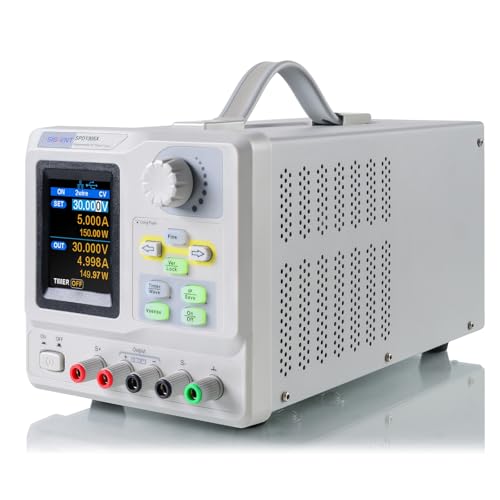
The SPD1305X suits a bench where one precise rail does most of the work and space is too tight for a wide instrument. Its single linear output covers the common 30 V range for microcontroller boards, sensor modules, and small motor drivers, while the colour display keeps voltage, current, and power visible at a glance. Remote sense helps when long leads would otherwise drop voltage before it reaches the board, and the timer and waveform display give a simple way to watch a load change over time without adding another instrument to the desk.
Specs
- Single channel, 0 to 30 V, 0 to 5 A, 150 W total power
- Linear regulation with 1 mV and 1 mA setting resolution
- USB and LAN interfaces with SCPI command support
- 2.8-inch TFT display with 5-digit voltage and 4-digit current readouts
- Remote sense, timer function, and waveform display
Best for: a compact bench that needs one clean, precise rail for everyday board work.
Watch out for: confirm the rear clearance and the listed dimensions on the Amazon page, since the fan and connectors need room behind the case.
Siglent SPD1168X

The SPD1168X is the pick when your boards run at low voltage but pull serious current, which is exactly the pattern of 5 V and 12 V embedded work. Its 16 V ceiling looks modest next to 30 V supplies, yet the 8 A output covers hungry single-board computers, LED arrays, and power-hungry peripherals without breaking a sweat. The same compact single-channel case as its 30 V sibling keeps the footprint small, and the fine resolution lets you nudge a rail by a millivolt when a marginal board needs exactly the right level to behave.
Specs
- Single channel, 0 to 16 V, 0 to 8 A, 128 W total power
- Linear regulation with 1 mV and 1 mA setting resolution
- USB and LAN interfaces with SCPI command support
- 2.8-inch TFT-LCD display
- Voltage accuracy of 0.03 percent of reading plus 10 mV
- Save and recall for up to 5 system settings
Best for: low-voltage projects that draw high current from a single rail.
Watch out for: check the 16 V ceiling against every board you own before buying, since a 24 V project would need a different supply.
Korad KA3005P

The KA3005P earns its place as the most affordable route to a supply you can drive from a computer in a small lab. Its single linear channel delivers the familiar 30 V and 5 A range, and the USB and RS232 ports on the back let a script set voltage and current, read back measurements, and repeat a test without anyone touching the knob. Four memory presets on the front panel cover the everyday switch between common rails, so the bench stays quick for manual work and repeatable when a script takes over.
Specs
- Single channel, 0 to 30 V, 0 to 5 A, 150 W total power
- Linear regulation with a four-digit LED display
- USB and RS232 programmable interfaces with remote control software
- 4 memory presets for stored voltage and current settings
- Over-voltage protection and over-current protection
Best for: hobbyists and repair benches that want scripted control without a large case.
Watch out for: verify the software and driver requirements on the Amazon listing, since the remote control setup differs from the SCPI workflow on other models here.
Rigol DP832

The DP832 replaces three separate supplies with one box, which is the single biggest space saving a small lab can make. Two adjustable 30 V channels handle analog and digital rails side by side, while the third 5 V channel covers logic without a separate wall adapter cluttering the bench. Each channel is independently controlled, and the USB, LAN, and RS232 interfaces support SCPI programming for automated sequences. For a mixed-signal project, that combination removes a tangle of leads and frees the desk for the circuit itself.
Specs
- Three channels: 30 V, 3 A; 30 V, 3 A; 5 V, 3 A; 195 W total power
- Linear regulation with 10 mV and 10 mA resolution
- USB, LAN, and RS232 interfaces with SCPI support
- Independent control of each channel
- Built-in timer and waveform display functions
Best for: mixed analog and digital work that needs three rails running at once.
Watch out for: measure the bench depth first, since a triple-output case is wider and deeper than the single-channel units in this guide.
Siglent SPD3303X-E
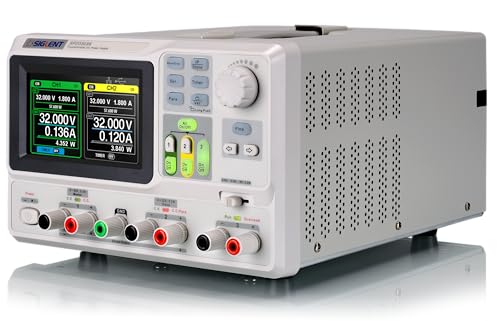
The SPD3303X-E is the most capable single box in this guide for a lab that keeps growing but cannot grow its bench. Its three isolated outputs run independently, in series, or in parallel, so one unit can feed a split supply, a higher-voltage rail, or three separate boards without extra hardware. The selectable third output covers the common logic levels, and the timing output supports simple automated sequences from the front panel. With USB and LAN control plus PC software, it behaves like a small programmable test system rather than a single supply.
Specs
- Three independent isolated outputs: 32 V, 3.2 A; 32 V, 3.2 A; 2.5, 3.3, 5 V at 3.2 A; 220 W total power
- Linear regulation with 1 mV and 1 mA resolution
- USB and LAN interfaces with SCPI support and EasyPower PC software
- Independent, series, and parallel output modes
- Timing output and trend graph display on a 4.3-inch TFT-LCD
Best for: a small lab that needs three isolated rails and scripted control from one unit.
Watch out for: check the total 220 W limit across all three channels, since the sum of the individual channel ratings exceeds what the unit can deliver at once.
Which One Fits Your Situation
Your desk holds one project at a time
Pick the Siglent SPD1305X when a single rail covers nearly everything you build. Its 30 V and 5 A range, fine resolution, and USB and LAN control fit microcontroller boards, sensors, and small drivers, while the narrow case leaves room for a meter and hand tools. You lose nothing you use daily and gain a bench that stays usable.
Your boards run at 5 V or 12 V and draw heavy current
Pick the Siglent SPD1168X when low voltage and high current define your work. The 8 A output handles single-board computers and LED loads that would trip the current limit on a 3 A channel, and the compact single-channel body keeps the footprint small. Just confirm no project in your queue needs more than 16 V.
You repeat the same tests and want the computer to run them
Pick the Korad KA3005P when scripted testing matters more than a third channel. USB and RS232 control plus four memory presets make it easy to rerun a voltage sweep or a burn-in routine, and the single linear output keeps the case modest. It is the simplest way to automate a small bench.
You power analog, digital, and logic rails together
Pick the Rigol DP832 or the Siglent SPD3303X-E when one box must feed a whole mixed-signal project. The DP832 covers the common 30 V and 5 V combination, while the SPD3303X-E adds isolated outputs, series and parallel modes, and finer resolution for more demanding setups. Either choice removes two extra supplies from the bench.
Common Mistakes
- Buying on voltage alone and discovering the current limit trips the moment a motor or LED array starts up.
- Ignoring the rear fan and cable clearance, then pushing the supply against a wall where it recirculates warm air.
- Choosing a single-channel supply for a project that always needs two or three rails at once, and spending the savings on adapters and extra boxes.
- Assuming every programmable supply speaks SCPI, when some models use their own command set over a serial link.
- Forgetting to check the total power limit on a multi-channel unit, and planning three channels at full load simultaneously.
Frequently Asked Questions
How much bench space does a programmable DC supply need?
Allow the listed width and depth plus several centimetres behind the case for the fan, mains lead, and interface cables. A single-channel unit fits a narrow shelf or a crowded desk, while a triple-output model needs a deeper bench but replaces two or three separate boxes, so measure the whole arrangement rather than the case alone.
Is a single-channel supply enough for a small lab?
Yes, when your projects run on one rail at a time, which covers most microcontroller, sensor, and repair work. A single 30 V and 5 A channel handles the common voltages, and the smaller case leaves room for other instruments. Move to three channels when you regularly power analog, digital, and logic rails together.
What does programmable control add over a manual supply?
It lets a computer set voltage and current, read back measurements, run timed sequences, and repeat a test exactly. That matters for burn-in runs, voltage sweeps, and logging how a board behaves over time. If you only turn a knob once per session, the front-panel presets on these models cover the same everyday need.
Can I stack other instruments on top of a bench supply?
Check the listing and the manual for the weight limit and the vent positions before stacking anything. Many supplies vent through the top or sides, and blocking those openings raises the internal temperature and shortens the life of the unit. A small shelf above the bench is usually safer than resting gear directly on the case.
Related guides
More from Amazon
Programs that pair well with the guide above. Offers and eligibility are set by Amazon and may change.
Free shipping on eligible items, Prime Video and more. Eligible new members can start with a free trial.
Start a Prime free trialAudiobooks and podcasts to listen to on the go. Eligible new members can start with a free trial.
Try Audible freeAd-free music streaming. Eligible new subscribers can start with a free trial.
Try Music Unlimited freeA free business account with business pricing and bulk-buying tools for work, shop or home office.
Create a business accountAs an Amazon Associate we earn from qualifying purchases.










Write Your Review
No reviews yet. Be the first to share your experience!