
Key takeaways
- Five balanced desktop DACs with XLR line outputs for stored music libraries, compared on format ceilings, rate displays, output modes and inputs.
What's inside
As an Amazon Associate I earn from qualifying purchases. This post may contain affiliate links at no extra cost to you.
A DAC bought for a stored music library lives a different life from one bought for streaming. It stays powered for years, it plays whatever the collection throws at it — a CD rip at 44.1kHz, then a 192kHz download, then a DSD album — and it feeds a balanced amplifier that expects a strong, clean line signal. The real decision is whether the format ceiling, the sample-rate feedback and the output mode match your files and your amp, not which chip tops a benchmark chart.
This guide is for desktop listeners whose music sits on a computer, NAS or local drive and plays into balanced-input amplifiers or powered monitors. Every pick below publishes balanced XLR line outputs on its Amazon listing, and the selections and specifications are drawn from the names and data on those Amazon product pages.
Quick Picks
As an Amazon Associate we earn from qualifying purchases.
| Product | Best for | Key spec from title |
|---|---|---|
| Topping D90 III Sabre | The main library rig that also works as a preamp | Dual ES9039SPRO, PCM 768kHz and DSD512 |
| SMSL D400EX | Listeners who want AKM conversion in a full-size case | AK4191 with dual AK4499EX, DSD512 |
| SMSL SU-9n | Feeding a speaker amp and a headphone amp at once | ES9038PRO, XLR and RCA outputs always active |
| SMSL DO100 Pro | One desk chain for the library and the television | Dual ES9039Q2M with HDMI ARC input |
| Schiit Modius E | CD-resolution libraries in a simple always-on chain | ES9028, balanced output up to 24-bit/192kHz |
How to Choose
Match the Format Ceiling to the Files You Actually Own
Start by auditing the collection, because the right ceiling depends entirely on what is in it. A library of CD rips needs nothing beyond 16-bit/44.1kHz, and even most hi-res downloads stop at 24-bit/192kHz. DSD only enters the picture if you own SACD rips or DSD downloads, and MQA decoding matters solely for MQA-encoded files. Four DACs here decode PCM to 768kHz and native DSD512 over USB, which covers every commercial format sold today. The Modius E stops at 24-bit/192kHz with no DSD at all — a genuine limit for DSD collectors, and no limit at all for a FLAC library built from CDs.
A Sample-Rate Display Confirms Bit-Perfect Playback
A mixed library changes sample rate constantly, and the listener’s problem is knowing whether the DAC received each file at its native rate or whether the operating system quietly resampled it. A front display that shows the incoming rate — fitted to the D90 III Sabre, D400EX, SU-9n and DO100 Pro — settles that at a glance during long sessions. Pair it with a player set to exclusive or bit-perfect output so rates switch track by track. Remember the input matters too: optical and coaxial connections on these units top out at 192kHz and DoP64, so the computer belongs on USB for anything higher.
Output Level and Mode Decide How the DAC Meets Your Amplifier
Balanced line outputs run hotter than RCA: the listings here quote XLR levels from 4.0 Vrms on the Modius E to 5.2 Vrms on the DO100 Pro. That headroom is welcome, but a sensitive amplifier input can be pushed too hard, which is why selectable levels, like the D90 III Sabre’s 4V or 5V XLR setting, are genuinely useful in a library chain that never changes. Then decide who controls volume. DACs with a variable preamp mode can drive a power amp or active monitors directly; the fixed-output Modius E cannot, so its amplifier must handle volume. Two models — the SU-9n and the Modius E — keep XLR and RCA live simultaneously for dual chains.
Always-On Practicalities: Size, Trigger, Remote and Standby
A library DAC is furniture as much as electronics: it sits on the desk permanently, so footprint, heat and day-to-day friction count. The D400EX is the largest unit here at 240mm wide, while the SU-9n takes the least space. A 12V trigger, fitted to the D90 III Sabre, lets the amplifier wake and sleep with the DAC — valuable when the chain runs daily. Remotes on the four SMSL and Topping models handle input switching and volume from the listening seat. Also check USB behaviour before buying: the DO100 Pro offers driver-free USB 1.1 and full-rate USB 2.0 modes, and switching between them requires a restart.
The 5 Best Options
Topping D90 III Sabre

The D90 III Sabre is the completeness pick for a serious library chain. Two ES9039SPRO chips work one per channel behind a fully balanced output stage, the display confirms the incoming sample rate as albums change, and selectable 4V or 5V XLR output lets you match the level to your amplifier once and leave it. A variable preamp mode and a 12V trigger mean it can anchor a power-amp setup and wake the whole chain together. Libraries mixing hi-res PCM, DSD and the occasional MQA file are fully covered, and AES and I2S inputs leave room for a CD transport later.
Specs
- DAC chips: 2 x ESS ES9039SPRO, one per channel
- USB interface: XMOS XU316
- Inputs: USB, coaxial, optical, AES/EBU, I2S, Bluetooth 5.1 with LDAC and aptX Adaptive
- Outputs: balanced XLR and single-ended RCA
- USB formats: PCM up to 32-bit/768kHz, native DSD512, MQA decoding
- Output levels: XLR 4V or 5V, RCA 2V or 2.5V (selectable)
- SNR: 135 dB at the XLR output; THD+N below 0.000045%
- Output modes: fixed DAC mode and variable preamp mode, remote control included
- Control: 12V trigger input and output
- Dimensions: 222 x 160 x 45 mm; weight 1.17 kg
Best for: the main library desktop where the DAC doubles as the system preamp.
Watch out for: the I2S input arrives on an HDMI-style socket whose pinout varies between brands — confirm compatibility before relying on it for a transport.
ASIN: B0CQJYWMJZ
SMSL D400EX

The D400EX is the AKM alternative in a group dominated by ESS designs: an AK4191 modulator feeds two AK4499EX chips in dual-mono configuration, and the result is a full-width, full-featured converter for listeners who prefer that conversion family. Its display reports sample rate across long sessions, the remote covers input and volume, and the input set — USB, optical, coaxial, AES, I2S and Bluetooth — accepts a computer library plus almost any second source. Full MQA and MQA-CD decoding is included for the libraries that contain such files, and DSD512 support covers SACD rips over USB.
Specs
- DAC chips: AK4191 plus 2 x AK4499EX, dual mono
- USB processor: XMOS XU-316 (3rd generation)
- USB playback: PCM up to 32-bit/768kHz, native DSD512
- Analog outputs: balanced XLR and unbalanced RCA
- Digital inputs: USB, optical, coaxial, AES, I2S, Bluetooth
- Bluetooth: Qualcomm QCC5125 — LDAC (24-bit/96kHz), aptX HD, aptX, SBC, AAC
- Decoding: MQA and MQA-CD full decoding
- THD+N: 0.00006%
- Dimensions: 240 x 188 x 43 mm; weight 1.85 kg
Best for: library listeners who want AKM-based conversion and a substantial, rack-friendly chassis.
Watch out for: it is the widest and heaviest DAC here — measure the desk space beside your monitor before ordering.
ASIN: B0C1ZHWWRM
SMSL SU-9n
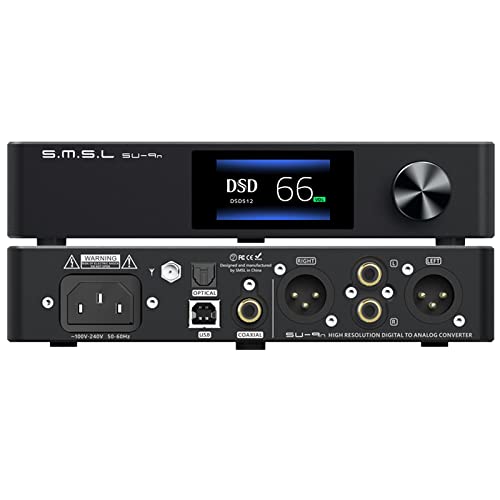
The SU-9n’s defining trick for a library desk is that its XLR and RCA outputs are both active at the same time, so one DAC can feed a balanced speaker amplifier and a single-ended headphone amplifier without cable swapping between listening modes. The ES9038PRO converter is paired with ESS’s ES9311 low-noise regulator, a colour display shows the incoming rate, and PCM and DSD filter options let you settle on one presentation for the whole collection. Output level can be fixed for a pure source role or switched to preamp mode with remote volume when it drives an amplifier directly.
Specs
- DAC chip: ESS ES9038PRO with ES9311 low-noise regulator
- USB processor: XMOS XU-208
- Inputs: USB, optical, coaxial, Bluetooth 5.0 (LDAC, aptX-HD)
- Outputs: balanced XLR and RCA line outputs, both always active
- Output level: XLR 4.8 Vrms in pre mode or 4.3 Vrms fixed; RCA 2.3 or 2.0 Vrms
- USB formats: PCM up to 32-bit/768kHz, native DSD512
- THD+N: 0.000065%; dynamic range: 130 dB (XLR)
- Display: 1.9-inch colour TFT; full-function remote control included
- Dimensions: 187.5 x 154 x 40 mm; weight 0.79 kg
Best for: a library desk that alternates between speakers and headphones on separate amplifiers.
Watch out for: there is no MQA decoding, so an MQA-heavy library plays those files without the final unfold.
ASIN: B09JC6BQ21
SMSL DO100 Pro

The DO100 Pro suits the library that shares a desk with a television. Alongside the usual USB, optical and coaxial inputs it adds an HDMI ARC input, so TV sound joins the same balanced chain that plays your stored files, and a remote moves between them. Dual ES9039Q2M chips, a sample-rate display and a strong 5.2 Vrms XLR output cover the music side, while seven PCM filters and adjustable DPLL settings give tinkerers something to set once and forget. Two USB modes — driver-free USB 1.1 for consoles and full-rate USB 2.0 for computers — make it easy to add a game console to the same setup.
Specs
- DAC chips: 2 x ESS ES9039Q2M with XMOS XU316 USB
- USB formats: PCM up to 32-bit/768kHz, DSD512, MQA decoding via USB, optical and coaxial
- Inputs: USB (Type-C), optical, coaxial, HDMI ARC, Bluetooth 5.1 (LDAC, aptX-HD, SBC, AAC)
- Outputs: balanced XLR (5.2 Vrms) and RCA (2.5 Vrms), usable simultaneously
- SNR: 131 dB via XLR; THD+N below 0.00005%
- USB modes: USB 1.1 driver-free and USB 2.0 full rate
- Settings: 7 PCM filters, 9 DPLL levels, display brightness control
- Control: full-function remote control included
- Dimensions: 189 x 186 x 45 mm; weight 1.45 kg
Best for: one balanced desk chain serving both a stored music library and a TV.
Watch out for: the HDMI ARC input accepts PCM only — set the television’s audio output format to PCM or you will get silence.
ASIN: B0CZ8YZH65
Schiit Modius E

The Modius E is the deliberate minimalist of this group, and for the right library that is a strength. Most stored collections are overwhelmingly CD-resolution, and this DAC handles everything up to 24-bit/192kHz with a balanced XLR output, a separate DC-coupled balanced output stage, and nothing else to configure: no display, no menu, no volume control, no firmware theatre. Both outputs stay live at once, so it can feed a speaker amp and a headphone amp together. Schiit’s Unison USB input keeps the computer connection simple, and an AES input covers studio-style sources. It asks only that your amplifier handles volume.
Specs
- DAC chip: ESS ES9028
- USB input: Schiit Unison USB interface
- Inputs: USB, Toslink optical, coaxial, AES
- Outputs: XLR balanced (4.0 Vrms) and RCA single-ended (2.0 Vrms), both active simultaneously
- Sample rates: 16-bit/44.1kHz to 24-bit/192kHz
- SNR: over 118 dB; THD+N: 0.0003%
- Output stages: separate balanced (LME49724) and single-ended (OPA1656), DC-coupled
- Output impedance: 75 ohms
- In the box: USB micro cable, 5V wall-wart power supply
Best for: CD-rip libraries in an always-on chain where the amplifier already controls volume.
Watch out for: the 24-bit/192kHz ceiling and the absence of DSD mean a growing hi-res or SACD-rip collection will outgrow it.
ASIN: B0B36QGLWR
Which One Fits Your Situation
Your Library Is Almost Entirely CD Rips
Choose the Schiit Modius E. A collection ripped from CDs never exceeds 16-bit/44.1kHz, so its 24-bit/192kHz ceiling is headroom rather than a restriction, and its fixed balanced output feeds an amplifier with its own volume control. You give up DSD, a display and a remote — and in exchange the chain becomes the simplest one here, with both outputs live for speakers and headphones.
You Play Mixed Hi-Res and DSD Files All Day
Choose the Topping D90 III Sabre. Its 768kHz PCM and native DSD512 ceiling covers every format a download library can hold, the display confirms each album’s rate as it changes, and the selectable XLR level plus trigger output suit a chain that runs for hours daily. The SMSL D400EX is the alternative if you prefer AKM conversion in the same role.
The Desk Chain Also Has to Handle the TV
Choose the SMSL DO100 Pro. The HDMI ARC input folds television sound into the same balanced amplifier and speakers that play your library, its remote switches sources from the seat, and USB 2.0 mode still delivers full-rate playback from the computer. Just set the TV to PCM output so the ARC input receives a signal it can decode.
You Alternate Between Speakers and Headphones
Choose the SMSL SU-9n. Because its XLR and RCA outputs run simultaneously, the balanced speaker amplifier and the single-ended headphone amplifier both stay connected, and switching between them happens at the amplifiers rather than behind the desk. Its colour display still confirms sample rates across a mixed library, and preamp mode is there if one chain ever needs the DAC to control volume.
Common Mistakes
- Paying for a DSD512 and MQA ceiling when the library contains neither DSD files nor MQA files — audit the collection’s formats before choosing.
- Feeding hi-res albums over an optical cable and blaming the DAC when playback caps at 192kHz; use USB for rates above that.
- Leaving the computer’s operating system mixer in charge, so every track is resampled to one rate — set the player to exclusive or bit-perfect output.
- Running a 5V XLR output setting into an amplifier input that expects less, or stacking the DAC’s preamp volume on top of the amplifier’s volume control.
- Assuming the balanced headphone socket on a DAC-amp is a balanced line output — check that the listing publishes a line-level XLR or 4.4mm output.
Frequently Asked Questions
Do balanced outputs actually matter for a home library chain?
They matter when the amplifier or powered monitors at the other end have balanced inputs, because the balanced connection rejects noise picked up along the cable run — useful on desks crowded with computers, drives and monitors. All five DACs here also provide RCA outputs, so a balanced model still works into a single-ended amplifier; the XLR sockets simply wait until a balanced amp joins the chain.
What format support does a stored library really need?
Match the DAC to the files: CD rips need 16-bit/44.1kHz, hi-res downloads typically peak at 24-bit/192kHz, and only SACD rips or DSD downloads require DSD support. Four DACs here reach 768kHz PCM and DSD512 over USB, which covers everything currently sold. The Modius E’s 24-bit/192kHz ceiling is enough for a PCM library but excludes DSD entirely.
Can one DAC feed both a speaker amplifier and a headphone amplifier?
Yes, with the right model. The SMSL SU-9n and Schiit Modius E keep their XLR and RCA outputs active simultaneously, so a balanced speaker amp and a single-ended headphone amp can both stay connected and you switch at the amplifiers. On the other DACs here, check the listing’s output arrangement before assuming two chains can share one unit without swapping cables.
How do I know the DAC is playing each file at its native rate?
Use a player with exclusive or bit-perfect output so the operating system does not resample, connect by USB, and confirm on the DAC’s display: the D90 III Sabre, D400EX, SU-9n and DO100 Pro all show the incoming sample rate, which should change as the library moves between 44.1kHz rips and hi-res albums. The display-free Modius E offers no such confirmation.
Related guides
More from Amazon
Programs that pair well with the guide above. Offers and eligibility are set by Amazon and may change.
Free shipping on eligible items, Prime Video and more. Eligible new members can start with a free trial.
Start a Prime free trialAudiobooks and podcasts to listen to on the go. Eligible new members can start with a free trial.
Try Audible freeAd-free music streaming. Eligible new subscribers can start with a free trial.
Try Music Unlimited freeA free business account with business pricing and bulk-buying tools for work, shop or home office.
Create a business accountAs an Amazon Associate we earn from qualifying purchases.










Write Your Review
No reviews yet. Be the first to share your experience!