
Key takeaways
- Compare five ported powered subwoofers for multichannel systems, from compact 12-inch models to high-output SVS subs, with specs and setup guidance.
What's inside
As an Amazon Associate I earn from qualifying purchases. This post may contain affiliate links at no extra cost to you.
A multichannel system lives or dies on its low end. The receiver sends the deepest effects to a dedicated LFE channel, and a small or sealed subwoofer can run out of breath exactly when an explosion, a pipe organ note, or a rumbling score needs room-filling weight. A ported powered subwoofer solves that problem by using its vent to reinforce output at the lowest frequencies, so it plays louder and deeper than a sealed box of similar size and amplifier power. The real decision is not ported versus sealed in the abstract. It is how much output your room needs, how low the subwoofer must reach, and how cleanly it will blend with the speakers your receiver already drives.
This guide is for home theater owners running an AV receiver with a subwoofer output, for people upgrading from a soundbar or a compact bundled subwoofer, and for anyone planning a dual-subwoofer setup down the line. Every model below is a powered, ported subwoofer chosen from the name and specifications shown on its Amazon listing, with attention to driver size, amplifier rating, port design, and the inputs a multichannel receiver actually uses.
Quick Picks
As an Amazon Associate we earn from qualifying purchases.
| Product | Best for | Key spec from title |
|---|---|---|
| SVS PB-1000 Pro | App-controlled deep bass in medium rooms | 12-inch ported subwoofer with 325W RMS amplifier |
| SVS PB-2000 Pro | High-output bass for large rooms | 12-inch ported subwoofer with 550W RMS amplifier |
| Klipsch SPL-120 | Punchy theater bass with a front slot port | 12-inch powered subwoofer with front-firing slot port |
| Klipsch R-120SW | Affordable 12-inch bass for first systems | 12-inch subwoofer with 200W RMS amplifier |
| BIC America F12 | Budget-friendly bass for movie nights | 12-inch powered subwoofer with 475W peak amplifier |
How to Choose
Match Output to Room Size and Seating Distance
A subwoofer that sounds powerful in a closed twelve-foot room can feel thin in an open-plan living space, because bass energy spreads through every connected cubic foot and every opening to a hallway or kitchen. Before comparing models, measure the room the system actually plays in, including open doorways, and note how far the main seat sits from the subwoofer location. Larger volumes and longer listening distances call for a bigger driver, a stronger amplifier, and a ported cabinet tuned low. A compact room with a short throw to the couch is far more forgiving, and a modest twelve-inch model can pressurize it without strain. Buying more output than the room needs is less risky than buying too little, since a strong subwoofer can always be turned down, while a weak one driven hard sounds boomy and distorted.
Read the Low-Frequency Extension, Not Just the Wattage
Two subwoofers can share a similar wattage rating and still sound completely different on the lowest notes. The specification that matters most for movie playback is how low the subwoofer reaches, usually listed as the bottom of its frequency response, because that number decides whether the deepest effects are felt or simply missing. A ported design typically extends lower than a sealed cabinet with the same driver, and the best models in this guide reach into the teens, where bass becomes physical. Wattage still matters for headroom, but compare continuous RMS ratings rather than peak figures, and remember that manufacturers measure peak power differently. A subwoofer rated down to 16 or 17 Hz with honest RMS power will deliver more convincing movie bass than a louder-sounding model that rolls off above 30 Hz.
Check How It Connects to Your AV Receiver
Nearly every modern receiver provides a dedicated subwoofer pre-out, and the cleanest connection is a single RCA cable from that output to the subwoofer LFE input, which bypasses the subwoofer internal crossover and lets the receiver bass management take charge. Confirm the subwoofer has an LFE or line-level input before buying, and look for a phase control and a variable low-pass crossover for systems where the receiver does not handle everything. Some models add app control with DSP, which lets you adjust volume, crossover, phase, and presets from the listening seat instead of reaching behind the cabinet. Speaker-level inputs are a useful fallback for older stereo amplifiers, but they are not the connection a multichannel receiver needs.
Plan for the Port, the Cabinet, and the Room
A ported subwoofer is a bigger box than a sealed equivalent, and the port needs breathing room to work without chuffing or turbulence. Rear-ported models should sit several inches from the wall, while front-ported designs are more forgiving when pushed close to a boundary. Measure the intended spot, including height and depth, and check the cabinet dimensions on the listing rather than guessing from photos. Placement matters as much as the model itself, since bass response changes dramatically with position: a corner boosts output but can exaggerate one-note boom, while a spot along the front wall often blends more smoothly with the main speakers. If the layout allows, leave room to experiment with two or three positions before settling, and remember that adding a second identical subwoofer later usually smooths room response more than buying one oversized unit.
The 5 Best Options
SVS PB-1000 Pro

The PB-1000 Pro is the most balanced pick in this guide for a medium room, pairing a twelve-inch driver with a ported cabinet tuned low enough to reproduce the deepest movie effects without demanding a huge box. Its dual front ports keep placement flexible against a wall, and the DSP smartphone app makes it easy to fine-tune volume, crossover, and phase from the couch after the receiver runs its calibration. It suits a 5.1 or 7.1 system where the owner wants genuine subsonic weight and clean integration rather than sheer maximum output, and it leaves a clear upgrade path to a second unit later.
Specs
- 12-inch high-excursion front-firing driver
- 325W RMS Sledge STA-325D Class D amplifier, 820W peak
- Dual front ports with port plugs included
- Frequency response down to 17 Hz
- SVS subwoofer DSP smartphone app for iOS, Android, and Amazon devices
- LFE and line-level RCA inputs
Best for: Medium home theater rooms where app control and deep extension matter.
Watch out for: The cabinet is larger and heavier than a sealed twelve-inch subwoofer, so confirm floor space and measure the spot before ordering.
SVS PB-2000 Pro

The PB-2000 Pro steps up to a far stronger amplifier and deeper tuning, making it the right choice when the room is large, open to other spaces, or seated well back from the screen. Its dual three-inch ports and high-excursion twelve-inch driver hold output steady on demanding passages, while the same DSP app as its smaller sibling keeps setup manageable despite the extra power. This is the model for listeners who want action scenes to hit with physical force and who plan to keep the subwoofer for years across receiver upgrades.
Specs
- 12-inch high-excursion front-firing driver
- 550W RMS Sledge STA-550D amplifier with fully discrete MOSFET output, 1500W peak and above
- Dual 3-inch ports
- Frequency response 16 Hz to 290 Hz, plus or minus 3 dB, in standard mode
- SVS subwoofer DSP smartphone app for volume, DSP functions, and custom presets
- LFE and line-level RCA inputs
Best for: Large or open-plan rooms with a multichannel receiver and demanding movie playback.
Watch out for: At roughly 65 pounds, it is a two-person lift up stairs, and its output can overwhelm a small closed room if levels are not calibrated.
Klipsch SPL-120

The SPL-120 brings Klipsch Reference Premiere build into a multichannel system at a more approachable level than the SVS models, with a rigid Cerametallic woofer and a front-firing slot port that lets it sit closer to a wall than rear-ported rivals. Its 24 Hz extension covers nearly all movie effects, and the generous amplifier headroom keeps bass clean when the volume climbs. It is a strong fit for a living-room theater where the subwoofer sits in view and needs to look as good as it sounds.
Specs
- 12-inch long-throw Cerametallic woofer
- 300W RMS Class D amplifier with analog preamp stage, 600W peak
- Frequency response 24 Hz to 125 Hz
- Bass-reflex enclosure via front-firing slot port
- Dual RCA and LFE line inputs, plus WA-2 wireless port
- Variable crossover from 40 Hz to 120 Hz and phase control
- Maximum acoustic output 118 dB
Best for: Living-room theaters that need strong, clean bass from a front-ported cabinet.
Watch out for: The WA-2 wireless adapter is sold separately, so budget for it if a cable run to the receiver is impractical.
Klipsch R-120SW

The R-120SW is the straightforward entry point in this guide, offering a twelve-inch spun-copper woofer and a rear bass-reflex port in a cabinet that fits easily beside a media console. It does not dig as deep as the SVS models, but its 29 Hz floor still covers the bulk of movie and music bass, and the all-digital amplifier keeps the sound controlled at normal listening levels. For a first multichannel system, or a second room that needs real bass on a modest budget, it delivers far more than a soundbar subwoofer or a bundled kit sub.
Specs
- 12-inch front-firing spun-copper IMG woofer
- 200W RMS all-digital amplifier, 400W peak
- Frequency response 29 Hz to 120 Hz
- Rear-firing bass-reflex port
- Line and LFE inputs
- Low-pass crossover and phase control
Best for: First-time multichannel systems and smaller rooms where value matters most.
Watch out for: The rear port needs clearance from the wall, so leave several inches behind the cabinet or expect port noise and muddy bass.
BIC America F12
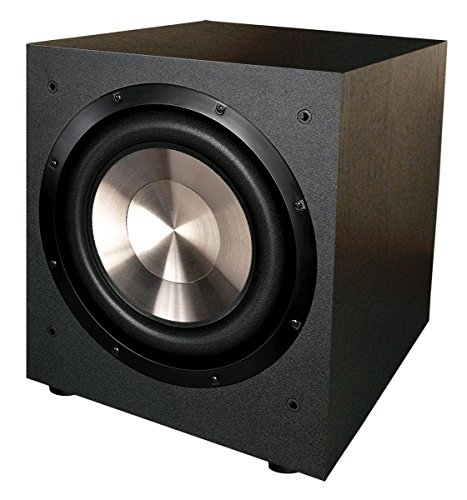
The F12 has been a budget home theater staple for years because it pairs a twelve-inch long-throw woofer with a vented cabinet and a simple, effective control set. Its patented Venturi vent is designed to reduce port noise, and the adjustable crossover, volume, and auto on-off controls make it easy to dial in with a receiver. It will not match the extension or refinement of the premium models here, but for movie nights in a medium room it delivers the low-end weight that makes a multichannel system feel complete.
Specs
- 12-inch injection-molded long-throw woofer
- 475W peak BASH amplifier
- Frequency response 25 Hz to 200 Hz
- Patented Venturi vent to reduce port noise
- Adjustable crossover, volume control, and automatic signal sensing
- LFE input for Dolby Digital and DTS, plus speaker-level inputs
- Five-year warranty
Best for: Budget-conscious buyers who want a proven twelve-inch ported subwoofer for movies.
Watch out for: The 475W figure is a peak rating, so do not compare it directly with the continuous RMS ratings of the other models in this guide.
Which One Fits Your Situation
You Have a Large Open Living Room
Choose the SVS PB-2000 Pro. Its 550W RMS amplifier and 16 Hz extension hold up where smaller subs fade, and the dual ports move enough air to pressurize an open-plan space. Run the receiver calibration first, then use the DSP app to trim the level so dialogue stays clear.
You Want a Dedicated Movie Room
Choose the SVS PB-1000 Pro, and plan for a second identical unit later. Its deep extension and app-based tuning suit a treated room where accuracy matters, and a matched pair smooths bass across several seats far better than a single larger box.
Your Subwoofer Sits in a Living Room
Choose the Klipsch SPL-120. The front slot port tolerates placement near a wall or a media console, the Cerametallic driver stays composed at high volume, and the cabinet looks at home next to furniture. Its 24 Hz reach covers nearly every film effect.
You Are Building Your First System
Choose the Klipsch R-120SW or the BIC America F12. The R-120SW is the cleaner and more compact of the two, while the F12 reaches slightly lower and costs less. Either one gives a new multichannel system real bass, and both leave budget for speakers and a receiver.
Common Mistakes
- Setting the subwoofer crossover by ear instead of letting the receiver bass management and calibration handle it, which creates a gap or a boom where the subwoofer and main speakers overlap.
- Pushing a rear-ported subwoofer tight against the wall, choking the port and adding noise and muddiness to the lowest notes.
- Comparing subwoofers by peak wattage alone, when continuous RMS power and low-frequency extension say far more about real movie performance.
- Skipping the receiver room correction and level matching, leaving the subwoofer far louder or quieter than the rest of the system.
- Buying one oversized subwoofer for a wide seating area instead of planning for two matched units, which usually evens out bass across every seat.
Frequently Asked Questions
Do ported subwoofers work with any AV receiver?
Yes, as long as the receiver has a subwoofer pre-out, which nearly every AV receiver does. Connect a single RCA cable from that output to the subwoofer LFE input, set the subwoofer crossover to its highest setting or LFE mode, and let the receiver handle bass management and calibration.
Can I use two different ported subwoofers in one system?
It is possible, but a matched pair is easier to set up and usually sounds smoother. Different models have different tuning frequencies and phase behavior, so mixing them can create uneven response. If you must mix, match their output levels carefully and re-run receiver calibration.
Where should I place a ported subwoofer?
Start along the front wall near the main speakers, or in a corner if you need maximum output. Keep several inches of clearance behind a rear-ported model, then try two or three positions and listen for the spot where bass sounds even rather than boomy at the main seat.
Do I need the DSP app to set up an SVS subwoofer?
No. Both SVS models in this guide have a rear-panel control interface for volume, crossover, and phase, so the app is optional. The app is convenient because it lets you adjust settings and save presets from the listening seat, but the subwoofer works fully without it.
Related guides
More from Amazon
Programs that pair well with the guide above. Offers and eligibility are set by Amazon and may change.
Free shipping on eligible items, Prime Video and more. Eligible new members can start with a free trial.
Start a Prime free trialAudiobooks and podcasts to listen to on the go. Eligible new members can start with a free trial.
Try Audible freeAd-free music streaming. Eligible new subscribers can start with a free trial.
Try Music Unlimited freeA free business account with business pricing and bulk-buying tools for work, shop or home office.
Create a business accountAs an Amazon Associate we earn from qualifying purchases.










Write Your Review
No reviews yet. Be the first to share your experience!