
Key takeaways
- Compare the best triple-output bench power supplies for mixed analog and digital work, with channel ratings, key specs, and a clear pick for each bench.
What's inside
As an Amazon Associate I earn from qualifying purchases. This post may contain affiliate links at no extra cost to you.
A triple-output bench supply earns its place when one box has to run a whole circuit at once: two rails for the analog or power stage and a third for the logic that controls it. The real decision is not the brand badge but how the three channels are arranged — how much voltage and current each one delivers, whether the third channel is fixed, selectable or fully adjustable, and how finely you can set and read back each output before a wiring mistake gets expensive.
This guide is for electronics hobbyists moving past a single-output supply, embedded developers powering mixed-signal boards, and lab or teaching-bench buyers who need several rails from one instrument. Every product below was chosen from the names and specifications printed on its Amazon product page, and only models with three outputs are included.
Quick Picks
As an Amazon Associate we earn from qualifying purchases.
| Product | Best for | Key spec from title |
|---|---|---|
| Rigol DP832 Triple Output 195 Watt Power Supply | Mixed analog and digital prototypes that need two adjustable rails plus a logic rail | 195W total across three outputs |
| Siglent Technologies SPD3303X-E Triple Output Power Supply | Buyers who want three independent supplies in one unit with PC control | Triple output, three independent channels |
| Rigol DP832A Programmable Linear DC Power Supply | Fine setting and logging work where small adjustments matter | 3 channels, 195W total, 30V/3A, 30V/3A, 5V/3A |
How to Choose
Channel Ratings and the Total Power Budget
Start with the rails your circuits actually draw, then check each channel separately instead of trusting the headline wattage. Two adjustable channels in the 30V class cover most analog and embedded work, but the total power budget is shared: running both main channels near their limits leaves little headroom for the third. Add up the worst-case draw of all three rails running together, including startup surges from motors, lamps or capacitive boards, and leave margin above that figure so the supply is not living at its limit every session.
What the Third Channel Can Do
The third output is where triple-output models differ most. Some units give a fixed 5V channel, which is fine for logic but useless for a 3.3V rail. Others let you select between a few preset voltages, and the most flexible designs make the third channel lower-rated but still adjustable. Decide which logic families you power most often before choosing: a selectable channel suits mixed 2.5V, 3.3V and 5V boards, while a plain fixed channel is simpler and cheaper when every board you own runs on the same rail.
Setting Resolution and Readback Quality
Resolution decides how precisely you can land on a voltage and how honestly the display reports what the output is doing. Coarse steps are acceptable for charging, heating and motor work, but they frustrate you when a sensor rail needs to sit just below a maximum rating or when you are hunting a brown-out threshold. Check both the setting step and the readback digits on the listing, and remember that current readback matters as much as voltage: a supply that shows small current changes helps you spot a board that is quietly drawing more than it should.
Isolation, Combined Modes and Remote Control
Channel isolation decides whether you can wire outputs in series for a higher voltage, in parallel for more current, or as split positive and negative rails around ground. If split-rail analog work is on your list, confirm from the product page that the channels are independent and that series or parallel operation is supported. Remote interfaces are the other divider: a front-panel-only unit suits occasional bench use, while USB or LAN control with standard remote commands pays off when the supply joins scripted measurements, timed output sequences or a shared lab setup.
The 3 Best Options
Rigol DP832 Triple Output 195 Watt Power Supply

The DP832 is the natural first look for a mixed-signal bench because its layout matches how most boards are powered: two 30V channels for the circuitry under development and a separate 5V channel for logic, all inside one programmable linear instrument. The Amazon listing describes three switchable outputs with a maximum power output of 195W and a 3.5-inch display, plus remote communication options for automated setups. It suits hobbyists stepping up from a single-output unit and developers who want one supply that follows a project from first prototype to repeated bench sessions.
Specs
- Brand: Rigol
- Model: DP832
- Outputs: 3 channels, 30V/3A, 30V/3A and 5V/3A
- Maximum output power: 195W
- Display: 3.5-inch
- Manufacturer: RIGOL TECHNOLOGIES USA INC
- Item part number: DP832
- UPC: 645759304902
Best for: General-purpose benches powering two adjustable rails and a 5V logic rail at the same time.
Watch out for: The third channel is a 5V output, so confirm your logic boards do not need an adjustable low-voltage rail before ordering.
ASIN: B00ENX02GC
Siglent Technologies SPD3303X-E Triple Output Power Supply
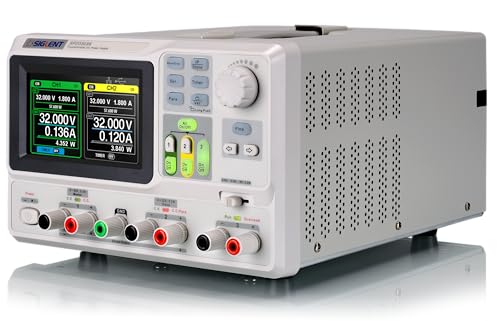
Siglent describes this model on its Amazon listing as three independent power supplies in one unit, which is exactly the mental model that makes a triple-output bench easy to live with: each rail can be set and switched on its own terms. The listing highlights a true linear design with an intelligent temperature-controlled fan, voltage resolution of 10mV and 10mA, and support for the EasyPower PC software, SCPI commands and a LabVIEW driver. That combination fits teaching labs, repair benches and developers who want front-panel simplicity today with a path to PC control later.
Specs
- Brand: Siglent Technologies
- Model: SPD3303X-E
- Outputs: 3 independent outputs
- Voltage resolution: 10mV / 10mA
- Software: EasyPower PC software, SCPI commands, LabVIEW driver
- Fan: intelligent temperature-controlled
- UPC: 718520016356
Best for: Buyers who value three genuinely independent channels and documented PC software support.
Watch out for: Check the listing carefully for which interfaces are fitted, since remote-control hardware varies across this model family.
ASIN: B01410O424
Rigol DP832A Programmable Linear DC Power Supply
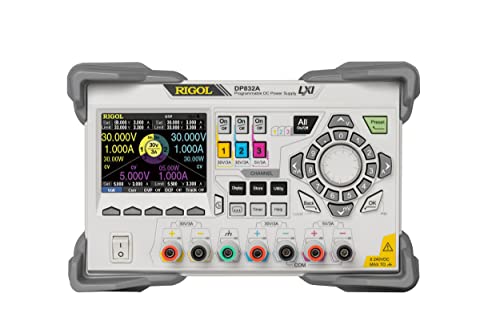
The DP832A is the step-up version of the DP832 formula, aimed at benches where setting precision is the bottleneck. Its Amazon title spells out the same three-channel, 195W layout with 30V/3A, 30V/3A and 5V/3A outputs, and the listing details add 1mV/1mA high-precision adjustment, a color display and USB, LAN, RS232 and GPIB interfaces included rather than left as future options. That makes it the pick for automated measurement routines, careful current-limit work and shared laboratory benches where the supply is driven from a computer as often as from its own front panel.
Specs
- Brand: Rigol
- Model number: DP832A
- Channels: 3
- Output range: 30V/3A, 30V/3A, 5V/3A
- Maximum power: 195 watts
- Resolution: 1mV/1mA
- Interfaces: USB, LAN, RS232 and GPIB included
- UPC: 519805776527
Best for: Precision and automation work where fine adjustment steps and built-in interfaces justify the step up.
Watch out for: You pay for resolution and interfaces you may never use, so price it against the plain DP832 if your work is front-panel only.
ASIN: B00EP9I086
Which One Fits Your Situation
Powering a Mixed-Signal Prototype Board
Choose the Rigol DP832. Two adjustable 30V channels handle the analog and power sections of a prototype while the 5V channel runs the microcontroller and logic, so one instrument covers the whole board during bring-up. Its programmable layout and display also make it easy to bring rails up in a safe order and watch current draw as each section of the circuit wakes up for the first time.
Running a Teaching or Repair Bench All Day
Choose the Siglent SPD3303X-E. Three independent channels behave predictably for whoever sits down at the bench, the temperature-controlled fan keeps noise down during long sessions, and the documented software support means instructors or technicians can add PC control when a procedure needs it. It is the most straightforward of the three to hand to different users without a long explanation of modes and menus.
Building an Automated Test Corner
Choose the Rigol DP832A. The finer 1mV/1mA setting resolution and the interfaces fitted as standard make it the easiest of these three to fold into scripted measurements, timed sequences and logged results. If your bench roadmap includes a computer driving the supply while other instruments record the outcome, starting with the A model avoids an upgrade cycle later.
Buying Your First Supply Beyond a Single Output
Choose the Rigol DP832 and spend the difference on leads, a decent multimeter and project parts. Its channel layout matches the boards most beginners and hobbyists actually build, and nothing about it blocks normal growth: you gain split rails, a logic output and programmability in one step. Move to the DP832A later only if fine resolution or built-in networking becomes a real requirement in your work.
Common Mistakes
- Adding the channel ratings together and assuming all three outputs can run at full power at once, instead of checking the shared total power budget.
- Buying a fixed 5V third channel when your boards need 3.3V or another adjustable low-voltage rail.
- Ignoring channel isolation, then discovering the outputs cannot be combined in series or wired as split positive and negative rails.
- Choosing the finest resolution model for purely manual work, or the coarsest model for threshold and current-limit testing.
- Forgetting the practical extras: suitable test leads, bench space for a deep instrument, and ventilation clearance for the fan.
Frequently Asked Questions
Can a triple-output supply replace two separate supplies?
For most bench work, yes. One triple-output unit gives you two adjustable rails plus a logic channel in a single chassis, with one power cord and one set of controls. Separate supplies still make sense when two people need power at the same time, when a rail must sit in a different room, or when one channel needs far more current than these combined instruments provide.
How do I get a negative voltage rail from a triple-output supply?
Use two independent channels of equal rating: tie the positive terminal of one channel to the negative terminal of the other, treat that junction as your ground, and the free terminals become your positive and negative rails. This only works safely when the channels are isolated from each other, which is why isolation belongs on your checklist before purchase rather than after the unit arrives.
Is a linear triple-output supply better than a switching one?
Linear models are the common choice in this class because their outputs are quiet and clean, which matters when the rail feeds analog circuitry, audio stages or sensitive measurements. Switching designs can be smaller for the same power, but noise on the output can leak into the circuit you are trying to evaluate. For a general electronics bench, the linear designs in this guide are the safer default.
What should I check first when the supply arrives?
Confirm every channel against a multimeter you trust: set several voltages across each range, check the current limit with a suitable load, and verify the third channel delivers what its label promises. Do this during the return window, before the supply becomes part of a project. A few minutes of checks catch shipping damage and wrong-variant shipments while they are still easy to resolve.
Related guides
More from Amazon
Programs that pair well with the guide above. Offers and eligibility are set by Amazon and may change.
Free shipping on eligible items, Prime Video and more. Eligible new members can start with a free trial.
Start a Prime free trialAudiobooks and podcasts to listen to on the go. Eligible new members can start with a free trial.
Try Audible freeAd-free music streaming. Eligible new subscribers can start with a free trial.
Try Music Unlimited freeA free business account with business pricing and bulk-buying tools for work, shop or home office.
Create a business accountAs an Amazon Associate we earn from qualifying purchases.










Write Your Review
No reviews yet. Be the first to share your experience!