
Key takeaways
- Triple-output bench power supplies for quality control benches, compared on channel isolation, setting resolution, current limiting and remote control.
What's inside
As an Amazon Associate I earn from qualifying purchases. This post may contain affiliate links at no extra cost to you.
A quality control bench rarely powers one rail at a time. A board under test may need a main supply rail, a separate analog rail and a logic rail live simultaneously, and the pass or fail decision depends on each rail sitting exactly where the procedure says it should. The real decision is not whether three outputs are useful, but which triple-output supply holds its settings repeatably across hundreds of identical tests, limits current fast enough to protect good boards from wiring mistakes, and fits the way your inspectors actually record results.
This guide is for incoming-inspection technicians, end-of-line test operators and QC engineers who power multi-rail products all day. Every model below is a true triple-output bench supply, and each one was chosen from the names and specifications printed on its Amazon product page, with the listing checked for current availability before it was included here.
Quick Picks
As an Amazon Associate we earn from qualifying purchases.
| Product | Best for | Key spec from title |
|---|---|---|
| Rigol DP832A Programmable Linear DC Power Supply | Repeatable incoming inspection with fine setting steps | 3 channels, 195W total, 30V/3A, 30V/3A, 5V/3A |
| Siglent Technologies SPD3303X-E Triple Output Power Supply | Scripted end-of-line tests run from a PC | Three isolated outputs, 220W total |
| Siglent Technologies SPD3303C DC Power Supply | Extra QC stations needing the same three-rail layout | Three independent outputs, 220W total |
How to Choose
Channel Isolation and Independent Control
In a QC procedure, each rail often has to be switched, limited and read on its own. Look for three outputs that are independently controlled and isolated, so a fault or a current limit trip on the board’s main rail does not drag the logic rail down with it. Isolation also lets you stack or float rails for products that use split supplies. Check the listing for wording such as independent or isolated outputs, and confirm each channel has its own on and off control rather than one shared output switch for the whole instrument.
Setting Resolution and Readback Repeatability
Pass and fail limits are only meaningful if the supply can be set to the same point every shift. Setting resolution tells you the smallest step the output can be adjusted in, and readback shows what the supply believes it is delivering. A finer resolution, such as one millivolt and one milliamp steps, suits tight-tolerance rails and sensor products, while ten millivolt steps are adequate for looser consumer boards. For QC work, prefer a supply whose readback is clear enough that two operators record the same numbers from the same setup.
Current Limiting and Output Protection
The supply is the last line of defense when a miswired harness or a solder bridge reaches the bench. Each output should have an adjustable current limit that the operator sets before the board is connected, so a faulty unit draws only the allowed current instead of damaging tracks, connectors or the supply itself. Overvoltage and overcurrent protection add a second layer for rails that must never exceed a ceiling. Before buying, confirm the limits can be set per channel and that outputs stay off at power-up until deliberately enabled.
Remote Control, Memory and Logging
Repeatable QC work leans on stored settings and, on busier lines, on a PC driving the test. Memory presets let an operator recall the exact rail voltages for a product instead of dialing them in by hand each time, which removes a common source of variation. A USB or LAN interface with a standard command set lets a test script set the rails, read back current draw and log the result against a serial number. Check which interfaces are actually fitted to the model you are buying, because they differ across otherwise similar supplies.
The 3 Best Options
Rigol DP832A Programmable Linear DC Power Supply
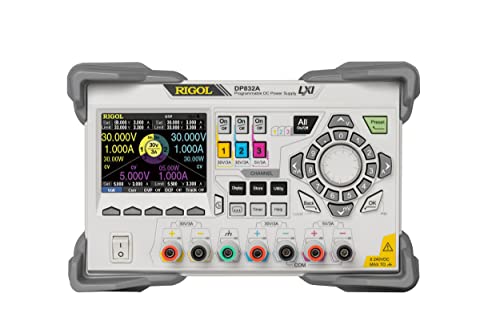
For a QC bench that repeats the same three-rail setup all day, the DP832A is the precision pick in this group. Its first two channels deliver up to 30V and 3A each, the third covers 5V at 3A, and the one millivolt and one milliamp setting resolution from its listing suits products with tight rail tolerances. The color display and the USB, LAN, RS232 and GPIB interfaces named on the product page make it easy to move a procedure from manual checks to a logged, script-driven station without changing instruments.
Specs
- Brand: Rigol
- Model Number: DP832A
- Channels: 3, rated 30V/3A, 30V/3A and 5V/3A
- Maximum Power: 195 watts
- Setting resolution: 1mV/1mA
- Display: Color display
- Interfaces named on the listing: USB, LAN, RS232, GPIB
Best for: Incoming inspection and audit benches that need the finest setting steps and full remote control options.
Watch out for: Confirm you are ordering the A model; the plain DP832 is a different listing with coarser standard resolution and fewer built-in interfaces.
Siglent Technologies SPD3303X-E Triple Output Power Supply
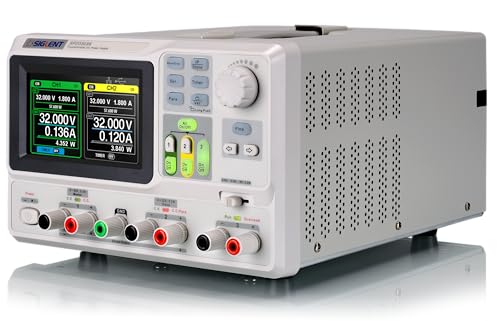
The SPD3303X-E fits QC stations where the test is partly scripted. Its listing describes three independent supplies in one linear unit, with two adjustable channels and a third output selectable between 2.5V, 3.3V and 5V, and it supports SCPI commands with the included Easy Power PC software, so a simple script can set rails, wait, and record current draw for each unit that passes through. The intelligent temperature-controlled fan also helps on benches where several instruments run side by side for a full shift.
Specs
- Brand: Siglent Technologies
- Model: SPD3303X-E
- Outputs: 3 independent outputs; two adjustable channels, third selectable at 2.5V, 3.3V or 5V
- Total power: 220W
- Resolution: 10mV/10mA
- Control: Easy Power PC software, SCPI commands, LabVIEW driver available
- Cooling: Intelligent temperature-controlled fan
Best for: End-of-line stations that log results from a PC over USB or LAN.
Watch out for: The third output is selectable between fixed voltages rather than fully adjustable, so confirm your logic rail is one of the listed values before ordering.
Siglent Technologies SPD3303C DC Power Supply
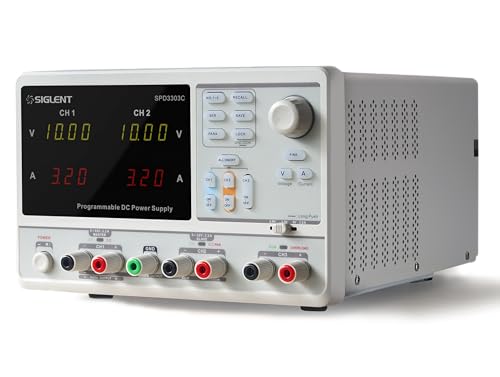
The SPD3303C is the straightforward choice when a QC area needs several matching triple-output stations. It keeps the same three-independent-output layout, with two adjustable channels plus a selectable 2.5V, 3.3V or 5V channel and 220 watts of total power, but presents it behind a simpler LED display. Its listing notes the same EasyPower PC software, SCPI command support and temperature-controlled fan as its sibling, so procedures and operator training carry across benches even where a station does not need the larger color screen.
Specs
- Brand: Siglent
- Model Number: SPD3303C
- Outputs: 3 independent outputs; third channel selectable at 2.5V, 3.3V or 5V
- Maximum Power: 220 watts
- Output Current: 3.2 amps
- Resolution: 10mV/10mA
- Item Dimensions: 16 x 14 x 11 inches
Best for: Rolling out matching inspection stations across a QC area.
Watch out for: Remote control is over USB on this model, with no LAN port, so check it fits how your benches connect to a test PC.
Which One Fits Your Situation
Incoming Inspection of Mixed-Voltage Boards
Boards arriving from a contract manufacturer often carry a main rail, an analog rail and a logic rail that all need checking against the same limits. Choose the Rigol DP832A here: its fine setting steps make it easier to sit exactly on a procedure’s test voltages, and its clear readback helps two inspectors record matching results on the same batch without arguing over the last digit.
Scripted End-of-Line Testing
When every finished unit gets the same power-up sequence and the results are logged by serial number, pick the Siglent SPD3303X-E. Its SCPI command support and PC software let a script raise the rails in order, watch the current draw settle, and store the reading, while the selectable third channel covers the logic rail without another instrument taking up space on the bench.
Several Matching Benches in One QC Area
If the job is equipping a row of inspection stations that all run the same checks, the Siglent SPD3303C keeps training and procedures uniform. Operators get the same three-output layout and the same software control at every seat, and the simpler LED display is easy to read at a glance when a station runs quick go or no-go checks all day long.
Dual-Rail Analog Products
Products with split analog rails need the two main channels to follow a procedure precisely while a third rail powers the digital side. Either Siglent works here, because the two main channels can also run in series or parallel when a test calls for a higher voltage or current; choose the SPD3303X-E if those tests are scripted, or the SPD3303C for manual stations.
Common Mistakes
- Buying a dual-output supply and powering the third rail from a wall adapter, which breaks the shared procedure and removes current limiting from that rail.
- Assuming the third channel is fully adjustable, when on many triple-output models it is selectable between fixed logic voltages only.
- Connecting a board before setting the current limit, so the first faulty unit to arrive can damage itself or the supply.
- Ignoring whether outputs are isolated, then discovering a split-rail product cannot be powered the way the procedure assumes.
- Recording only the set voltage in the QC log instead of the readback voltage and current draw, which are the values that actually show a drifting board.
Frequently Asked Questions
Why does quality control need three outputs instead of one?
Most multi-rail products must be powered the way they will run in service, with every rail live at once. A single-output supply forces rail-by-rail checks that miss interaction faults, such as a logic section misbehaving only when the main rail sags. Three outputs let the inspector reproduce the real operating state in one connection and one procedure step.
Are the outputs on these supplies isolated from each other?
The models in this guide provide independently controlled outputs, and the Siglent units are described with isolated channels in their listing material, which lets rails float relative to each other for split-supply products. Always confirm the isolation wording on the exact listing before writing a procedure around it, because grounding arrangements differ between models and affect how test leads are connected.
Can the two main channels be combined for a higher voltage or current?
Yes, within the limits printed for each model. The Siglent supplies support series and parallel operation of the two main channels, which a procedure can use for a product that needs a higher rail during one test stage. Note that series mode on the SPD3303C is given as 60 volts in its product questions, not simply double the single-channel maximum.
What should an operator set before connecting a board under test?
Set the voltage for each rail first, then set the current limit slightly above the board’s known good draw, and only then enable the outputs. That order means a shorted or miswired board trips the limit instead of taking full current. The QC procedure should record the expected draw for a good unit so the limit is never guessed at the bench.
Related guides
More from Amazon
Programs that pair well with the guide above. Offers and eligibility are set by Amazon and may change.
Free shipping on eligible items, Prime Video and more. Eligible new members can start with a free trial.
Start a Prime free trialAudiobooks and podcasts to listen to on the go. Eligible new members can start with a free trial.
Try Audible freeAd-free music streaming. Eligible new subscribers can start with a free trial.
Try Music Unlimited freeA free business account with business pricing and bulk-buying tools for work, shop or home office.
Create a business accountAs an Amazon Associate we earn from qualifying purchases.










Write Your Review
No reviews yet. Be the first to share your experience!