
Key takeaways
- Compare the best 10-inch powered subwoofers for large living rooms, with amplifier power, low-frequency extension and placement tips for big open spaces.
What's inside
As an Amazon Associate I earn from qualifying purchases. This post may contain affiliate links at no extra cost to you.
A large living room changes the subwoofer question completely. In a small room, almost any powered 10-inch sub can sound full, because the walls do half the work. In a big open space with high ceilings, an open kitchen and a sofa ten feet from the screen, the same sub can sound thin at the listening seat and boomy near a corner. The real decision is how much amplifier power and low-frequency extension you need to fill the volume of air in front of you, and where the cabinet will sit so the bass reaches the seats instead of pooling in one spot.
This guide is for homeowners furnishing a large living room, renters who want movie bass without a giant cabinet, and music listeners who want low notes that keep up with floorstanding speakers. Every pick below is a powered 10-inch subwoofer sold on Amazon, chosen from the driver size, amplifier rating and frequency range stated on its Amazon listing.
Quick Picks
As an Amazon Associate we earn from qualifying purchases
| Product | Best for | Key spec from title |
|---|---|---|
| Klipsch R-100SW | Largest rooms on a single-sub budget | 10-inch spun-copper woofer, 150 watts continuous |
| ELAC Debut 2.0 SUB3010 | Odd-shaped rooms that need tuning | 10-inch driver with app AutoEQ, 400 watts peak |
| Dayton Audio SUB-1000 | Tight budgets and discreet placement | 10-inch driver, 100 watts, 30 to 140 Hz |
| Polk Audio PSW10 | Smaller end of large rooms, or a second sub | 10-inch woofer, 50 watts RMS, 100 watts dynamic |
How to Choose
Match amplifier power to room volume
In a large living room, amplifier power is headroom, not loudness for its own sake. A 50-watt amplifier can sound fine at modest volume in a closed room, then run out of clean output when the same space opens into a kitchen or hallway and the seating sits far from the cabinet. As a working rule, look for at least 100 watts continuous in a genuinely large room, and treat a 150-watt continuous rating as the safer single-sub choice. If the room is open plan with ceilings above nine feet, plan for a second subwoofer later rather than expecting one small cabinet to do everything.
Check low-frequency extension, not just driver size
Two 10-inch subwoofers can sound very different, because the driver diameter says nothing about how low the cabinet plays. Read the frequency response on the listing and look for the lower number: a sub that reaches 32 Hz will reproduce far more movie rumble and bass guitar weight than one that stops at 40 Hz, even when both carry the same 10-inch badge. Watch whether the figure is quoted with a tolerance, since a response listed without one can hide a steep roll-off. In a large room, extension matters more than in a small one, because there is more air to move before the lowest notes register at the sofa.
Test placement before you commit to a spot
Bass behaves differently from the rest of the sound in a large room, and the spot that looks tidy is rarely the spot that sounds best. A corner boosts output but can make one note boom while others vanish, while a position midway along a wall can leave a dead zone at the main seat. Start with the sub near the front wall beside the media console, listen from your usual seat, then try the opposite side of the room before settling. If the bass sounds uneven as you move between seats, moving the cabinet a foot or two often helps more than turning the gain up.
Look for controls that fit an open-plan room
A large living room usually means the sub sits far from the listener, so the controls matter more than they do in a bedroom setup. A variable low-pass crossover lets you blend the sub with your main speakers instead of letting both play the same frequencies, and a phase control helps when the sub is far from the front speakers. App control with room correction is worth having when the room is L-shaped or opens into another space, because it tunes the output to the room instead of leaving you to guess with knobs behind the cabinet.
The 4 Best Options
Klipsch R-100SW

The R-100SW is the strongest single-sub choice in this group for a large living room. Its 150-watt continuous amplifier gives it more clean headroom than the budget picks here, and its 32 Hz lower limit reaches deeper into movie effects and bass-heavy music. The front-firing 10-inch spun-copper woofer suits placement against a wall or beside a media console, which is where most living room subs end up. Rear-panel gain, low-pass and phase controls make it easy to blend with bookshelf or floorstanding speakers without menu diving.
Specs
- 10-inch spun-copper IMG woofer, front-firing
- All-digital amplifier, 150 watts continuous and 300 watts peak
- Frequency response of 32 to 120 Hz
- Cabinet dimensions of 14.5 by 12.5 by 16.4 inches
Best for: A single subwoofer that has to fill a large living room on its own.
Watch out for: A 32 Hz lower limit means it does not reach the deepest sub-bass notes, so very large open-plan rooms may still need a second sub or a larger driver for full movie impact.
ELAC Debut 2.0 SUB3010

The SUB3010 is the pick for large rooms that are awkward rather than simply big. Its app-based AutoEQ uses your phone microphone to tune the sub to the room, which helps when the space is L-shaped, has hard floors, or opens into another room. A 10-inch driver pairs with a 10-inch passive radiator, and the 200-watt continuous BASH amplifier keeps up at normal listening levels. The compact braced cabinet tucks beside a sofa or under a side table. Note that there are no knobs on the cabinet at all, so setup and every adjustment happen through the app.
Specs
- 10-inch high-excursion driver with a 10-inch passive radiator
- BASH amplifier, 200 watts continuous and 400 watts peak
- Bluetooth app control with AutoEQ and eight parametric EQ curves
- Braced MDF cabinet, controlled entirely through the ELAC SubEQ app
Best for: L-shaped or open-plan rooms where built-in room tuning earns its keep.
Watch out for: There are no physical controls on the cabinet, so a compatible phone and the app are required for setup and every later adjustment.
Dayton Audio SUB-1000

The SUB-1000 is the value pick for buyers who want real low-frequency support in a large living room without spending on the strongest amplifier in this guide. Its 100-watt amplifier and 30 Hz lower limit cover most music and television bass, and the ported cabinet is compact enough to sit beside a media console or behind a chair. Auto on and off, a variable crossover and line-level inputs keep setup simple with almost any receiver. It will not pressurize a very large open-plan room the way the Klipsch does, so treat it as a solid single-sub start with room to add a second unit.
Specs
- 10-inch driver in a ported bass-reflex enclosure
- 100 watts continuous amplifier power
- Frequency response of 30 to 140 Hz
- Variable crossover, auto on and off, line-level inputs
Best for: A first subwoofer on a tight budget, with a second unit as a later upgrade.
Watch out for: Output is modest for a very large open-plan space, so check the room size honestly before expecting one unit to fill it at movie volume.
Polk Audio PSW10
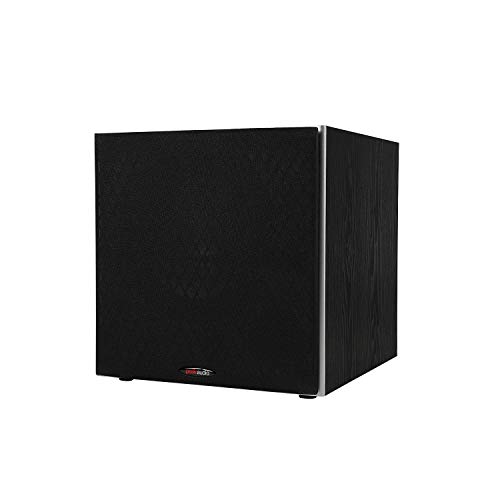
The PSW10 is the smallest amplifier in this group, so it earns its place as the budget pick for the smaller end of a large living room, or as a second subwoofer added later to even out bass across the seating area. Its 10-inch Dynamic Balance woofer and Power Port design deliver smooth, musical bass for television and everyday listening, and the 80 to 160 Hz variable crossover makes it easy to blend with compact speakers. The listing itself describes it as a solution for small-to-mid-size rooms, so buyers with truly open spaces should weigh the stronger options above first.
Specs
- 10-inch Dynamic Balance woofer with Power Port technology
- 50 watts RMS and 100 watts dynamic power
- Frequency response of 40 to 160 Hz
- Continuously variable 80 to 160 Hz crossover
Best for: A second subwoofer to even out bass, or the smaller end of a large living room.
Watch out for: The listing positions it for small-to-mid-size rooms, so a single PSW10 can run out of headroom in a truly large open space.
Which One Fits Your Situation
Your living room opens into the kitchen
Choose the ELAC SUB3010, with the Klipsch R-100SW as the alternative if you prefer physical knobs. Open-plan rooms create uneven bass because the sound has more space to spread into, and the ELAC app-based AutoEQ tunes the sub to that specific room. If the open area is very large, plan for a second matching sub later rather than pushing one cabinet to its limit.
Movie nights come first
Choose the Klipsch R-100SW. Its 150-watt continuous amplifier and 32 Hz extension give it the most headroom and the deepest reach in this group, which is what action scenes and soundtracks need at the main seat. Place it near the front wall beside the media console, set the crossover to blend with your front speakers, and leave room to add a second unit if the far seats still sound thin.
Music matters more than movies
Choose the ELAC SUB3010 or the Polk Audio PSW10. The ELAC suits a music listener whose room is hard to place a sub in, since AutoEQ smooths out the room modes that muddy bass guitar and kick drum. The Polk suits a smaller living room where the goal is warm, musical low end at moderate volume rather than room-shaking output.
Your budget is tight, or you plan to add a second sub
Choose the Dayton Audio SUB-1000. It covers the bass most living rooms actually use, and its lower cost makes a second matching unit realistic later, which is the most effective upgrade for a large room. Start with one unit near the front wall, learn where the weak spots are, and add the second sub on the opposite side when the budget allows.
Common Mistakes
- Buying on driver size alone and ignoring amplifier power and low-frequency extension.
- Putting the sub in the only free corner without listening from the main seat first.
- Setting the crossover too high, so voices and mid-bass leak into the subwoofer.
- Expecting one 10-inch sub to pressurize a very large open-plan room on its own.
- Forgetting the sub needs a power outlet and a cable run back to the receiver.
Frequently Asked Questions
Is a 10-inch subwoofer enough for a large living room?
It can be, if the amplifier is strong enough and the room is not fully open plan. A 10-inch sub with 150 watts continuous and extension to 32 Hz, like the Klipsch R-100SW, fills most large living rooms. For very large open spaces with high ceilings, two subwoofers or a larger driver will do a better job than any single 10-inch unit.
Where should I place a subwoofer in a large living room?
Start beside the media console on the front wall, then listen from your usual seat. If the bass sounds uneven, try the opposite side of the room or a spot along a side wall. Avoid tucking it behind heavy furniture, which muffles output, and test at least two positions before deciding, since small moves change the sound a lot.
Do I need two subwoofers in a large room?
Not always, but two subs are the most reliable fix for uneven bass across several seats. One sub can sound great at the main seat and weak elsewhere, while two units spread the output more evenly. If your budget only stretches to one now, pick a model you can buy a matching second unit of later.
Ported or sealed for a large living room?
Ported designs, like all four picks in this guide, move more air and play louder at low frequencies for the same driver size, which helps in a big room. Sealed subs can sound tighter for music, but they usually need a larger driver or a stronger amplifier to match a ported 10-inch sub in a large space.
Related guides
More from Amazon
Programs that pair well with the guide above. Offers and eligibility are set by Amazon and may change.
Free shipping on eligible items, Prime Video and more. Eligible new members can start with a free trial.
Start a Prime free trialAudiobooks and podcasts to listen to on the go. Eligible new members can start with a free trial.
Try Audible freeAd-free music streaming. Eligible new subscribers can start with a free trial.
Try Music Unlimited freeA free business account with business pricing and bulk-buying tools for work, shop or home office.
Create a business accountAs an Amazon Associate we earn from qualifying purchases.










Write Your Review
No reviews yet. Be the first to share your experience!