
Key takeaways
- Triple-output bench power supplies for technical training compared: three isolated outputs, clear displays and programmable control for teaching labs.
What's inside
As an Amazon Associate I earn from qualifying purchases. This post may contain affiliate links at no extra cost to you.
A training bench has to power a logic rail, an analog section and a sensor or motor circuit at the same time, and it has to do that for a room full of students whose wiring mistakes are part of the lesson. The real decision is not raw wattage; it is whether one unit can supply three rails cleanly, show every setting at a glance, and survive being reconfigured many times a day.
This guide is for technical instructors, school and college lab managers, and training providers equipping electronics benches for classes. Every product below is a genuine triple-output bench power supply, chosen from the names and specifications printed on its Amazon product page, with no single-output or dual-output units included.
Quick Picks
As an Amazon Associate we earn from qualifying purchases.
| Product | Best for | Key spec from title |
|---|---|---|
| Siglent Technologies SPD3303X-E Triple Output Power Supply | Busy teaching labs needing isolated rails and remote control | Three isolated outputs, 220 W total |
| Rigol DP832 Triple Output 195 Watt Power Supply | Structured coursework with programmable sequences | 195 W total across three outputs |
| Siglent SPD3303X DC Power Supply | Precision demonstrations and advanced classes | 1 mV/1 mA resolution, 220 W total |
| Rigol DP832A Programmable Linear DC Power Supply | Instructor stations and assessment benches | 30 V/3 A, 30 V/3 A and 5 V/3 A outputs |
How to Choose
Output Ranges and the Third Channel
Start with the rails your syllabus actually uses. Two adjustable channels in the 30 V to 32 V range cover most analog and digital coursework, from op-amp circuits running on split supplies to microcontroller boards and small motors. The third channel matters just as much in a classroom: a selectable 2.5 V, 3.3 V or 5 V output gives students a ready-made logic rail without tying up an adjustable channel. Check the current rating on that third channel too, because a whole row of student boards can draw more than a token logic supply provides during a practical session.
Isolation and Series or Parallel Modes
For training work, isolated outputs are worth insisting on. Isolation lets an instructor build a split positive and negative supply for op-amp labs by combining channels, and it protects one student’s circuit from another rail’s fault. Series mode, which stacks two channels for a higher voltage, and parallel mode, which combines them for more current, turn one bench unit into several different teaching setups across a term. If your course covers bipolar analog circuits or battery simulation, confirm the model supports these modes rather than assuming every triple-output unit handles channel combining the same way.
Display Readability and Setting Resolution
In a classroom, the display is a teaching tool. A color screen that shows all three channels at once lets an instructor check a student’s settings from the end of the bench, and it helps learners connect the numbers on screen with the circuit in front of them. Resolution shapes the exercises you can set: a 10 mV and 10 mA setting step is fine for most introductory work, while 1 mV and 1 mA resolution supports precision measurement topics, calibration demonstrations and sensor labs where small changes are the whole point of the experiment.
Programmability, Interfaces and Memory
Programmable control changes how a lab runs. USB or LAN interfaces let an instructor send the same setup to every bench, log results during an experiment, or drive a supply from the same software students use for other instruments. Stored memory presets are just as practical: saving the standard setups for each week’s practical means students start from a known state instead of a blank panel. For a training provider running identical benches, weigh interface options and preset memory as heavily as output ratings, because they decide how much lesson time goes to setup rather than learning.
The 4 Best Options
Siglent Technologies SPD3303X-E Triple Output Power Supply
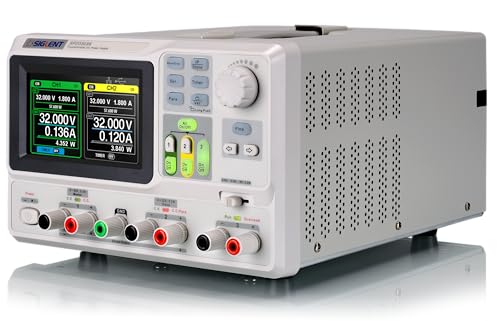
This is the natural default for a teaching lab that needs one unit to handle a full practical session. Its two adjustable channels and selectable logic rail run independently, in series or in parallel, so the same bench can teach single-rail digital work one week and split-supply analog circuits the next. The color display shows all three outputs together, which helps students verify their settings before powering a board. USB and LAN connections support remote setup and logging for instructors managing several benches at once.
Specs
- Model Name: SPD3303X-E
- Outputs: 3 independently controlled and isolated outputs
- Channel ratings: 32 V/3.2 A and 32 V/3.2 A, plus 2.5 V/3.3 V/5 V at 3.2 A
- Output Wattage: 220 watts
- Item Weight: 17.6 Pounds
- Item Dimensions: 16 x 14 x 11 inches
Best for: Teaching labs that need isolated rails, series and parallel modes, and remote control from an instructor station.
Watch out for: Confirm the bench can take the unit’s weight and depth, and check the input voltage selector matches your local supply before the first session.
ASIN: B01410O424
Rigol DP832 Triple Output 195 Watt Power Supply

The DP832 suits structured coursework where repeatability matters more than squeezing out the highest channel voltage. Its three outputs cover the classic training combination of two adjustable rails and a dedicated 5 V rail for logic boards, and the programmable interface supports timed outputs and stored setups that an instructor can recall at the start of each class. The front panel layout groups each channel clearly, which suits students who are still learning to read a bench supply. For departments standardizing benches across several rooms, it offers a consistent platform for lesson plans and assessments.
Specs
- Model: DP832
- Item Part Number: DP832
- Manufacturer: RIGOL TECHNOLOGIES USA INC
- Outputs: 3 outputs, 30 V/3 A, 30 V/3 A and 5 V/3 A
- Total power: up to 195 W
Best for: Schools and colleges running structured, repeatable practical exercises across many identical benches.
Watch out for: The third channel is a fixed 5 V rail rather than a selectable logic output, so check it matches the logic levels your course teaches.
ASIN: B00ENX02GC
Siglent SPD3303X DC Power Supply
Where the SPD3303X-E trades resolution for value, this model is the precision option in the same 220 W frame. Its finer setting and readback resolution supports lessons where students measure small voltage steps, characterize sensors, or compare set values against a multimeter with meaningful digits. The three isolated outputs and series or parallel modes carry over, so advanced classes can still build split supplies and combined rails. It fits instructor demonstration benches and higher-level courses where the supply itself becomes part of the measurement exercise rather than just a power source behind it.
Specs
- Model Number: SPD3303X
- Outputs: 3 independently controlled and isolated outputs
- Channel ratings: 32 V/3.2 A and 32 V/3.2 A, plus 2.5 V/3.3 V/5 V at 3.2 A
- Minimum resolution: 1 mV/1 mA
- Output Wattage: 220 watts
- Maximum Input Voltage: 230 volts
- Item Dimensions: 16 x 14 x 11 inches
Best for: Advanced classes, calibration demonstrations and instructor benches where fine resolution supports the lesson.
Watch out for: Verify your mains voltage against the listed input range and confirm the finer resolution is something your syllabus will actually use.
ASIN: B017266CKQ
Rigol DP832A Programmable Linear DC Power Supply
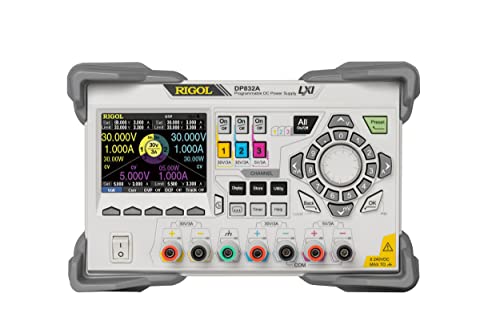
The DP832A is the step-up Rigol for training providers who want the finest control and the widest connectivity in this group. It keeps the three-output, 195 W layout but adds higher setting resolution and a fuller interface set, which suits assessment benches where an examiner configures a scenario and students respond to it. The color display presents channel status clearly for observation across a room. With USB, LAN, RS232 and GPIB connections listed, it also integrates with older instrument fleets that a training center may already own and still teach on.
Specs
- Channels: 3 channels, 195 W total power
- Maximum output range: 30 V/3 A, 30 V/3 A and 5 V/3 A
- Resolution: 1 mV/1 mA
- Interfaces: USB, LAN, RS232 and GPIB
- Item model number: DP832A
Best for: Instructor and assessment stations, and training centers integrating a supply into an existing instrument fleet.
Watch out for: Check which interface cables and options are included in the box, since lab integration plans often assume a specific connection is present.
ASIN: B00EP9I086
Which One Fits Your Situation
Equipping a Full Classroom of Student Benches
For a room of student benches, the Siglent SPD3303X-E is the balanced choice: isolated outputs forgive wiring mistakes, the selectable logic rail covers mixed analog and digital exercises, and remote interfaces let one instructor prepare every bench the same way. Its combination of a clear all-channel display and series or parallel modes means one purchase supports several terms of varied coursework without swapping equipment between rooms.
Running Repeatable, Timetabled Practical Sessions
When the priority is starting every class from an identical setup, the Rigol DP832 fits best. Stored setups and programmable control let instructors reset benches quickly between groups, and the fixed 5 V third channel matches the logic boards used in most introductory exercises. Departments teaching the same practical in parallel rooms benefit from that consistency, because worksheets, expected readings and troubleshooting steps stay aligned across every bench students might sit at.
Teaching Precision Measurement and Calibration Topics
Choose the Siglent SPD3303X when the lesson is about the numbers themselves. Its 1 mV and 1 mA resolution gives students settings and readbacks fine enough to compare against handheld meters and discuss accuracy honestly. It works well on a demonstration bench at the front of the room, or in smaller advanced groups where each pair of students can work through characterization and sensor exercises at their own pace.
Building an Instructor or Assessment Station
The Rigol DP832A suits the bench the instructor controls. Its finer resolution, color display and broad interface set make it easier to stage fault-finding scenarios, demonstrate remote operation, and connect to legacy instruments during assessments. Training centers that examine candidates on mixed fleets will appreciate the GPIB option alongside modern USB and LAN control, keeping one station compatible with both new and long-serving teaching equipment.
Common Mistakes
- Buying a single-output or dual-output supply to save money, then discovering that mixed analog and digital exercises need a third rail on every bench.
- Ignoring the third channel’s specification, and finding the logic rail is fixed at one voltage or cannot supply the current a full class of boards draws.
- Overlooking isolation, which rules out split-supply op-amp labs and makes channel combining unsafe or impossible for the circuits in the syllabus.
- Choosing resolution by headline numbers alone, without checking whether students need fine steps for measurement topics or just clear, coarse adjustment.
- Forgetting bench logistics: weight, depth, mains voltage range and interface cables all decide whether a unit actually fits the room it was bought for.
Frequently Asked Questions
Why do training labs need three outputs instead of one?
Most electronics coursework runs several rails at once: a logic supply for a microcontroller, a higher rail for analog circuitry, and often a negative rail for op-amps. A triple-output unit provides all three from one bench instrument, so students learn on the same arrangement they will meet in industry, and instructors manage one device per bench instead of a tangle of separate supplies.
Can two channels be combined for higher voltage or current?
On the models in this guide, yes: series mode stacks two channels for a higher combined voltage, and parallel mode combines them for more current. These modes are themselves valuable teaching material, showing students how supplies behave when linked. Always confirm the exact combined limits in the product documentation before building a practical exercise around them.
Is programmable control worth it for a teaching lab?
For a single hobby bench, often not; for a classroom, usually yes. Programmability lets instructors load identical setups onto every bench, log output behavior during an experiment, and demonstrate remote instrument control, which is a syllabus topic in its own right. Memory presets alone can save several minutes of setup at the start of each timetabled session.
What should we check before ordering for a whole department?
Confirm the output ranges against your syllabus, the third channel’s voltage options and current rating, and that outputs are isolated if split-supply work is taught. Then check the physical side: unit weight and depth for your benches, the mains input range for your building, and which interface cables are included, so the rollout is not delayed by missing accessories.
Related guides
More from Amazon
Programs that pair well with the guide above. Offers and eligibility are set by Amazon and may change.
Free shipping on eligible items, Prime Video and more. Eligible new members can start with a free trial.
Start a Prime free trialAudiobooks and podcasts to listen to on the go. Eligible new members can start with a free trial.
Try Audible freeAd-free music streaming. Eligible new subscribers can start with a free trial.
Try Music Unlimited freeA free business account with business pricing and bulk-buying tools for work, shop or home office.
Create a business accountAs an Amazon Associate we earn from qualifying purchases.










Write Your Review
No reviews yet. Be the first to share your experience!