
Key takeaways
- Small bench, real measurements: compare the three impedance analyzers verified on Amazon US, from a pocket-size Digilent adapter to Tonghui bench units.
What's inside
As an Amazon Associate I earn from qualifying purchases. This post may contain affiliate links at no extra cost to you.
In a small laboratory, the real decision is rarely just which impedance analyzer measures best. Precision analyzers are traditionally the widest, heaviest boxes on the bench, so the true question is whether swept impedance measurement justifies surrendering a large share of your only work surface. That answer hinges on two things: the frequency ceiling your components demand, and whether a compact host instrument already sitting on the desk can carry the measurement instead of a full-size chassis.
This guide is written for compact R&D corners, shared teaching benches, and home labs where space is measured in centimeters. Candor first: Amazon US stocks very few instruments whose own listings present them as impedance analyzers, and only three verify, so those three are covered here rather than padding the page with relabeled LCR meters. Every specification below comes from the names and data published on the Amazon product pages.
Quick Picks
As an Amazon Associate we earn from qualifying purchases
| Product | Best for | Key spec from title |
|---|---|---|
| Tonghui TH2840B | A small lab that still needs full frequency sweeps | 20 Hz to 2 MHz test frequency |
| Tonghui TH2840A | Narrow benches measuring mainstream parts | 20 Hz to 500 kHz test frequency |
| Digilent Impedance Analyzer for Analog Discovery | The tightest desks that already run an Analog Discovery | 1 Hz to 15 MHz excitation range |
How to Choose
Start With Footprint, Depth and Weight
Measure the bench before comparing a single specification. The two benchtop candidates here share a chassis listed at 430 × 177 × 265 mm and 11 kg, which is wider than many small-lab shelves are deep once cables bend behind the unit. Leave working room in front for the test fixture and component leads, and keep ventilation slots clear rather than stacking supplies on top. If the only available home is a shelf above the bench, remote interfaces become a genuine selection criterion, because the instrument will live away from your hands. The adapter option, by contrast, asks for almost no dedicated space at all.
Keep the Analyzer Features, Shrink Everything Else
Limited space tempts buyers toward compact LCR meters, but compactness is no substitute for the features that make an analyzer an analyzer: swept measurements, not just spot readings. Look for point test, list scan and graph scan modes, plus a display that shows several parameters at once so resonance and loss trends are visible. Then set the frequency ceiling honestly. A 500 kHz top end covers power and audio components; reaching 2 MHz catches the self-resonant region of smaller parts. The little adapter quotes a 15 MHz excitation span, yet its published capacitance and inductance windows are far narrower than the bench units’ ranges.
Test Level and DC Bias Decide Measurement Honesty
Small labs often measure parts exactly as they will be used, crammed into dense products, so small-signal readings can mislead. Multilayer ceramic capacitors shed capacitance as DC voltage rises, and inductors lose inductance as current pushes the core toward saturation. An analyzer with an adjustable test level and a built-in DC bias source reproduces those conditions on the bench. The Tonghui listings publish a test level up to 20 Vrms, a ±40 V bias supply and a separate 2 A current source for magnetics. The Digilent listing publishes no bias capability, so treat its results as unloaded, small-signal values when planning a design.
Connections and Remote Control in Tight Quarters
In a cramped lab, where the instrument sits matters as much as what it measures. A benchtop unit with LAN, USB and serial control plus SCPI or MODBUS commands can live on a shelf or rack while a laptop on the desk drives it, freeing the work surface for soldering and assembly. Check what fixture the listing actually includes, because leaded and surface-mount parts need different hardware and fixtures consume their own storage space. The adapter route trades all that for dependence on one host device and its WaveForms software, which is fine while that host stays on the desk and a problem if it travels.
The 3 Best Options
Tonghui TH2840B
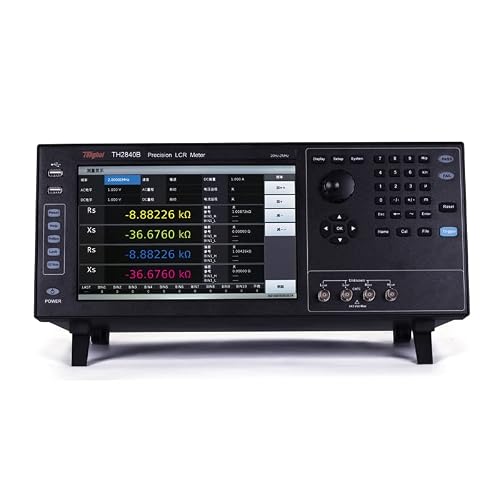
The TH2840B is the full-capability choice, and for a small lab that characterizes components across frequency every week, one deep instrument can be a smarter use of space than three shallow ones. Its listing spans 20 Hz to 2 MHz with point, list scan and graph scan modes, so impedance curves and resonance points appear on the 10.1-inch touchscreen instead of being inferred from single readings. Built-in DC bias and a 2 A current source let it exercise capacitors and magnetics under load. The footprint is identical to its sibling, so the space cost is paid once for the widest verified capability on Amazon US.
Specs
- Test frequency: 20 Hz to 2 MHz
- Basic accuracy: 0.01%
- Test signal level: up to 20 Vrms / 100 mArms
- Built-in DC bias: ±40 V, 100 mA, with 2 A DC current source support
- Measurement speed: up to 1,000 measurements per second, dual CPU
- Display: 10.1-inch capacitive touchscreen, 1280 × 800
- Test modes: point test, list scan and graph scan, four-parameter display
- Interfaces: RS-232C, USB host, USB device, handler and LAN
- Remote control: SCPI and MODBUS command support
- Dimensions: 430 × 177 × 265 mm; weight 11 kg
Best for: Space-limited R&D benches that sweep components across frequency and need bias testing in a single instrument.
Watch out for: Measure your shelf or bench depth before ordering; at 265 mm deep and 11 kg, this chassis dominates a small workspace, and the listing does not clearly state which test fixture is included.
ASIN: B09ZB6ZXG9
Tonghui TH2840A

The TH2840A makes the space calculation simpler: it occupies exactly the same 430 mm chassis as the TH2840B, so choosing it is purely a frequency decision, not a size decision. Its span stops at 500 kHz, which still covers the electrolytic and film capacitors, power inductors and mains-frequency magnetics that fill most small-lab projects. Everything else carries over, including the touchscreen, the three sweep modes, the built-in bias supply and the remote interfaces that let it sit on a shelf while a computer runs it. For a compact bench whose parts never approach megahertz test frequencies, it delivers the same workflow in the same footprint.
Specs
- Test frequency: 20 Hz to 500 kHz
- Basic accuracy: 0.01%
- Test signal level: up to 20 Vrms / 100 mArms
- Built-in DC bias: ±40 V, 100 mA, with 2 A DC current source support
- Measurement speed: up to 1,000 measurements per second, dual CPU
- Display: 10.1-inch capacitive touchscreen, 1280 × 800
- Test modes: point test, list scan and graph scan, four-parameter display
- Interfaces: RS-232C, USB host, USB device, handler and LAN
- Remote control: SCPI and MODBUS command support
- 14 range configurations for measurement stability
- Dimensions: 430 × 177 × 265 mm; weight 11 kg
Best for: Small labs focused on power, audio and general-purpose components specified at 500 kHz or below.
Watch out for: The 500 kHz ceiling is a hard limit; if a current project or a planned one characterizes parts near or above that frequency, the wider-range model is the safer single purchase.
ASIN: B09R1QTSWB
Digilent Impedance Analyzer for Analog Discovery

The Digilent module is the footprint outlier of this guide: a board listed at 1.96 × 1.77 inches and 0.64 ounces that plugs into an Analog Discovery host and adds swept impedance measurement through the WaveForms Impedance Analyzer tool. Automatically adjusting reference resistors and relays pick a suitable configuration for the attached part, which keeps setup quick for occasional measurements. Its published windows cover capacitance from 50 pF to 500 µF and inductance from 10 µH to 1000 mH, enough for screening passives and plotting how they behave across frequency. For a desk where a bench chassis simply cannot fit, it is the only verified route.
Specs
- Adapter for Analog Discovery 2 and Analog Discovery (Legacy), 2×15 connector
- Model number: 410-378
- Capacitance measurement range: 50 pF to 500 µF
- Inductance measurement range: 10 µH to 1000 mH
- Excitation frequency range: 1 Hz to 15 MHz
- Reference selection: automatically adjusting reference resistors and relays
- Software required: WaveForms version 3.8.2 or later
- Dimensions: 1.96 × 1.77 × 1.5 inches; item weight 0.64 ounces
Best for: Desks and teaching benches that already run an Analog Discovery and need impedance plots without another instrument.
Watch out for: It is an accessory, not a standalone analyzer; confirm your exact Analog Discovery model and WaveForms version before ordering, and note the listing publishes no DC bias capability.
ASIN: B07FP3WHDW
Which One Fits Your Situation
One Bench, Serious Characterization Work
Choose the Tonghui TH2840B. A small lab doing real component characterization cannot fake sweep data, and this unit plots impedance curves to 2 MHz, applies DC bias, and measures quickly enough for batch checks, all from one chassis. Place it on the sturdiest shelf, drive it over LAN, and the bench itself stays clear for assembly work.
Mostly Power and Audio Parts on a Narrow Bench
Choose the Tonghui TH2840A. Film and electrolytic capacitors, power inductors and mains magnetics are specified at frequencies comfortably inside its 500 kHz span, and the shared platform means the same bias source, touchscreen workflow and remote control as the flagship. The footprint is identical, so spend the decision on frequency needs rather than size.
Your Desk Already Hosts an Analog Discovery
Choose the Digilent Impedance Analyzer. It stores in a drawer, mounts on the host in seconds, and covers the capacitance and inductance ranges most compact projects use. For screening parts, comparing samples and teaching sweep interpretation, it returns bench space instead of consuming it. Just remember the measurement stops at the published component ranges.
A Shared Bench That Must Clear Between Sessions
Choose the Digilent adapter if an Analog Discovery is part of the shared kit. Shared and teaching benches get reconfigured constantly, and a pocket-size board that disappears into a parts drawer between sessions beats negotiating over a fixed 430 mm instrument. If formal, repeatable acceptance measurements are required instead, give the TH2840A a permanent shelf home.
Common Mistakes
- Ordering a 430 mm-wide, 11 kg analyzer before measuring shelf depth, bench depth and the clearance needed for cables behind the unit.
- Treating the Digilent board as a standalone instrument when it does nothing without a compatible Analog Discovery host and WaveForms software.
- Judging the adapter by its 15 MHz excitation headline while overlooking its published capacitance and inductance limits.
- Filling a space problem with a compact LCR meter that cannot sweep frequency or plot impedance, then discovering the missing curves mid-project.
- Parking a benchtop analyzer where its front terminals and fixture have no working room, making every measurement a reach across other equipment.
Frequently Asked Questions
How much bench space does a benchtop impedance analyzer actually need?
The Tonghui listings state dimensions of 430 × 177 × 265 mm and a weight of 11 kg. Beyond the chassis itself, allow room in front for the test fixture and component leads, plus space behind for power and interface cables to bend. Measure the shelf or bench, including any lip or door swing, before ordering.
Can a small lab rely on the Digilent adapter instead of a benchtop analyzer?
For swept checks of capacitors and inductors inside its published ranges, largely yes, provided an Analog Discovery host already lives on the desk. It plots impedance across frequency and stores nothing on the bench. It is not a standalone instrument, publishes no DC bias capability, and suits screening and characterization better than formal acceptance records.
Why does this guide contain only three models?
Because the Amazon US catalog is genuinely thin for this instrument class. Most precision impedance analyzers are sold through specialist distributors, and most marketplace search results turn out to be LCR meters once their listings are read closely. This guide includes only products whose own Amazon listings present them as impedance analyzers, and only three verify.
Do any of these analyzers measure components under DC bias?
Yes, both Tonghui bench units do. Their listings publish a built-in DC bias supply of ±40 V at 100 mA and a separate DC current source rated at 2 A, which suits loading inductors and biasing capacitors during measurement. The Digilent listing publishes no bias specification, so plan on small-signal, unloaded readings from the adapter.
Related guides
More from Amazon
Programs that pair well with the guide above. Offers and eligibility are set by Amazon and may change.
Free shipping on eligible items, Prime Video and more. Eligible new members can start with a free trial.
Start a Prime free trialAudiobooks and podcasts to listen to on the go. Eligible new members can start with a free trial.
Try Audible freeAd-free music streaming. Eligible new subscribers can start with a free trial.
Try Music Unlimited freeA free business account with business pricing and bulk-buying tools for work, shop or home office.
Create a business accountAs an Amazon Associate we earn from qualifying purchases.










Write Your Review
No reviews yet. Be the first to share your experience!