
Key takeaways
- Compare 5 programmable DC loads for electronics labs, from 150 W bench units to a 400 W model, with modes, interfaces and power ranges explained.
What's inside
As an Amazon Associate I earn from qualifying purchases. This post may contain affiliate links at no extra cost to you.
A programmable DC electronic load is the instrument that turns a vague worry about a power supply into a measured answer. Instead of guessing whether a regulator holds its voltage under a heavy draw, or whether a battery pack delivers its stated capacity, a lab can set an exact current, resistance, power or voltage and watch the source respond. The choice matters because the wrong load either runs out of power halfway through a test or sits on the bench with features nobody in the room ever uses.
This guide is written for people equipping a general electronics laboratory: repair benches, teaching labs, small design teams and makers who test supplies, chargers, converters and battery packs in the same week. Every load below was picked from the name and specifications shown on its Amazon listing, with the focus on the power range, the operating modes and the interfaces that let one instrument serve many different jobs.
Quick Picks
As an Amazon Associate we earn from qualifying purchases.
| Product | Best for | Key spec from title |
|---|---|---|
| Siglent SDL1020X-E | A first programmable load for a mixed-use electronics bench | 150 V, 30 A, 200 W single-channel programmable DC electronic load |
| Siglent SDL1030X-E | Higher-power testing of 12 V and 24 V supplies and larger battery packs | 150 V, 30 A, 300 W single-channel programmable DC electronic load |
| Rigol DL3021 | Scripted and stepped test sequences run from the bench or a PC | 150 V, 40 A, 200 W single-channel programmable DC electronic load |
| Korad KEL103 | Networked logging of long discharge tests in a shared lab | 120 V, 30 A, 300 W single-channel programmable DC electronic load |
| East Tester ET5410A+ | Big battery packs and high-current 24 V supplies on a tight budget | 150 V, 40 A, 400 W single-channel programmable DC electronic load |
How to Choose
Match the power envelope to the heaviest test, not the average one
A load can only sink as much power as its rating allows, and that limit is set by voltage times current together, not by either number alone. A 200 W load testing a 24 V supply can draw about 8 A before it hits its ceiling, even though its current rating says 30 A or 40 A. Work out the largest supply or battery pack the lab will ever test, multiply its voltage by its current, and leave headroom above that figure. A lab that mostly tests 5 V and 12 V boards but occasionally checks a 24 V, 10 A LED driver needs a 300 W or 400 W unit, while a bench that never leaves the low-voltage world can stay with a 150 W or 200 W model and spend the difference elsewhere.
Pick modes that mirror the circuits the lab actually builds
Constant current mode is the workhorse: it draws a fixed current and shows whether the voltage holds. Constant voltage mode suits charger and solar panel checks, constant resistance mimics a real resistive load, and constant power imitates a downstream converter drawing steady watts. A combined mode such as constant current plus constant voltage earns its place when the lab tests battery chargers, because it reproduces the way a charger hands over from one phase to another. Before buying, list the three most common tests the lab runs and check that the load covers them; a missing mode cannot be added later, and a load bought for one trick quickly becomes a shelf ornament.
Check the minimum operating voltage before trusting low-voltage results
Every electronic load needs some voltage across its input terminals before it can sink its full rated current, and that floor is easy to overlook. A load that needs a volt or more at full current will struggle to test a single lithium cell or a 3.3 V rail pulled hard, because the voltage available is barely above the floor. Labs that test low-voltage regulators, single cells and USB-powered boards should look for a low minimum operating voltage and fine current resolution in the low range. If the listing states a minimum operating voltage at full current, compare it with the lowest rail the lab tests and treat a large gap as a warning sign.
Treat the remote interface as part of the instrument, not an accessory
A load with USB, RS-232 or LAN control can be driven from a script, logged overnight and folded into a repeatable test routine, while a load without a workable interface stays a manual knob-turning exercise. In a shared lab, a LAN port is worth more than it looks on paper: one person can start a long discharge test and another can check the logged data without standing at the bench. Confirm that the interface the lab plans to use is actually fitted on the exact model being bought, since some series offer a port as an option or drop it on a cheaper variant. Also check that the lab has a PC and cable ready, because a remote-capable load with no cable is manual-only in practice.
The 5 Best Options
Siglent SDL1020X-E

The SDL1020X-E is the most balanced load in this group for a general electronics laboratory, because it covers the middle of the power range with a full set of modes and every common interface. Its 150 V and 30 A input handles everything from small regulators to 48 V supplies, and the dynamic mode switches current fast enough to reveal how a regulator reacts to sudden load changes. A built-in battery discharge test measures pack capacity to a cut-off voltage, and four-wire sense keeps readings honest when test leads carry heavy current. The colour screen and familiar front-panel layout make it easy for different people in a shared lab to pick up and use.
Specs
- Input range: 150 V, 30 A, 200 W maximum power
- Operating modes: CC, CV, CR and CP, with a CC dynamic mode up to 25 kHz
- Interfaces: USB, RS-232 and LAN
- Readback resolution: 1 mV and 1 mA
- Battery discharge test with cut-off voltage
- Four-wire remote sense
Best for: A general electronics bench that tests regulators, USB supplies, chargers and battery packs in the same week.
Watch out for: Check the listing to confirm the E variant, since the non-E model in the same series uses different readback resolution.
Siglent SDL1030X-E
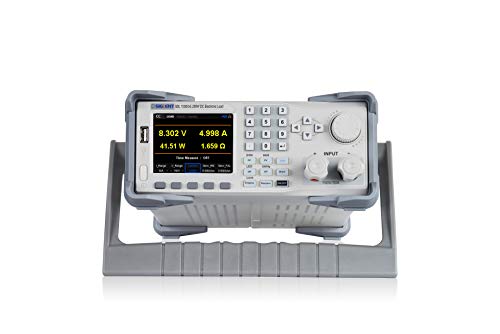
The SDL1030X-E is the same instrument as the SDL1020X-E with its power rating raised to 300 W, and that extra headroom is the whole reason to choose it. At 12 V or 24 V, a 200 W load runs out of power long before it runs out of current, so the 300 W rating lets the lab push LED drivers, motor supplies and larger battery packs to their real limits. Everything else carries over: the four static modes, the fast dynamic mode, the battery test, four-wire sense and the three remote interfaces. It is the sensible step up for a lab whose work is drifting toward higher-power supplies rather than staying with small boards.
Specs
- Input range: 150 V, 30 A, 300 W maximum power
- Operating modes: CC, CV, CR and CP, with a CC dynamic mode up to 25 kHz
- Interfaces: USB, RS-232 and LAN
- Readback resolution: 1 mV and 1 mA
- Battery discharge test with cut-off voltage
- Four-wire remote sense
Best for: Labs that regularly test 12 V and 24 V supplies, LED drivers or battery packs too large for a 200 W load.
Watch out for: Confirm the power rating on the listing, since the 200 W and 300 W models look nearly identical and share the same series name.
Rigol DL3021

The DL3021 earns its place through test automation. Beyond the four standard modes it offers three dynamic modes and a list function of up to 512 steps, so a whole load profile can be programmed once and run without anyone touching the front panel. Built-in battery, over-current protection and over-power protection tests let the lab check a supply through a complete sequence and record where it trips. Its 40 A current rating is the highest in the 200 W class here, which helps when a low-voltage supply needs a heavy draw. USB and RS-232 interfaces support scripted control from a PC, making this the natural pick where repeatable, unattended testing matters.
Specs
- Input range: 150 V, 40 A, 200 W maximum power
- Operating modes: CC, CV, CR and CP, with three dynamic modes
- List function with up to 512 steps
- Built-in battery, OCP and OPP tests
- Interfaces: USB and RS-232
- Readback resolution: 0.1 mV and 0.1 mA
Best for: Scripted and stepped test sequences, production-style checks and overnight battery discharge runs.
Watch out for: Verify the listing states USB and RS-232, and check whether the lab needs a LAN port, since this model does not list one.
Korad KEL103

The KEL103 gives a lab 300 W and a LAN port in a compact bench unit, a combination that suits shared workspaces where tests run long and results need to be logged from another machine. Its 120 V and 30 A input covers the supplies most general labs actually test, and the four operating modes handle regulators, chargers and battery packs without fuss. Fine resolution in the low ranges helps with small currents, and the dynamic mode covers pulsed loading up to 10 kHz. A hundred memory settings let different users store their own test setups and recall them quickly, which keeps a shared bench from becoming a daily reconfiguration chore.
Specs
- Input range: 120 V, 30 A, 300 W maximum power
- Operating modes: CC, CV, CR and CW, with dynamic mode up to 10 kHz
- Interfaces: USB, RS-232 and LAN
- Readback resolution: 0.1 mV and 0.1 mA in the low ranges
- Battery discharge test with cut-off voltage
- Stores up to 100 instrument settings
Best for: A shared lab that logs long discharge tests over the network and needs 300 W without a large bench footprint.
Watch out for: Check the listing for the exact interface set, since some sellers describe the same model with different interface lists.
East Tester ET5410A+
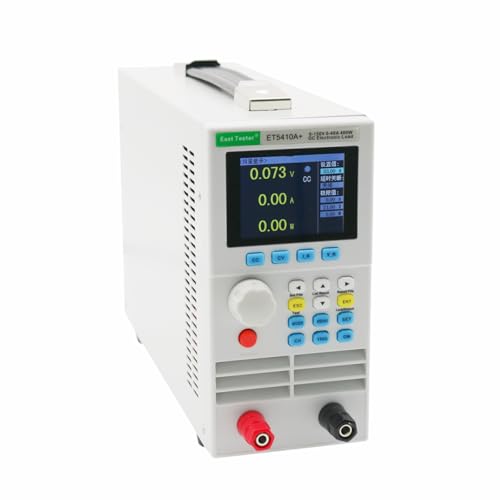
The ET5410A+ is the high-power option in this group, sinking 400 W at up to 150 V and 40 A, which makes it the load to reach for when a 300 W unit would run out of room. It suits big battery packs, 24 V supplies feeding heavy loads and capacity tests that would take too long at lower currents. The four standard modes cover the usual bench tests, and built-in battery capacity and internal resistance testing give the lab a way to grade cells and packs without extra instruments. A colour screen keeps voltage, current and power visible at a glance. Its generous power rating for the class is the main attraction, and it fits labs where the heaviest test sets the budget.
Specs
- Input range: 150 V, 40 A, 400 W maximum power
- Operating modes: CC, CV, CR and CP
- Battery capacity test and internal resistance test
- Colour display showing voltage, current and power
- Interface: USB
Best for: Large battery packs and high-current 24 V supplies where a 300 W load would run out of power.
Watch out for: Confirm the interface and the plus variant on the listing, since several sellers list this model with different interface descriptions.
Which One Fits Your Situation
Setting up a first general-purpose lab bench
The Siglent SDL1020X-E is the right starting point. Its 200 W envelope, four modes, dynamic testing, battery test and three interfaces cover the widest spread of jobs a new lab will meet, from regulator checks to pack capacity tests, without demanding a specialist instrument for each one. Buy it when the bench needs one load that can do a little of everything and be learned quickly by everyone who uses it.
Testing 12 V and 24 V supplies or larger battery packs
The Siglent SDL1030X-E fits, because its 300 W rating removes the power ceiling that a 200 W load hits at those voltages. If the lab also handles big packs or heavy 24 V draws, the East Tester ET5410A+ is the alternative, offering 400 W and 40 A for the most demanding jobs. Choose the Siglent when interface choice and battery testing matter most, and the East Tester when raw power headroom is the priority.
Running repeatable, scripted or overnight tests
The Rigol DL3021 fits, because its 512-step list function and built-in protection tests turn a manual bench check into a repeatable routine that runs on its own. It is the pick for a lab that tests the same supplies again and again, or that wants discharge curves logged while nobody is in the room. Pair it with a PC and a USB or RS-232 cable so the scripted features are actually used.
Sharing one load across a team or a teaching lab
The Korad KEL103 fits, because its LAN port lets tests be monitored and logged from another machine while the bench stays free, and its 100 stored settings let each user recall their own setup. Its 300 W rating is generous for classroom and shared-bench work. Choose it when several people use the same instrument and the lab values networked logging over the deepest feature set.
Common Mistakes
- Buying on the headline current alone and forgetting that voltage times current must stay under the power rating.
- Testing a low-voltage rail without checking the minimum operating voltage, then wondering why the load cannot sink full current.
- Choosing a load with no remote interface and later discovering that long discharge tests need someone standing at the bench.
- Mixing up lookalike models in the same series, such as a 200 W and a 300 W variant, and ordering the wrong one.
- Skipping the cut-off voltage in a battery discharge test and running a pack far below its safe limit.
Frequently Asked Questions
What does a programmable DC electronic load do?
It sinks a controlled amount of current, power or resistance from a DC source so the lab can measure how that source behaves under load. A programmable model lets the operator set exact values from the front panel or a PC, run stepped sequences and log results, instead of relying on fixed resistors that only give one load point at a time.
Which operating mode should I use to test a bench power supply?
Constant current mode is the usual starting point, because it draws a fixed current and shows whether the output voltage holds steady. Constant power mode suits supplies feeding downstream converters, and the dynamic mode shows how the supply reacts to sudden current changes. Use the battery test mode only for cells and packs, never for a bench supply.
Can one load test both small boards and large battery packs?
It can, but only within its power envelope. A 200 W load handles small boards and modest packs easily, yet it will hit its ceiling on a large 24 V pack drawing heavy current. Labs that test both should pick a load rated above their heaviest test, which usually means a 300 W or 400 W model, or keep a second larger load for pack work.
Do I need a LAN port on an electronic load?
A LAN port matters when tests run long or the lab wants results logged from another machine, because it allows remote monitoring and scripted control over the network. For short manual checks at the bench, USB or RS-232 is enough. In a shared or teaching lab, the LAN port is worth having, since it keeps the bench free while a discharge test runs.
Related guides
More from Amazon
Programs that pair well with the guide above. Offers and eligibility are set by Amazon and may change.
Free shipping on eligible items, Prime Video and more. Eligible new members can start with a free trial.
Start a Prime free trialAudiobooks and podcasts to listen to on the go. Eligible new members can start with a free trial.
Try Audible freeAd-free music streaming. Eligible new subscribers can start with a free trial.
Try Music Unlimited freeA free business account with business pricing and bulk-buying tools for work, shop or home office.
Create a business accountAs an Amazon Associate we earn from qualifying purchases.










Write Your Review
No reviews yet. Be the first to share your experience!