
Key takeaways
- Only a few true impedance analyzers are sold on Amazon US. Compare two Tonghui benchtop analyzers and the Digilent module by frequency, bias and speed.
What's inside
As an Amazon Associate I earn from qualifying purchases. This post may contain affiliate links at no extra cost to you.
Choosing a precision impedance analyzer starts with a filter most buyers skip: separating true analyzers from the far larger crowd of LCR meters. An analyzer sweeps test frequency and plots how impedance and phase behave across a band, which is how resonance points and loss trends become visible. A spot-check LCR meter cannot show any of that. The second decision is the frequency ceiling and test drive your parts need, because those two specs decide which of the few analyzers listed on Amazon US fits your bench.
This guide serves component R&D engineers characterizing parts across frequency, quality-control technicians sorting incoming stock, and teaching labs that already run an Analog Discovery station. Honesty matters here: only a small number of instruments sold on Amazon US are presented by their own listings as impedance analyzers, so this guide covers the three that verify instead of padding the list with relabeled LCR meters. Every pick below comes from the product names and specification data published on the Amazon product pages.
Quick Picks
As an Amazon Associate we earn from qualifying purchases
| Product | Best for | Key spec from title |
|---|---|---|
| Tonghui TH2840B | Frequency sweeps on a component R&D bench | 20 Hz to 2 MHz test frequency |
| Tonghui TH2840A | Fast sorting at an incoming-inspection bench | 20 Hz to 500 kHz test frequency |
| Digilent Impedance Analyzer for Analog Discovery | Analog Discovery owners in teaching and hobby labs | Auto-ranging adapter for Analog Discovery |
How to Choose
Start With the Frequency Range and Sweep Modes
The top test frequency decides which parts an analyzer can characterize honestly. A unit that stops at 500 kHz covers audio-frequency capacitors, power inductors and most commodity components, but it cannot reach the self-resonant region of smaller RF-leaning parts. Just as important is how the instrument sweeps: point test mode suits single spot checks, list scan steps through programmed frequency points for batch comparison, and graph scan draws the impedance curve so resonance and roll-off are visible at a glance. Decide which of those views your work needs before comparing anything else, because a meter without sweep modes is an LCR meter, whatever the badge says.
Check Test Signal Level and Built-In DC Bias
Components rarely behave at a bench signal the way they behave in a working circuit. Inductors saturate as DC current rises, and capacitor values shift with applied voltage, so an analyzer with a strong AC test level and a built-in DC bias source measures parts closer to real operating conditions. Look for the published signal level in volts and milliamps, the bias voltage and current limits, and any separate DC current source for magnetics. If a listing is silent on bias, assume the part will be measured unloaded and treat the readings as small-signal values only, which may not predict in-circuit behavior at all.
Match Measurement Speed to Sorting Work
Raw measurement speed matters most when the analyzer feeds a pass-or-fail decision hundreds of times a day. A dual-CPU design rated at up to 1,000 measurements per second keeps an inspection queue moving, especially when paired with a multi-point list scan that checks several frequencies in one pass. For occasional characterization work, that speed is a luxury rather than a requirement, and sweep resolution plus display clarity deserve the budget instead. Be realistic about your daily volume: a research bench measuring ten parts a week gains little from headline speed, while a goods-inward station measuring ten parts a minute stalls without it.
Confirm Terminals, Fixtures and Remote Control
An analyzer only measures as well as the fixture holding the part. Check what connection the listing describes, whether a test fixture is actually included or merely pictured, and whether add-on fixtures exist for the leaded or surface-mount parts you handle. Four-parameter simultaneous display shortens setup time because related values appear together instead of through menu dives. For automated benches, published SCPI or MODBUS command support lets the analyzer join an existing test script, while a host-dependent module such as the Digilent instead ties you to its companion software and one specific hardware platform.
The 3 Best Options
Tonghui TH2840B
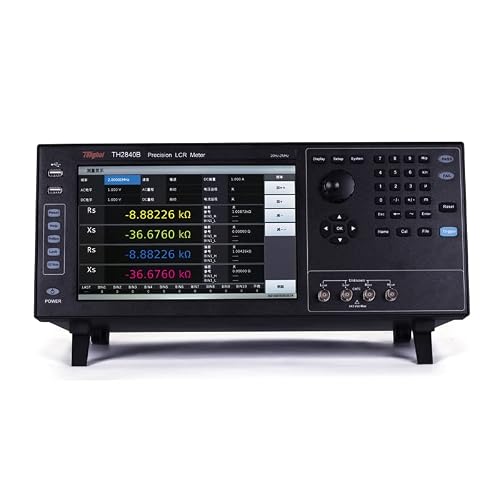
The TH2840B is the broadest verified option in this thin Amazon US field, built around a 20 Hz to 2 MHz test range that reaches the resonant behavior of many inductors and capacitors a 500 kHz ceiling would miss. Its graph scan mode draws impedance curves directly on the 10.1-inch touchscreen, while list scan handles repetitive multi-point checks. A 20 VAC test level, built-in DC bias and a separate DC current source let it exercise magnetics and capacitors under load rather than only at small signal. It suits R&D benches characterizing parts across frequency and labs that want plotted curves instead of single readings.
Specs
- Test frequency: 20 Hz to 2 MHz
- Test signal level: 20 VAC / 100 mAAC
- Built-in DC bias: ±40 VDC / 100 mADC
- Built-in DC current source: ±2 A
- Measurement speed: up to 1,000 times per second, dual CPU architecture
- Display: 10.1-inch capacitive touch screen, 1280 × 800 resolution
- Test methods: point test, list scan and graph scan
- Four-parameter measurement with 201-point multi-parameter list scan
- Remote control: SCPI and MODBUS command support
Best for: R&D engineers sweeping components across frequency and inspecting resonance behavior on one bench instrument.
Watch out for: the listing data does not spell out which test fixture ships in the box, so confirm the included fixture and terminal style before ordering.
ASIN: B09ZB6ZXG9
Tonghui TH2840A

The TH2840A shares the same platform as its wider-range sibling but caps the test frequency at 500 kHz, which still covers the audio, power-supply and general-purpose components that dominate most inspection work. It keeps the fast dual-CPU measurement rate, the large touchscreen and the same three test methods, including list scan for stepping through programmed points during batch checks. Built-in DC bias and the ±2 A current source remain on board, so inductors can be checked under realistic load current. It fits incoming-inspection and quality benches where throughput and repeatability matter more than reaching megahertz frequencies.
Specs
- Test frequency: 20 Hz to 500 kHz
- Test signal level: 20 VAC / 100 mAAC
- Built-in DC bias: ±40 VDC / 100 mADC
- Built-in DC current source: ±2 A
- Measurement speed: up to 1,000 times per second, dual CPU architecture
- Display: 10.1-inch capacitive touch screen, 1280 × 800 resolution
- Test methods: point test, list scan and graph scan
- Four-parameter measurement with 201-point multi-parameter list scan
- 14 range configurations for measurement stability
Best for: quality-control and goods-inward benches sorting commodity components quickly at audio and power frequencies.
Watch out for: the 500 kHz ceiling leaves no headroom for parts whose resonance sits higher, so check your fastest component’s datasheet before choosing it over the 2 MHz model.
ASIN: B09R1QTSWB
Digilent Impedance Analyzer for Analog Discovery

This module takes a completely different route: instead of a standalone bench instrument, it is an accessory that turns an Analog Discovery 2 or the original Analog Discovery into an impedance analyzer through the Impedance Analyzer tool in WaveForms software. Automatically adjusting reference resistors and relays select the most appropriate configuration for whatever unknown impedance is attached, which keeps setup simple for students and occasional users. It cannot work alone, and its measurement personality comes from the host device and software rather than a dedicated front panel. For labs already standardized on Analog Discovery stations, it adds impedance plotting for very little bench space.
Specs
- Accessory for Analog Discovery 2 and Analog Discovery (Legacy)
- Works with the Impedance Analyzer tool in WaveForms software
- Automatically adjusting reference resistors and relays
- Automatically selects the most appropriate configuration for the attached unknown impedance
- Connector: 2×15 Analog Discovery connector
Best for: teaching labs, students and engineers who already own an Analog Discovery and want impedance analysis without another bench box.
Watch out for: a compatible Analog Discovery host is required and is not the same purchase, so confirm your exact host model before ordering the module.
ASIN: B07FP3WHDW
Which One Fits Your Situation
Characterizing Parts Across Frequency in R&D
Pick the Tonghui TH2840B. Its 2 MHz ceiling and graph scan mode show impedance curves, resonance points and loss trends that spot measurements hide, and the strong test level plus DC bias let you watch a part’s behavior change under realistic drive. It is the only verified pick here that pairs megahertz reach with plotted sweeps on a standalone instrument.
Sorting Incoming Components at an Inspection Bench
Pick the Tonghui TH2840A. Most commodity capacitors, resistors and power inductors live comfortably below its 500 kHz ceiling, and the 1,000-per-second measurement rate with 201-point list scanning keeps a goods-inward queue moving. Step up to the TH2840B only if your incoming parts regularly include smaller inductors or RF-leaning components whose behavior must be checked above 500 kHz.
Adding Impedance Plots to a Teaching or Home Lab
Pick the Digilent Impedance Analyzer if an Analog Discovery already sits on the bench. The module adds impedance measurement through WaveForms with automatic configuration switching, so students spend time interpreting curves instead of wiring ranges. If no Analog Discovery is present, the honest choice is one of the Tonghui benchtop units rather than buying a host device solely for this accessory.
Testing Magnetics and Capacitors Under DC Bias
Pick either Tonghui unit, because both publish a built-in ±40 VDC bias supply and a ±2 A DC current source for loading inductors during measurement. Choose the TH2840A when your biased parts stay below 500 kHz, and the TH2840B when you also need frequency sweeps into the megahertz region to see how bias and frequency interact.
Common Mistakes
- Buying a fixed-frequency LCR meter and expecting sweep plots: if the listing never mentions list scan or graph scan modes, the instrument almost certainly cannot draw an impedance curve.
- Comparing headline frequency ranges while ignoring test signal level and DC bias, then discovering that inductors measured unloaded behave differently in the finished product.
- Assuming a test fixture is included because one appears in product photos; check the listing’s stated contents and budget for the fixture your leaded or surface-mount parts require.
- Ordering the Digilent module as a first instrument, when it is an accessory that does nothing without a compatible Analog Discovery host connected.
- Treating every listing titled with the words LCR meter as an analyzer, when the defining analyzer features are frequency sweeping and multi-parameter curve display.
Frequently Asked Questions
What separates an impedance analyzer from an LCR meter?
An impedance analyzer sweeps its test frequency across a band and records how impedance magnitude and phase change, producing curves that reveal resonance and frequency-dependent loss. A typical LCR meter measures inductance, capacitance and resistance at one or a few fixed frequencies. Only the analyzer shows behavior across the frequencies a part will actually meet in a circuit.
Why are there so few impedance analyzers on Amazon US?
Most precision impedance analyzers are sold through specialist test-equipment distributors rather than general marketplaces, so the Amazon US catalog is genuinely thin for this instrument class. Many search results turn out to be conventional LCR meters once their specifications are read closely. This guide includes only products whose own listings present them as impedance analyzers.
Can these instruments test components under DC bias?
The two Tonghui benchtop units can, according to their listings: both publish a built-in DC bias supply rated at ±40 VDC and 100 mADC, plus a separate DC current source rated at ±2 A for loading inductors. Inductance falls as core saturation approaches, so a biased measurement predicts in-circuit behavior better. The Digilent listing publishes no bias specification.
Does the Digilent Impedance Analyzer work on its own?
No. It is an accessory board that connects to an Analog Discovery 2 or the original Analog Discovery through its 2×15 connector, and operates through the Impedance Analyzer tool in WaveForms software on the host. Without that hardware it cannot generate a test signal or record a measurement, so confirm your exact host model before buying.
Related guides
More from Amazon
Programs that pair well with the guide above. Offers and eligibility are set by Amazon and may change.
Free shipping on eligible items, Prime Video and more. Eligible new members can start with a free trial.
Start a Prime free trialAudiobooks and podcasts to listen to on the go. Eligible new members can start with a free trial.
Try Audible freeAd-free music streaming. Eligible new subscribers can start with a free trial.
Try Music Unlimited freeA free business account with business pricing and bulk-buying tools for work, shop or home office.
Create a business accountAs an Amazon Associate we earn from qualifying purchases.










Write Your Review
No reviews yet. Be the first to share your experience!