
Key takeaways
- Compare benchtop LCR meters for design, QC, and lab benches, with test frequency, accuracy, display, and interface details for five in-stock models.
What's inside
As an Amazon Associate I earn from qualifying purchases. This post may contain affiliate links at no extra cost to you.
Choosing a benchtop LCR meter is really a decision about how your components behave in a real circuit. A capacitor or inductor rarely sits at one tidy test condition, so the meter you pick has to offer the test frequencies, signal levels, and measurement parameters that match the parts on your bench. A unit that tops out at 100 kHz suits most audio and power work, while RF-leaning projects push buyers toward wider frequency coverage and finer accuracy.
This guide is for design engineers checking parts against a datasheet, QC and incoming-inspection staff sorting components, teaching labs equipping shared benches, and serious hobbyists moving up from a handheld. Every product below was chosen from the names and specifications printed on its Amazon product page, and only full-size benchtop models are included.
Quick Picks
As an Amazon Associate we earn from qualifying purchases.
| Product | Best for | Key spec from title |
|---|---|---|
| GW Instek LCR-6100 | A precision bench for design and quality work | 100 kHz top test frequency |
| B&K Precision 891 | Wide-range component characterization | 300 kHz test frequency |
| MATRIX MCR5200 | Fast sorting with data saving | 40 Hz to 200 kHz, 41 frequency points |
| East Tester ET4510 | Dialing in one exact test frequency | 10 to 100 kHz in 1 Hz steps |
| East Tester ET4410 | A first full-size bench meter | 16 test frequency points to 100 kHz |
How to Choose
Test Frequency Range and Steps
The test frequency decides which parts a meter can judge fairly. Electrolytic capacitors and power inductors are usually characterized at 100 or 120 Hz, general-purpose parts at 1 kHz, and small ceramic capacitors or RF inductors at 100 kHz and above. Check the top frequency first, then look at how the range is divided. Fixed points such as 100 Hz, 1 kHz, 10 kHz, and 100 kHz cover standard datasheet conditions, while a meter with fine steps, down to 1 Hz increments, can reproduce an unusual test frequency exactly instead of settling for the nearest preset.
Basic Accuracy and Display Resolution
Basic accuracy tells you how close a reading should sit to the true value under the stated conditions, and it separates lab instruments from casual testers. Figures around 0.05 to 0.1 percent suit design verification and matched-part work, while looser accuracy is fine for spotting dead or drifted components. Display resolution matters alongside it: a five-digit readout for both the main and secondary parameters lets you watch small changes in dissipation factor or quality factor instead of rounding them away. Remember that accuracy figures assume proper open and short calibration with the fixture you actually use.
Test Levels, Bias, and Fixtures
Components respond to the signal you apply, so the available test levels shape your results. Several selectable levels, commonly between 0.1 V and 2 V, let you measure sensitive parts gently and drive larger parts firmly. An internal DC bias output helps when a capacitor must be checked under working voltage conditions. Fixtures deserve equal attention. Four-terminal Kelvin connections reduce lead resistance errors on low-value parts, and a direct component fixture beats loose clips for repeatability. Before buying, confirm which leads or fixtures the listing includes and which are sold separately.
Interfaces, Sorting, and Data Handling
A bench meter earns its place when it fits your workflow, not just your shelf. Comparator or bin sorting functions speed up incoming inspection by flagging parts inside or outside a set tolerance. Interfaces such as USB, RS232, LAN, or a handler port let the meter send results to a computer or work inside an automated test setup, and SCPI command support makes that integration far easier. Setup memory is a quieter benefit: saving and recalling stored configurations keeps repeat jobs consistent between operators and across shifts on a shared bench.
The 5 Best Options
GW Instek LCR-6100

The LCR-6100 is the steady professional choice in this group, a bench precision meter from Instek America that covers the test band most design and quality work actually uses. Its listed range runs from 10 Hz to 100 kHz, which spans the standard points for electrolytics, film capacitors, and magnetics without paying for spectrum you may never open. The full-size bench format, 4 kg weight, and clearly named model and part numbers suit a fixed lab station where the same instrument gets used every day by more than one engineer.
Specs
- Test frequency: 10 Hz to 100 kHz
- Model: LCR-6100
- Part number: LCR-6100
- Manufacturer: Instek America Corp
- Item weight: 4 kg
- Dimensions: 12.28 x 10.43 x 4.21 inches
- Measurement type: LCR meter
Best for: Design and quality benches that work within the 100 kHz band.
Watch out for: The listing is sold under a marketplace brand name, so confirm the model number LCR-6100 on the page before ordering.
ASIN: B01BMCT2LC
B&K Precision 891

The 891 is the wide-range option here, built for characterizing components rather than simply checking them. Its test frequency runs from 20 Hz to 300 kHz with selectable test levels, and the listed measurement parameters go well beyond the basics to include conductance, susceptance, admittance, dissipation factor, quality factor, phase angle, and DC resistance. That breadth suits engineers sweeping a part across conditions to see where it stops behaving. It is also the heaviest unit in this guide, a mains-powered bench instrument meant to stay put on a lab bench or in a rack.
Specs
- Test frequency: 20 Hz to 300 kHz
- Best accuracy: 0.05 percent
- Test levels: 0.5 Vrms and 1 Vrms, selectable
- Measurement parameters: C, L, R, G, B, Y, D, Q, phase angle, and DCR
- Model: 891
- Item weight: 11 pounds
- Dimensions: 16.5 x 12.5 x 7.6 inches
- Specification met: CE, UL 61010-1
Best for: Engineers characterizing parts across a wide frequency span.
Watch out for: Its size and weight make it a fixed installation, so measure your bench or rack space first.
ASIN: B016S9GRNK
MATRIX MCR5200

The MCR5200 is aimed at benches that measure parts in volume. It offers 41 test frequency points from 40 Hz to 200 kHz, three measurement speeds topping out at 30 readings per second, and data saving through its USB Host and RS232C ports, with SCPI and GPIB command support for automated setups. The 4.3 inch TFT display shows five digits, and the listed ranges are wide, from hundredths of a microhenry up to very large inductance and capacitance values. Included four-terminal test leads mean low-value parts can be measured without building a fixture first.
Specs
- Basic accuracy: 0.1 percent
- Test frequencies: 41 points from 40 Hz to 200 kHz
- Display: 4.3 inch TFT LCD, 5-digit display
- Inductance range: 0.01 µH to 99999 H
- Capacitance range: 0.01 pF to 9.9999 F
- Resistance and impedance range: 0.1 mΩ to 99.999 MΩ
- Measurement speeds: 30, 10, and 3 times per second
- Interfaces: RS232C, USB Host, and Handler ports, with SCPI and GPIB command support
- Dimensions: 9.45 x 13.08 x 3.94 inches
- Item weight: 7.7 pounds
- Included components: LCR meter, 4-terminal test leads, power cord, test report, fuse table
Best for: Sorting and logging many parts on a production or inspection bench.
Watch out for: The frequency points are fixed rather than continuously adjustable, so check the 41 points cover your test conditions.
ASIN: B07ZCJ1319
East Tester ET4510

The ET4510 stands out for one feature the fixed-point meters cannot match: its test frequency adjusts continuously from 10 to 100 kHz in 1 Hz steps. When a datasheet specifies an awkward frequency, or when you are comparing two instruments and need both set identically, that fine control removes the rounding compromise. The listing pairs it with a five-digit display for the main and secondary parameters and a stated basic accuracy of 0.1 percent. It is a desktop bridge in the classic format, sold here under the wellmeter storefront name with the ET4510 part number.
Specs
- Test frequency: 10 to 100 kHz, adjustable in 1 Hz steps
- Display: 5-digit display
- Basic accuracy: 0.1 percent
- Style: benchtop
- Part number: 4510
- UPC: 762949869321
- Included components: user manual and power plug
Best for: Buyers who must reproduce one exact test frequency.
Watch out for: The listing includes only a manual and power plug, so budget separately for Kelvin leads or a component fixture.
ASIN: B0F196RB8M
East Tester ET4410
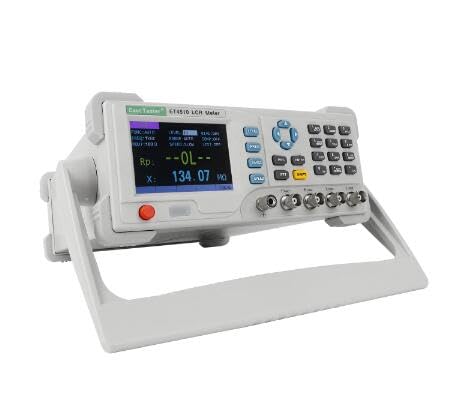
The ET4410 is the accessible entry point to a true bench bridge. It provides 16 fixed test frequencies from 100 Hz to 100 kHz, covering the standard points used for most capacitors, inductors, and resistors, and shows both parameters on a dual five-digit display. Six fixed test levels, an adjustable internal bias, and three measurement speeds give it more working flexibility than its position suggests, and open and short calibration support is built in. For a home lab or a small workshop bench, it delivers the core benchtop experience without the cost of the wider-range instruments above.
Specs
- Test frequencies: 16 points from 100 Hz to 100 kHz
- Display: 3.5 inch TFT screen, 5-digit display
- Basic accuracy: 0.1 percent
- Measurement speeds: 2, 4, and 8 readings per second
- Test levels: six fixed levels from 0.1 V to 2 V
- Internal bias: 0 to 1500 mV, adjustable in 1 mV steps
- Style: benchtop
- Part number: ET4410
- UPC: 762949869468
- Included components: user manual and power plug
Best for: A first benchtop LCR meter for a home or small workshop bench.
Watch out for: Several near-identical ET4410 listings exist, so match the ASIN and the 16-point specification before ordering.
ASIN: B0F9KVFD63
Which One Fits Your Situation
You Characterize Components for Design Work
Pick the B&K Precision 891. Its 20 Hz to 300 kHz range and long parameter list, including phase angle and DC resistance, let you follow a component across the conditions a design will actually impose. The GW Instek LCR-6100 is the alternative when your work stays under 100 kHz and you prefer a mainstream lab brand on the bench.
You Run a Teaching or Shared Lab Bench
Pick the GW Instek LCR-6100. A fixed bench format, a clear model identity from Instek America, and coverage of the standard test band make it easy to standardize student instructions and lab procedures around one instrument. Its 100 kHz ceiling matches what undergraduate and technician courses actually measure, from electrolytic capacitors to small inductors.
You Sort Incoming Parts Against a Tolerance
Pick the MATRIX MCR5200. Measurement speeds up to 30 readings per second keep a tray of parts moving, the wide listed ranges mean one instrument handles the whole delivery, and data saving over USB Host and RS232C gives you a record of what passed. The included four-terminal leads help keep low-value readings consistent between operators.
You Need One Exact Test Frequency on a Budget
Pick the East Tester ET4510 when the job specifies a frequency that fixed presets miss, since it adjusts in 1 Hz steps anywhere between 10 and 100 kHz. If your work uses only standard points such as 120 Hz, 1 kHz, and 100 kHz, the East Tester ET4410 covers them with its 16 fixed frequencies and costs you less complexity.
Common Mistakes
- Buying on top frequency alone, then discovering the meter lacks the low test points, such as 100 or 120 Hz, that electrolytic capacitors are specified at.
- Skipping open and short calibration after changing leads or fixtures, which quietly shifts every reading that follows.
- Measuring low-value resistors or inductors with plain two-wire clips instead of a four-terminal Kelvin connection, so lead resistance becomes part of the result.
- Testing a charged capacitor without discharging it first, which can damage the meter input and ruins the reading anyway.
- Assuming two listings with the same model number are identical, when sellers bundle different leads, plugs, and fixtures under near-identical titles.
Frequently Asked Questions
What does a benchtop LCR meter measure?
It measures inductance, capacitance, and resistance, usually alongside a secondary value such as dissipation factor, quality factor, equivalent series resistance, or phase angle. The meter applies a small AC test signal at a chosen frequency and level, then calculates the component values from the response. Benchtop models add wider frequency ranges, better accuracy, and fixtures that handheld units cannot match.
Which test frequency should I use for a capacitor?
Use the frequency printed in the component datasheet whenever one is given. Large electrolytic capacitors are commonly specified at 100 or 120 Hz, general-purpose parts at 1 kHz, and small ceramic capacitors at 100 kHz or higher. Measuring at a different frequency is not wrong, but the reading will differ, so comparisons only hold when the test conditions match.
Is a higher basic accuracy figure always better?
A tighter accuracy figure, such as 0.05 percent instead of 0.1 percent, helps when you are matching parts, verifying against tight tolerances, or comparing measurements taken months apart. For go or no-go repair checks, either figure is more than sufficient. Accuracy also depends on calibration, fixture quality, and test conditions, so a well-set-up mid-range meter can outperform a neglected precision one.
Do I need Kelvin leads for a benchtop LCR meter?
They matter most for low resistance, low inductance, and large capacitance measurements, where lead and contact resistance are a meaningful share of the reading. A four-terminal Kelvin connection separates the current and sense paths so the meter ignores most of that error. For mid-range values at 1 kHz, standard leads are usually acceptable, but Kelvin leads make results easier to repeat.
Related guides
More from Amazon
Programs that pair well with the guide above. Offers and eligibility are set by Amazon and may change.
Free shipping on eligible items, Prime Video and more. Eligible new members can start with a free trial.
Start a Prime free trialAudiobooks and podcasts to listen to on the go. Eligible new members can start with a free trial.
Try Audible freeAd-free music streaming. Eligible new subscribers can start with a free trial.
Try Music Unlimited freeA free business account with business pricing and bulk-buying tools for work, shop or home office.
Create a business accountAs an Amazon Associate we earn from qualifying purchases.










Write Your Review
No reviews yet. Be the first to share your experience!