
Key takeaways
- Compare five sealed powered subwoofers with DSP controls for home theaters, from a compact dual-driver model to a 13-inch theater sub before you buy.
What's inside
As an Amazon Associate I earn from qualifying purchases. This post may contain affiliate links at no extra cost to you.
A sealed subwoofer asks a home theater owner to trade raw rumble for control. With no port to lean on, the driver, amplifier, and digital processing carry the whole low end, and the result is bass that starts and stops cleanly instead of lingering after an explosion or a bass note. That trade only pays off when the processing is genuinely useful, since a sealed design with a fixed response can sound thin in a lively room or boomy in a small one. The real decision is whether the subwoofer gives you the tuning tools to match its output to your room and system.
This guide is for home theater owners who want tight, musical bass without a large ported cabinet dominating the room, including apartment dwellers and mixed movie and music listeners. Every model below was picked from the name and specifications on its Amazon listing, and each one is a powered subwoofer with a sealed enclosure and digital processing stated on the listing.
Quick Picks
As an Amazon Associate we earn from qualifying purchases
| Product | Best for | Key spec from title |
|---|---|---|
| SVS SB-1000 Pro | Small to medium rooms on a first serious theater build | 12-inch driver, sealed cabinet, DSP app |
| SVS SB-2000 Pro | A step up in output without a bigger footprint | 12-inch driver, sealed cabinet, DSP controlled |
| SVS SB-3000 | Larger rooms that need deeper extension | 13-inch driver, sealed cabinet, 800 watts RMS |
| SVS 3000 Micro | Apartments and tight corners where size matters most | Dual 8-inch drivers, sealed cabinet, 800 watts RMS |
| KEF KC62 | Design-led living rooms and near-wall placement | Dual 6.5-inch Uni-Core drivers, sealed cabinet, DSP |
How to Choose
Match sealed output to the size of your room
A sealed subwoofer gives up some deep-bass output to a ported cabinet of the same driver size, so room volume decides how much driver and amplifier you need. A compact 12-inch model can pressurize a closed bedroom or a modest living room, yet the same unit can feel restrained in a large open-plan space where bass must also fill a kitchen and hallway. Measure the length, width, and ceiling height of the space the subwoofer must serve, and treat adjoining open areas as part of that volume. When the room is large or open, move toward a bigger driver, a stronger amplifier, or a second subwoofer later rather than expecting one small sealed cabinet to do everything.
Check what the DSP really lets you change
Digital processing varies widely, and the label alone tells you little about how much control you will get. Some subwoofers offer a phone app with a parametric equalizer, adjustable crossover, phase, polarity, and saved presets for movies, music, and late-night listening. Others provide a handful of placement presets that adapt the response for a corner, a wall, a cabinet, or an apartment, which is simpler but less flexible. A few add room correction that measures the space with a microphone and builds a correction curve. Before buying, read the listing for the specific controls named and confirm whether they live in an app or on the rear panel, since a control you cannot reach is no control at all.
Weigh driver size against low-frequency extension
Driver size, cabinet volume, and amplifier power work together to set how low a sealed subwoofer can reach and how loudly it can play down there. A 13-inch driver in a larger cabinet generally digs deeper and plays louder than a compact dual 8-inch design, while the smaller model wins on placement freedom and disappears beside a media console. Frequency response figures help, but they only make sense with the tolerance attached, so compare numbers quoted with the same tolerance rather than treating a bare low-frequency figure as a promise. If your viewing leans toward action films with sustained deep effects, favor extension and output; if music and dialogue clarity matter more, favor speed and control.
Plan inputs, placement, and daily use before ordering
A home theater subwoofer lives or dies on integration, so the connections and the spot you have deserve the same attention as the driver. Most receivers feed the subwoofer through a single LFE output, while some owners also want speaker-level inputs for a two-channel system or a 12-volt trigger that wakes the subwoofer with the receiver. Sealed cabinets tolerate placement closer to walls than ported designs, yet a corner still boosts output and can exaggerate one-note bass, which is exactly where the DSP earns its keep. Check the cabinet dimensions and weight against the space and the floor, confirm the power cord reaches an outlet, and leave room to reach the rear panel or the phone app during setup.
The 5 Best Options
SVS SB-1000 Pro

The SB-1000 Pro is the sensible starting point for a first serious home theater, packing the core of the SVS sealed lineup into a cabinet that fits beside a sofa without dominating the room. Its 12-inch high-excursion driver and Sledge amplifier deliver clean, tuneful bass for films and music alike, while the phone app puts volume, crossover, phase, and a three-band parametric equalizer in your hand from the listening seat. That matters in real rooms, where a peak from a wall or a null at the main seat can spoil an otherwise capable subwoofer. It suits owners who want genuine tuning control without a larger cabinet.
Specs
- 12-inch high-excursion SVS driver
- Sledge STA-325D amplifier, 325 watts RMS, 820 watts peak power
- Sophisticated 50 MHz Analog Devices Audio DSP
- SVS subwoofer DSP smartphone app for iOS and Android
- 3-band parametric EQ controller
- Frequency response: 20-270 Hz, plus or minus 3 dB
- Sealed cabinet design
- Inputs: RCA, speaker level, 12V trigger
Best for: Small to medium home theaters where a compact sealed cabinet and full app tuning matter more than maximum output.
Watch out for: Confirm the Black Ash finish listing matches the finish you want, since the same model is sold in several finishes under different listings.
SVS SB-2000 Pro

The SB-2000 Pro keeps the same compact sealed footprint and spends the upgrade on output and headroom, making it the natural pick when a room is too large for an entry-level sealed subwoofer. Its redesigned 12-inch driver and Sledge STA-550D amplifier move more air with the same controlled character, and the 50 MHz DSP plus the SVS app give you volume, crossover, phase, and preset controls. Low-frequency extension reaches below 20 Hz in-room, so film soundtracks keep their weight on the deepest effects without the cabinet growing to ported proportions. It suits owners who want one subwoofer to cover movies and music for years.
Specs
- 12-inch high-excursion SVS driver
- Sledge STA-550D amplifier with fully discrete MOSFET output
- 50 MHz Analog Devices Audio DSP
- SVS subwoofer smartphone app for volume, DSP functions, and custom presets
- Sealed cabinet design
- Frequency response: 19-240 Hz
- In-room low-frequency extension: 17 Hz
- Inputs: RCA, speaker level, 12V trigger
Best for: Medium rooms and mixed movie and music systems where extra headroom is welcome but cabinet size must stay modest.
Watch out for: Check the listed dimensions against your planned spot, since the cabinet is deeper than the 15-inch width suggests once the grille and connections are counted.
SVS SB-3000
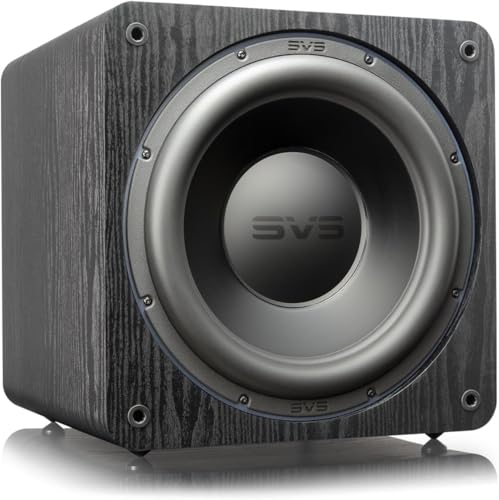
The SB-3000 is the pick for home theaters where the room is large enough that smaller sealed models start to run out of breath on demanding film passages. Its 13-inch high-excursion driver and Sledge STA-800D2 amplifier deliver deeper extension and greater output while keeping the sealed cabinet just over 15 inches cubed, so it still tucks beside a media unit. The 50 MHz DSP and the 3000 Series app handle volume, crossover, phase, and parametric equalization from a phone, with presets for music, movies, and gaming. Owners who watch a lot of action films will notice the extra authority most on sustained low effects and large-scale scores.
Specs
- 13-inch high-excursion SVS driver
- Sledge STA-800D2 amplifier, 800 watts RMS, 2500 watts peak power
- 50 MHz Analog Devices Audio DSP
- 3000 Series subwoofer app for DSP functions and custom presets
- Sealed cabinet design
- Frequency response: 18-270 Hz, plus or minus 3 dB
- Dimensions with grille: 15.6 x 15.2 x 17.8 inches
- Weight: 54.5 lbs
- Control method: App
Best for: Larger home theaters and dedicated media rooms that need deep, authoritative bass from a sealed cabinet.
Watch out for: At 54.5 lbs it is a two-person lift up stairs, and the piano gloss finishes show fingerprints, so check which finish the listing you order actually ships.
SVS 3000 Micro

The 3000 Micro answers a different question from the rest of this list: how much home theater bass can fit in a cabinet barely larger than a shoebox. Two active 8-inch drivers face opposite directions to cancel vibration, and the same Sledge STA-800D2 amplifier and 50 MHz DSP found in the larger 3000 Series drive them, so the tiny cabinet still offers app-based equalization and preset control. It will not pressurize a large open room the way a 13-inch sealed subwoofer can, yet in an apartment, a bedroom, or a living room where the subwoofer must hide beside a console, it delivers tight, tuneful bass that a soundbar cannot match.
Specs
- Fully active dual 8-inch drivers
- Sledge STA-800D2 amplifier, 800 watts RMS
- 50 MHz Analog Devices DSP
- SVS subwoofer DSP smartphone app for advanced tuning and control
- Sealed cabinet design
- Compact 10-inch class cabinet
- Protective non-resonant steel mesh grilles
- Control method: App
Best for: Apartments, bedrooms, and small living rooms where cabinet size is the deciding factor and DSP tuning must still be available.
Watch out for: Confirm the listing is for a single subwoofer and not a pair, since the 3000 Micro is also sold as a matched pair under a separate listing.
KEF KC62

The KC62 takes the most unusual path here, replacing one large driver with two 6.5-inch force-cancelling drivers mounted back to back in a single Uni-Core motor system inside a sealed aluminum enclosure. The result is a football-sized subwoofer that reaches down to 11 Hz on its specification sheet, with 1000 watts RMS of Class D amplification. Its digital processing takes the form of five room-placement equalization presets for free space, wall, corner, cabinet, and apartment use, driven by the Music Integrity Engine DSP rather than a full parametric equalizer app. That makes it the best fit for living rooms where looks, placement, and simple setup matter as much as output.
Specs
- Dual 6.5-inch Uni-Core force-cancelling drive units
- 1000 watts RMS Class D amplification, 2 x 500 watts
- 5 DSP room-placement equalization presets: Room, Wall, Corner, Cabinet, Apartment
- Music Integrity Engine DSP algorithms
- Ultra-compact acoustic suspension sealed cabinet design
- Frequency response: 11-200 Hz, plus or minus 3 dB
- Maximum output: 105 dB
- Variable low-pass crossover: 40-140 Hz
- Inputs: line-level and LFE RCA, speaker level
- Dimensions: 10-1/8 x 9-5/8 x 11-1/16 inches
- Weight: 30.9 lbs
Best for: Design-led living rooms, near-wall placement, and small spaces where a tiny sealed cabinet with preset DSP tuning is the priority.
Watch out for: There is no full parametric EQ app, so if you want to carve out a specific room peak by hand, a model with the SVS app gives you finer control.
Which One Fits Your Situation
You live in an apartment or a small living room
Pick the SVS 3000 Micro when the cabinet must disappear beside furniture and the neighbors share a wall, since its compact sealed box and app tuning let you dial the level down for late viewing without losing clarity. The KEF KC62 is the alternative when the subwoofer will sit in plain sight and its apartment DSP preset and aluminum cabinet matter, though its preset-based tuning gives you less direct control than the SVS app.
Your theater room is large or open to other spaces
Choose the SVS SB-3000, because its 13-inch driver and 800 watts RMS amplifier hold extension and output where smaller sealed models start to fade in a big volume. The SB-2000 Pro is the fallback when the budget or the available floor space rules out the larger cabinet, and a second SB-2000 Pro later is a realistic upgrade path for a room that proves bigger than expected.
You watch movies and listen to music in equal measure
Take the SVS SB-1000 Pro or the SB-2000 Pro, since both pair a sealed cabinet with a full parametric equalizer app and saved presets, letting you keep one tuning for films and another for music. The sealed design keeps bass guitar and kick drum tight, while the presets mean you are not re-tuning the subwoofer by hand every time the household switches from a film to an album.
The subwoofer must blend into a shared living space
Go with the KEF KC62 when appearance and placement flexibility lead the decision, because its small aluminum cabinet and five placement presets are built for rooms where the subwoofer sits near a wall, inside a cabinet, or beside a sofa. If the room is larger than the KC62 can comfortably serve, the SVS SB-1000 Pro is the discreet alternative that trades some visual polish for deeper extension and finer app control.
Common Mistakes
- Buying a sealed subwoofer sized for the seating area alone and forgetting that open doorways, hallways, and adjoining rooms add to the volume it must fill.
- Assuming every subwoofer with a phone app offers the same tuning, when some apps give full parametric EQ and others only switch between a few placement presets.
- Placing the subwoofer in a corner for maximum output and then never using the DSP to tame the boomy peak that corner placement creates.
- Setting the crossover by guesswork instead of matching it to the main speakers and letting the receiver handle bass management, which leaves a gap or an overlap in the handover region.
- Ordering a finish, a single unit, or a pair without reading the listing carefully, since several models here are sold in multiple finishes and as singles and pairs under separate listings.
Frequently Asked Questions
Is a sealed subwoofer good enough for home theater movies?
Yes, when the driver and amplifier are sized to the room, because a sealed design delivers fast, controlled bass that keeps effects tight. The compromise is output at the very lowest frequencies, where a ported cabinet of the same size plays louder. In a big or open room, choose a larger sealed model or plan for a second subwoofer, and use the DSP to smooth the response.
Does subwoofer DSP replace my AV receiver room correction?
No, the two work at different points in the chain and complement each other. Subwoofer DSP shapes the subwoofer itself through its own equalizer, crossover, and presets, while receiver room correction measures the whole system at the listening position and adjusts levels and equalization across all speakers. Run the subwoofer setup first, then let the receiver calibrate, and avoid stacking aggressive corrections from both on the same frequency.
Do I need one subwoofer or two for a home theater?
One well-placed sealed subwoofer with DSP is enough for most small to medium rooms, especially with a single sofa. Two help when seating spans a wide row, when the room has strong peaks and nulls, or when even bass across several seats matters. Start with one good model and add a matching second unit only after living with the first.
What if I do not want to control my subwoofer from a phone?
That is a good reason to favor the KEF KC62, whose five placement presets are selected on the unit and need no phone. The SVS models rely on their app for full access to the parametric equalizer and presets, though basic level and crossover adjustments remain available. Check the listing for onboard controls before ordering, and keep the app installed for setup even when daily use stays hands-off.
Related guides
More from Amazon
Programs that pair well with the guide above. Offers and eligibility are set by Amazon and may change.
Free shipping on eligible items, Prime Video and more. Eligible new members can start with a free trial.
Start a Prime free trialAudiobooks and podcasts to listen to on the go. Eligible new members can start with a free trial.
Try Audible freeAd-free music streaming. Eligible new subscribers can start with a free trial.
Try Music Unlimited freeA free business account with business pricing and bulk-buying tools for work, shop or home office.
Create a business accountAs an Amazon Associate we earn from qualifying purchases.










Write Your Review
No reviews yet. Be the first to share your experience!