
Key takeaways
- Five sealed powered subwoofers for low-frequency upgrades, from compact dual-driver models to a 13-inch home theater sub, compared by driver and amp.
What's inside
As an Amazon Associate I earn from qualifying purchases. This post may contain affiliate links at no extra cost to you.
Upgrading the low end of a system is not about adding more boom. Most bookshelf speakers and soundbars roll off well above the deepest notes in music and film, so the missing piece is a subwoofer that reaches low, stays controlled, and blends with the speakers already in the room. A sealed powered subwoofer is the natural choice for that job, because its closed cabinet trades the extra output of a port for tighter, more accurate bass that suits both music and movies.
This guide is for music listeners who want bass lines with shape instead of mud, home theater owners whose current sub runs out of depth on film soundtracks, and small-room owners who need real low end from a cabinet that fits beside a desk or media console. Every model below was picked from the name and specifications shown on its Amazon listing, with sealed construction and powered operation confirmed before it made the list.
Quick Picks
As an Amazon Associate we earn from qualifying purchases
| Product | Best for | Key spec from title |
|---|---|---|
| SVS SB-1000 Pro | First sealed upgrade in a small to medium room | 12-inch driver, 325 watts RMS, sealed cabinet |
| SVS SB-2000 Pro | A clear step up in output for home theater | 12-inch driver, 550 watts RMS, sealed cabinet |
| SVS SB-3000 | Deepest low end in this group for large rooms | 13-inch driver, 800 watts RMS, sealed cabinet |
| KEF KC62 | Compact rooms and design-led setups | Dual 6.5-inch Uni-Core drivers, 1,000 watts RMS |
| REL T/7x | Music-first systems needing a fast, musical sub | 8-inch driver, 200 watts Class AB, sealed design |
How to Choose
Read the low-end reach, not just the driver size
A subwoofer built for a low-frequency upgrade lives or dies by how low it plays and how gracefully it rolls off. The frequency response on the listing is the first number to check, along with the tolerance attached to it, because a model rated to 20 Hz behaves very differently from one that only reaches the low 30s. Driver size hints at output, but the cabinet, amplifier, and DSP decide how deep the usable bass actually goes. Compare the stated low-frequency limit across models at the same tolerance before letting a big driver number sway the choice.
Match the subwoofer to the room, not to the wish list
Room volume sets the real output requirement. A compact sealed sub can pressurize a bedroom or office with ease, yet the same model may sound thin in an open-plan living room with high ceilings and doorways into other spaces. Measure the listening room, count open doorways, and be honest about how loud the system plays. Larger rooms and higher listening levels call for more driver area and amplifier power, while smaller enclosed rooms reward a compact model that can be placed well and tuned carefully.
Treat amplifier power and DSP as part of the sound
The amplifier in a powered subwoofer does more than make noise. Its power rating sets the headroom available for sudden low-frequency peaks in film soundtracks, and the DSP behind it shapes the response, protects the driver, and often provides app control for volume, crossover, phase, and room gain. Models with a control app let the owner adjust settings from the listening seat instead of reaching behind the cabinet, which matters during setup. Check whether the listing mentions DSP, parametric EQ, and preset modes before deciding.
Check the inputs your system actually uses
Integration decides whether a good subwoofer sounds good in a real system. A home theater receiver usually connects through a single LFE output, while a stereo amplifier may need a high-level speaker connection or a line-level output. Some compact subs offer only RCA inputs, which is fine for a receiver but limiting for a two-channel setup. Confirm the input types on the listing, the crossover range, and whether the sub can be set to bypass its own crossover when the receiver handles bass management.
The 5 Best Options
SVS SB-1000 Pro

The SB-1000 Pro is the most sensible starting point for a sealed low-frequency upgrade, because it packs a 12-inch driver and a strong DSP-controlled amplifier into a cabinet barely larger than a cube. Its low-end reach covers the depth most music and film demand, while the sealed design keeps bass tight enough to follow fast bass lines without smearing. The SVS control app makes setup far easier than the rear-panel knobs on older subs, letting the owner fine-tune volume, crossover, and phase from the sofa.
Specs
- 12-inch high-excursion driver in a sealed cabinet
- 325 watts RMS, 820 watts peak, Sledge STA-325D amplifier
- Frequency response 20 to 270 Hz, plus or minus 3 dB
- 50 MHz Analog Devices Audio DSP with smartphone app control
- RCA line-level and LFE inputs, front-firing driver
Best for: A first sealed subwoofer in a small to medium room where music and movies share the system.
Watch out for: Check the cabinet depth against the planned spot, since the front-firing driver and rear connections still need breathing room behind the unit.
SVS SB-2000 Pro

The SB-2000 Pro takes the same sealed formula and adds a meaningful jump in amplifier power and low-end authority, which shows up most clearly on demanding film passages and large-scale music. It keeps the compact footprint that makes sealed SVS models easy to place, yet it moves more air and holds its composure at higher volumes than its smaller sibling. App control carries over, so crossover, phase, and room gain can be adjusted without crawling behind the cabinet during setup.
Specs
- 12-inch high-excursion driver in a sealed cabinet
- 550 watts RMS, 1500 watts peak, Sledge STA-550D amplifier
- Frequency response 19 to 240 Hz, plus or minus 3 dB
- 50 MHz Analog Devices Audio DSP with smartphone app control
- RCA line-level and LFE inputs, front-firing driver
Best for: Home theater owners in medium rooms who want deeper, louder bass than the entry sealed model delivers.
Watch out for: Confirm the receiver has an LFE or subwoofer output and that the crossover can be set in the receiver, so the sub and receiver do not fight over bass management.
SVS SB-3000
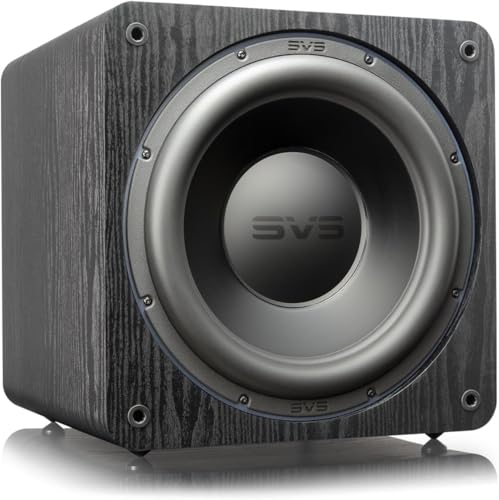
The SB-3000 is the deepest-reaching sealed subwoofer in this group, built around a 13-inch driver and an 800-watt RMS amplifier that give it the headroom to fill large rooms without strain. Its sealed cabinet keeps the low end fast and controlled even at high output, which matters when a home theater system needs both impact on film effects and accuracy on music. The app-based DSP includes parametric EQ and presets, so the owner can shape the response to the room instead of accepting a fixed tuning.
Specs
- 13-inch high-excursion driver in a sealed cabinet
- 800 watts RMS, 2500 watts peak, Sledge STA-800D2 amplifier
- Frequency response 18 to 270 Hz, plus or minus 3 dB
- 50 MHz Analog Devices Audio DSP with smartphone app control
- RCA line-level and LFE inputs, front-firing driver
Best for: Large living rooms and dedicated media rooms where the upgrade must reach the deepest notes at theater volume.
Watch out for: Weigh the cabinet and check the delivery path, because this is a heavy subwoofer that is awkward to move alone into a tight media room.
KEF KC62

The KC62 is the outlier here, and it earns its place by doing what no conventional single-driver sub of its size can. Two 6.5-inch Uni-Core drivers fire in opposite directions inside a sealed cabinet barely larger than a football, cancelling vibration while reaching down to 11 Hz on the listing. It suits rooms where a large black box is not an option, and its five preset EQ modes help it adapt to corners, free space, and wall placement. The result is deep, clean bass from a subwoofer that disappears into a living room.
Specs
- Dual 6.5-inch Uni-Core force-cancelling drivers in a sealed cabinet
- 1,000 watts RMS total, dual 500-watt Class D amplifiers
- Frequency response 11 Hz to 200 Hz
- Five preset EQ modes for room placement and corner use
- LFE and RCA line-level inputs, compact aluminum cabinet
Best for: Compact rooms, apartments, and design-led setups where a full-size subwoofer will not fit or will not pass the household test.
Watch out for: Verify the five EQ presets match the planned placement, since a corner position and a free-space position need different settings to sound right.
REL T/7x
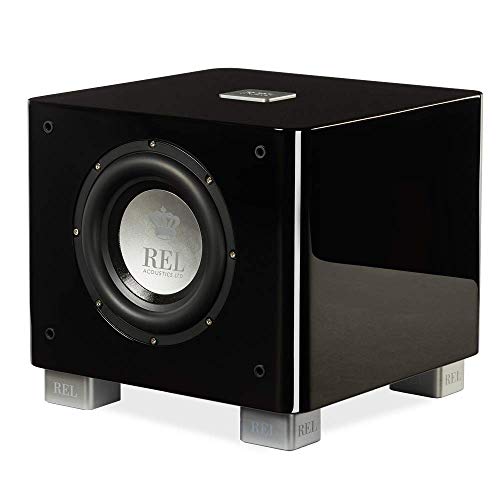
The T/7x is the music-first pick in this group, built for stereo systems where the subwoofer must keep pace with fast, detailed main speakers. Its 8-inch front-firing driver pairs with a 10-inch passive radiator inside a sealed cabinet, and the 200-watt Class AB amplifier gives the bass a natural, unforced character. The high-level Neutrik Speakon input is the key feature for two-channel owners, since it lets the sub take its signal from the same amplifier terminals as the main speakers.
Specs
- 8-inch front-firing long-throw driver with 10-inch passive radiator
- 200 watts Class AB amplifier in a sealed cabinet
- Low-frequency response down to 30 Hz at minus 6 dB
- High-level Neutrik Speakon, LFE, and low-level RCA inputs
- High-gloss cabinet with front-firing driver
Best for: Stereo music systems where the sub must blend invisibly with stand-mount or floor-standing speakers.
Watch out for: Check that the stereo amplifier has accessible speaker terminals for the high-level connection, and confirm the finish color on the listing before ordering.
Which One Fits Your Situation
Your room is small and music comes first
Pick the KEF KC62 or the REL T/7x. The KC62 fits where nothing else will and still reaches remarkably deep, while the T/7x blends with a stereo pair through its high-level input. Both keep bass tight and controlled at moderate volumes, which is exactly what a small room rewards for everyday listening.
Your home theater needs real depth on film soundtracks
Pick the SVS SB-3000 if the room is large, or the SB-2000 Pro for a medium room. Both deliver the output and low-end extension that make film effects feel physical, and their app control makes it easy to balance the sub against the rest of the system from the listening seat after setup.
You want the simplest first sealed upgrade
Pick the SVS SB-1000 Pro. It reaches low enough for most music and film, fits easily beside a media console, and its app control removes much of the guesswork from setup. It is the lowest-risk way to hear what a sealed subwoofer adds to a system you already enjoy every day.
The subwoofer has to disappear into the room
Pick the KEF KC62. Its cabinet is small enough to hide beside furniture or under a side table, and the dual-driver design cancels the vibration that would otherwise rattle nearby objects. The preset EQ modes help it adapt to whatever spot it ends up in around the room at home.
Common Mistakes
- Buying the largest driver available and then placing the subwoofer in a corner without any tuning, which produces boomy bass that drowns out the main speakers.
- Choosing a ported subwoofer by accident when the goal is tight, musical bass, then wondering why the low end feels slow on music.
- Skipping the crossover setting and letting the subwoofer overlap the main speakers across the same frequencies, which muddies voices and instruments.
- Placing the subwoofer where it looks tidy instead of where it sounds best, and never trying a second position before deciding it is the wrong model.
- Ignoring the input types on the listing and discovering after delivery that the stereo amplifier has no matching output for the subwoofer.
Frequently Asked Questions
Is a sealed subwoofer better than a ported one for a low-frequency upgrade?
A sealed subwoofer is the better pick when accuracy and speed matter most, because its closed cabinet produces tighter bass with a more gradual roll-off. Ported models can play louder around their tuning frequency, but they often sound less controlled on music. Choose sealed for mixed music and film use in small to medium rooms, and ported only when maximum output at a specific low frequency is the priority.
How low should a subwoofer reach for a real upgrade?
Aim for a stated response that reaches at least into the low 20 Hz range for home theater, since film soundtracks carry energy below what most speakers reproduce. Music listeners can be happy with a sub that reaches the low 30s, because most recordings have little content below that. Always compare the low-frequency limit at the same tolerance, since a number quoted without one tells only part of the story.
Do I need a receiver with bass management to use these subwoofers?
A receiver with bass management makes setup easier, but it is not required for every model here. The SVS models work well from a receiver LFE output, while the REL T/7x is designed to connect to a stereo amplifier through its high-level input. Check the inputs on the listing against the outputs on the amplifier or receiver before ordering.
Can one sealed subwoofer fill a large open-plan room?
One compact sealed subwoofer can struggle in a large open-plan space, because the air volume is far greater than in an enclosed room. A larger model like the SB-3000 handles that job better, and some owners eventually add a second matching subwoofer to even out the bass across seating positions. Start with the largest suitable model the room and budget allow, then judge the result before adding another.
Related guides
More from Amazon
Programs that pair well with the guide above. Offers and eligibility are set by Amazon and may change.
Free shipping on eligible items, Prime Video and more. Eligible new members can start with a free trial.
Start a Prime free trialAudiobooks and podcasts to listen to on the go. Eligible new members can start with a free trial.
Try Audible freeAd-free music streaming. Eligible new subscribers can start with a free trial.
Try Music Unlimited freeA free business account with business pricing and bulk-buying tools for work, shop or home office.
Create a business accountAs an Amazon Associate we earn from qualifying purchases.










Write Your Review
No reviews yet. Be the first to share your experience!