
Key takeaways
- Compare the best mixed-signal oscilloscopes for quality control, with 16 digital channels, deep memory, and mask testing for inspection benches.
What's inside
As an Amazon Associate I earn from qualifying purchases. This post may contain affiliate links at no extra cost to you.
Quality control inspection fails in a particular way: a board passes its analog checks, yet an intermittent logic glitch, a mistimed bus transaction, or a marginal clock edge slips through and reaches a customer. A mixed-signal oscilloscope closes that gap by showing analog waveforms and sixteen digital channels on one time-aligned screen, so an inspector can prove that both halves of a design behaved during the same capture.
This guide serves incoming-inspection teams, production test technicians, and quality engineers who verify assembled boards and finished electronic products before they ship or enter stock. Every product below is a benchtop mixed-signal model with genuine digital channels, chosen from the names and specifications printed on its Amazon product page, with no plain oscilloscopes and no computer-tethered instruments included.
Quick Picks
As an Amazon Associate we earn from qualifying purchases.
| Product | Best for | Key spec from title |
|---|---|---|
| Rigol MSO5104 | Main inspection bench for mixed-signal boards | 100 MHz, 8 GSa/s, 16 digital channels |
| Rigol MSO5074 | Repeat pass or fail stations on a tighter budget | 70 MHz, 8 GSa/s, 16 digital channels |
| Rigol DHO914S | Fine analog detail on power and sensor lines | 125 MHz, 12-bit, 16 digital channels |
| Rigol DHO924S | Faster boards and higher-speed digital edges | 250 MHz, 12-bit, 16 digital channels |
How to Choose
Analog Bandwidth Matched to the Fastest Signal
Bandwidth decides whether an edge on the inspection report looks like the edge the board actually produced. A scope rated well above the fastest clock or switching signal on your products keeps rise times honest, which matters when a marginal driver only fails at full speed. Match the rating to the fastest signal in your current product mix, then leave headroom for the next revision. Choosing barely enough bandwidth today often means requalifying a different instrument next year, repeating fixture work and rewriting the inspection procedure around new menus and file formats.
Digital Channels and the Logic Probe
Sixteen digital channels let an inspector watch a whole parallel bus, a set of control lines, or several status signals beside the analog waveform that caused them. Confirm how the digital inputs are delivered before ordering: on the Rigol models here, the channels are built into the instrument, while the PLA2216 logic probe that connects them is a separate purchase on the DHO900 models. A quality station that cannot connect its logic lines on day one stalls the whole line, so treat the probe as part of the station cost, not an accessory to add later.
Memory Depth and Capture Rate for Intermittent Faults
Quality escapes are usually rare events: one bad frame in a long bus transfer, one dropout during a power ramp. Deep memory holds a long capture at a useful sample rate, so the faulty moment stays in the record when the technician zooms in afterwards. A high waveform capture rate raises the odds that a fast, infrequent glitch appears on screen during a short inspection window. Together, memory and capture rate decide whether the station catches the one-in-a-thousand fault or signs it off as a pass.
Mask Testing, Saving, and Repeatability
An inspection station earns its keep by giving the same verdict on every shift. Mask or pass and fail testing compares each capture against a stored limit and flags failures without relying on an operator’s judgement of a trace. Equally important is how setups and results are saved: a scope that stores its configuration and exports screen images or waveform data makes audit trails and supplier discussions far easier. Check that the exact pass criteria can be locked into a recalled setup, so a night-shift operator runs the identical test as the engineer who qualified it.
The 4 Best Options
Rigol MSO5104

The MSO5104 suits a main quality control bench that inspects varied mixed-signal boards all day. Its 100 MHz bandwidth and 8 GSa/s sample rate cover typical microcontroller, interface, and power-stage signals, while 100 Mpts of standard memory keeps long bus transfers in one capture for review. Sixteen digital channels sit beside the four analog inputs, and the listing notes the MSO5000-BND bundle is included, which broadens the analysis functions available to the inspection team without a second ordering step for licences.
Specs
- Bandwidth: 100 MHz
- Analog channels: 4, plus 16 digital channels
- Sample rate: up to 8 GSa/s
- Memory depth: 100 Mpts, optional up to 200 Mpts
- Waveform capture rate: over 500,000 wfms/s
- Display: 9-inch capacitive multi-touch screen
- Vertical range: 500 μV/div to 10 V/div
- Bundle: MSO5000-BND included
- Dimensions: 367 mm × 200 mm × 130 mm; weight 3.5 kg
Best for: A central inspection bench verifying several board types against documented limits.
Watch out for: The 16 digital channels need the PLA2216 logic probe to operate, so confirm whether it is in the box or order it with the scope.
ASIN: B07KMKQM4Z
Rigol MSO5074

The MSO5074 fits repeat inspection stations where every bench runs the same checks and the product’s signals stay within 70 MHz. It keeps the same 8 GSa/s sampling, 100 Mpts standard memory, and sixteen digital channels as its 100 MHz sibling, so test procedures, fixtures, and saved setups transfer between stations without retraining operators. For a quality manager equipping several identical pass or fail points on one line, that shared platform simplifies spares, documentation, and the audit trail behind each verdict.
Specs
- Bandwidth: 70 MHz
- Analog channels: 4, plus 16 digital channels
- Sample rate: up to 8 GSa/s
- Memory depth: 100 Mpts, optional up to 200 Mpts
- Waveform capture rate: over 500,000 wfms/s
- Display: 9-inch capacitive multi-touch screen
- Vertical range: 500 μV/div to 10 V/div
- Bundle: MSO5000-BND included
- Dimensions: 367 mm × 200 mm × 130 mm; weight 3.5 kg
Best for: Multiple identical inspection stations running the same documented checks each shift.
Watch out for: The 70 MHz ceiling is fixed for this model variant, so check the fastest signal in upcoming product revisions before standardising on it.
ASIN: B07PC2B7CY
Rigol DHO914S
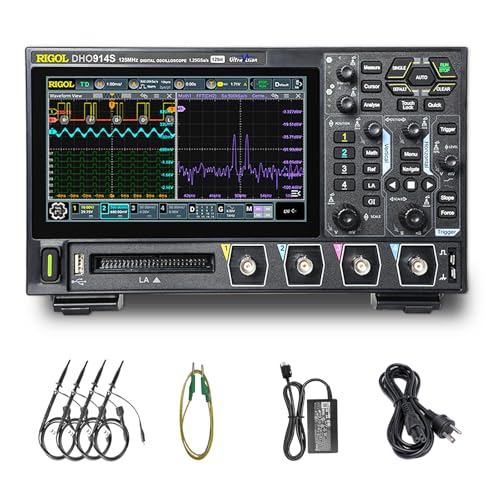
The DHO914S suits inspection work where the analog detail itself is the verdict: power rail ripple, sensor outputs, and slow control signals that an 8-bit scope renders coarsely. Its 12-bit resolution and 125 MHz bandwidth give finer vertical steps, and the built-in signal generator with Bode plot support helps a quality lab run response checks on filters and feedback loops at the same bench. Sixteen digital channels are standard in the design, keeping logic context beside those sensitive analog traces during a single capture.
Specs
- Bandwidth: 125 MHz
- Analog channels: 4, plus 16 digital channels
- Sample rate: up to 1.25 GSa/s
- Vertical resolution: 12-bit
- Memory depth: up to 50 Mpts
- Waveform capture rate: up to 1,000,000 wfms/s in UltraAcquire mode
- Built-in single-channel arbitrary function generator and Bode plot
- Digital channels require the PLA2216 probe, sold separately
Best for: Inspecting power rails, sensors, and analog outputs where fine vertical detail decides the verdict.
Watch out for: Budget for the PLA2216 logic probe separately, and note the sample rate is shared, so it falls as more channels are switched on.
ASIN: B0CGHRL266
Rigol DHO924S

The DHO924S is the step up for quality teams whose products run faster clocks and sharper edges. It doubles the DHO914S bandwidth to 250 MHz while keeping the 12-bit resolution, 50 Mpts memory, built-in generator, and Bode plot capability, so a lab can qualify higher-speed boards without giving up fine analog detail. That combination fits end-of-line verification on communications and computing hardware, where a marginal timing relationship between a fast clock and its data lines is exactly the fault the station exists to catch.
Specs
- Bandwidth: 250 MHz
- Analog channels: 4, plus 16 digital channels
- Sample rate: up to 1.25 GSa/s
- Vertical resolution: 12-bit
- Memory depth: up to 50 Mpts
- Waveform capture rate: up to 1,000,000 wfms/s in UltraAcquire mode
- Built-in single-channel arbitrary function generator and Bode plot
- Digital channels require the PLA2216 probe, sold separately
Best for: End-of-line checks on faster boards where clock and data timing margins decide pass or fail.
Watch out for: With all channels active the shared sample rate drops, so confirm the per-channel rate still resolves the fastest edge in your test plan.
ASIN: B0CGHTLRHS
Which One Fits Your Situation
One Bench Inspecting Many Different Board Types
Choose the Rigol MSO5104. Its 100 MHz bandwidth, deep standard memory, and included MSO5000-BND bundle cover the widest spread of products without reconfiguring the station between jobs. Saved setups for each board keep changeovers quick, and the sixteen digital channels handle the bus checks that a plain analog scope would miss entirely during incoming inspection.
Several Identical Pass or Fail Stations on One Line
Choose the Rigol MSO5074 for each station. The shared platform means one procedure document, one training session, and interchangeable fixtures across the line, while the 70 MHz rating still covers the control and interface signals most production boards use. Consistency between stations matters more in this setting than the extra bandwidth a flagship model would add.
Verifying Power Supplies and Analog Subassemblies
Choose the Rigol DHO914S. The 12-bit converter resolves small ripple and drift that decide whether a power stage or sensor board ships, and the built-in generator with Bode plot lets the same bench run response checks during qualification. Add the PLA2216 probe so logic enables and fault lines are recorded beside the analog evidence.
Qualifying Faster Digital Products at End of Line
Choose the Rigol DHO924S. Its 250 MHz bandwidth keeps fast clock edges truthful, and the 12-bit resolution still shows the analog behaviour behind a timing failure. For communications or computing hardware leaving the line, that pairing catches marginal boards that a slower or coarser instrument would pass without comment or a second look.
Common Mistakes
- Buying a plain digital oscilloscope for a mixed-signal job, then discovering the control lines and bus states behind a failure were never captured.
- Forgetting the logic probe: on several models the digital channels are built in, but the probe that connects them is a separate line item.
- Setting a pass limit from a single golden board, so normal production spread triggers false failures or lets marginal boards through.
- Leaving inspection setups unsaved, which lets each shift run slightly different vertical, trigger, and mask settings on the same product.
- Judging a board on a short capture when its known fault is intermittent and only deep memory or a long record would contain it.
Frequently Asked Questions
Why does quality control need digital channels as well as analog ones?
Many field failures are timing relationships, not bad levels: a control line that changes too late, a bus that settles after its clock edge. Sixteen digital channels shown on the same timebase as the analog traces let an inspector prove both halves behaved together, instead of passing a board whose signals each looked acceptable in isolation.
Is the logic probe included with these oscilloscopes?
Not always. On the Rigol MSO5000 models the sixteen digital channels are standard and the listing states the PLA2216 probe is required to operate them, while the DHO900 models list that probe as sold separately. Read the exact listing contents before ordering, and add the probe to the station budget whenever it is not shown as included.
How much memory depth does an inspection station need?
Enough to hold the longest event the test must judge at the chosen sample rate. A power-up sequence or a full bus transfer can run far longer than a single screen at fast sampling, and shallow memory forces a slower rate that blurs edges. The 50 to 100 Mpts classes listed here suit most board-level inspection records comfortably.
Can one setup be reused across shifts and stations?
Yes, provided the scope saves full configurations and the team recalls them rather than rebuilding settings by hand. Save the qualified setup under the product’s name, protect it from casual edits, and keep the same model at each station where possible. That discipline is what turns an oscilloscope reading into a repeatable quality record.
Related guides
More from Amazon
Programs that pair well with the guide above. Offers and eligibility are set by Amazon and may change.
Free shipping on eligible items, Prime Video and more. Eligible new members can start with a free trial.
Start a Prime free trialAudiobooks and podcasts to listen to on the go. Eligible new members can start with a free trial.
Try Audible freeAd-free music streaming. Eligible new subscribers can start with a free trial.
Try Music Unlimited freeA free business account with business pricing and bulk-buying tools for work, shop or home office.
Create a business accountAs an Amazon Associate we earn from qualifying purchases.










Write Your Review
No reviews yet. Be the first to share your experience!