
Key takeaways
- Compare programmable DC electronic loads on remote control, dynamic modes, list functions and power ratings for power supply and battery testing work.
What's inside
As an Amazon Associate I earn from qualifying purchases. This post may contain affiliate links at no extra cost to you.
A programmable DC electronic load earns its place on the bench when a test has to run the same way every time: a scripted discharge curve, a stepped load profile during a design review, or an overnight battery run nobody wants to babysit. The real decision is not the wattage on the box. It is whether the load’s interfaces, dynamic modes and measurement resolution match the supplies and packs you actually validate, because a load that cannot be driven from your PC or sequencer is just an expensive resistor with a fan.
This guide is for design engineers automating power-supply validation, technicians running repeatable battery discharge tests, and lab managers standardising one load model across benches. Every pick below is a programmable DC electronic load sold on Amazon US, selected from the names, interfaces and ratings published on its product page.
Quick Picks
As an Amazon Associate we earn from qualifying purchases
| Product | Best for | Key spec from title |
|---|---|---|
| Siglent SDL1020X-E | Scripted bench tests over a network | 150 V / 30 A / 200 W with LAN built in |
| Rigol DL3021 | Stepped load profiles run on the instrument | 150 V / 40 A / 200 W, list mode to 512 steps |
| Siglent SDL1030X-E | 12 V and 24 V supplies that need headroom | 150 V / 30 A / 300 W with LAN built in |
| Korad KEL103 | Networked discharge logging on a budget | 120 V / 30 A / 300 W with LAN built in |
| East Tester ET5410A+ | Large battery packs and higher-power rails | 150 V / 40 A / 400 W, battery test functions |
How to Choose
Match the voltage, current and power envelope together
A load has three ceilings, and the one you hit first depends on the device under test. A 24 V supply delivering 10 A already needs 240 W, so a 200 W load runs out of power long before its 30 A current limit matters. Work the other way for a 3.3 V rail: current and the minimum operating voltage decide whether the load can even sink what you ask at that voltage. List the highest voltage, the highest current and the highest wattage across your real test queue, then buy the envelope that covers all three at once rather than upgrading twice.
Check which remote interfaces are actually fitted
Programmable only means something if the load speaks to your controller. USB is enough for a single bench driven by a laptop. RS-232 still shows up on loads aimed at older automated racks. LAN is the option that pays off in shared labs, because the instrument gets its own address and any machine on the network can run the test or pull the log. Confirm the fitted ports on the listing before ordering, since several families sell near-identical front panels with different interface sets, and an optional module is an extra purchase, not a firmware unlock.
Look at dynamic mode and slew rate for transient work
Static modes tell you how a supply behaves at a steady draw. Dynamic mode tells you how it survives a load step: the load alternates between two current levels at a set frequency while you watch the rail dip and recover on a scope. A dynamic range reaching 25 kHz covers processor and radio burst patterns that slower loads simply smooth over. Slew rate matters just as much, because a load that ramps at 2.5 A per microsecond can reproduce the sharp edges of real digital loads, while a slow ramp flatters a weak regulator into looking stable.
Weigh readback resolution and remote sense
The load is also your measuring instrument during a test, so its readback resolution sets the smallest change you can trust. One millivolt and one milliamp steps suit most supply work; finer low ranges help when a discharge curve flattens near the cut-off voltage. Four-wire remote sense is the other quiet essential. At 20 A or more, the test leads themselves drop real voltage, and without sense leads connected at the device terminals the load regulates against the wrong number and your recorded curve drifts from the truth.
The 5 Best Options
Siglent SDL1020X-E

For a bench that runs its tests from a computer, this is the load the rest of the guide is measured against. It pairs a 200 W input stage with USB, RS-232 and LAN fitted as standard, so a script can set the mode, step the current and collect the log without anyone touching the front panel. The dynamic mode reaches 25 kHz for burst-style transient checks, and the built-in battery discharge function with a settable cut-off handles cell and pack capacity runs. It suits engineers automating supply validation and technicians who repeat the same discharge routine daily.
Specs
- Input: 150 V, 30 A, 200 W maximum
- Modes: CC, CV, CR and CP, plus dynamic operation
- CC dynamic mode up to 25 kHz
- Readback resolution: 1 mV / 1 mA
- Interfaces: USB, RS-232 and LAN built in
- Battery discharge test function with cut-off setting
- Four-wire remote sense supported
- Display: 3.5 inch TFT-LCD
- Adjustable current slew rate: 0.001 to 2.5 A/µs
Best for: Automated power-supply validation and repeatable battery discharge tests driven from a PC.
Watch out for: GPIB needs an optional USB-GPIB module, so confirm your rack’s bus before assuming it is covered.
ASIN: B07RS2B8VT
Rigol DL3021

Rigol built this load around running profiles on the instrument itself. Its list function chains up to 512 steps, so a supply can be walked through a whole sequence of loads, dwells and transitions without a computer attached, and the built-in battery, OCP and OPP test routines cover the checks design teams repeat most. The 40 A input ceiling is the highest current rating in this guide at 200 W, which helps with low-voltage, high-current converters. USB and RS-232 handle remote work. It fits design engineers who want self-contained automated sequences during development and review testing.
Specs
- Input: 150 V, 40 A, 200 W maximum
- Modes: CC, CV, CR and CP
- Dynamic modes: continuous, pulsed and toggled, up to 15 kHz
- List function: up to 512 steps
- Built-in battery, OCP and OPP test functions
- Interfaces: USB and RS-232 built in
- Current slew rate up to 2.5 A/µs
- Display: 4.3 inch TFT LCD
Best for: Stepped load profiles and protection tests that should run without a PC attached.
Watch out for: There is no LAN port fitted, so network-based lab setups need the USB or serial connection instead.
ASIN: B074P7MTSS
Siglent SDL1030X-E
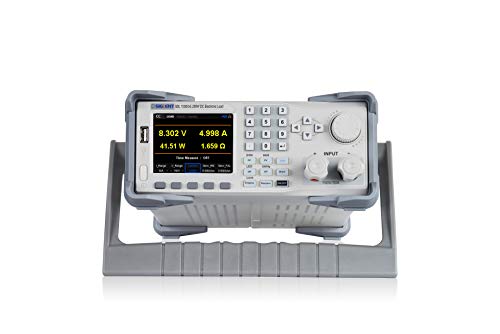
This is the SDL1020X-E’s platform with the power stage raised to 300 W, and that single change decides who should buy it. At 12 V or 24 V, a 200 W load exhausts its wattage while its current meter still shows headroom, which is exactly where LED drivers, motor supplies and larger battery packs live. Everything else carries over: the same four static modes, 25 kHz dynamic operation, battery discharge test, four-wire sense and the full USB, RS-232 and LAN interface set. Choose it when your test queue regularly crosses 200 W and you want one instrument to stay on the bench for years.
Specs
- Input: 150 V, 30 A, 300 W maximum
- Modes: CC, CV, CR and CP, plus dynamic operation
- CC dynamic mode up to 25 kHz
- Readback resolution: 1 mV / 1 mA
- Interfaces: USB, RS-232 and LAN built in
- Battery discharge test function with cut-off setting
- Four-wire remote sense supported
- Display: 3.5 inch TFT-LCD
- Adjustable current slew rate: 0.001 to 2.5 A/µs
Best for: Testing 12 V and 24 V supplies and larger packs that push past 200 W.
Watch out for: The extra wattage buys nothing for low-voltage logic rails, so size it against your real test queue.
ASIN: B07RQYH3KW
Korad KEL103

The KEL103 is the value route into a networked programmable load. It offers a 300 W input with USB, RS-232 and LAN control, which puts scripted discharge logging within reach of smaller labs and serious home benches that cannot justify the bigger brands. Its low measurement ranges resolve to 0.1 mV and 0.1 mA per the listing, finer than the one-millivolt class above, which helps when a discharge curve needs a precise endpoint. The trade-offs sit in polish rather than capability: the interface and firmware are simpler, and the voltage ceiling is 120 V instead of 150 V. For battery work and mid-voltage supplies, neither limit bites often.
Specs
- Input: 120 V, 30 A, 300 W maximum
- Modes: CC, CV, CR and CW
- Interfaces: USB, RS-232 and LAN built in
- Low-range resolution: 0.1 mV / 0.1 mA per the listing
- Programmable operation for scripted discharge logging
Best for: Battery discharge logging and scripted tests in labs watching the equipment budget.
Watch out for: The 120 V ceiling rules it out for higher-voltage supply work, so check your maximum test voltage first.
ASIN: B07GVNQZQF
East Tester ET5410A+
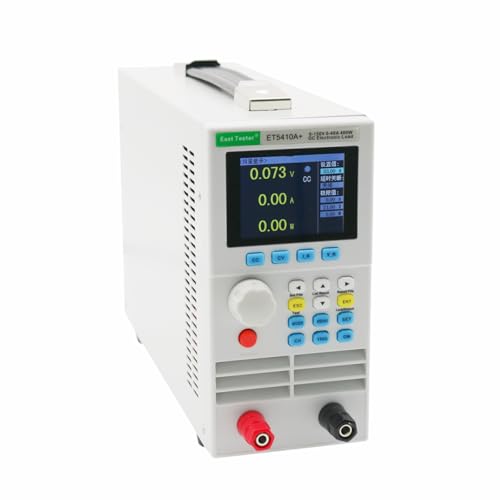
When the job is draining big packs or loading a 24 V supply near its limit, wattage stops being a luxury. The ET5410A+ is rated at 400 W with a 40 A input, the largest envelope in this guide, and it adds battery capacity and internal resistance test functions aimed squarely at pack work. A color display and the four standard modes, CC, CV, CR and CP, round out a specification that leans toward throughput rather than lab polish. It suits battery builders, repair benches and anyone whose discharge tests regularly run past what a 200 W or 300 W instrument can absorb.
Specs
- Input: 150 V, 40 A, 400 W maximum
- Modes: CC, CV, CR and CP
- Battery capacity and internal resistance test functions
- Color display
- Single-channel programmable operation
Best for: High-power battery pack discharge work and heavily loaded 24 V supplies.
Watch out for: Independent listings note the effective measurement resolution can be coarser than headline figures, so verify the readback against a trusted meter for fine work.
ASIN: B0C9LVZ8WK
Which One Fits Your Situation
You run the same validation script on every prototype
Take the Siglent SDL1020X-E. LAN control means the test lives on the instrument’s network address, any workstation can launch it, and the battery and dynamic functions cover the two routines prototype teams repeat most. The Rigol DL3021 is the alternative when the sequence should live inside the load itself rather than in a script on a PC.
Your supplies live at 12 V and 24 V
Pick the Siglent SDL1030X-E. Its 300 W stage is the difference between finishing a full-load test and watching a 200 W instrument fold back halfway through, and it keeps the same interfaces and battery test as its smaller sibling, so nothing about your workflow changes when the wattage goes up.
You discharge large packs every week
The East Tester ET5410A+ fits, because its 400 W and 40 A envelope absorbs long, heavy discharges that would thermally stress a smaller load, and its built-in capacity and internal resistance functions are aimed at exactly this work. For gentler pack testing with network logging, the Korad KEL103 is the calmer choice.
Your lab shares instruments across several benches
Choose a LAN-equipped model, which means the two Siglents or the Korad KEL103. A networked load can be booked, driven and read from whichever bench is free, and its logs land on a server instead of a USB stick. Between them, decide on wattage: 200 W, 300 W, or the Korad when budget leads.
Common Mistakes
- Sizing a load by wattage alone, then discovering the voltage or current ceiling blocks the test you actually run.
- Testing single cells or low-voltage rails without checking the load’s minimum operating voltage at your target current.
- Skipping the remote sense leads on high-current runs, so cable drop quietly corrupts every recorded value.
- Assuming programmable means networked, and ordering a USB-only model for a rack that was wired for LAN control.
- Starting a long discharge without setting the protection cut-offs, leaving a battery to drain below its safe floor.
Frequently Asked Questions
What does programmable actually mean on a DC electronic load?
It means the load can be driven by stored sequences or by a computer, not just by its front-panel knobs. Depending on the model that covers list or step functions, remote control over USB, RS-232 or LAN with standard command sets, and automatic test routines for batteries and protection limits. The point is repeatability: the same profile runs identically today and next month.
Can one of these loads test batteries as well as power supplies?
Yes. A battery discharge test draws a set current or power until the pack reaches a cut-off voltage you choose, then reports the delivered capacity. Most models here include a dedicated battery function, and the same instrument still handles constant-current, constant-voltage, constant-resistance and constant-power work for supply validation, so one purchase covers both benches.
How much power rating do I really need?
Multiply the highest voltage you test by the highest current you draw at that voltage, then leave headroom. A 5 V, 3 A supply needs only 15 W, while a 24 V, 10 A supply needs 240 W and therefore a 300 W or 400 W class load. Remember the envelope is three limits at once, not a single wattage figure.
Is LAN control worth it if I only have one bench?
For a single bench next to its computer, USB does the same job and every model here includes it. LAN earns its place when the load moves between benches, sits in a rack away from the operator, or feeds results to a shared server. If none of that describes your setup, spend the difference on wattage or resolution instead.
Related guides
More from Amazon
Programs that pair well with the guide above. Offers and eligibility are set by Amazon and may change.
Free shipping on eligible items, Prime Video and more. Eligible new members can start with a free trial.
Start a Prime free trialAudiobooks and podcasts to listen to on the go. Eligible new members can start with a free trial.
Try Audible freeAd-free music streaming. Eligible new subscribers can start with a free trial.
Try Music Unlimited freeA free business account with business pricing and bulk-buying tools for work, shop or home office.
Create a business accountAs an Amazon Associate we earn from qualifying purchases.










Write Your Review
No reviews yet. Be the first to share your experience!