
Key takeaways
- Compare programmable DC electronic loads with constant-current mode for research labs: CC profiles, remote control, and repeatable automated testing.
What's inside
As an Amazon Associate I earn from qualifying purchases. This post may contain affiliate links at no extra cost to you.
A research lab rarely buys an electronic load for a single afternoon of bench work. The real decision is whether the instrument can run the same discharge profile on Tuesday that it ran on Monday, log the result without someone babysitting the front panel, and hold a steady constant-current draw while a device under test drifts, warms up, or sags. A load that only works by hand becomes a bottleneck the moment a test plan grows past a handful of steps.
This guide is written for research engineers, lab technicians, and graduate researchers who need programmable DC loads with a genuine constant-current mode for repeatable work. Every product below was picked from its name and specifications on its Amazon listing, with attention to voltage, current and power limits, the CC mode itself, and the interfaces that let a computer drive the test.
Quick Picks
As an Amazon Associate we earn from qualifying purchases.
| Product | Best for | Key spec from title |
|---|---|---|
| Siglent SDL1020X-E | Scripted supply and battery tests on a shared bench | 150 V, 30 A, 200 W with USB, RS-232, and LAN |
| Rigol DL3021 | Long automated load profiles with hundreds of steps | 150 V, 40 A, 200 W with a list function up to 512 steps |
| Korad KEL103 | Networked logging from a remote test station | 120 V, 30 A, 300 W with USB, RS-232, and LAN |
| Maynuo M9712 | Straightforward CC discharge work at higher power | 150 V, 30 A, 300 W with USB programming |
| East Tester ET5410A+ | High-power battery and charger testing on a budget bench | 150 V, 40 A, 400 W with CC, CV, CR, and CP modes |
How to Choose
Match the operating box to the device under test
Voltage, current, and power limits form a box, and a test only works inside it. A 24 volt supply delivering 10 amps needs 240 watts, so a 200 watt load runs out of headroom even though its voltage and current ratings look generous on their own. Write down the highest voltage, the highest current, and the product of the two for every device the lab plans to test, then pick a load whose three numbers cover all of them with room to spare. Checking this arithmetic before ordering prevents the common frustration of a load that trips its power limit halfway through a discharge run.
Treat constant-current mode as the working mode, not a checkbox
Almost every programmable load lists CC mode, yet the details decide whether it serves research work. Look at the current ranges the listing states, because a load with a low range near the currents you actually use gives finer setting steps and steadier readings than one that only resolves well near full scale. Also check the minimum operating voltage, since a load may need a volt or more across its terminals before it can sink its rated current, which matters when testing single cells or low-voltage rails. The listing should name CC explicitly alongside the other modes.
Judge the programming path before the front panel
A research load earns its keep when a computer can drive it, so the remote interface deserves as much attention as the display. USB suits a bench beside a laptop, RS-232 fits older test racks, and LAN lets a load sit in another room or on a shared network while scripts collect data. Ask whether the listing mentions a list or sequence function, how many steps it stores, and whether the instrument remembers settings after power-off. A load with a documented command set and a stored sequence can repeat a full test plan with one command instead of a morning of button presses.
Weigh resolution and readback against the measurements you must defend
Research results get questioned, so the numbers a load reports need to stand up. Finer voltage and current resolution helps when characterizing a regulator at light load or tracing a battery discharge curve, while coarse steps hide the small changes that reveal a design problem. Compare the setting resolution and the readback resolution separately, since some instruments set coarsely and measure finely, or the reverse. Also note whether the listing mentions four-wire remote sensing, which removes lead resistance from the reading at higher currents and keeps long cable runs from corrupting the data.
The 5 Best Options
Siglent SDL1020X-E

The SDL1020X-E suits a research bench where one load must cover supply validation, battery discharge, and scripted regression tests without changing instruments between jobs. Its program function builds automated sequences from different modes and durations, and the battery test tracks discharge down to a cut-off, which covers two of the most common lab routines in a single box. Built-in USB, RS-232, and LAN mean the same unit works beside a laptop today and on a networked test rack tomorrow, and the colour display keeps voltage, current, and power visible at a glance during manual setup.
Specs
- Input range of 150 V, 30 A, and 200 W
- Four static modes: CC, CV, CR, and CP
- CC dynamic mode up to 25 kHz
- Built-in USB, RS-232, and LAN interfaces
- Program function for automated test sequences
- Battery discharge test function
- Setting resolution of 1 mV and 1 mA
- 3.5-inch TFT-LCD display
Best for: A shared research bench that needs scripted CC tests plus battery discharge in one instrument.
Watch out for: Confirm the 200 watt ceiling against your highest voltage-times-current test, since headroom disappears fast on 24 volt work.
Rigol DL3021

Rigol built the DL3021 around long automated runs, and the list function is the feature that sets it apart for research use. A sequence of up to 512 steps can walk a supply through its whole operating range, dwell at each point, and repeat the pattern without an operator touching the controls, which is exactly how a lab proves a design behaves the same way every time. The 40 amp ceiling also gives it an edge over most 200 watt rivals when testing low-voltage, high-current rails, and the dynamic modes let it switch between two current levels to probe transient response.
Specs
- Input range of 150 V, 40 A, and 200 W
- Four static modes: CC, CV, CR, and CP
- List function with up to 512 steps
- Three dynamic modes: continuous, pulsed, and toggled
- Dynamic mode up to 15 kHz
- Built-in RS-232 and USB interfaces
- Battery test, over-current protection test, and over-power protection test
- Readback resolution of 0.1 mV and 0.1 mA
Best for: Labs that run long step-by-step load profiles and need 40 amps at low voltage.
Watch out for: Check that the listing for the unit you order includes the interface module your test rack expects, since remote control options vary by configuration.
Korad KEL103

The KEL103 makes sense for a lab that wants solid power and a network connection without stepping up to a premium instrument. Its 300 watt rating covers larger supplies and battery packs that would trip a 200 watt load, and the LAN port lets scripts log discharge curves from another machine while the bench stays clear. One hundred memory sets give researchers a practical way to store recurring test setups and recall them in seconds, which matters when several people share one bench and each project needs its own starting point. The low ranges resolve down to a tenth of a millivolt and a tenth of a milliamp.
Specs
- Input range of 120 V, 30 A, and 300 W
- Four modes: CC, CV, CR, and CW
- USB, RS-232, and LAN interfaces
- 100 sets of memory for stored settings
- Resolution of 0.1 mV and 0.1 mA in low ranges
- Battery test, automatic test, over-power protection test, and over-current protection test
- Dynamic mode frequency up to 10 kHz
Best for: A remote or shared test station that logs CC discharge data over LAN at 300 watts.
Watch out for: Verify the 120 volt ceiling covers your highest-voltage device, since the extra power does not extend the voltage range.
Maynuo M9712

Maynuo has supplied benches for years, and the M9712 keeps the formula simple: a compact programmable load with a genuine CC mode, a 300 watt envelope, and USB programming for logged tests. It fits labs that already know the M97 series workflow and want a second or third unit that behaves the same way as the ones already on the shelf. The 150 volt and 30 amp ratings cover most bench supplies, chargers, and battery packs a research group tests day to day, and the straightforward front panel makes it easy for a new student to set a CC discharge and start recording without a long training session.
Specs
- Input range of 150 V, 30 A, and 300 W
- Four modes: CC, CV, CR, and CW
- Programmable DC electronic load with USB interface
- Designed for testing DC power sources, batteries, and DC-DC converters
- Compact benchtop form factor
Best for: Research groups that want a familiar, compact 300 watt CC load for routine discharge work.
Watch out for: Confirm the exact interface and software included with the listing you buy, since Maynuo bundles have varied and older software can be awkward on current systems.
East Tester ET5410A+
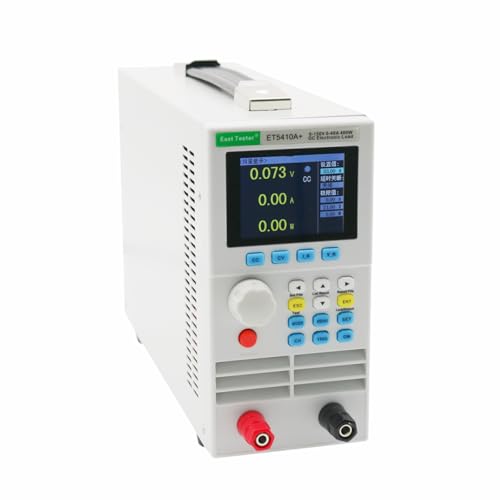
The ET5410A+ brings the most power in this group to benches that test big battery packs and high-current chargers. Its 400 watt rating and 40 amp ceiling handle 24 volt supplies at currents that would overwhelm every 200 watt load here, and the combined CC plus CV and CR plus CV modes help when a test needs a current limit that hands over to a voltage limit, as charger testing often does. A battery test with capacity and internal resistance measurement adds a second routine to the same instrument, and the colour screen keeps the running values readable from across the bench.
Specs
- Input range of 150 V, 40 A, and 400 W
- Modes: CC, CV, CR, and CP, plus combined CC plus CV and CR plus CV
- CC mode ranges of 0 to 3 A and 0 to 40 A
- Battery test with capacity and internal resistance measurement
- USB interface
- 2.8-inch TFT LCD screen
Best for: High-power battery and charger testing where 400 watts and 40 amps matter more than a premium brand badge.
Watch out for: Several Amazon listings carry this model under different sellers, so match the ASIN and the stated specifications on the listing before ordering.
Which One Fits Your Situation
Running the same test plan every week
Pick the Rigol DL3021 when repeatability is the priority. Its list function stores up to 512 steps, so a whole profile runs the same way each time without manual re-entry, and the battery, over-current, and over-power tests add pass-fail checks to the routine. The Siglent SDL1020X-E is the fallback if the lab also needs LAN control and a battery discharge test in the same instrument.
Testing supplies and batteries from another room
Choose the Korad KEL103 for networked work. The LAN interface lets a script drive the load and collect data while the device under test stays in a separate area, and the 300 watt rating covers larger packs than the 200 watt models. Keep the Siglent SDL1020X-E in mind if the lab also wants its faster dynamic mode for transient checks.
Covering low-voltage, high-current rails
Take the Rigol DL3021 or the East Tester ET5410A+, since both reach 40 amps. The Rigol fits when the test is a long automated profile, while the East Tester fits when the priority is raw power, because its 400 watt ceiling handles 24 volt supplies at currents that stop a 200 watt load. Check the minimum operating voltage on the listing before testing single cells.
Equipping a teaching or multi-user bench
Go with the Siglent SDL1020X-E for a bench that many people share. Its colour display, three built-in interfaces, and program function cover manual setup, scripted tests, and battery work without extra modules, so students and researchers can each run their own routine on the same instrument. The Maynuo M9712 works as a simpler second unit for routine CC discharge once the main bench is covered.
Common Mistakes
- Buying on voltage and current alone and forgetting that watts equal volts times amps, so the load trips its power limit mid-test.
- Treating every CC mode as equal and never checking the current ranges, the setting resolution, or the minimum operating voltage on the listing.
- Ordering a load for automated testing and then discovering the interface the lab needs is an optional module rather than built in.
- Running a battery discharge without setting a cut-off voltage, so the test keeps draining the cell past a safe point.
- Using long, thin test leads at high current and blaming the load for voltage readings that the lead resistance actually caused.
Frequently Asked Questions
What does constant-current mode do on a DC electronic load?
Constant-current mode makes the load sink a fixed current from the device under test no matter how its voltage moves within the rated range. Researchers use it to hold a steady draw while measuring voltage regulation, efficiency, and heat, and to discharge a battery at a known rate so capacity can be calculated from the elapsed time.
How is a programmable load different from a fixed resistor bank?
A resistor bank gives one load value per resistor and changes as it heats, while a programmable load holds a set current, voltage, resistance, or power value and can step through a stored sequence on its own. That control is what makes results repeatable across days and operators, which is the point of most laboratory testing.
Which interface should a research lab choose for automated tests?
USB works well for a load beside a control laptop, RS-232 fits older racks and long-running setups, and LAN suits loads in another room or on a shared network. Pick the interface the lab already supports in its scripts, and confirm on the Amazon listing that it is built in rather than an add-on module.
Can one load test both power supplies and batteries?
Yes, when its modes and limits cover both jobs. Constant-current mode discharges a battery at a steady rate, constant-voltage mode tests chargers, and a battery test function stops the discharge at a set cut-off. Check that the voltage, current, and power ratings cover the largest supply and the largest pack the lab plans to test.
Related guides
More from Amazon
Programs that pair well with the guide above. Offers and eligibility are set by Amazon and may change.
Free shipping on eligible items, Prime Video and more. Eligible new members can start with a free trial.
Start a Prime free trialAudiobooks and podcasts to listen to on the go. Eligible new members can start with a free trial.
Try Audible freeAd-free music streaming. Eligible new subscribers can start with a free trial.
Try Music Unlimited freeA free business account with business pricing and bulk-buying tools for work, shop or home office.
Create a business accountAs an Amazon Associate we earn from qualifying purchases.










Write Your Review
No reviews yet. Be the first to share your experience!