
Key takeaways
- Compare mixed-signal oscilloscopes for product development: the Tektronix MSO24 leads four benchtop MSOs with 16 digital channels and deep memory.
What's inside
As an Amazon Associate I earn from qualifying purchases. This post may contain affiliate links at no extra cost to you.
Product development work rarely fails on a clean analog waveform alone. A prototype misbehaves when a control line switches late, a bus transaction collides with a power rail event, or a sensor output drifts at the exact moment firmware changes state. A mixed-signal oscilloscope answers that class of fault because it records analog channels and digital lines on one shared time base, so cause and effect stay aligned. The real decision is which combination of bandwidth, sample rate, memory depth, and digital channel arrangement matches the boards actually moving through development.
This guide is for development engineers, prototype teams, and small product companies choosing a bench MSO for embedded and mixed-signal bring-up. It compares four benchtop models with digital channel capability, from a compact Tektronix 2 Series MSO to deep-memory Rigol platforms. Each product was chosen from the names and specifications printed on its Amazon product page, so the figures quoted here are the figures a buyer can check before ordering.
Quick Picks
As an Amazon Associate we earn from qualifying purchases.
| Product | Best for | Key spec from title |
|---|---|---|
| Tektronix MSO24 2-BW-200 | Development benches standardising on a compact, established platform | 200 MHz, 4 Channels, 2.5 GS/s |
| Rigol MSO5104 | Deep-memory captures of long bus transactions during bring-up | 100 MHz, 4 + 16 Ch, 8GSa/s |
| Rigol DHO914S | Power and embedded work needing fine vertical detail plus a generator | 125 MHz, 4-Ch + 16 Digital, 12-bit |
| Rigol MSO5072 | Two-analog-channel projects that still need sixteen logic inputs | 70 MHz, 2 + 16 Ch, 8GSa/s |
How to Choose
Bandwidth and Sample Rate for Development Boards
Development boards mix slow control logic with fast clock edges, so bandwidth and sample rate must be judged together. Bandwidth decides which signal content survives to the screen, while sample rate decides how precisely edges and glitches are placed in time. A 70 MHz model sampling at 8 GSa/s can time moderate signals very finely, while a 200 MHz model sampling at 2.5 GS/s follows faster analog content with coarser spacing. Check how each listing states its rate, because headline figures often apply to fewer channels than a full prototype setup uses.
Digital Channels and the Logic Probe
Sixteen digital channels are the defining feature of this product class, yet they are not always usable on the day the box arrives. Several models carry the digital inputs as standard hardware but need a named logic probe, such as the PLA2216, which is sold separately, and some platforms enable the digital side through an option or licence. Before ordering, confirm on the listing which probe the digital channels need, whether it is bundled, and what digital sample rate and memory the logic side provides for long captures.
Memory Depth Across a Whole Transaction
Memory depth decides whether a capture covers a single edge or an entire exchange between a controller and its peripherals. Deep analog memory, such as 100 Mpts, holds a long serial transaction at a fast sample rate, so one frame can still be examined closely afterwards. Digital channels keep their own record, which may be much shorter than the analog depth printed in the headline. For development work chasing intermittent faults, compare both depths and the frame recording options rather than trusting one large number.
Protocol Decode, Generators, and Bench Workflow
Product development benches reward tools that reduce instrument swapping. Serial triggering and decoding for buses such as I2C, SPI, UART, and CAN turn the digital channels into a protocol view rather than a row of edges, and listings differ on whether decode is standard or an added bundle. A built-in signal generator with Bode plot support helps when a power stage or filter must be stimulated and measured with the same instrument. Remote interfaces, web control, and screen size also shape daily workflow on a shared development bench.
The 4 Best Options
Tektronix MSO24 2-BW-200

This 200 MHz configuration of the Tektronix 2 Series MSO leads this guide because product development teams often standardise on one maker’s interface, probes, and calibration habits across several benches. Four analog channels and sampling up to 2.5 GS/s cover everyday embedded bring-up, while the family’s optional sixteen digital channels handle the logic side of a mixed-signal fault. Its slim, portable format suits development benches that are rearranged between projects, and the shared interface with higher Tektronix series shortens the learning curve for teams already using those instruments.
Specs
- Bandwidth: 200 MHz
- Analog channels: 4
- Maximum sample rate: 2.5 GS/s
- Record length: 10M points
- Product type: Mixed Signal Oscilloscope
- Manufacturer: Tektronix
- Manufacturer reference: TEK-MSO24 2-BW-200
Best for: Development teams that want a compact 200 MHz Tektronix MSO as the standard bench instrument.
Watch out for: The sixteen digital channels are an option on this family, so confirm the MSO configuration and its probe on the listing before ordering.
ASIN: B0B4FB5C2V
Rigol MSO5104

Development work that hinges on long captures is where the MSO5104 earns its place. Its 100 Mpts of standard analog memory, expandable by option, keeps a complete bus exchange sampled fast enough to zoom into a single frame afterwards, and the 8 GSa/s maximum rate preserves edge timing on its 100 MHz channels. Sixteen digital channels sit alongside the four analog inputs for controller and peripheral debugging, and the platform’s upgrade paths let a growing product team add bandwidth or memory as later board revisions run faster.
Specs
- Bandwidth: 100 MHz
- Analog channels: 4, plus 16 digital channels
- Maximum sample rate: up to 8 GSa/s
- Memory depth: 100 Mpts, up to 200 Mpts with option
- Waveform capture rate: 500,000 wfms/s or more
- Display: 9-inch capacitive multi-touch screen
- Display resolution: 1024 x 600
- Vertical resolution: 8 bits
Best for: Bring-up work that needs deep memory and sixteen logic inputs on 100 MHz boards.
Watch out for: The digital channels require the optional PLA2216 logic probe, which is not included.
ASIN: B07KMKQM4Z
Rigol DHO914S
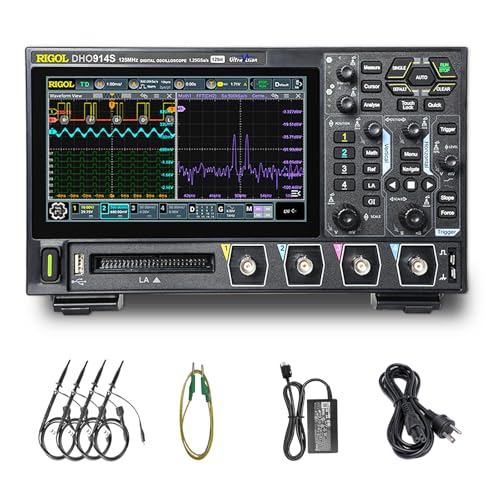
When the development problem sits in a power stage or a slow sensor signal, the DHO914S offers finer vertical detail than the 8-bit models here. Its 12-bit converter resolves smaller level changes on its 125 MHz channels, and the S configuration adds a built-in signal generator with Bode plot support, which suits loop response and filter checks during power supply development. Sixteen digital channels, 50 Mpts of memory, and a very fast capture rate keep it useful for embedded work, all in a compact body that leaves room on a crowded prototype bench.
Specs
- Bandwidth: 125 MHz
- Analog channels: 4, plus 16 digital channels
- Maximum sample rate: 1.25 GSa/s
- Vertical resolution: 12-bit
- Memory depth: 50 Mpts
- Waveform capture rate: 1,000,000 wfms/s UltraAcquire
- Built-in generator: signal generator with Bode plot support (S model)
- Item model number: DHO914S
- Product dimensions: 10.45 x 3.05 x 6.37 inches
- Item weight: 6.45 pounds
Best for: Power and embedded development needing 12-bit detail and a built-in generator.
Watch out for: The sixteen digital channels need the PLA2216 logic probe, sold separately.
ASIN: B0CGHRL266
Rigol MSO5072

Not every development board needs four analog channels on day one. The MSO5072 starts with two analog inputs at 70 MHz while keeping the MSO5000 platform’s sixteen digital channels, 8 GSa/s maximum sampling, and deep standard memory, which covers many microcontroller and interface projects where the logic side carries most of the debugging load. Its 9-inch touch screen, web remote control, and wide interface set suit shared development benches, and the platform leaves the project room to grow within the same instrument family.
Specs
- Bandwidth: 70 MHz
- Analog channels: 2, plus 16 digital channels
- Maximum sample rate: 8 GSa/s
- Memory depth: 100 Mpts
- Waveform capture rate: 500,000 wfms/s
- Display: 9-inch colour touch screen
- Interfaces: USB Device and Host, LAN, USB-GPIB, TRIG OUT, HDMI
- Dimensions: 367 x 200 x 130 mm
- Weight: 3.5 kg
Best for: Two-analog-channel development projects where sixteen logic inputs do most of the work.
Watch out for: Only two analog channels are active as listed, and the digital channels need the PLA2216 logic probe.
ASIN: B07RWM1B99
Which One Fits Your Situation
Standardising Several Development Benches
Choose the Tektronix MSO24 2-BW-200 when a product team wants one interface and probe ecosystem repeated across benches. Its 200 MHz bandwidth covers the fastest signals in this guide’s mainstream group, the format moves easily between workstations, and engineers who already know higher Tektronix series need little retraining. Budget for the digital channel option and its probe so every bench ends up with the same mixed-signal capability.
Debugging Long Bus Transactions in Bring-Up
Pick the Rigol MSO5104 when bring-up sessions revolve around complete I2C, SPI, or UART exchanges rather than single edges. The deep standard memory keeps a whole transaction at a fast sample rate, the capture rate helps with intermittent faults, and sixteen digital channels show controller and peripheral lines together. Order the PLA2216 probe with it, because the logic side stays idle without one.
Developing Power Stages and Slow Signals
Choose the Rigol DHO914S when the analog detail matters more than raw bandwidth. The 12-bit converter shows smaller ripple and level changes on power rails and sensor outputs, while the built-in generator and Bode plot support cover loop response checks without a second instrument. Its compact body also fits benches where a larger scope would crowd out the prototype hardware under development.
Starting With Two Analog Channels
Pick the Rigol MSO5072 when the current project uses two analog measurement points but a full set of logic lines. It keeps the deep memory, fast sampling, and touch interface of its four-channel platform mates at the lowest channel count in this guide, which suits interface-heavy prototypes and shared benches. Confirm the project will not need third and fourth analog channels before the next board revision.
Common Mistakes
- Buying the scope but not the logic probe, leaving sixteen digital channels unusable until a separate order arrives.
- Comparing headline sample rates without checking how the rate changes when all analog and digital channels run together.
- Assuming protocol decode is included, when the listing treats it as a bundle or option that must be specified.
- Judging memory by the analog depth alone and ignoring the separate, shorter record kept for digital channels.
- Choosing bandwidth for today’s board only, with no headroom for the faster clocks planned in the next revision.
Frequently Asked Questions
Does a mixed-signal oscilloscope replace a separate logic analyzer for development work?
For most embedded development, yes for everyday tasks. Sixteen digital channels timed with the analog inputs cover bus timing, handshaking, and control line faults in one capture. A dedicated analyzer still wins for very wide buses or long state listings, but development benches usually need the combined analog and digital view more often than extreme logic depth.
Is the logic probe included with these oscilloscopes?
Often not. On the Rigol models here the sixteen digital channels are standard hardware, but the PLA2216 probe that connects them is sold separately, and the Tektronix family enables its digital side as an option. Read the listing’s contents carefully and budget for the probe, because without it the instrument works as an analog oscilloscope only.
How much bandwidth does product development usually need?
Match bandwidth to the fastest edge on the board rather than the clock frequency printed on a datasheet. Many microcontroller and interface projects sit comfortably within 70 to 125 MHz, while faster memory, high-speed serial, or switching designs push buyers toward 200 MHz and beyond. Sample rate and memory depth matter alongside bandwidth, so compare all three figures on the listing.
Can these models decode serial protocols during bring-up?
Yes, that is a central reason to choose an MSO for development. The models here support triggering and decoding for common buses such as I2C, SPI, UART, and CAN, though the exact protocol set and whether it is bundled or optional varies by listing. Confirm the protocols your boards use against the listing before ordering, and add any required bundle at the same time.
Related guides
More from Amazon
Programs that pair well with the guide above. Offers and eligibility are set by Amazon and may change.
Free shipping on eligible items, Prime Video and more. Eligible new members can start with a free trial.
Start a Prime free trialAudiobooks and podcasts to listen to on the go. Eligible new members can start with a free trial.
Try Audible freeAd-free music streaming. Eligible new subscribers can start with a free trial.
Try Music Unlimited freeA free business account with business pricing and bulk-buying tools for work, shop or home office.
Create a business accountAs an Amazon Associate we earn from qualifying purchases.










Write Your Review
No reviews yet. Be the first to share your experience!