
Key takeaways
- Compare four benchtop DC electronic loads for product development, with programmable modes, dynamic tests, remote sense and PC control for validation.
What's inside
As an Amazon Associate I earn from qualifying purchases. This post may contain affiliate links at no extra cost to you.
Developing a power product means proving the design behaves at every corner: full load at low line, load steps when a radio wakes, a battery near empty. A benchtop DC electronic load is the instrument that applies those conditions repeatably, so the choice is less about raw wattage and more about whether the load can reproduce the profiles your product will meet in the field, hold them steady, and record what the supply under test actually did in response.
This guide is for design and development engineers equipping a bench to validate power supplies, chargers, DC-DC converters and battery-powered products, from first prototype spin to pre-production checks. Every pick below is a benchtop DC electronic load currently sold on Amazon US, and each entry is drawn from the names and specifications on its Amazon product page: input ratings, operating modes, dynamic and list functions, measurement resolution, remote sense and the interfaces offered for PC control.
Quick Picks
As an Amazon Associate we earn from qualifying purchases
| Product | Best for | Key spec from title |
|---|---|---|
| Siglent SDL1020X-E | All-round development bench for low-voltage products | 200 W, 150 V / 30 A |
| Siglent SDL1030X-E | 12 V and 24 V designs needing more dissipation headroom | 300 W, 150 V / 30 A |
| Rigol DL3021 | Scripted load profiles and fine readback resolution | 200 W, 150 V / 40 A |
| Korad KEL103 | Networked validation runs on a tighter equipment budget | 300 W, 120 V / 30 A |
How to Choose
Match the input ratings to your design envelope
Start from the worst case your product can produce, not its nominal rating. A 24 V supply that must deliver 10 A needs a load rated above 240 W at that voltage, and power ratings fall as voltage drops on many models, so read the rating as a voltage-current envelope rather than a single watt figure. Check the minimum operating voltage as well: a load that needs about a volt across its input cannot pull full current from a nearly empty single cell. Leave headroom for inrush and fault testing, where you deliberately exceed normal operating points.
Dynamic and list modes decide what you can simulate
Static CC mode alone only proves a supply can hold one operating point. Product development needs movement: dynamic mode switches between two current levels at a set frequency and slew rate, exposing regulator droop and ringing when a load wakes or sleeps. List or program mode chains many steps with different modes and durations, so a single run can replay a full usage profile, from standby draw to transmit bursts. Compare the dynamic frequency range and the number of list steps each model publishes, and confirm the slew rate is adjustable rather than fixed.
Resolution and remote sense protect your measurements
A load is also a measuring instrument, and development decisions rest on its readbacks. Fine setting and readback resolution, down to 0.1 mV and 0.1 mA on higher-specification models, lets you verify low-current sleep states and small efficiency differences between design revisions. Four-wire remote sense matters just as much at high current: it measures voltage at the device under test instead of at the load terminals, removing the drop across your test leads from the result. Without it, a long cable run can make a healthy supply look out of specification.
Interfaces turn one-off tests into repeatable validation
Development testing repeats: the same load profile runs on every prototype revision, and the results need to be comparable. A load with USB, RS-232 or LAN control can be driven from a PC script, logging voltage and current over hours-long battery discharges or thermal soaks without an engineer standing at the bench. Check which interfaces are built in rather than optional modules, whether the manufacturer publishes a programming manual or SCPI command set, and whether stored test setups can be recalled from the front panel for quick manual checks between automated runs.
The 4 Best Options
Siglent SDL1020X-E

The SDL1020X-E is the natural starting point for a development bench that mostly handles low-voltage products. Its 200 W input covers supplies and converters up to 150 V and 30 A, and the CC dynamic mode runs to 25 kHz, fast enough to imitate the pulsed draw of radios and processors while you watch the rail on a scope. A dedicated battery test, CR-LED mode for LED driver work and four-wire sense round out the development toolkit, and USB, RS-232 and LAN are all built in for scripted runs.
Specs
- Input range: 150 V, 30 A, 200 W
- Modes: CC, CV, CR, CP, plus CR-LED and battery test functions
- CC dynamic mode: up to 25 kHz
- Measurement resolution: 1 mV / 1 mA
- Adjustable current rise time: 0.001 A/µs to 2.5 A/µs
- Four-wire remote sense
- Interfaces: USB, RS-232, LAN
- Display: 3.5-inch TFT-LCD
Best for: Design engineers validating low-voltage supplies, converters and battery-powered products on one bench instrument.
Watch out for: The 200 W ceiling means about 8 A at 24 V, so check your worst-case dissipation first; also confirm the published minimum operating voltage before testing single cells at high current.
ASIN: B07RS2B8VT
Siglent SDL1030X-E
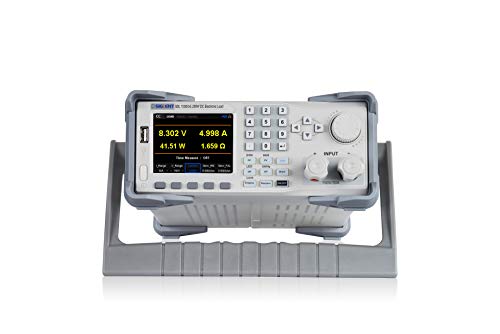
Choose the SDL1030X-E when the products under development regularly push past 200 W: 24 V industrial supplies, larger battery packs and LED drivers all eat dissipation quickly. It keeps the same 150 V and 30 A input span as its smaller sibling and raises the power rating to 300 W, with the same mode set, 25 kHz CC dynamic operation and battery test function. Because the front panel, programming model and interfaces carry over, a team can standardise methods and scripts across both instruments and move a test between benches without rewriting it.
Specs
- Input range: 150 V, 30 A, 300 W
- Modes: CC, CV, CR, CP, plus CR-LED and battery test functions
- CC dynamic mode: up to 25 kHz
- Measurement resolution: 1 mV / 1 mA
- Four-wire remote sense
- Interfaces: USB, RS-232, LAN
- Display: 3.5-inch TFT-LCD
Best for: Teams developing 12 V and 24 V products or discharging larger packs that exceed a 200 W load.
Watch out for: This is the X-E variant with 1 mV / 1 mA resolution; if your work needs the finer 0.1 mV / 0.1 mA readback of the SDL1030X without the E suffix, confirm the exact variant named on the listing before ordering.
ASIN: B07RQYH3KW
Rigol DL3021

The DL3021 suits development work that leans on programmed sequences. Its list function holds up to 512 steps, so a complete load profile, including pauses and mode changes, can run unattended while results are logged over USB or RS-232. Readback resolution of 0.1 mV and 0.1 mA is the finest in this group, which helps when comparing efficiency between board revisions. Three dynamic modes, continuous, pulsed and toggled, cover transient checks, and built-in battery, OCP and OPP test functions shorten common validation routines for protection behaviour.
Specs
- Input range: 150 V, 40 A, 200 W
- Modes: CC, CV, CR, CP
- Dynamic modes: continuous, pulsed and toggled
- List function: up to 512 steps
- Readback resolution: 0.1 mV / 0.1 mA
- Built-in battery, OCP and OPP tests
- Interfaces: USB, RS-232
Best for: Engineers who script multi-step load profiles and need fine readback resolution for revision-to-revision comparisons.
Watch out for: LAN and GPIB are not part of the standard interface set on this listing; if your validation rack is Ethernet-based, confirm the configuration before buying.
ASIN: B074P7MTSS
Korad KEL103

The KEL103 is the value route into a networked development load. It offers 300 W of dissipation across a 120 V, 30 A input, with CC, CV, CR and CW modes and low-range resolution of 0.1 mV and 0.1 mA, figures that sit above what its price class usually publishes. The built-in LAN port is the draw for development teams: discharge curves and long validation runs can be logged from a script on the lab network. Documentation and software are plainer than the bigger brands, but the published specification covers the core development jobs.
Specs
- Input range: 120 V, 30 A, 300 W
- Modes: CC, CV, CR, CW
- Resolution: 0.1 mV / 0.1 mA in low ranges
- Interfaces: USB, RS-232, LAN
Best for: Development benches that want LAN-logged battery and supply testing as the value pick in this group.
Watch out for: Confirm the listing is the KEL103 with LAN rather than the smaller KEL102, and check that the seller’s stated input rating matches the 300 W specification.
ASIN: B07GVNQZQF
Which One Fits Your Situation
Developing battery-powered and IoT products
Pick the Siglent SDL1020X-E. Its battery test function, 25 kHz dynamic mode and four-wire sense map directly onto the jobs this work involves: capacity checks, pulsed radio loads and honest low-voltage readings. The 200 W rating is ample for single-cell and USB-powered designs, and the LAN interface lets overnight discharge runs log themselves.
Validating 12 V and 24 V supplies and larger packs
Take the Siglent SDL1030X-E. At 24 V, a 200 W load runs out of dissipation near 8 A, while the 300 W rating here keeps roughly half as much headroom again for full-load and fault testing. The shared interface and programming model with the smaller Siglent also means existing test scripts carry straight over.
Running scripted design-validation sequences
The Rigol DL3021 fits best. A 512-step list function lets one programmed run step a prototype through its whole operating profile, and the 0.1 mV and 0.1 mA readback resolution makes small regressions between revisions visible in the logged data. Built-in OCP and OPP tests also automate the protection checks every revision should repeat.
Equipping a development bench on a tight budget
Choose the Korad KEL103. It publishes 300 W, a LAN interface and fine low-range resolution, the three things a small team most needs for supply and battery validation, as the value pick in this group. Put the remaining budget toward decent test leads and a remote-sense setup, which affect result quality more than brand badges.
Common Mistakes
- Sizing the load by headline watts only, then discovering the power rating collapses at low voltage or that the minimum operating voltage blocks single-cell testing.
- Checking transient behaviour in static CC mode and missing the droop and ringing that dynamic mode would have exposed.
- Skipping remote sense on high-current tests, so lead resistance gets recorded as if it were supply sag.
- Buying a load whose automation interfaces are optional modules, then finding the budget spent before the first scripted validation run.
- Discharging lithium packs without setting a cut-off voltage in battery test mode, damaging the very cells under development.
Frequently Asked Questions
What is the difference between the SDL1020X-E and SDL1030X-E?
The two Siglent models share the same 150 V and 30 A input span, mode set, dynamic performance and interfaces. The difference is dissipation: 200 W on the SDL1020X-E and 300 W on the SDL1030X-E. Choose by your worst-case product of voltage and current; a 24 V, 10 A test already needs 240 W, which rules the smaller unit out.
Can these loads test a single lithium cell at high current?
Only within their published minimum operating voltage. A load needs some voltage across its input to regulate current, so a nearly empty cell around 3 V leaves little room at high draw. Check the minimum operating voltage figure in the listing specifications, use short, thick leads, and enable remote sense so cable drop does not distort the result.
Do I need LAN control, or is USB enough?
USB covers a single bench instrument driven by one PC, which is enough for most prototype work. LAN earns its place when the load sits on a rack or in a thermal chamber, when several engineers share it, or when long discharge logs should be collected centrally. Both Siglent models and the Korad include LAN as standard; the Rigol listing centres on USB and RS-232.
What does dynamic mode tell me that static CC mode cannot?
Static CC shows one steady operating point. Dynamic mode switches the load between two currents at a set frequency and slew rate, imitating events such as a radio waking or a motor starting. Watching the supply rail during those steps reveals voltage droop, overshoot and recovery time, the behaviours that decide whether a product resets or misbehaves in the field.
Related guides
More from Amazon
Programs that pair well with the guide above. Offers and eligibility are set by Amazon and may change.
Free shipping on eligible items, Prime Video and more. Eligible new members can start with a free trial.
Start a Prime free trialAudiobooks and podcasts to listen to on the go. Eligible new members can start with a free trial.
Try Audible freeAd-free music streaming. Eligible new subscribers can start with a free trial.
Try Music Unlimited freeA free business account with business pricing and bulk-buying tools for work, shop or home office.
Create a business accountAs an Amazon Associate we earn from qualifying purchases.










Write Your Review
No reviews yet. Be the first to share your experience!