
Key takeaways
- Compare 6.5-inch and 8-inch powered studio monitors on bass, room size and mixing needs, with five top picks for small and large home studios.
What's inside
As an Amazon Associate I earn from qualifying purchases. This post may contain affiliate links at no extra cost to you.
Choosing between a 6.5-inch and an 8-inch powered studio monitor is really a question about your room, not about which size is better in the abstract. The larger woofer reaches lower and plays louder with less strain, but it also excites more room modes, needs more space behind it, and can overwhelm a small desk setup. A 6.5-inch monitor gives up a little low end in exchange for easier placement and a cleaner result in tight quarters.
This guide is for home-studio producers, mixers, and musicians weighing that trade-off, whether the room is a spare bedroom, a treated project studio, or a shared living space. The five monitors below come from their Amazon listings, with driver size, amplification, frequency response, and connections taken from the product pages, so you can compare the two sizes on facts rather than habit.
Quick Picks
As an Amazon Associate we earn from qualifying purchases.
| Product | Best for | Key spec from title |
|---|---|---|
| JBL Professional 306P MkII (6.5-inch) | Small desk setups that need clear imaging | 6.5-inch woofer, 112-watt bi-amp |
| Yamaha HS7 (6.5-inch) | Honest midrange mixing in a small room | 6.5-inch woofer, 95-watt bi-amp |
| Yamaha HS8 (8-inch) | Deeper bass in a medium or treated room | 8-inch woofer, 120-watt bi-amp |
| Mackie MR824 (8-inch) | Flexible connections and easy room setup | 8-inch woofer, 85-watt bi-amp |
| KRK Rokit 8 G4 (8-inch, pair) | Built-in room tuning for an untreated space | 8-inch woofer, DSP EQ with 25 settings |
How to Choose
Match the Woofer to the Room You Actually Have
Room size decides this comparison more than any specification sheet does. In a bedroom or office under roughly 12 feet on the long wall, an 8-inch monitor has a habit of exciting low-frequency room modes that make bass sound boomy in one corner and thin in another, and no amount of turning the volume down fully fixes that. A 6.5-inch monitor produces less low-end energy, so the room has less to exaggerate, and mixes tend to translate better. Measure the room, note where the desk sits relative to the walls, and be honest about whether acoustic treatment is planned. If the space is small and untreated, the smaller woofer is usually the safer starting point.
Read the Low-End Figure, Not Just the Woofer Size
Two monitors with the same woofer diameter can reach quite different low frequencies, so the published response tells you more than the size label. In this guide the 6.5-inch models reach down to 43 Hz and 47 Hz, while the 8-inch models reach 35 Hz, 36 Hz, and 38 Hz, which is a real but modest gap of roughly one musical step at the bottom. Ask yourself what you actually mix: electronic music, hip-hop, and film work lean on that bottom octave, while acoustic, vocal, and guitar-led material rarely does. If your work lives below 40 Hz, an 8-inch monitor or a dedicated subwoofer deserves serious thought.
Check Inputs and Rear-Panel Controls Before Ordering
A monitor only sounds as good as the signal reaching it, so connections matter as much as drivers. Every model here offers balanced XLR input, and most add balanced TRS, while the Mackie also includes RCA for interfaces and mixers without balanced outputs. Rear-panel controls are equally worth a look: room-control switches tame bass buildup near walls, high-frequency trim adjusts for bright or dull rooms, and input-sensitivity switches match the monitor to the output level of your interface. Confirm the cable types your interface provides, count how many outputs it has, and make sure the monitor accepts them without adapters you did not plan to buy.
Plan Placement and Stands Before the Boxes Arrive
Eight-inch monitors are substantially larger and heavier than 6.5-inch models, and that physical difference shapes the whole setup. A pair of 8-inch cabinets can crowd a standard desk, push the listening triangle wider than the room allows, and demand proper stands or isolation pads rather than a wobbly shelf. Rear-ported designs also need breathing room behind the cabinet, so a desk pushed flat against the wall is a poor match. Sketch the layout first, check the cabinet dimensions on the listing, and decide whether stands fit the budget and the floor plan. Buying the bigger monitor and then discovering it has nowhere sensible to sit is an avoidable mistake.
The 5 Best Options
6.5-inch monitors
JBL Professional 306P MkII

The 306P MkII suits a compact desk where imaging and detail matter more than sheer low-end weight. Its patented waveguide widens the sweet spot, which helps when the listening position shifts during long sessions, and the Slip Stream port keeps bass tidy rather than boomy at moderate volumes. With 112 watts of Class-D bi-amplification behind a 6.5-inch woofer, it plays cleanly at nearfield distances without asking the room to absorb more bass than a small space can handle. A high-frequency trim switch lets the top end be adjusted to taste.
Specs
- Woofer: 6.5-inch low-frequency driver; tweeter: 1-inch
- Amplification: 112 watts, dual integrated Class-D bi-amp
- Frequency response: 47 Hz to 20 kHz; frequency range: 39 Hz to 24 kHz
- Inputs: balanced XLR and 1/4-inch TRS, with input-sensitivity switch
- Design details: Image Control Waveguide, Slip Stream low-frequency port, high-frequency trim switch
- Sold individually, not as a pair
Best for: small desk setups where imaging and a wide sweet spot matter most.
Watch out for: the listing sells a single monitor, so a stereo pair needs two units and two sets of cables.
Yamaha HS7

The HS7 is the middle child of the HS line, and it earns its place by pairing the familiar HS voicing with a 6.5-inch woofer that reaches down to 43 Hz. Its midrange stays forward and revealing, which is exactly where vocal and guitar balance decisions get made, and the 95-watt bi-amped design has enough headroom for nearfield work without strain. Room Control and High Trim switches on the rear panel help it adapt to desks placed near walls. It is a steady choice for anyone who found a 5-inch monitor too thin but does not have the room for an 8-inch cabinet.
Specs
- Woofer: 6.5-inch cone; tweeter: 1-inch dome
- Amplification: 95 watts bi-amped, 60 watts low frequency plus 35 watts high frequency
- Frequency response: 43 Hz to 30 kHz
- Inputs: balanced XLR and 1/4-inch TRS
- Controls: Room Control and High Trim switches
- Enclosure: 2-way bass-reflex powered monitor
Best for: mixers who want the HS sound with usable low end in a small room.
Watch out for: the rear port needs clearance from the wall, so measure the gap behind the desk before ordering.
8-inch monitors
Yamaha HS8
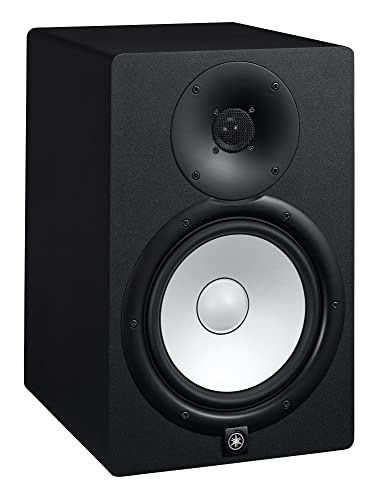
The HS8 takes the same design language as the HS7 and adds the low-end reach that bass-heavy mixing demands, extending down to 38 Hz with 120 watts of bi-amplification. That extra octave of usable bass makes kick drums and bass guitars easier to judge without a subwoofer, and the larger cabinet stays composed at higher listening levels. Because it shares the HS7 voicing, moving from the smaller model later feels familiar rather than a fresh learning curve. It belongs on stands or a deep desk in a medium-sized or treated room, where its output has space to develop properly.
Specs
- Woofer: 8-inch cone; tweeter: 1-inch dome
- Amplification: 120 watts bi-amped, 75 watts low frequency plus 45 watts high frequency
- Frequency response: 38 Hz to 30 kHz
- Inputs: balanced XLR and 1/4-inch TRS
- Controls: Room Control and High Trim switches
- Sold individually, not as a pair
Best for: medium or treated rooms where deeper bass judgment matters for the mix.
Watch out for: the cabinet is large and heavy, so confirm desk depth or stand space first.
Mackie MR824

The MR824 stands out in the 8-inch group for connection flexibility, adding RCA inputs alongside balanced XLR and TRS, which suits interfaces, mixers, and DJ gear that lack balanced outputs. Its 8-inch polypropylene woofer and 1-inch silk-dome tweeter are driven by 85 watts of Class A/B bi-amplification, and the published response reaches 35 Hz, the lowest in this guide. Acoustic Space controls and a treble trim simplify setup against walls or in corners, and the logarithmic waveguide spreads the treble wide for a forgiving listening position.
Specs
- Woofer: 8-inch polypropylene; tweeter: 1-inch silk dome
- Amplification: 85 watts Class A/B bi-amped
- Frequency response: 35 Hz to 20 kHz
- Inputs: balanced XLR, balanced TRS, and RCA
- Controls: Acoustic Space settings and treble trim
- Design details: logarithmic waveguide for wide treble dispersion
Best for: setups that need RCA inputs or placement controls for tricky wall positions.
Watch out for: some marketplace listings disagree on the wattage figure, so confirm the specification on the listing you order from.
KRK Rokit 8 G4
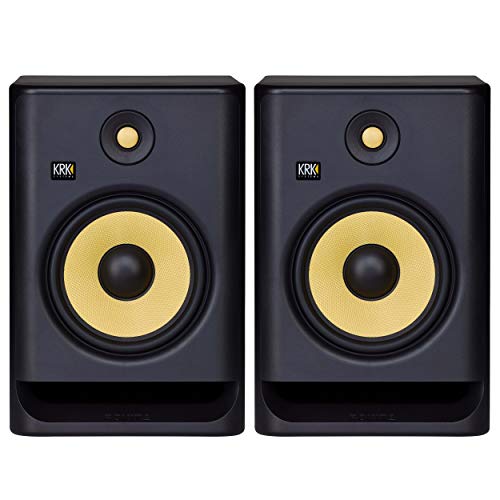
The Rokit 8 G4 is the most feature-packed 8-inch monitor here, pairing an 8-inch Kevlar woofer with DSP-driven room tuning that offers 25 graphic EQ settings on an onboard LCD, plus app-assisted setup. That tuning help matters in untreated rooms, where placement compromises are common and a little correction goes a long way. The front-firing port eases placement near walls compared with rear-ported rivals, and the Kevlar drivers are built for consistent response across the range. Note that this listing is sold as a pair, which simplifies ordering a stereo set in one step.
Specs
- Woofer: 8-inch Kevlar Aramid Fiber; tweeter: 1-inch Kevlar Aramid Fiber
- Amplification: custom Class D bi-amped design; Amazon listing notes 100 watts maximum output power
- Frequency response: 36 Hz to 40 kHz
- Room tuning: DSP-driven graphic EQ with 25 settings, onboard LCD, KRK app support
- Inputs: XLR, as listed on Amazon
- Sold as a pair
Best for: untreated rooms where built-in EQ help and a one-step pair purchase appeal.
Watch out for: the pair listing has shown out-of-stock periods, so confirm current availability before ordering.
Which One Fits Your Situation
Small Bedroom Desk With No Treatment
Pick the JBL 306P MkII or the Yamaha HS7. Both 6.5-inch models keep low-end energy low enough that an untreated bedroom stays manageable, and their rear-panel trims help with the wall behind the desk. The JBL suits listeners who move around while working thanks to its wide waveguide, while the HS7 suits mixers who want a forward, revealing midrange. Either one leaves the option of adding a subwoofer later if the room gets treatment.
Larger Treated Room and Bass-Heavy Music
Pick the Yamaha HS8. Its 38 Hz reach and 120-watt bi-amplification give kick drums and bass lines enough weight to judge without a subwoofer, and a treated room keeps that extra low end under control. The larger cabinet also holds up better at the higher levels common when checking a mix at performance volume. Place it on stands with space behind the cabinet for the best result.
Basic Interface With Unbalanced Outputs
Pick the Mackie MR824. Its RCA inputs connect directly to entry-level interfaces, mixers, and DJ controllers that lack balanced outputs, avoiding adapter chains and ground-loop headaches. The 35 Hz response is the deepest in this guide, and the Acoustic Space controls help when the desk sits against a wall. It is a practical pick for a first serious monitoring setup.
Untreated Room Where Setup Help Matters
Pick the KRK Rokit 8 G4 pair. Its DSP room tuning, onboard LCD, and companion app walk through placement and EQ choices that beginners often guess at, and the front-firing port forgives tight placement. Buying the pair in one listing also removes the risk of ordering a single monitor by mistake. Confirm the listing is in stock first, since it has shown out-of-stock periods.
Common Mistakes
- Buying 8-inch monitors for a tiny untreated room, then fighting boomy bass that the room itself creates.
- Judging bass by woofer size alone instead of comparing the published low-frequency figures.
- Ordering one monitor when the listing sells a single unit, and discovering the stereo pair is incomplete.
- Pushing a rear-ported monitor flat against the wall with no clearance behind the cabinet.
- Skipping the rear-panel controls and leaving Room Control or trim switches at their defaults in a difficult room.
Frequently Asked Questions
Is an 8-inch monitor always better than a 6.5-inch monitor?
No. An 8-inch monitor reaches lower and plays louder, but in a small untreated room that extra low end often turns into muddy, uneven bass that makes mixing harder. A 6.5-inch monitor in the same room usually gives a cleaner, more trustworthy picture. The better choice depends on room size, treatment, and what you mix, not on the diameter alone.
Do I still need a subwoofer with 8-inch monitors?
Usually not for music mixing, since the 8-inch models here reach 35 Hz to 38 Hz, which covers nearly all musical bass. A subwoofer becomes relevant for film work, sound design, or checking the very bottom octave below 35 Hz. Many mixers also add one later for client playback rather than for mix decisions.
Can I mix a 6.5-inch monitor with an 8-inch monitor as a pair?
No, a stereo pair should always use two identical monitors. Different woofer sizes, tunings, and output levels create an unbalanced stereo image, with one side sounding bassier and louder than the other. If a bigger monitor is needed, replace both sides together and keep the matched pair intact.
How far should I sit from 6.5-inch and 8-inch monitors?
Both sizes are nearfield designs meant for roughly arm’s length to about 5 feet, arranged in an equilateral triangle with the listening position. The 8-inch models tolerate a slightly longer distance and higher levels, while the 6.5-inch models are happiest at a close desk distance. Keep tweeters at ear height either way, and angle both monitors toward the listening spot.
Related guides
More from Amazon
Programs that pair well with the guide above. Offers and eligibility are set by Amazon and may change.
Free shipping on eligible items, Prime Video and more. Eligible new members can start with a free trial.
Start a Prime free trialAudiobooks and podcasts to listen to on the go. Eligible new members can start with a free trial.
Try Audible freeAd-free music streaming. Eligible new subscribers can start with a free trial.
Try Music Unlimited freeA free business account with business pricing and bulk-buying tools for work, shop or home office.
Create a business accountAs an Amazon Associate we earn from qualifying purchases.










Write Your Review
No reviews yet. Be the first to share your experience!