
Key takeaways
- Compare 5-inch vs 8-inch powered studio monitors on bass, room size and coverage for home studios, with five real models from JBL, Yamaha and PreSonus.
What's inside
As an Amazon Associate I earn from qualifying purchases. This post may contain affiliate links at no extra cost to you.
Choosing between a 5-inch and an 8-inch powered studio monitor is really a decision about how much low end you need and how much room you have to let it breathe. A 5-inch woofer reaches less deep into the bass, yet it stays tight and controlled at a desk, while an 8-inch woofer moves more air and digs lower, which changes how kick drums, bass guitars and synth sub-bass come across in a mix. Pick the wrong size and you either chase bass that is not there or fight a low end that overwhelms a small room.
This guide is for home producers mixing in bedrooms and spare rooms, podcasters and editors building a desktop setup, and musicians moving into a larger treated space who want monitors that match the room rather than the marketing. Every model below is a powered two-way studio monitor sold on Amazon, with its driver size, amplifier power, frequency response and inputs taken from the product listing.
Quick Picks
As an Amazon Associate we earn from qualifying purchases
| Product | Best for | Key spec from title |
|---|---|---|
| JBL 305P MkII | Small desk setups that need a wide sweet spot | 5-inch woofer, 82 watts total |
| Yamaha HS5 | Flat, honest mixing in a compact room | 5-inch woofer, 70 watts bi-amplified |
| JBL 308P MkII | Larger rooms that need deep bass without a subwoofer | 8-inch woofer, 112 watts total |
| Yamaha HS8 | Critical mixing where midrange detail matters most | 8-inch woofer, 120 watts bi-amplified |
| PreSonus Eris E8 XT | Big rooms and loud playback with flexible inputs | 8-inch woofer, 140 watts total |
How to Choose
Match the woofer to the room, not the ambition
Room size decides more than taste does. A 5-inch monitor suits a desk in a bedroom or office where the listening position sits about an arm’s length away, because its smaller woofer excites fewer room modes and keeps the bass from piling up in corners. An 8-inch monitor belongs in a room where you can sit at least a metre and a half back and pull the speakers away from the walls. Measure the space first: if the room is under about 12 square metres and untreated, the smaller driver will usually translate better, while a larger treated room gives the 8-inch woofer the air it needs to sound open instead of boomy.
Read the low end honestly
Frequency response numbers tell you where the bass starts to roll off, and the difference between the two sizes is real but easy to overstate. A typical 5-inch monitor reaches down to roughly the mid 40s in hertz, which covers most bass guitar and kick drum fundamentals, while an 8-inch model extends into the high 30s and adds weight to synth bass and cinematic lows. Check whether the listing quotes response at plus or minus 3 dB, since that figure is far more honest than a wider range quoted at minus 10 dB. If your work lives below 40 hertz, neither size replaces a subwoofer.
Check amplifier power and headroom
Power ratings matter because they set how loud a monitor plays cleanly before it strains. The 5-inch models here run between 70 and 82 watts total, which is plenty for nearfield listening at a desk, where you rarely need more than a few watts of continuous output. The 8-inch models run from 112 to 140 watts, and that extra headroom shows up as effortless dynamics at higher volumes and in bigger rooms. Look for bi-amplified designs, where separate amplifiers drive the woofer and tweeter, because that split keeps the bass from stealing energy from the highs when a mix gets busy.
Weigh inputs, tuning controls and placement
Every monitor in this guide takes balanced XLR and TRS inputs, and the PreSonus adds unbalanced RCA for consumer gear, so match the outputs on your audio interface before you buy. Rear-panel tuning controls matter just as much: room control and high trim switches on the Yamaha models, boundary and high frequency EQ on the JBL models, and full acoustic tuning on the PreSonus let you tame bass buildup when a speaker sits near a wall. Also confirm the practical details: monitors are usually sold singly, so a stereo pair needs two units, and 8-inch cabinets are heavier and deeper, so check that your desk or stands can hold them.
The 5 Best Options
5-inch powered studio monitors
JBL 305P MkII

The JBL 305P MkII is the compact pick for producers who want a wide, forgiving sweet spot at a desk. Its patented Image Control Waveguide spreads the stereo image so the mix stays stable even when you shift in your chair, and the 5-inch woofer keeps the low end tight enough for a small untreated room. Dual Class-D amplifiers give it clean headroom for nearfield levels, and the rear boundary EQ helps when the speaker must sit close to a wall. It suits beat makers, editors and first-time studio builders who need an honest monitor that does not demand a large room.
Specs
- 5-inch low frequency driver with 1-inch tweeter
- 82 watts total power, 41 watts low frequency plus 41 watts high frequency Class-D amplification
- Frequency response 49 Hz to 20 kHz, frequency range 43 Hz to 24 kHz
- Balanced XLR and TRS inputs
- Image Control Waveguide for a wide sweet spot
- Sold individually
Best for: Bedroom producers and desktop editors who mix at close range in small rooms.
Watch out for: Some owners report a faint hiss at idle when listening very close in a quiet room, so check your gain staging before assuming a fault.
Yamaha HS5

The Yamaha HS5 is the flat, no-nonsense option for anyone who wants a mix to translate to other speakers. Its 5-inch cone woofer and 1-inch dome tweeter follow the same design philosophy as the larger HS models, with a deliberately uncoloured midrange that exposes harsh vocals and muddy low mids instead of hiding them. The 70-watt bi-amplified system is modest on paper but well matched to the drivers, and the room control and high trim switches give useful correction for desk and wall placement. It is a strong fit for mixing, editing and learning to hear critically.
Specs
- 5-inch cone woofer with 1-inch dome tweeter
- 70 watts total power, 45 watts low frequency plus 25 watts high frequency bi-amplified
- Frequency response 54 Hz to 30 kHz
- XLR and TRS phone jack inputs
- Room Control and High Trim response controls
- Two-way bass-reflex design
Best for: Mixers who want a flat reference in a compact room and care most about midrange honesty.
Watch out for: The low end rolls off earlier than on 8-inch models, so check sub-bass content on headphones or add a matched subwoofer later.
8-inch powered studio monitors
JBL 308P MkII

The JBL 308P MkII takes everything the 305P does well and scales it up for larger rooms. The 8-inch woofer reaches noticeably deeper, so kick drums and bass lines carry real weight without a subwoofer, and the 112-watt bi-amplified system keeps dynamics clean at higher listening levels. The same Image Control Waveguide keeps the stereo image wide, which matters when you sit further back than a typical desk setup allows. It suits producers in a dedicated studio room, DJs and anyone mixing bass-heavy music where the low end needs to be felt as well as heard.
Specs
- 8-inch low frequency driver with 1-inch tweeter
- 112 watts total power, 56 watts low frequency plus 56 watts high frequency Class-D amplification
- Frequency response 45 Hz to 20 kHz, frequency range 37 Hz to 24 kHz
- Balanced XLR and TRS inputs
- Image Control Waveguide for a wide sweet spot
- Sold individually
Best for: Larger home studios and bass-heavy genres where deep low end matters without adding a subwoofer.
Watch out for: The cabinet is substantially larger and heavier than a 5-inch monitor, so confirm desk depth and stand capacity before ordering.
Yamaha HS8
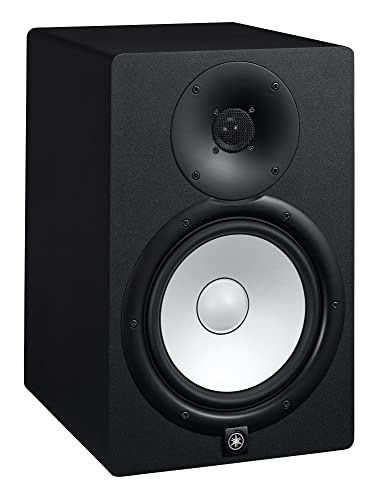
The Yamaha HS8 is the reference choice for critical listening in a room big enough to let it work. Its 8-inch cone woofer and 1-inch dome tweeter deliver the same flat HS voicing as the HS5, but with deeper bass extension and more headroom, so mixes reveal low frequency problems that a 5-inch monitor would gloss over. The 120-watt bi-amplified system stays composed at the higher volumes a larger room demands, and the room control and high trim switches help tame boundary buildup. It is the pick for serious mixers who have treated their space and want a monitor they can trust for years.
Specs
- 8-inch cone woofer with 1-inch dome tweeter
- 120 watts total power, 75 watts low frequency plus 45 watts high frequency bi-amplified
- Frequency response 38 Hz to 30 kHz
- XLR and TRS phone jack inputs
- Room Control and High Trim response controls
- Two-way bass-reflex design
Best for: Dedicated mixing rooms where accuracy and deep, controlled bass are the priority.
Watch out for: In a small untreated room the extra bass energy can overwhelm the mix, so this model rewards acoustic treatment and proper placement.
PreSonus Eris E8 XT

The PreSonus Eris E8 XT is the most flexible 8-inch option in this guide, built for rooms where loud, full-range playback is part of the job. Its 8-inch woven composite woofer and 1.25-inch silk dome tweeter are driven by 140 watts of Class AB power, the highest total in this roundup, and the EBM waveguide widens the sweet spot for longer listening sessions. Three input types and detailed acoustic tuning controls make it easy to connect almost any source and adapt to an imperfect room. It fits project studios, multimedia work and anyone who wants one pair of monitors to cover mixing, tracking and casual listening.
Specs
- 8-inch woven composite low frequency driver with 1.25-inch silk dome tweeter
- 140 watts total power, 75 watts low frequency plus 65 watts high frequency Class AB amplification
- Frequency response 35 Hz to 20 kHz
- Balanced XLR, balanced TRS and unbalanced RCA inputs
- Acoustic tuning controls for gain, mid frequency, high frequency, low cutoff and acoustic space
- EBM waveguide for a wide sweet spot
Best for: Larger rooms and louder playback where flexible inputs and room tuning matter as much as bass depth.
Watch out for: Class AB amplification runs warmer than Class D, so leave ventilation space around the rear panel and avoid enclosing the cabinet tightly.
Which One Fits Your Situation
You mix at a desk in a small bedroom
Pick the JBL 305P MkII or the Yamaha HS5, and spend the money you save on acoustic treatment or a better interface. Both keep the bass controlled at close range, and their smaller cabinets fit a desk without crowding your keyboard and screen. The JBL suits producers who move around while working thanks to its wide sweet spot, while the Yamaha suits mixers who want the flattest possible reference. Either way, sit close, keep the speakers away from the wall if you can, and check sub-bass on headphones.
You have a dedicated studio room with space to breathe
Choose the Yamaha HS8 if accuracy is the goal, or the JBL 308P MkII if you want more low end weight for electronic and hip-hop production. Both need at least a metre and a half of listening distance and some distance from the walls to sound their best. Add basic bass trapping in the corners and the extra low end becomes an asset instead of a problem. This is the room size where the 8-inch advantage finally shows up in the mix.
You need one pair for mixing, tracking and loud playback
The PreSonus Eris E8 XT is the most versatile pick here, with the highest power output, three input types and the most detailed tuning controls. It handles a full band tracking session, a loud playback check and a quiet mix pass without needing extra gear in the chain. Its RCA inputs also make it easy to connect a turntable preamp or media player alongside your interface. Just give it room and ventilation, and it covers more roles than any other model in this guide.
You are building your first studio on a tight budget
Start with a 5-inch pair, either the JBL 305P MkII or the Yamaha HS5, and learn your room before spending more. A 5-inch monitor in a small room tells you more about your mix than an 8-inch monitor fighting room modes ever will. You can add a matched subwoofer later when the budget allows, and by then you will know exactly which frequencies your room hides. Buying the smaller monitor first is the cheaper path to mixes that translate.
Common Mistakes
- Buying 8-inch monitors for a tiny untreated bedroom, then blaming the speakers when the bass sounds muddy and undefined.
- Judging bass depth from a frequency range quoted at minus 10 dB instead of the stricter response figure quoted at plus or minus 3 dB.
- Ordering a single monitor when the listing sells one unit, and discovering you need two for a stereo pair.
- Placing monitors directly against a wall or in a corner without using the rear tuning controls to compensate for the extra bass buildup.
- Sitting too close to an 8-inch monitor, where the woofer and tweeter do not blend properly and the stereo image narrows.
Frequently Asked Questions
Is an 8-inch studio monitor always better than a 5-inch one?
No, because better depends on the room. An 8-inch monitor reaches deeper and plays louder, which is an advantage in a larger treated space. In a small untreated bedroom, a 5-inch monitor usually sounds tighter and translates more reliably, since its smaller woofer excites fewer room modes and less bass buildup.
Do I need a subwoofer with 5-inch studio monitors?
It depends on what you mix. For most music, podcasts and video work, a 5-inch monitor covers the fundamentals you need to hear. If you regularly work with sub-bass, cinematic lows or electronic music that lives below 45 hertz, a matched subwoofer fills the gap the small woofer cannot reach.
Can I mix 5-inch and 8-inch monitors in the same setup?
You can, but it is rarely a good idea for a main stereo pair, because the two sizes have different bass extension, output and voicing. A matched pair keeps the stereo image consistent. Some engineers use a second pair of a different size as a reference check, which is a different job from daily mixing.
How far should I sit from an 8-inch studio monitor?
Aim for at least a metre and a half from each speaker, with the speakers forming an equilateral triangle with your head. That distance lets the woofer and tweeter blend into a single coherent sound and gives the low end room to develop. Sitting closer works better with a 5-inch monitor designed for nearfield use.
Related guides
More from Amazon
Programs that pair well with the guide above. Offers and eligibility are set by Amazon and may change.
Free shipping on eligible items, Prime Video and more. Eligible new members can start with a free trial.
Start a Prime free trialAudiobooks and podcasts to listen to on the go. Eligible new members can start with a free trial.
Try Audible freeAd-free music streaming. Eligible new subscribers can start with a free trial.
Try Music Unlimited freeA free business account with business pricing and bulk-buying tools for work, shop or home office.
Create a business accountAs an Amazon Associate we earn from qualifying purchases.










Write Your Review
No reviews yet. Be the first to share your experience!