
Key takeaways
- Compare 5 tube integrated amplifiers for two-channel listening, from 12-watt EL34 single-ended amps to 45-watt KT88 push-pull models, with specs included.
What's inside
As an Amazon Associate I earn from qualifying purchases. This post may contain affiliate links at no extra cost to you.
Choosing a tube integrated amplifier is really a decision about how much power your speakers need and how much upkeep you are willing to accept. A low-power single-ended amp can sound gorgeous on sensitive bookshelf speakers and fall flat on a demanding floorstander, while a push-pull KT88 design drives a wider range of speakers but brings more tubes, more heat, and more maintenance. The choice is not about finding the warmest sound in the abstract; it is about matching watts, tube type, and inputs to the room and speakers you already own.
This guide covers five tube integrated amplifiers sold on Amazon, from a compact 12-watt EL34 single-ended amp to a 45-watt KT88 push-pull model with a phono stage and balanced inputs. Each pick below lists its tube complement, output power, and connections exactly as stated on its Amazon product page, so you can compare the real hardware before deciding which one fits your two-channel setup.
Quick Picks
As an Amazon Associate we earn from qualifying purchases.
| Product | Best for | Key spec from title |
|---|---|---|
| Willsenton R8 | Listeners who want tube swapping and headphone use | KT88/EL34 x4 tube integrated amp with headphone output |
| Reisong A10 | First-time tube listeners with sensitive bookshelf speakers | EL34 single-end Class A stereo tube amplifier |
| BoyuuRange A50 MKIII 300B | Low-power single-ended listening with high-efficiency speakers | 300B single-end Class A integrated tube amplifier with tube cage |
| MUZISHARE X7 | Vinyl listeners who want balanced inputs and a phono stage | KT88 x4 push-pull tube integrated amplifier with MM phono and balanced XLR |
| BoyuuRange MT-34 MKII | Mid-power EL34 push-pull listening in a medium room | EL34 x4 push-pull tube integrated amplifier, 25 watts per channel |
How to Choose
Match Power to Speaker Sensitivity
Output power is the first number to check, because tube amplifiers generally deliver far fewer watts than solid-state models at a similar size. A 12-watt single-ended amplifier works best with bookshelf speakers rated at 89 dB sensitivity or higher, and the Reisong A10 listing itself warns buyers to confirm that figure before ordering. If your speakers are rated below that, or you listen in a large room, a push-pull design such as the Willsenton R8 or the MUZISHARE X7 gives you substantially more headroom. Check your speaker manual for its sensitivity rating and nominal impedance, then choose an amplifier whose rated output leaves comfortable margin above your normal listening level.
Pick a Tube Type for the Sound You Want
The output tube shapes much of an amplifier’s character, and each of the amps in this guide commits to a different one. EL34 tubes are known for a warm, midrange-forward presentation that flatters vocals and acoustic instruments, which is why both the Reisong A10 and the BoyuuRange MT-34 MKII use them. KT88 tubes deliver more power and firmer bass control, making them a better fit for larger rooms and less sensitive speakers. The 300B tube in the BoyuuRange A50 MKIII is a classic single-ended triode prized for midrange texture, but it produces only a few watts, so it demands highly efficient speakers.
Check the Inputs Against Your Sources
A tube integrated amplifier is only as useful as the sources it accepts, so count your inputs before you buy. If you play vinyl, look for a built-in phono stage, such as the MM phono input on the MUZISHARE X7, so you do not need a separate preamp. Streamers, CD players, and DACs connect through standard RCA line inputs, which every amp here provides, but only some models add balanced XLR or a headphone output. Think through every source you plan to connect, including a turntable, a streamer, and a television, and confirm the amplifier has a matching input for each one.
Plan for Tube Maintenance and Heat
Vacuum tubes wear out, run hot, and occasionally need replacement, so budget for that reality before you commit. Power tubes typically last a few thousand hours, and a matched set of four KT88 or EL34 tubes is a real ongoing cost, not a one-time purchase. Some amplifiers, including the Willsenton R8, let you adjust bias, which means learning a simple maintenance routine or paying a technician. Give the amplifier open ventilation on all sides, keep it away from curious hands and pets while the tubes are hot, and keep the protective tube cage fitted if the model ships with one.
The 5 Best Options
Willsenton R8

The Willsenton R8 is the most flexible amplifier in this guide, and that flexibility is the reason to choose it. It runs four KT88 output tubes by default and accepts EL34 or 6550 tubes as substitutes, giving you three distinct sound profiles from one chassis, and a front-panel switch changes between triode and ultra-linear operation without powering down. It also works as a pure power amplifier or a headphone amplifier, so it covers more roles than a standard integrated amp. Its 26-kilogram weight and large chassis demand a sturdy rack shelf, but buyers who want to experiment with tube rolling will find few rivals at this level.
Specs
- Output tubes: KT88 x4, interchangeable with EL34 or 6550
- Preamp tubes: 6SL7 x2, 6SN7 x3
- FTC power output: 30 watts per channel ultra-linear, 16 watts per channel triode, into 8 ohms
- Non-FTC rated output: 45 watts per channel ultra-linear, 23 watts per channel triode
- Amplifier class: Class AB push-pull
- Inputs: CD, AUX1, AUX2, PRE-IN
- Speaker outputs: 4 ohms and 8 ohms
- Headphone output impedance: 30 ohms to 300 ohms
- Frequency response: 12 Hz to 40 kHz
- Signal-to-noise ratio: 89 dB
- Dimensions: 400 x 390 x 200 mm
- Net weight: 26 kg
Best for: Listeners who want to swap tubes, switch operating modes, and drive both speakers and headphones from one amp.
Watch out for: The 26-kilogram weight needs a strong shelf, and bias should be checked during the first months of use.
Reisong A10
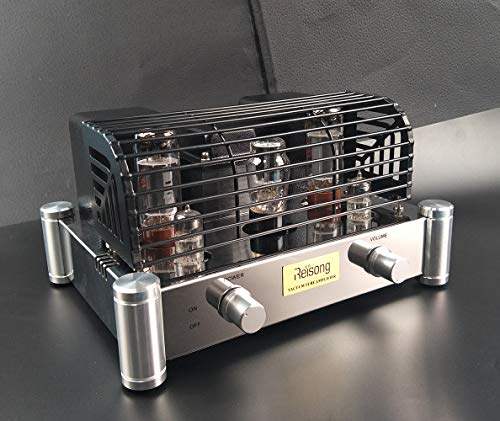
The Reisong A10 is the simplest way into true single-ended tube sound, and its low power is both its charm and its limit. Two EL34 output tubes deliver 12 watts per channel in a single-ended Class A circuit, with a 5Z4PJ rectifier and a hand-wired layout that keeps the signal path short. That modest output pairs naturally with sensitive bookshelf speakers, where it produces a warm, spacious presentation that suits vocals, jazz, and acoustic music. The listing is explicit that buyers should confirm their speakers are rated at 89 dB sensitivity or higher, and that guidance should be taken seriously before ordering.
Specs
- Output tubes: EL34 x2
- Preamp tubes: 6N2J x2
- Rectifier tube: 5Z4PJ x1
- Output power: 12 watts per channel
- Amplifier class: Single-ended Class A
- Circuit: Hand-wired point-to-point
- Recommended speaker sensitivity: 89 dB or higher
- Included: Tube protective cover and circuit diagram
Best for: First-time tube buyers with sensitive bookshelf speakers in a small or medium room.
Watch out for: 12 watts will not drive low-sensitivity or large floorstanding speakers to satisfying levels.
BoyuuRange A50 MKIII 300B

The BoyuuRange A50 MKIII is built around the 300B directly heated triode, a tube with a long reputation for midrange realism in single-ended designs. It runs in single-ended Class A, with two 300B power tubes flanked by smaller driver tubes, and the front panel carries VU meters and a volume control behind a protective tube cage. Power output is modest at 8 watts per channel, so this amplifier belongs with high-efficiency speakers, ideally horn-loaded or wideband designs rated well above 90 dB. For that specific pairing, it offers a direct, uncluttered sound that push-pull amplifiers rarely match at a comparable size.
Specs
- Output tubes: 300B x2
- Amplifier class: Single-ended Class A
- Output power: 8 watts per channel
- Inputs: AUX, CD, TAPE
- Front panel: VU meters, input selector, volume control
- Included: Protective tube cage
- Chassis: Silver with gold front panel
Best for: Listeners with high-efficiency speakers who want a classic 300B single-ended presentation.
Watch out for: 8 watts per channel is only enough for efficient speakers, so verify sensitivity before buying.
MUZISHARE X7
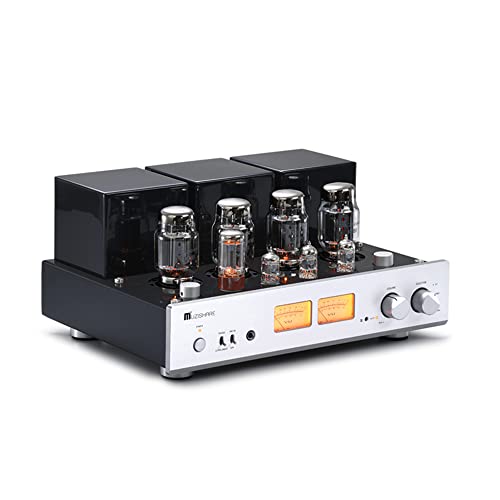
The MUZISHARE X7 is the most complete two-channel package in this guide, combining a KT88 push-pull power stage with the inputs a vinyl listener needs. It uses four KT88 tubes for AB1 push-pull amplification, with 12AX7 and 12AU7 tubes handling voltage amplification and phase inversion, and it switches between triode and ultra-linear modes. A built-in MM phono stage covers turntables, balanced XLR inputs accept higher-end sources, and a headphone amplifier and remote control round out a genuinely full-featured design. It is a heavy, substantial unit, but buyers who want one box to handle vinyl, digital, and headphones will appreciate how much it integrates.
Specs
- Output tubes: KT88 x4
- Preamp tubes: 12AX7 and 12AU7
- Amplifier class: Class AB1 push-pull
- Output power: 45 watts per channel ultra-linear, 25 watts per channel triode
- Phono stage: MM phono input
- Inputs: Balanced XLR, RCA line inputs, pre-amp inputs
- Modes: Triode and ultra-linear
- Features: Headphone amplifier, remote control, mute delay on startup
- Volume control: Japanese ALPS motor potentiometer
Best for: Vinyl listeners who want balanced inputs, a phono stage, and headphone use in one tube amp.
Watch out for: Confirm the phono stage matches your cartridge type, since it is designed for moving-magnet cartridges.
BoyuuRange MT-34 MKII

The BoyuuRange MT-34 MKII sits in the middle of this guide on power, price, and complexity, which makes it a sensible default for many rooms. Four EL34 tubes in a push-pull circuit deliver 25 watts per channel in ultra-linear mode or 15 watts in triode mode, with a 5Z4P rectifier and three 6N1J preamp tubes completing the complement. That output drives a wider range of bookshelf and small floorstanding speakers than the single-ended amps here, while keeping the EL34 warmth that suits vocals and acoustic music. Its frequency response extends from 30 Hz to 45 kHz, and the standard CD and auxiliary inputs cover the usual two-channel sources.
Specs
- Output tubes: EL34 x4
- Preamp tubes: 6N1J x3
- Rectifier tube: 5Z4P x1
- Output power: 25 watts per channel ultra-linear, 15 watts per channel triode
- FTC power output: 12 watts per channel ultra-linear, 8 watts per channel triode, into 8 ohms
- Frequency response: 30 Hz to 45 kHz
- Signal-to-noise ratio: 88 dB
- Input sensitivity: 550 mV
- Input impedance: 100k ohms
- Power supply: AC 110V to 120V
- Dimensions: 375 x 290 x 180 mm
Best for: Medium-room listening with bookshelf or small floorstanding speakers where EL34 warmth matters.
Watch out for: The FTC-rated output is lower than the headline figure, so judge it on the FTC numbers for demanding speakers.
Which One Fits Your Situation
You Are Buying Your First Tube Amp
Start with the Reisong A10 if your speakers are sensitive enough, because its simple single-ended circuit has fewer tubes to maintain and its 12 watts are honest about what they can do. If your speakers fall below 89 dB sensitivity, step up to the BoyuuRange MT-34 MKII instead, which keeps the EL34 sound while adding enough push-pull power for a broader range of speakers.
You Listen Mostly to Vinyl
Choose the MUZISHARE X7, since its built-in MM phono stage, balanced XLR inputs, and remote control cover a complete vinyl setup without extra boxes. The Willsenton R8 is the alternative if you already own a separate phono preamp and want the freedom to swap KT88, EL34, and 6550 tubes to tune the sound of your records.
You Own High-Efficiency Speakers
The BoyuuRange A50 MKIII is the natural match, because its 300B single-ended circuit is designed for exactly this pairing and rewards efficient speakers with a direct, textured midrange. Keep the volume moderate and the room small to medium, and confirm your speakers are rated well above 90 dB sensitivity before committing to only 8 watts per channel.
You Want One Amp for Speakers and Headphones
Pick the Willsenton R8, which functions as an integrated amplifier, a power amplifier, and a headphone amplifier, with a headphone output rated for 30 to 300 ohms. The MUZISHARE X7 also includes a headphone amplifier, so it is the fallback if you also need balanced inputs and a built-in phono stage in the same chassis.
Common Mistakes
- Buying a low-power single-ended amp for low-sensitivity speakers, then finding it cannot reach normal listening levels without distortion.
- Ignoring the FTC power rating and judging an amplifier only on its higher non-FTC headline wattage.
- Placing a tube amplifier in a closed cabinet with no airflow, which traps heat and shortens tube life.
- Skipping the bias check on amplifiers that allow adjustment, especially during the first months of use.
- Forgetting to confirm the phono stage type, and pairing a moving-magnet input with a moving-coil cartridge that needs more gain.
Frequently Asked Questions
How many watts do I need from a tube integrated amplifier?
It depends on your speakers, not on the amplifier alone. A 12-watt single-ended amp suits bookshelf speakers rated at 89 dB sensitivity or higher in a small room, while a 45-watt push-pull KT88 amp covers larger rooms and less sensitive speakers. Check your speaker sensitivity rating first, then choose an amp with comfortable headroom above your normal listening level.
Do tube integrated amplifiers need regular maintenance?
Yes, and the main task is replacing tubes as they wear, typically after a few thousand hours of use for power tubes. Some amplifiers also need periodic bias adjustment, which keeps the output tubes operating at the correct current. Keep spare tubes on hand, give the amp open ventilation, and follow the manual for bias checks if your model supports adjustment.
Can I swap different tube types in the same amplifier?
Only when the manufacturer states it is supported. The Willsenton R8 is designed to accept KT88, EL34, or 6550 output tubes, but most amplifiers are built around one tube type and should not be fitted with substitutes. Always confirm compatibility in the product manual and use matched sets when replacing power tubes.
Is a tube integrated amplifier good for a small room?
Yes, a small room is often the best place for a tube amplifier, because lower power goes further when the listening distance is short. Single-ended amps such as the Reisong A10 or the BoyuuRange A50 MKIII shine in nearfield and small-room setups with sensitive speakers. Just allow space around the chassis for heat, and keep the tubes out of reach while they are hot.
Related guides
More from Amazon
Programs that pair well with the guide above. Offers and eligibility are set by Amazon and may change.
Free shipping on eligible items, Prime Video and more. Eligible new members can start with a free trial.
Start a Prime free trialAudiobooks and podcasts to listen to on the go. Eligible new members can start with a free trial.
Try Audible freeAd-free music streaming. Eligible new subscribers can start with a free trial.
Try Music Unlimited freeA free business account with business pricing and bulk-buying tools for work, shop or home office.
Create a business accountAs an Amazon Associate we earn from qualifying purchases.










Write Your Review
No reviews yet. Be the first to share your experience!