
Key takeaways
- Compare headphone DAC amplifiers for a personal listening station, with remote control, multiple inputs and tidy one-box setups for chairs and desks.
What's inside
As an Amazon Associate I earn from qualifying purchases. This post may contain affiliate links at no extra cost to you.
A personal listening station is a one-person spot built around a single chair, a small table, and one pair of headphones, so the DAC amplifier has to be easy to live with every day. The real decision is not chasing the highest specification, but choosing one tidy box that switches cleanly between your sources, drives your headphones without strain, and lets you change volume without getting up or reaching across a desk.
This guide serves listeners building a bedside setup, a reading-chair corner, or a small desk station away from the main system. Every product below is a single unit combining a DAC and a headphone amplifier, chosen from the names and specifications printed on the Amazon product pages rather than from roundups or secondhand summaries.
Quick Picks
As an Amazon Associate we earn from qualifying purchases.
| Product | Best for | Key spec from title |
|---|---|---|
| S.M.S.L DL200 Audio Headphone Amplifier | Changing volume from the chair | ES9039Q2M chip with remote control |
| Topping DX3 Pro+ DAC and Headphone Amplifier | Wireless and wired sources in one spot | Bluetooth 5.0 LDAC with NFCA amplifier |
| FiiO K11 Desktop DAC and Headphone Amplifier | A compact first station on a small table | 1400mW output with 4.4mm balanced jack |
| iFi ZEN DAC V2 | A simple computer-fed bedside setup | MQA decoder with 4.4mm balanced output |
| FiiO K5Pro ESS Desktop DAC and Headphone Amplifier | Several wired sources plus an analog input | ES9038PRO DAC with coaxial and optical inputs |
How to Choose
Count the Sources the Station Must Switch Between
A listening station rarely stays a one-source setup for long. It might start with a laptop, then gain a television feed, a disc player, or a phone streamed over Bluetooth, and every added source means another cable run or another device competing for the same small table. List the sources you actually plan to sit down with, then choose a unit whose inputs cover them all at once, so switching becomes a button press on the unit or its remote instead of a cable swap behind furniture. Inputs worth counting include USB, optical, coaxial, Bluetooth, and an analog line input for older players.
Decide Whether a Remote Control Matters
At a desk, the volume knob is always within reach, so a remote can feel unnecessary. At a reading chair or a bedside station, the picture changes: the unit may sit on a side table an arm’s length away, or across the room under a television, and standing up to adjust volume breaks the session. A remote that handles volume, input selection, and mute turns the station into something you operate from the seat. Check what the listing says is included, because some units ship with a remote in the box while others offer none at all, and a station planned around remote use should not depend on an accessory that is not listed.
Match Headphone Outputs and Power to Your Headphones
Your headphones decide which outputs you need. A standard 6.35mm jack covers most full-size models, a 4.4mm balanced jack suits headphones that ship with a balanced cable, and a 3.5mm jack fits portable models and in-ear monitors without an adapter. Power figures on the listings are quoted into specific loads, usually 32 ohms, so compare the number against your headphone’s impedance rather than treating the biggest figure as automatically best. Sensitive in-ear monitors need clean low-gain behavior more than raw wattage, while high-impedance over-ear models need enough voltage swing to reach comfortable volume with headroom to spare.
Plan the Footprint and the Daily Routine
A personal station lives on furniture that was not designed for audio gear, so measure the table before ordering. Compact units around the size of a paperback suit a bedside table, while wider models need a proper side table or a shelf. Think about the daily routine as well: where the headphone cable will rest, whether the display can be dimmed or switched off at night, how the unit powers on, and whether one knob handles both volume and input switching. A station that is pleasant to use every evening beats a larger, more capable box that crowds the chair and gathers dust.
The 5 Best Options
S.M.S.L DL200 Audio Headphone Amplifier

The DL200 suits a chair-side station better than most desktop units because the listing includes a remote control, so volume and input changes happen from the seat. Its ES9039Q2M conversion stage accepts USB, optical, coaxial, and Bluetooth sources, which lets one box serve a laptop, a television, and a phone without cable swaps. That mix fits a reading chair or bedside table where the station is used in short, relaxed sessions and the hardware should stay out of the way. Listeners who want high-resolution file support also get MQA decoding and very high PCM and DSD ceilings from the listing.
Specs
- DAC chip: ES9039Q2M
- Digital inputs: USB, optical, coaxial, and Bluetooth
- Format support: PCM up to 768kHz/32bit and DSD512
- Decoding: MQA support via the XMOS USB stage
- Control: Remote control included in the listing title
Best for: A reading-chair or bedside station run from the seat with a remote.
Watch out for: Confirm which headphone jack sizes your cables need, since the listing title focuses on inputs rather than the front-panel sockets.
ASIN: B0CCY9MXMD
Topping DX3 Pro+ DAC and Headphone Amplifier

The DX3 Pro+ is the flexible hub of this group, combining wired USB, optical, and coaxial inputs with Bluetooth 5.0 reception that supports LDAC, so a phone can feed the station without a cable. The listing includes a remote control, a Bluetooth antenna, and a USB cable in the box, which keeps the side-table setup complete on day one. Its NFCA headphone amplifier stage is rated well beyond what most home headphones require, and the RCA line output lets the same unit feed powered speakers when headphones come off. It fits listeners whose station doubles as a small-room source for both private and shared listening.
Specs
- DAC chip: ES9038Q2M
- Bluetooth: Version 5.0 with LDAC audio decoding
- Amplifier: NFCA headphone amplifier circuit
- Headphone output power: 1800mW x2 at 32 ohms and 250mW x2 at 300 ohms
- Line output: RCA
- Headphone output: 3.5mm
- Included components: DX3 Pro+ unit, DC15V/1A power adapter, remote control, USB cable, Bluetooth antenna
Best for: A station that mixes phone streaming, wired sources, and occasional speaker use.
Watch out for: The headphone output is 3.5mm only, so check your headphone plug or budget for an adapter before ordering.
ASIN: B09HBS8SLJ
FiiO K11 Desktop DAC and Headphone Amplifier

The K11 is the tidy, compact choice for a first personal station, with a small footprint that leaves room on a side table for a book and a lamp. The listing gives it both a 6.35mm jack and a balanced 4.4mm jack, so headphones with either cable style plug straight in, and its 1400mW rated output covers a wide range of home headphones. Around the back, USB, coaxial, and optical inputs handle a computer and a television or disc player, while the RCA output can feed a small powered speaker. It suits a listener who wants one neat box, simple controls, and no separate DAC and amplifier stack.
Specs
- Headphone outputs: 6.35mm and balanced 4.4mm
- Output power: 1400mW
- Format support: 384kHz/24Bit and DSD256
- Inputs: USB, coaxial, and optical
- Line output: RCA
- Use case in listing title: Home audio and PC
Best for: A compact first station on a small table or a bedroom desk corner.
Watch out for: There is no Bluetooth input on this listing, so a phone source needs a wired or computer-based route.
ASIN: B0CJFG3DC7
iFi ZEN DAC V2
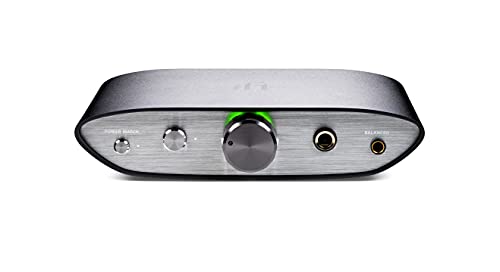
The ZEN DAC V2 is the simplest station here to live with when the computer is the only source. The listing is explicit that the input is USB only, which removes input switching from the daily routine entirely: sit down, put the headphones on, and turn the volume knob. Its Burr Brown True Native converter handles PCM, DSD, DXD, and full MQA decoding, and the front panel offers both a 6.3mm unbalanced jack and a 4.4mm balanced jack, with RCA outputs at the back for active speakers. It fits a bedside or desk-corner station built around a laptop and one favorite pair of headphones.
Specs
- Input: USB 3.0 B only, compatible with USB 2.0 sources
- Headphone outputs: 6.3mm unbalanced and 4.4mm balanced
- Line output: RCA
- DAC: Burr Brown True Native converter
- Format support: PCM up to 384kHz/24bit, DSD256, and DXD 384kHz
- Decoding: Full MQA decoder
- Package note in listing: Unit only
Best for: A laptop-fed bedside or desk station where simplicity beats source switching.
Watch out for: With USB as the only input, a television or disc player cannot connect directly, so plan the station around the computer.
ASIN: B091B2JCXQ
FiiO K5Pro ESS Desktop DAC and Headphone Amplifier

The K5Pro ESS is the wired-source anchor of the group, adding an RCA line input alongside USB, coaxial, and optical, so an older disc player or a turntable stage with its own phono correction can join the station. Its ES9038PRO converter supports very high PCM rates and native DSD512, and the amplifier rating gives demanding over-ear headphones comfortable headroom at the chair. The larger front volume knob suits listeners who adjust level often by hand rather than by remote. Choose it when the station is a permanent side-table fixture fed by several wired components and one main pair of full-size headphones.
Specs
- DAC chip: ESS ES9038PRO, 32-bit
- Format support: 768kHz/32Bit and native DSD512
- Output power: 1.5W at 32 ohms, with 20Vpp at 300 ohms
- Headphone output: 6.35mm
- Inputs: USB, coaxial, optical, and RCA line input
- Line output: RCA
- USB decoding: XMOS XUF208 stage named in the listing description
Best for: A permanent side-table station with several wired sources and full-size headphones.
Watch out for: The only headphone jack is 6.35mm and there is no remote in the listing, so balanced-cable headphones and armchair control need another pick.
ASIN: B09MMVRWCG
Which One Fits Your Situation
A Reading Chair With a Side Table
Choose the S.M.S.L DL200. A chair-side station is used from the seat, and the included remote handles the two actions that matter most there, volume and input switching, without reaching for the table. Its Bluetooth input also lets a phone become the source on evenings when the laptop stays in another room, while optical can carry the television for late sessions.
A Bedside Station Used at Low Volume
The iFi ZEN DAC V2 fits a bedside routine built around a laptop, because its single USB input removes switching decisions when you are half asleep. The FiiO K11 is the alternative if the bedside table also needs a television feed, since its optical input can take that source while the compact case leaves room for a lamp and a clock.
A Desk Corner That Doubles as a Speaker Setup
Pick the Topping DX3 Pro+. Its RCA line output feeds powered speakers for daytime use, the headphone output takes over in the evening, and the remote moves between inputs without opening a menu on the computer. Bluetooth with LDAC also covers phone listening at the desk without tying up the USB input your computer is using.
A Permanent Station With Several Wired Components
The FiiO K5Pro ESS is built for a fixed setup where a computer, a disc player, and an analog source all stay connected. Its RCA line input is the difference maker, since the other units here are digital-only on the input side. The strong output rating also suits a listener whose main headphones are full-size models that need real drive.
Common Mistakes
- Buying a separate DAC and a separate amplifier for a one-chair station, then losing the small table to a stack, extra power supplies, and interconnect cables.
- Choosing a unit with only a USB input for a station that also needs a television or disc player feed, which forces an adapter chain or a second device.
- Ignoring the headphone jack format, then discovering the headphones use a 4.4mm balanced plug while the chosen unit offers only a single-ended socket, or the reverse.
- Placing the unit out of reach at a chair or bedside station and only then realizing the listing never included a remote control.
- Judging power by one headline figure without checking the load it was measured into, which matters when headphones are high-impedance models.
Frequently Asked Questions
Does a personal listening station need a remote control?
Only if the unit sits beyond comfortable reach. At a desk, the front-panel knob is enough, but at a reading chair or bedside table a remote for volume and input switching keeps you seated. Among these picks, the S.M.S.L DL200 and the Topping DX3 Pro+ list a remote in the box, while the FiiO and iFi units are knob-operated.
Can one DAC amplifier serve both headphones and powered speakers?
Yes, when the unit offers a line output as well as a headphone jack. Every pick here includes an RCA output, so the station can feed powered speakers or a small amplifier when headphones are off. Check whether the listing describes the output as fixed or variable if you plan to control speaker volume from the unit itself.
Which inputs matter most for a chair-side setup?
USB covers a computer, optical covers most televisions and many disc players, and Bluetooth covers a phone without a cable. A station using all three source types should shortlist the S.M.S.L DL200 or the Topping DX3 Pro+, since both combine those inputs in one box. An analog RCA input only becomes essential when an older player joins the setup.
Is a balanced 4.4mm output worth choosing a unit for?
It is worth it when your headphones already have a 4.4mm balanced cable, because you can use that cable without an adapter and, on the FiiO K11 listing, the balanced output is where the full rated power is available. If your headphones use a standard 6.35mm or 3.5mm plug, a balanced jack adds nothing you will use daily.
Related guides
More from Amazon
Programs that pair well with the guide above. Offers and eligibility are set by Amazon and may change.
Free shipping on eligible items, Prime Video and more. Eligible new members can start with a free trial.
Start a Prime free trialAudiobooks and podcasts to listen to on the go. Eligible new members can start with a free trial.
Try Audible freeAd-free music streaming. Eligible new subscribers can start with a free trial.
Try Music Unlimited freeA free business account with business pricing and bulk-buying tools for work, shop or home office.
Create a business accountAs an Amazon Associate we earn from qualifying purchases.










Write Your Review
No reviews yet. Be the first to share your experience!