
Key takeaways
- Upgrading your headphones? These desktop DAC amplifiers add the power, balanced outputs and cleaner conversion a better headphone needs to shine.
What's inside
As an Amazon Associate I earn from qualifying purchases. This post may contain affiliate links at no extra cost to you.
Buying better headphones is the easy part. The harder decision comes when the new pair sounds quiet, flat, or strangely harsh from a laptop jack or phone dongle: the headphones have outgrown the source feeding them. A desktop DAC amplifier replaces that weak link with proper digital conversion and enough clean power to drive demanding drivers at realistic volumes, so the upgrade you paid for is actually audible.
This guide is for listeners stepping up to their first serious wired headphones, owners of planar magnetic or high-impedance models that need real drive, and desk listeners who want one box for a computer and a console. Every product below was chosen from the names and specifications printed on its Amazon product page.
Quick Picks
As an Amazon Associate we earn from qualifying purchases.
| Product | Best for | Key spec from title |
|---|---|---|
| iFi ZEN DAC 3 | First step up from a laptop or phone output | Desktop digital analog converter with USB-C input |
| FiiO K7 | The most power and inputs in this group | Dual AK4493S DACs with THX AAA 788+ amplification |
| FiiO K11 R2R | Listeners curious about resistor-ladder conversion | 24-bit R2R DAC with balanced 4.4mm output |
| SMSL C200 PRO | Wireless listening and remote control from the couch | ES9039Q2M DAC with Bluetooth and MQA decoding |
How to Choose
Match Output Power and Gain to Your Headphones
Start with the headphones you just bought, not the amplifier’s headline numbers. Easy dynamic headphones reach comfortable volume almost anywhere, while planar magnetic models and high-impedance designs draw far more current or voltage before they open up. Check the output power printed on the product page, and look for switchable gain: low gain keeps sensitive earphones quiet and hiss-free, while high gain gives demanding over-ears the headroom they need. A unit with both a modest starting gain and a stronger setting covers a growing collection better than one fixed, very hot output stage.
Choose the DAC Architecture and Format Support
Every unit here converts digital audio, but the conversion approach differs. Most use a delta-sigma chip from ESS, AKM, or Burr-Brown, while the FiiO K11 R2R uses a resistor-ladder array instead, a design some listeners prefer for its presentation. Neither approach is automatically better, so treat it as a character choice rather than a quality ranking. Format support matters more practically: confirm the page lists decoding for the files and streams you actually own, whether that is high-rate PCM, DSD, or MQA, instead of paying for headline sample rates your library never uses.
Check Headphone Outputs and Balanced Connections
Look at the front panel before anything else. A 6.35mm jack suits most stock cables, while a 4.4mm balanced output gives compatible headphones a separate left and right ground path and, on several models here, noticeably more output power. If your upgraded headphones ship with a balanced cable, or you plan to buy one, a balanced socket protects that investment. Also check whether the rear line outputs are fixed or variable: variable output lets the same box act as a preamp for powered speakers, which matters for a desk that serves both duties.
Count Inputs for Every Source You Own
An upgrade source only helps if everything you listen to can reach it. USB suits a computer, optical connects cleanly to many televisions and game consoles, and coaxial still appears on CD transports and streamers. Bluetooth input adds phone and tablet listening without another cable across the desk. List your sources first, then cross off any unit missing one of those connections, because adapters and switch boxes added later cost money and desk space. The simplest setup is the one where the DAC amplifier you buy today still covers the source you add next year.
The 4 Best Options
iFi ZEN DAC 3

The ZEN DAC 3 is the gentlest first step for someone whose new headphones have exposed a noisy laptop output. It takes a single USB-C connection for both data and power, converts with a Burr-Brown chip, and offers both single-ended and balanced headphone sockets on the front. PowerMatch gain suits everything from earphones to full-size over-ears, and the XBass+ analogue circuit restores low-end weight that many open-back upgrade headphones lose. Rear RCA and balanced line outputs with a fixed or variable setting let it feed powered speakers later, so the purchase keeps working as the desk grows.
Specs
- DAC: Burr-Brown True Native
- Formats: PCM up to 768kHz, DSD512, MQA full decoding
- Input: USB-C for digital audio and power
- Headphone outputs: 6.35mm single-ended and 4.4mm balanced
- Line outputs: RCA and 4.4mm balanced, fixed or variable
- Controls: PowerMatch gain switch and XBass+ bass correction
- Power: USB powered, with an optional 5V DC input
Best for: A first dedicated source for a new pair of wired headphones at a computer desk.
Watch out for: USB is the only digital input, and the optional 5V power supply is not included.
ASIN: B0D1QWKTQ5
FiiO K7
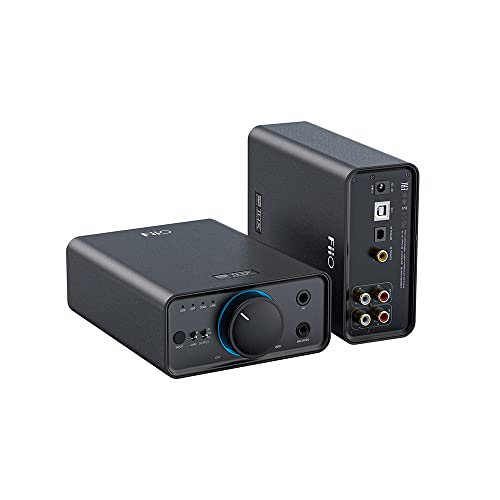
The K7 is the pick for buyers whose upgrade headphones are genuinely hard to drive and whose desk holds more than one source. Dual AK4493S DAC chips feed a fully balanced THX AAA 788+ amplifier stage, and the rear panel accepts USB, optical, coaxial, and an analogue line input, so a computer, console, and streamer can all stay connected. Three output modes switch between headphone output, preamp output, and fixed line output, and two gain levels keep both sensitive earphones and demanding planar magnetic headphones in a comfortable volume range. An included low-noise power supply means nothing extra to buy.
Specs
- DAC: Dual AK4493S chips with XMOS XU208 USB
- Formats: PCM up to 384kHz and DSD256
- Amplifier: THX AAA 788+, fully balanced design
- Inputs: USB, optical, coaxial, and RCA line in
- Headphone outputs: 6.35mm single-ended and 4.4mm balanced
- Controls: Three output modes, two gain levels, RGB status indicators
- Power supply: 12V low-noise switching supply included
Best for: Hard-to-drive upgrade headphones and desks with several digital sources.
Watch out for: There is no Bluetooth input, so phone listening stays wired through another device.
ASIN: B0BJKKPL71
FiiO K11 R2R

The K11 R2R suits the upgrader who is curious about a different kind of conversion. Instead of a conventional DAC chip, it uses FiiO’s self-developed fully differential 24-bit R2R resistor array, built from precision thin-film resistors, with switchable NOS and OS modes that change how the signal is reconstructed. Output is still thoroughly modern: balanced drive rated at 1300mW per channel, three gain levels, and both balanced and single-ended headphone sockets. USB-C, coaxial, and optical inputs cover the usual desk sources, and an electronic volume control keeps channel balance even at low listening levels with sensitive earphones.
Specs
- DAC: Fully differential 24-bit R2R resistor array with 192 thin-film resistors
- Formats: PCM up to 384kHz/24bit and DSD256
- Output power: 1300mW plus 1300mW in balanced mode
- Headphone outputs: 6.35mm single-ended and 4.4mm balanced
- Inputs: USB-C, coaxial, and optical, with RCA line output
- Modes: NOS and OS decoding modes, three gain levels
- Volume control: NJW1195A electronic volume chip
- Chassis: Aluminum alloy
Best for: Listeners who want resistor-ladder conversion and strong balanced power in a compact box.
Watch out for: There is no analogue line input, so an external turntable stage or other analogue source cannot pass through it.
ASIN: B0D9BB5RL1
SMSL C200 PRO

The C200 PRO fits the upgrader whose listening happens a few metres from the screen. Its ES9039Q2M DAC and XMOS XU-316 USB processor handle PCM up to 32bit/768kHz, DSD512, and MQA decoding, while Bluetooth input lets a phone or tablet join the system without a cable. Both balanced 4.4mm and single-ended 6.35mm headphone sockets are on the front, and RCA plus balanced TRS line outputs can feed powered speakers or a separate amplifier as the setup evolves. Optical and coaxial inputs cover a television or console, making this the most connection-flexible unit in the group for mixed listening.
Specs
- DAC: ESS ES9039Q2M with XMOS XU-316 USB processor
- Formats: DSD512, PCM up to 32bit/768kHz, MQA and MQA-CD decoding
- Inputs: USB-C, optical, coaxial, and Bluetooth
- Headphone outputs: 4.4mm balanced and 6.35mm single-ended
- Line outputs: RCA and balanced TRS
- Use case listed: Headphone amplifier for gaming consoles, Switch, and PC
Best for: Mixed computer, console, and phone listening with balanced output on a budget footprint.
Watch out for: Confirm your headphones use a 4.4mm plug if you want the balanced socket, since no balanced adapter is the buyer’s responsibility to source.
ASIN: B0DZWYMX34
Which One Fits Your Situation
You Just Bought Your First Serious Headphones
Start with the iFi ZEN DAC 3. One USB-C cable connects it to the computer you already own, the gain switch covers both earphones and your new over-ears, and the bass correction helps open-back models that sound thinner than expected. It is the smallest change to your routine with the clearest payoff.
Your New Headphones Sound Quiet or Thin
Choose the FiiO K7. Its balanced THX amplifier stage and two gain levels are built for headphones that a laptop output barely moves, and the balanced socket delivers the strongest drive when paired with a balanced cable. The extra inputs also mean a console or streamer gets the same power.
You Want One Box for Computer, Console, and Phone
Pick the SMSL C200 PRO. Optical covers the console or television, USB-C covers the computer, and Bluetooth covers the phone, so nothing needs unplugging when you switch activities during the day. Balanced and single-ended sockets on the front mean both your headphones stay ready without adapters, whichever source you used last.
Your Desk Also Feeds Powered Speakers
Take the FiiO K11 R2R or the ZEN DAC 3, both of which offer line output suitable for powered speakers alongside their headphone sockets. The K11 R2R adds resistor-ladder conversion and stronger balanced headphone power, while the ZEN DAC 3 keeps the smallest footprint and the simplest single-cable setup for a crowded desk.
Common Mistakes
- Buying an amplifier-only or DAC-only box when the goal was one unit that does both jobs.
- Ignoring gain settings, then blaming the headphones for hiss with earphones or weak volume with planar models.
- Paying for a balanced output while owning only single-ended cables, with no plan to change them.
- Choosing by headline sample rates instead of checking that the inputs match the sources on the desk.
- Feeding a new DAC amplifier from a headphone jack with a cheap adapter instead of a digital input, which keeps the old noisy conversion in the chain.
Frequently Asked Questions
Do better headphones really need a separate DAC amplifier?
Often, yes. A laptop or phone output is built for efficiency, not for driving demanding drivers, so upgraded headphones can sound quiet, lose bass control, or pick up audible hiss. A desktop DAC amplifier supplies cleaner conversion and more power, which lets the headphones perform as designed rather than as the weakest output allows.
What is the difference between the 6.35mm and 4.4mm outputs?
The 6.35mm socket is single-ended and works with most stock headphone cables. The 4.4mm socket is balanced, keeping left and right grounds separate, and on several models here it also delivers more output power. Balanced connection requires a balanced cable for your specific headphones, so check compatibility before relying on that socket.
Can one of these units also run my powered speakers?
Yes, provided the unit offers a line output, which all four picks here do in some form. Connect the rear RCA or balanced line outputs to your powered speakers or amplifier, and use the output mode or fixed and variable switch described on the product page to control whether the volume knob governs the speakers.
Should I choose an R2R model or a conventional DAC chip design?
Treat it as a preference, not a hierarchy. The FiiO K11 R2R uses a resistor-ladder array with switchable NOS and OS modes, while the other picks use ESS, AKM, or Burr-Brown chips. All decode the same files; the practical differences are inputs, power, and features, so choose on those first and let conversion style break a tie.
Related guides
More from Amazon
Programs that pair well with the guide above. Offers and eligibility are set by Amazon and may change.
Free shipping on eligible items, Prime Video and more. Eligible new members can start with a free trial.
Start a Prime free trialAudiobooks and podcasts to listen to on the go. Eligible new members can start with a free trial.
Try Audible freeAd-free music streaming. Eligible new subscribers can start with a free trial.
Try Music Unlimited freeA free business account with business pricing and bulk-buying tools for work, shop or home office.
Create a business accountAs an Amazon Associate we earn from qualifying purchases.










Write Your Review
No reviews yet. Be the first to share your experience!