
Key takeaways
- Compare four programmable DC bench power supplies for lab work, from a single 30V channel to triple-output units with USB, RS232 and LAN control.
What's inside
As an Amazon Associate I earn from qualifying purchases. This post may contain affiliate links at no extra cost to you.
A programmable bench supply is the one lab purchase where the wrong choice keeps costing time long after the box is opened. Voltage and current ceilings decide which boards you can power, the channel count decides whether a second rail means a second box on the desk, and the programming interface decides whether a repetitive test stays manual forever. Buying on watts alone leaves the daily friction untouched, so the sensible order is to settle the work first, then match the instrument to it.
This guide is written for electronics hobbyists, repair technicians, students and engineers who want one dependable supply for everyday bench work rather than a specialist unit for a single project. It covers single-channel and triple-output models side by side, and every specification named below comes from the product name and details on that model’s Amazon listing, so you can check each claim against the same page before ordering.
Quick Picks
As an Amazon Associate we earn from qualifying purchases
| Product | Best for | Key spec from title |
|---|---|---|
| KORAD KA3005P | A first programmable bench supply for a small bench | 30V, 5A DC linear programmable supply with USB and RS232 |
| Siglent SPD3303X-E | Two adjustable rails plus a fixed rail in one box | Triple output, 2 x 32V, 3.2A, 220W, USB and LAN |
| Siglent SPD3303X | Finer setting steps for measurement-led work | Triple output, 2 x 32V, 3.2A, 220W, 1 mV, 1 mA resolution |
| Rigol DP832 | Three independent channels for mixed analog and digital boards | Triple output, 30V, 3A, 30V, 3A, 5V, 3A, 195W |
How to Choose
Match voltage, current and total watts to the load
Start with the highest voltage and the highest current your work will ever ask for at the same time, then check the wattage ceiling, because a supply rated 30V and 5A is usually capped at 150W and cannot deliver both maxima together. Microcontroller boards and sensors live happily under 12V and a couple of amps, while motor drivers, LED strips and battery packs push toward 24V or more and several amps in bursts. Write down the three numbers for your heaviest load, add a little headroom for inrush current at switch-on, and only then compare models. A supply that meets all three numbers with room to spare stays useful as projects grow.
Count channels before you count watts
A second output changes daily work more than a second hundred watts does. Boards that mix 3.3V logic, 5V peripherals and a 12V or 24V driver need three rails at once, and running them from one triple-output unit keeps grounds tidy and frees desk space that three separate boxes would swallow. Single-channel supplies still make sense when one rail is all a project ever needs, and they leave more of the budget for resolution and build quality. Before choosing, list the rails your most complicated board needs simultaneously, then decide whether one box with several channels or one strong channel fits that list better.
Pick the programming interface you will actually use
Programmable can mean memory presets on the front panel, or it can mean a computer driving the output over USB, RS232 or LAN, and the two are not interchangeable. Presets suit repetitive manual work: store 3.3V for logic, 12V for a driver, recall either with a keypress. Computer control suits scripted sequences, logging and unattended runs, where SCPI over USB or LAN is the common language and RS232 usually needs an adapter on a modern laptop. Check which port the listing actually names, whether the maker’s software or command set is documented, and whether your computer has that port free before the supply arrives.
Weigh resolution, noise and everyday reliability
Resolution decides how finely you can set a rail, and the gap between 10 mV steps and 1 mV steps matters when a circuit is sensitive to a tenth of a volt. Linear supplies run heavier and warmer, yet their output stays quiet, which suits analog, audio and measurement work where ripple lands straight in the result. Switching designs run cooler and lighter for the same watts, at the cost of more output noise. Reliability is quieter still: clear displays, a firm output on and off switch, over-voltage and over-current protection, and a maker that answers support questions all matter more after the first month than any single headline number.
The 4 Best Options
KORAD KA3005P

The KA3005P is the straightforward entry point in this list: one linear channel, a clear four-digit display, and a programming interface that actually works from a computer. Its 30V and 5A range covers the great majority of microcontroller, sensor and small motor work, and the four memory presets turn the two rails a hobbyist reaches for most often into single keypresses. Over-voltage and over-current protection sit on the front panel rather than buried in a menu, which makes the current limit easy to set before a new board is connected. For a first programmable bench supply, its simplicity is the point.
Specs
- Output: 0 to 30V, 0 to 5A, 150W
- Type: linear DC power supply, digital regulated
- Channels: 1
- Programming: USB and RS232
- Display: four-digit LED display for voltage and current
- Memory: 4 preset recall buttons
- Protection: over-voltage and over-current protection
Best for: A first programmable bench supply for microcontroller and sensor work.
Watch out for: Confirm the listing shows the P model, since the similar D model has no USB or RS232 interface.
Siglent SPD3303X-E
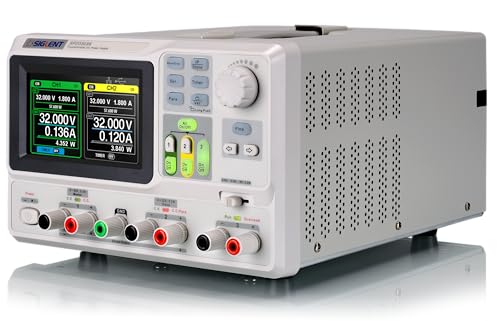
The SPD3303X-E earns its place by replacing three separate boxes with one instrument. Two adjustable channels reach 32V at 3.2A each, and the third channel offers fixed 2.5V, 3.3V or 5V at 3.2A, so a board needing logic, peripherals and a driver rail can run from a single unit. Independent, series and parallel modes stretch the pair of main channels further, joining them for higher voltage or higher current when a load demands it. USB and LAN interfaces carry SCPI commands, which makes scripted sequences and logging straightforward from a computer already on the bench network.
Specs
- Outputs: 2 x 32V, 3.2A, plus fixed 2.5V, 3.3V or 5V at 3.2A
- Total power: 220W
- Channels: 3, independently controlled and isolated
- Resolution: 10 mV, 10 mA
- Interfaces: USB and LAN
- Modes: independent, series and parallel
- Control: SCPI remote programming
Best for: Mixed-rail boards that need two adjustable outputs and a fixed logic rail at once.
Watch out for: The third channel is fixed-voltage only, so check that 2.5V, 3.3V or 5V matches the rail you need.
Siglent SPD3303X
The SPD3303X shares the same triple-output layout as the E model, with two 32V, 3.2A channels and a fixed 2.5V, 3.3V or 5V channel, yet it steps the setting resolution down to 1 mV and 1 mA. That finer step is what separates it: dialling in a rail for a sensitive analog stage or characterising a regulator’s dropout becomes a matter of small, deliberate moves instead of coarse jumps. A 4.3-inch TFT-LCD display shows voltage with five digits and current with four, and the unit supports remote programming with a real-time wave display. Choose this one when the reading itself has to be trustworthy, not merely close.
Specs
- Outputs: 2 x 32V, 3.2A, plus fixed 2.5V, 3.3V or 5V at 3.2A
- Total power: 220W
- Channels: 3, independently controlled and isolated
- Resolution: 1 mV, 1 mA
- Display: 4.3-inch TFT-LCD, 5-digit voltage and 4-digit current readouts
- Features: remote programming and real-time wave display
Best for: Measurement-led work where fine setting steps and a detailed display matter.
Watch out for: Confirm the interface set on the listing before ordering, since the E and non-E versions differ mainly in resolution.
Rigol DP832

Rigol’s DP832 takes a different route to the same goal: three channels arranged as two 30V, 3A outputs and one 5V, 3A output, all inside a 195W linear instrument. The arrangement suits benches where analog and digital sections live on the same board, because each section gets its own rail and its own current limit instead of sharing one. USB remote control with SCPI commands covers scripted work, while LAN, RS232 and GPIB appear as options for benches already wired that way. Its linear design keeps the rails quiet enough for analog sections sitting beside digital logic.
Specs
- Outputs: 30V, 3A; 30V, 3A; 5V, 3A
- Total power: 195W
- Channels: 3
- Type: programmable linear DC power supply
- Resolution: 10 mV, 10 mA
- Interfaces: USB remote control with SCPI; LAN, RS232 and GPIB listed as options
Best for: Mixed analog and digital boards that need three separate rails with individual limits.
Watch out for: LAN, RS232 and GPIB are listed as options, so confirm which interfaces the exact listing includes.
Which One Fits Your Situation
Starting a first electronics bench
Pick the KORAD KA3005P. One 30V, 5A linear channel covers microcontroller boards, sensors and small motors, the four presets store the rails you use most, and USB plus RS232 control is there when scripted work starts to appeal. It asks for the least setup of the four, and its limits are easy to learn before a project outgrows them.
Powering a board with several rails at once
Pick the Siglent SPD3303X-E. Two adjustable 32V channels handle driver and analog rails while the fixed channel feeds 3.3V or 5V logic, so one box replaces a tangle of adapters. Series and parallel modes add flexibility when a single rail needs more voltage or more current, and LAN control fits a bench that already runs scripted tests.
Characterising a circuit where small steps matter
Pick the Siglent SPD3303X. Its 1 mV and 1 mA resolution turns regulator dropout checks and sensitive analog work into fine adjustments instead of rough guesses, and the five-digit voltage readout shows exactly where the rail sits. The same triple-output layout as the E model means multi-rail boards still run from one instrument.
Running analog and digital sections side by side
Pick the Rigol DP832. Its two 30V channels and separate 5V channel give each section of a mixed board its own rail and current limit, which keeps a fault on one side from dragging the other down. USB control with SCPI handles scripted sequences, and the linear output suits analog stages that dislike noisy rails.
Common Mistakes
- Buying on voltage alone and forgetting the wattage ceiling, so 30V and 5A cannot arrive together.
- Choosing a fixed-voltage third channel that does not match the logic rail the board needs.
- Assuming every interface in a model family is standard, when LAN, RS232 or GPIB may be optional on the exact listing.
- Confusing a non-programmable lookalike with the programmable model, especially where one letter in the model name decides whether USB or RS232 is fitted.
- Leaving the current limit at maximum for a first power-up instead of setting it low enough to protect a new board.
Frequently Asked Questions
What does programmable mean for a DC bench power supply?
Programmable means the output can be set, stored and recalled beyond a manual knob turn. At the simplest level it is memory presets that return to a saved voltage and current with one keypress. At the full level it is computer control over USB, RS232 or LAN, where a script sets values, reads back measurements and steps through a sequence without anyone touching the front panel.
Is a triple-output supply better than a single-channel one?
Better depends on how many rails a board needs at the same time. A triple-output unit powers logic, peripherals and a driver from one box, keeps grounds tidy and saves desk space. A single-channel unit suits work that only ever needs one rail, and it usually leaves more budget for finer resolution or quieter output. Count the simultaneous rails first, then choose.
Do I need 1 mV resolution, or is 10 mV enough?
For microcontroller boards, motors and general bench work, 10 mV steps are usually enough, because those circuits tolerate small rail differences without complaint. The finer 1 mV step earns its place when characterising regulators, trimming an analog reference or hunting a threshold that sits between two coarse steps. If the work is measurement-led, buy the finer resolution; if it is build-led, save the difference.
Can I control these supplies from a computer?
Yes, on the models in this guide, provided the listing names the interface you plan to use. The KORAD uses USB and RS232, the Siglent units use USB and LAN with SCPI commands, and the Rigol uses USB with SCPI while LAN, RS232 and GPIB appear as options. Check the port list on the exact listing and confirm your computer has a matching port or adapter before ordering.
Related guides
More from Amazon
Programs that pair well with the guide above. Offers and eligibility are set by Amazon and may change.
Free shipping on eligible items, Prime Video and more. Eligible new members can start with a free trial.
Start a Prime free trialAudiobooks and podcasts to listen to on the go. Eligible new members can start with a free trial.
Try Audible freeAd-free music streaming. Eligible new subscribers can start with a free trial.
Try Music Unlimited freeA free business account with business pricing and bulk-buying tools for work, shop or home office.
Create a business accountAs an Amazon Associate we earn from qualifying purchases.










Write Your Review
No reviews yet. Be the first to share your experience!