
Key takeaways
- Compare five 12-inch powered subwoofers for stereo systems, from sealed and ported cabinets to high-level inputs, crossover control, and room fit.
What's inside
As an Amazon Associate I earn from qualifying purchases. This post may contain affiliate links at no extra cost to you.
A two-channel system can sound thin when the main speakers hand off too early, and adding a subwoofer is the most direct fix. The real decision is not whether to add bass, but which kind of bass suits the room: a sealed cabinet that stays tight and quick, or a ported cabinet that reaches deeper with more output. Connection type matters just as much, because many stereo amplifiers have no dedicated subwoofer output at all.
This guide is written for listeners who run a stereo amplifier with a pair of bookshelf or floorstanding speakers and want the low end to blend in rather than call attention to itself. Every model below was selected from the name and specifications shown on its Amazon listing page, with driver size, amplifier rating, frequency response, and input options checked against that listing before inclusion.
Quick Picks
As an Amazon Associate we earn from qualifying purchases.
| Product | Best for | Key spec from title |
|---|---|---|
| SVS SB-1000 Pro | Tight, controlled bass in small to medium rooms | 12-inch sealed driver, 325-watt RMS amplifier |
| SVS PB-1000 Pro | Deep extension for larger rooms | 12-inch ported driver, 17 Hz low end |
| Klipsch R-12SW | Punchy bass on a modest budget | 12-inch copper-spun driver, 400 watts |
| BIC America F12 | Stereo amplifiers without a subwoofer output | 12-inch driver, speaker-level inputs |
| Polk Audio PSW505 | Flexible crossover tuning | 12-inch driver, 300-watt continuous amplifier |
How to Choose
Sealed or Ported Cabinet
A sealed cabinet generally produces bass that starts and stops quickly, which keeps double bass, kick drums, and acoustic instruments sounding natural next to stereo speakers. A ported cabinet uses one or more tuned openings to add output and reach lower frequencies, so it suits larger rooms and listeners who want more physical impact. Neither design is better in every room. Small and medium rooms often reward the sealed approach, while open-plan spaces usually benefit from the extra output of a ported box.
How It Connects to a Stereo Amplifier
Many stereo amplifiers lack a subwoofer output, so the connection options on the subwoofer decide whether the pairing works at all. Speaker-level inputs let the subwoofer take its signal from the same terminals that feed the main speakers, which keeps older and simpler amplifiers in play. Line-level and LFE inputs suit amplifiers and receivers that already provide a preamp or subwoofer output. Before buying, look at the rear panel of the amplifier and match it to the inputs listed on the subwoofer page.
Crossover and Phase Controls
The crossover sets the frequency where the subwoofer takes over from the main speakers, and getting it right is what makes the bass disappear into the music instead of sitting underneath it. A continuously variable low-pass control gives more room to fine-tune the blend than a fixed switch. Phase control matters too, because it aligns the timing of the subwoofer with the main speakers at the listening position. Models with both controls are far easier to integrate into a stereo system than models with volume alone.
Room Size and Placement
A 12-inch driver moves a large amount of air, so room size and placement shape the result as much as the subwoofer itself. Corner placement reinforces output but can exaggerate certain notes, while placement along the front wall near the main speakers usually gives a more even blend. Measure the floor space before ordering, since a 12-inch cabinet is substantially larger than the 8-inch and 10-inch models many buyers upgrade from. Leave clearance around any rear port and keep the driver clear of furniture that could muffle it.
The 5 Best Options
SVS SB-1000 Pro

The SB-1000 Pro pairs a reimagined 12-inch high-excursion driver with a Sledge STA-325D amplifier in a sealed cabinet, a combination aimed squarely at music listeners who value control over sheer output. Its frequency response reaches down to 20 Hz, and a 50 MHz DSP handles tuning through a smartphone app, which makes adjustments from the listening seat practical rather than a chore. RCA, speaker-level, and 12-volt trigger inputs cover nearly every stereo amplifier, including models with no subwoofer output. At roughly 15.6 inches high and 54.5 pounds, it is compact for its driver size and fits beside a media console without dominating the room.
Specs
- 12-inch high-excursion SVS driver
- Sledge STA-325D amplifier, 325 watts RMS
- Frequency response: 20-270 Hz
- Inputs: RCA, speaker level, 12-volt trigger
- Bluetooth DSP control app for iOS and Android
- Sealed MDF cabinet, about 15.6 x 15.2 x 17.8 inches, 54.5 pounds
Best for: Music-first stereo systems in small to medium rooms where tight, accurate bass matters most.
Watch out for: Confirm the cabinet depth fits the planned spot, since the sealed box is deeper than it looks in photos.
SVS PB-1000 Pro

The PB-1000 Pro takes the same 12-inch high-excursion driver and 325-watt RMS Sledge amplifier as its sealed sibling and puts them in a dual-port cabinet that reaches down to 17 Hz. Variable port tuning modes offer Standard and Sealed response curves, so the same box can lean toward maximum output or toward faster transient response depending on how the ports are configured. The smartphone app controls volume, DSP functions, and custom presets, which helps when one setting suits music and another suits films. Its larger cabinet and front-firing ports suit bigger living rooms where a sealed model would run out of reach.
Specs
- 12-inch high-excursion SVS driver
- Sledge STA-325D amplifier, 325 watts RMS, 820 watts peak
- Frequency response: 17-260 Hz
- Dual-port cabinet with variable port tuning modes
- Bluetooth DSP control app with custom presets
- Inputs: RCA line and LFE, 12-volt trigger
Best for: Larger rooms and listeners who want the deepest extension a 12-inch driver can offer.
Watch out for: This model has no speaker-level input, so an amplifier without a preamp or subwoofer output cannot connect to it directly.
Klipsch R-12SW

The R-12SW uses a front-firing 12-inch copper-spun woofer with a 400-watt digital amplifier, and its frequency response of 29 to 120 Hz covers the range where most bookshelf speakers start to fade. An integrated low-pass crossover and phase control sit on the rear panel, giving the basic tools needed to blend the subwoofer with stereo speakers. LFE and line-level inputs handle connection to amplifiers and receivers that provide a subwoofer or preamp output. The brushed black vinyl cabinet measures about 14 by 18.5 by 16 inches, making it one of the easier 12-inch models to place against a wall or beside a stand.
Specs
- 12-inch front-firing copper-spun woofer
- 400 watts of digital amplifier power
- Frequency response: 29-120 Hz
- Integrated low-pass crossover and phase control
- LFE and line-level inputs
- Cabinet about 14 x 18.5 x 16 inches
Best for: Listeners who want punchy, room-filling bass from a straightforward subwoofer without app setup.
Watch out for: Check the amplifier for a line-level or LFE output first, because this model does not list speaker-level inputs.
BIC America F12
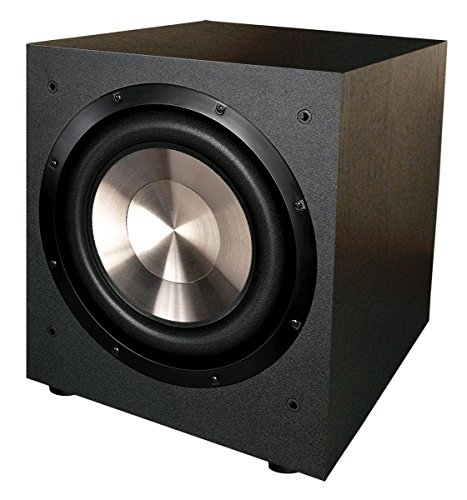
The F12 has been a familiar name in budget home audio for years, and its 12-inch injection-molded long-throw woofer is driven by a 475-watt peak amplifier designed by BASH. Frequency response runs from 25 Hz to 200 Hz, and the rear panel carries an adjustable crossover, volume control, and automatic signal sensing. Speaker-level inputs sit alongside RCA inputs, which makes this model unusually friendly to stereo amplifiers that offer nothing but speaker terminals. Dolby Pro Logic and Dolby Digital and DTS inputs are also listed, so the same box can serve a simple surround setup later if the system grows.
Specs
- 12-inch injection-molded long-throw woofer
- 475-watt peak BASH amplifier
- Frequency response: 25-200 Hz
- Adjustable crossover, volume control, and auto on and off
- Speaker-level and RCA inputs
- Weight about 40.3 pounds
Best for: Stereo amplifiers with no subwoofer output, where speaker-level connection is the only option.
Watch out for: Its 25 Hz lower limit is modest next to the SVS models, so listeners chasing the deepest notes should compare the response figures first.
Polk Audio PSW505
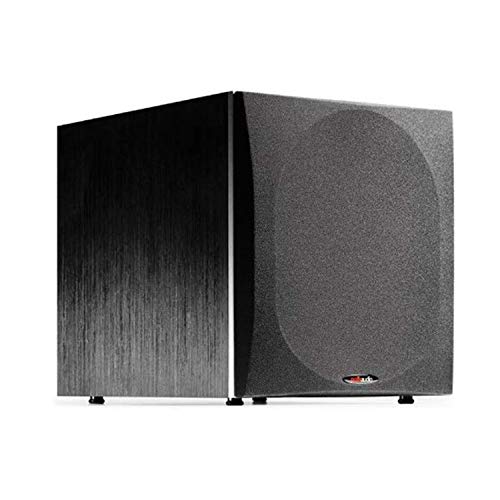
The PSW505 drives a 12-inch long-throw woofer with a 300-watt continuous amplifier rated at 460 watts of dynamic power, and a slot-load vent keeps distortion down as output rises. Its overall frequency response spans 23 Hz to 160 Hz, with a lower 3 dB limit of 28 Hz. The continuously variable low-pass filter adjusts from 60 to 125 Hz, giving finer control over the handoff to the main speakers than a stepped switch allows. Speaker-level 5-way binding posts join line-level and LFE inputs, so the subwoofer connects to almost any stereo amplifier. The wood cabinet is about 16 inches high, 15 inches wide, and 18 inches deep.
Specs
- 12-inch long-throw woofer with polymer composite cone
- 300 watts continuous amplifier output, 460 watts dynamic power
- Overall frequency response: 23-160 Hz
- Variable low-pass crossover, 60-125 Hz
- Inputs: speaker-level 5-way binding posts, line level, LFE
- Slot-load vented enclosure, about 16.1 x 15.1 x 18.2 inches
Best for: Listeners who want precise crossover tuning and flexible connections at a mid-range position.
Watch out for: Measure the depth carefully, since the vented cabinet runs deeper than many 12-inch sealed boxes.
Which One Fits Your Situation
Small Room With Bookshelf Speakers
The SVS SB-1000 Pro fits this situation best, because its sealed cabinet keeps bass tight in a space where reflections build up quickly. Set the crossover near the point where the bookshelf speakers roll off, then use the app to trim volume from the listening seat. Keep the subwoofer near the front wall and away from the corner to avoid excess boom.
Large Living Room With Floorstanding Speakers
The SVS PB-1000 Pro suits a large room, where its ported cabinet and 17 Hz extension fill space that a sealed model would struggle to energize. Its variable port tuning lets the same box favor output or speed depending on the room. Place it along the front wall first, then try the corner only if the bass still feels thin.
Amplifier With No Subwoofer Output
The BIC America F12 or the Polk Audio PSW505 solves this problem, since both offer speaker-level inputs that connect straight to the amplifier speaker terminals. The Polk adds finer crossover control, while the BIC keeps the setup simpler. Either way, run speaker wire from the amplifier to the subwoofer and then onward to the main speakers as the manual describes.
Music-First Listener Who Hates Boomy Bass
The SVS SB-1000 Pro or the Polk Audio PSW505 rewards careful tuning, with the sealed SVS offering the quickest response and the Polk offering the most adjustable crossover. Start with the crossover low and the volume modest, then raise each in small steps until the bass supports the music without drawing attention to itself.
Common Mistakes
- Buying a subwoofer without checking whether the amplifier has a matching output, then discovering the connection does not exist.
- Setting the crossover too high, which lets the subwoofer reproduce mid-bass that the main speakers already handle well.
- Placing the subwoofer in a corner by default, which can exaggerate some notes and leave others weak.
- Turning the volume up until the bass is always audible, instead of blending it so it only appears when the music calls for it.
- Ignoring cabinet depth and weight, then finding the box blocks a walkway or will not fit the planned shelf or nook.
Frequently Asked Questions
Do I need a subwoofer output on my amplifier?
Not always. Subwoofers with speaker-level inputs, such as the BIC America F12 and Polk Audio PSW505, connect to the same speaker terminals that feed the main speakers. Models with only line-level or LFE inputs, such as the SVS PB-1000 Pro and Klipsch R-12SW, do need a preamp or subwoofer output on the amplifier.
Is a 12-inch subwoofer too big for a small room?
A 12-inch driver can work in a small room when the cabinet is sealed and the volume is set with care, and the SVS SB-1000 Pro is a good example. The risk is not the driver size itself but placement and level: a corner position or high volume will overwhelm a compact space. Start near the front wall with modest volume.
Sealed or ported for music?
Sealed cabinets usually suit music better because their bass starts and stops quickly, keeping rhythm instruments clear. Ported cabinets reach lower and play louder, which suits larger rooms and film sound. The SVS PB-1000 Pro bridges the two with a sealed tuning mode, though its cabinet stays larger than a dedicated sealed model.
Where should I place the subwoofer?
Start beside or between the main speakers along the front wall, with the driver facing the listening position and clearance around any rear port. Move it in small steps and listen for even bass across the seating area. Corner placement adds output but often makes the response uneven, so treat it as an experiment rather than a default.
Related guides
More from Amazon
Programs that pair well with the guide above. Offers and eligibility are set by Amazon and may change.
Free shipping on eligible items, Prime Video and more. Eligible new members can start with a free trial.
Start a Prime free trialAudiobooks and podcasts to listen to on the go. Eligible new members can start with a free trial.
Try Audible freeAd-free music streaming. Eligible new subscribers can start with a free trial.
Try Music Unlimited freeA free business account with business pricing and bulk-buying tools for work, shop or home office.
Create a business accountAs an Amazon Associate we earn from qualifying purchases.










Write Your Review
No reviews yet. Be the first to share your experience!