
Key takeaways
- Survival watches compared on navigation sensors, solar power and ruggedness, with verified Amazon ASINs from Garmin and Casio for off-grid and emergency use.
What's inside
As an Amazon Associate I earn from qualifying purchases. This post may contain affiliate links at no extra cost to you.
A survival watch is not bought for how it looks in a blackout; it is bought for the information it still provides when phones are dead, signal is gone and weather is closing in. The real decision is which failures you are planning for: a flat battery, a lost trail, a storm arriving early, or a case that cracks on rock. Each failure points to a different watch in this guide.
These picks serve hikers, expedition and field workers, rural property owners and prepared households building go-bags. Every model was chosen from its Amazon product page, using stated features such as solar charging, multi-GNSS positioning, triple sensors and water ratings, so the survival claims here rest on listed hardware rather than marketing words like tactical or extreme.
Quick Picks
As an Amazon Associate we earn from qualifying purchases.
| Product | Best for | Key spec from title |
|---|---|---|
| Garmin Instinct 2 Solar Tactical | Multi-day off-grid trips where solar GPS runtime matters most | Solar charging, GPS, tactical edition features |
| Casio Pro Trek PRG-270-1 | Hikers who want compass, altitude and weather warning without charging | Tough Solar, Triple Sensor, 100 m water resistance |
| Garmin Instinct 2 Graphite | Trail users who want GPS navigation and health tracking in one watch | GPS, Multi-GNSS, TracBack, rugged outdoor build |
| Casio G-Shock DW5600E-1V | A bombproof go-bag and backup watch that asks for nothing | Resin strap, shock resistant, 200 m water resistance |
How to Choose
Power first: how long it runs away from sockets
In a genuine emergency the battery is the watch. Solar models from Garmin and Casio stretch runtime from days into weeks or effectively indefinitely in good light, which is why two of the four picks here harvest sunlight. A standard quartz digital can also be a rational survival choice, because a multi-year battery with zero features drawing power is its own kind of reliability. What you should avoid is a watch that needs a cable every second night; its navigation features will be dead exactly when the trip goes wrong.
Navigation tools that work without a phone
A survival watch earns the name when it can get you back without a network. Garmin’s multi-GNSS positioning with TracBack retraces your route to the trailhead, while Casio’s Pro Trek reads direction from a magnetic compass that needs no satellites at all. The two approaches complement rather than replace each other: satellite fixes are precise but power-hungry, while a compass and altimeter keep working in storms, canyons and dead-battery scenarios. Serious off-grid users often carry one of each philosophy across a group.
Weather and altitude sensing as early warning
A barometer is the most underrated survival feature on this page. Falling pressure shown on the Pro Trek’s tendency graph, or tracked by the Garmin, warns of incoming weather hours before the sky changes, which is the difference between descending early and being caught on a ridge. Altimeters support map-and-compass navigation when visibility drops. These sensors need occasional calibration against a known altitude or pressure reading, a small chore that product pages mention and buyers routinely skip, then blame the watch for drift.
Build quality you can verify on the listing
Survival marketing is cheap, so judge the hardware you can check: water resistance of at least 100 metres, a case described as shock resistant or built for all elements, and a strap that can be replaced in the field. Low-temperature ratings, like the Pro Trek’s minus 10 degree specification, matter for winter use and are stated on its product page. Glass type, case material and strap construction are all listed fields; if a so-called survival watch hides them, treat that silence as the answer.
The 4 Best Options
Garmin Instinct 2 Solar Tactical
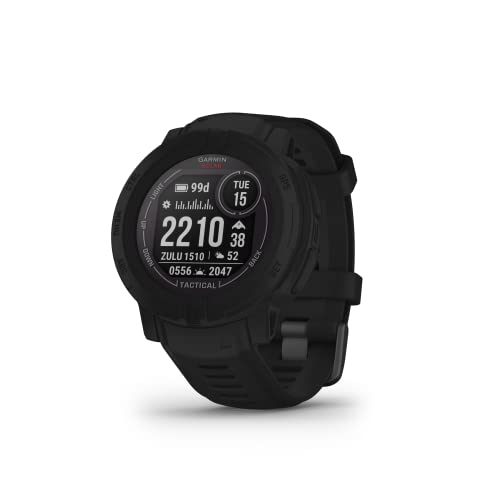
The Solar Tactical edition stretches the Instinct formula further from the charger: its solar lens harvests sunlight to extend battery life, which is exactly what multi-day trips and remote work demand. The tactical feature set, multi-GNSS positioning and TracBack routing serve users who navigate deliberately rather than recreationally. If your idea of a survival watch includes never packing a charging cable and still having GPS at the end of week two, this is the shortlist topper.
Specs
- Model 010-02627-13, Tactical Edition as listed
- Solar charging capability extends battery life in sunlight
- GPS with Multi-GNSS support and TracBack routing
- Rugged outdoor case built for all elements
- Silicone strap with stealth and tactical feature set
Best for: Multi-day off-grid trips where solar GPS runtime matters most
Watch out for: Solar gains depend on sun exposure; shaded forest routes charge far less
Casio Pro Trek PRG-270-1
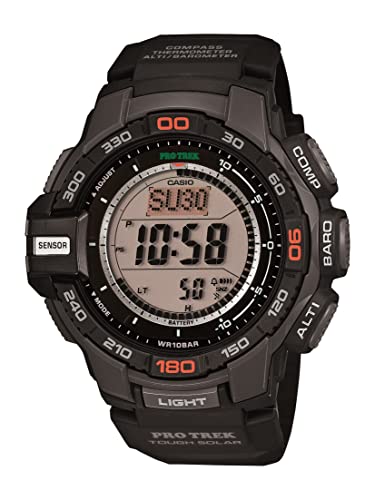
The PRG-270-1 is built around information rather than toughness theatre: its Triple Sensor package reads altitude, barometric pressure and direction, and a pressure-tendency alarm warns when weather is turning. Tough Solar power means the sensors do not drain a disposable battery, and the watch is rated for use down to minus 10 degrees. Hikers crossing unfamiliar ridgelines and field workers who plan around weather will get more from this Casio than from any purely rugged fashion piece.
Specs
- Model PRG-270-1 with Tough Solar power as listed
- Triple Sensor: altimeter, barometer and digital compass
- Thermometer and barometric pressure tendency alarm
- Water resistant to 100 metres, low-temperature resistant to minus 10 degrees C
- Sunrise and sunset data, five alarms and stopwatch functions
Best for: Hikers who want compass, altitude and weather warning without charging
Watch out for: No GPS, so position fixes still need a map or a phone
Garmin Instinct 2 Graphite

The Instinct 2 takes the G-Shock formula and adds navigation: GPS with multi-GNSS support, TracBack routing to retrace a route, and health tracking in a case built for rough handling. Its silicone strap and fibre-reinforced body shrug off the knocks that end glass-slab smartwatches, while the transflective display stays readable in hard sunlight. It fits hikers, trail runners and outdoor workers who want guidance on the wrist but refuse to charge a watch every night.
Specs
- Model 010-02626-10, rugged outdoor watch with GPS as listed
- Multi-GNSS support and TracBack routing
- Built for all elements, fibre-reinforced case design
- Silicone strap and monochrome sunlight-readable display
- Health and activity tracking with connected smart features
Best for: Trail users who want GPS navigation and health tracking in one watch
Watch out for: Battery still needs a cable eventually, unlike the solar edition
Casio G-Shock DW5600E-1V

Think of the DW5600E-1V as the watch equivalent of a steel-toe boot: plain, deliberate and very hard to break. The resin strap is the detail that matters most for this guide, because resin ignores the things that ruin leather and stain fabric, from machine oil to chlorinated pool water. Add genuine shock resistance and a 200-metre rating and you get a watch that can be worn into almost any environment without a second thought or a protective sleeve.
Specs
- Model DW-5600E-1V, resin case and resin strap as listed
- Shock-resistant G-Shock construction
- Water resistant to 200 metres on the product page
- 1/100-second stopwatch, countdown timer and multi-function alarm
- Quartz digital movement, listed accuracy of plus or minus 15 seconds per month
Best for: A bombproof go-bag and backup watch that asks for nothing
Watch out for: No sensors or navigation; it tells time and survives, nothing more
Which One Fits Your Situation
You are building a go-bag or emergency kit
Pack the G-Shock DW5600E-1V and stop overthinking it. It needs no charging cable in the bag, its battery runs for years, and shock resistance plus a 200-metre rating means it will work whenever the bag is finally opened. Add the Pro Trek later if your plans involve real navigation. Simplicity is a survival feature in itself, because gear that needs no management cannot be forgotten or misconfigured.
You hike multi-day routes beyond phone signal
Choose the Garmin Instinct 2 Solar Tactical. Multi-GNSS positioning and TracBack handle the navigation, solar charging stretches the battery across long trips, and the rugged case tolerates the weather that makes the navigation necessary. It is the most complete single-watch answer here. It is the watch most likely to still be working, and still be worn, when a genuine emergency finally happens.
Your main fear is weather turning on high ground
Take the Casio Pro Trek PRG-270-1. Its barometric tendency alarm and altimeter are aimed squarely at that scenario, and solar power keeps the sensors alive all season. Walkers in changeable mountain climates will use these readings weekly, long before any emergency arrives. Every other feature on this page is secondary to a barometer you actually learn to read and trust.
You want survival features in a daily watch
The standard Instinct 2 is the compromise that works: full GPS navigation and health tracking for everyday training, in a case built for rough treatment. It lacks the solar top-up of its Tactical sibling, so home charging remains part of the routine. That balance of capability and endurance is why it anchors so many everyday carry lists.
Common Mistakes
- Buying a smartwatch that needs charging every two days and calling it emergency gear.
- Trusting a barometer or altimeter that has never been calibrated since the watch arrived.
- Assuming a compass app on a dead phone counts as a navigation backup plan.
- Choosing fashion-tactical styling with no stated water rating or shock resistance on the listing.
- Storing a solar watch in a dark kit bag for a year, then expecting a full charge in an emergency.
Frequently Asked Questions
Do survival watches need GPS?
Not necessarily. GPS gives precise position and route retracing, as on the Garmin models, but it drains power and needs sky view. A compass, altimeter and barometer, as on the Casio Pro Trek, support traditional map navigation indefinitely on solar power. The right choice depends on whether your trips rely on marked trails or open country.
How long can a solar survival watch run?
In smartwatch terms, solar Garmin models extend battery life from weeks towards much longer with regular sun exposure, while solar Casio digitals can run for many months per charge because their displays draw little power. Exact figures depend on GPS use and light levels, and the product pages state the assumptions behind their estimates.
Is 100 metres of water resistance enough?
For survival and outdoor use, yes, in practice. A 100-metre rating covers river crossings, heavy rain, swimming and being submerged briefly, which exceeds what almost any land emergency involves. The G-Shock here goes further at 200 metres. What matters more is that the rating is genuine and stated, not printed as a style cue.
Should a survival watch be automatic?
An automatic never needs a battery, which appeals to long-term planners, but it stops after a day or two unworn and offers no sensors or navigation. Solar quartz and solar GPS watches give far more emergency information per gram. Most prepared buyers choose solar power now and keep the automatic for everyday wear.
Related guides
More from Amazon
Programs that pair well with the guide above. Offers and eligibility are set by Amazon and may change.
Free shipping on eligible items, Prime Video and more. Eligible new members can start with a free trial.
Start a Prime free trialAudiobooks and podcasts to listen to on the go. Eligible new members can start with a free trial.
Try Audible freeAd-free music streaming. Eligible new subscribers can start with a free trial.
Try Music Unlimited freeA free business account with business pricing and bulk-buying tools for work, shop or home office.
Create a business accountAs an Amazon Associate we earn from qualifying purchases.










Write Your Review
No reviews yet. Be the first to share your experience!