
Key takeaways
- Compare five 10-inch powered subwoofers for movies and music, from compact 100-watt models to a 400-watt app-tuned pick. Find the right bass for your room.
What's inside
As an Amazon Associate I earn from qualifying purchases. This post may contain affiliate links at no extra cost to you.
A 10-inch powered subwoofer sits in a useful middle ground: it moves enough air to give films weight and music a foundation, yet it stays small enough for a living room, a bedroom system, or a desk-adjacent setup. The real decision is not whether to buy one, but which balance of amplifier power, cabinet design, and controls matches the room, the speakers it will join, and the volume the household tolerates day to day.
This guide serves first-time home theater buyers, music listeners upgrading small speakers, and anyone replacing an aging subwoofer without upsizing the cabinet. Every model below is a 10-inch powered subwoofer with a built-in amplifier, chosen from the driver size, amplifier rating, and connection details shown on its Amazon listing.
Quick Picks
As an Amazon Associate we earn from qualifying purchases
| Product | Best for | Key spec from title |
|---|---|---|
| Polk Audio PSW10 | Small rooms and first home theater setups | Up to 100 watts |
| Klipsch R-100SW | Punchy movie bass with a copper driver | All-digital amplifier |
| Polk Audio HTS 10 | Larger living rooms needing deeper extension | Up to 200 watts |
| ELAC Debut 2.0 SUB3010 | App-based room tuning | 400-watt amplifier |
| Dayton Audio SUB-1000 | Budget stereo and DIY-friendly systems | 10-inch powered subwoofer |
How to Choose
Match amplifier power to room size
Amplifier power matters most as a match to room volume, not as a score to maximize. A 100-watt subwoofer can fill a bedroom or a small apartment living room without strain, while the same unit in a large open-plan space will run out of headroom on demanding film scenes. Bigger rooms with high ceilings and open doorways call for the 200-watt class or above, because bass energy spreads and fades with distance. Before comparing watt figures, measure the room and note whether it opens into a kitchen or hallway. A modest amplifier in a closed room usually sounds cleaner than a powerful one fighting a space it cannot pressurize.
Mind port placement and wall clearance
Nearly every 10-inch powered subwoofer uses a ported cabinet, and where that port fires changes how much space the cabinet needs. A front-firing port tolerates placement close to a wall, which suits tight corners and media consoles. A rear port needs several inches of breathing room behind the cabinet, or the bass turns thick and boomy. A floor-firing port needs a hard, flat surface and clear space underneath, so thick carpet can muffle it. Check the port direction in the listing photos and measure the gap your spot allows before choosing between otherwise similar models.
Look for controls that make setup easier
The rear panel decides how painless setup will be. At minimum, look for a volume knob, a variable low-pass crossover, and a phase switch, since those three let the subwoofer blend with the main speakers instead of doubling their bass. An auto on and off function saves the daily reach behind the cabinet. Some models add app-based room correction, which measures the room and adjusts the response without extra hardware. None of these controls replace placement, but a subwoofer with flexible controls is far more forgiving when the only available corner is not the ideal one.
Check inputs against your receiver or stereo
A subwoofer is only useful if it connects to the system driving it. Most AV receivers use a single RCA subwoofer output, which pairs with the LFE or line-level input found on nearly every powered model here. Stereo amplifiers without a subwoofer output need a different route, usually speaker-level inputs that accept wire from the amplifier terminals. Confirm which outputs the receiver or amplifier actually has, then confirm the matching input on the subwoofer listing. Buying first and discovering a missing connection is one of the most common and most avoidable mistakes in this category.
The 5 Best Options
Polk Audio PSW10
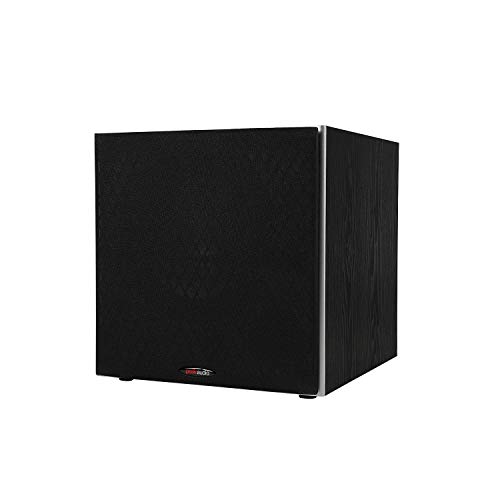
The PSW10 has been the default first subwoofer for small rooms for years, and its appeal is simple: a compact cabinet, a straightforward rear panel, and enough output to transform a soundbar-free TV setup or a pair of bookshelf speakers. Its front-firing design and front port keep placement flexible in tight spots, while the Power Port design smooths airflow at higher volumes. For a bedroom, a dorm, or a first apartment theater, it adds the low end that small speakers cannot produce, without dominating the floor plan or the setup process.
Specs
- 10-inch Dynamic Balance woofer
- Up to 100 watts of power
- Power Port Technology for smoother bass
- Frequency response of 35 to 200 Hz
- Front-firing driver with front port
- Line-level and speaker-level inputs
- Volume, low-pass crossover, and phase controls
Best for: First-time buyers adding bass to a small room or a compact speaker system.
Watch out for: Confirm the finish and cabinet size on the listing before ordering, and measure the planned spot, since the cabinet is deeper than it looks in photos.
Klipsch R-100SW

Klipsch builds the R-100SW around its signature copper spun woofer and an all-digital amplifier, a combination aimed squarely at home theater impact. The front-firing driver delivers punchy, forward bass that suits film effects and modern music, while the rear port adds low-end extension when the cabinet has room to breathe. Gain, low-pass, and phase controls sit on the rear panel alongside line-level and LFE inputs, so it integrates with most receivers without extra hardware. It is the pick for buyers who want their subwoofer to be felt during action scenes.
Specs
- 10-inch spun-copper IMG woofer
- All-digital amplifier, 150 watts continuous and 300 watts peak
- Frequency response of 32 to 120 Hz
- Front-firing driver with rear port
- Low-pass crossover and phase controls
- Line-level and LFE inputs
- Dimensions of 14.5 x 12.5 x 16.4 inches
Best for: Movie lovers who want punchy, forward bass in a medium-sized room.
Watch out for: The rear port needs clearance from the wall, and a separate two-pack listing exists, so confirm the single-unit listing before ordering.
Polk Audio HTS 10

The HTS 10 steps up from the PSW10 with a stronger amplifier and a longer-throw woofer, and the difference shows in larger living rooms where a smaller subwoofer would strain. Its front-firing driver pairs with a floor-firing Power Port, a design that vents downward to keep the front baffle clean while extending low-frequency output. Volume, low-pass, and phase controls cover the usual setup adjustments, and the cabinet finish is closer to furniture than to raw audio gear. Buyers furnishing a main living room theater get deeper bass without moving to a 12-inch cabinet.
Specs
- 10-inch long-throw Dynamic Balance woofer
- Up to 200 watts from a Class D amplifier
- Power Port Technology with floor-firing port
- Frequency response of 25 to 180 Hz
- Front-firing driver
- Volume, low-pass filter, and phase controls
- LFE and line-level inputs
Best for: Larger living rooms where a 100-watt subwoofer would run out of headroom.
Watch out for: The floor-firing port needs a hard, flat surface and clear space underneath, so check the flooring and measure the cabinet footprint first.
ELAC Debut 2.0 SUB3010

ELAC aims the SUB3010 at buyers who want the subwoofer to adapt to the room rather than the other way around. Its AutoEQ system uses a phone app to measure the room and tune the response, which helps in awkward spaces with hard floors, open walls, or limited placement choices. Behind that convenience sits a serious amplifier and a long-throw 10-inch driver in a bass-reflex cabinet, so the tuning is not covering for weak hardware. It suits listeners who enjoy setup as part of the hobby and want a subwoofer that can be retuned after moving furniture.
Specs
- 10-inch long-throw woofer
- 400-watt BASH amplifier
- AutoEQ automatic room calibration with app control
- Frequency response of 28 to 150 Hz
- Front-firing bass-reflex port
- RCA line-level and LFE inputs
- Volume and crossover controls
Best for: Awkward rooms where app-based calibration can correct placement compromises.
Watch out for: AutoEQ needs a compatible phone and the app, so confirm app support for the model and check that the front port has clear space.
Dayton Audio SUB-1000

Dayton Audio built its reputation on straightforward, no-frills components, and the SUB-1000 follows that pattern. It is a plain black cabinet with a 10-inch long-throw driver, a 100-watt amplifier, and the essential controls, without cosmetic extras or app features. That simplicity makes it a strong match for stereo systems, garage setups, and DIY speaker builds, where the subwoofer is expected to do one job well. Speaker-level inputs let it join amplifiers that lack a dedicated subwoofer output, which widens the systems it can serve.
Specs
- 10-inch long-throw woofer
- 100 watts RMS
- Frequency response of 30 to 140 Hz
- Bass-reflex enclosure
- Variable crossover from 40 to 140 Hz
- Volume, phase, and auto on and off controls
- Line-level and speaker-level inputs
Best for: Budget stereo systems and DIY builds that need simple, reliable bass.
Watch out for: Confirm the seller and availability on the listing before ordering, and check that the amplifier outputs match the line-level or speaker-level inputs.
Which One Fits Your Situation
First home theater in a small living room
Start with the Polk Audio PSW10. Its 100-watt amplifier is enough for a closed living room, its front port tolerates placement near a wall or console, and its speaker-level inputs cover receivers and stereo amplifiers alike. The compact cabinet fits beside a TV stand without rearranging furniture, and the simple rear panel keeps the first setup short. Spend the savings on placement experiments rather than on power the room cannot use.
Movie nights in a larger room
Choose the Polk Audio HTS 10 when the room is large, open to other spaces, or has high ceilings. The 200-watt amplifier and deeper extension hold up on demanding film soundtracks where a smaller subwoofer would distort or disappear. Keep the floor-firing port in mind and place the cabinet on a hard surface with space underneath. If the room is medium-sized and the budget is tighter, the Klipsch R-100SW is the fallback with similar theater punch.
Music-first listening with small speakers
Pick the Klipsch R-100SW for a stereo setup where bass needs to stay tight and rhythmic. Its front-firing driver and 32 Hz extension add weight to acoustic bass, kick drums, and electronic music without overwhelming the main speakers. Set the crossover low so the subwoofer handles only the lowest notes, then adjust the phase until the bass locks in with the speakers. This is the most music-friendly option among the theater-oriented models here.
An awkward room with limited placement
Take the ELAC Debut 2.0 SUB3010 when the only available corner is compromised by hard floors, glass, or an open wall. AutoEQ measures the room through the app and adjusts the response, which compensates for placement that no manual knob fully fixes. The stronger amplifier also helps when the subwoofer must sit farther from the listening seat than ideal. Run the calibration after the furniture is final, not before.
Common Mistakes
- Judging a subwoofer by watts alone while ignoring driver size, cabinet volume, and port design, which shape the sound just as much.
- Pushing a rear-ported or floor-ported cabinet flush against a wall or onto thick carpet, choking the port it needs to breathe.
- Setting the crossover too high, so dialogue and mid-bass leak into the subwoofer and the sound turns muddy.
- Skipping the phase and volume match with the main speakers, leaving a gap or a boom at the crossover point.
- Ordering a two-pack listing by mistake when only one subwoofer is needed, or assuming every finish shares the same listing.
Frequently Asked Questions
Is a 10-inch powered subwoofer enough for a living room?
For most closed living rooms, yes. A 10-inch powered subwoofer adds the low end that bookshelf speakers and TV speakers miss, covering film effects and music bass in small to medium spaces. Very large or open-plan rooms may need a 200-watt model from this list, or a larger driver, to keep the bass even at the listening seat.
Do I need a receiver with a subwoofer output?
Not always. Most AV receivers have a dedicated subwoofer output that connects to the LFE or line-level input on these models. Stereo amplifiers without that output can use the speaker-level inputs found on the Polk PSW10 and Dayton SUB-1000, which accept wire from the amplifier terminals. Check the amplifier outputs first, then match them to the subwoofer inputs.
Where should I place a 10-inch subwoofer?
Start in a front corner near the main speakers, with the driver facing the listening area and the port given the clearance its design needs. Front-ported models tolerate wall placement, rear-ported models need space behind them, and floor-ported models need a hard surface. Try two or three spots and listen for even bass before settling.
Can a 10-inch subwoofer work for music as well as movies?
Yes, when the crossover is set low and the volume is matched to the main speakers. A 10-inch driver is fast enough for kick drums and bass guitar while still reaching low enough for film effects. The Klipsch R-100SW and Dayton SUB-1000 suit music-first setups, while the Polk HTS 10 leans toward theater impact in bigger rooms.
Related guides
More from Amazon
Programs that pair well with the guide above. Offers and eligibility are set by Amazon and may change.
Free shipping on eligible items, Prime Video and more. Eligible new members can start with a free trial.
Start a Prime free trialAudiobooks and podcasts to listen to on the go. Eligible new members can start with a free trial.
Try Audible freeAd-free music streaming. Eligible new subscribers can start with a free trial.
Try Music Unlimited freeA free business account with business pricing and bulk-buying tools for work, shop or home office.
Create a business accountAs an Amazon Associate we earn from qualifying purchases.










Write Your Review
No reviews yet. Be the first to share your experience!