
Key takeaways
- Compare triple-output bench power supplies with overvoltage protection for research labs, checking OVP wording, channel ratings and remote control options.
What's inside
As an Amazon Associate I earn from qualifying purchases. This post may contain affiliate links at no extra cost to you.
A research bench rarely powers one circuit at a time. A single experiment can need a positive rail for an amplifier stage, a matched negative or second positive rail for a converter, and a steady logic supply for the controller, all running for hours while measurements are logged. The decision that matters most is not the headline wattage but whether the supply protects irreplaceable samples and prototypes when a wiring slip or a failing load pushes voltage where it should never go.
This guide is written for laboratory researchers, graduate students, and technicians who run mixed-signal experiments and cannot afford a damaged device under test. Every model below is a genuine three-output bench supply whose Amazon product page states overvoltage protection in its own specifications or feature bullets, and each one was chosen from the names and specifications printed on that page rather than from a datasheet alone.
Quick Picks
As an Amazon Associate we earn from qualifying purchases.
| Product | Best for | Key spec from title |
|---|---|---|
| Rigol DP832A High-Precision DC Bench Power Supply | Precision measurement benches needing isolated channels | 195W 3-channel with 1mV/1mA high precision |
| Rigol DP832 Programmable Linear DC Power Supply | Automated test setups driven over LAN or USB | 195W total power, 30V/3A, 30V/3A, 5V/3A |
| MATRIX MPS-3005H-3C Triple Linear DC Power Supply | Higher-current rails and series or parallel wiring | 30V 5A 315W with USB, RS232 and RS485 |
How to Choose
Confirm the Overvoltage Protection Is Really Specified
Overvoltage protection is easy to assume and surprisingly hard to confirm. Many bench supplies advertise short-circuit or overload protection, which reacts to excess current, while true OVP watches the output voltage itself and shuts the channel down when it rises past a set limit. Before ordering, read the feature bullets and specification table on the product page and look for the actual words overvoltage protection or OVP, not a generic promise of safety features. In this guide every pick passed that check on its own Amazon page, because a protection feature that appears only in a manual may belong to a different variant of the model.
Match Channel Layout to Your Experiment
Most triple-output supplies follow one of two layouts. The common pattern pairs two adjustable channels with a fixed low-voltage channel for logic, which suits boards that combine analog stages with a microcontroller. The alternative gives three fully adjustable outputs, useful when an experiment needs a negative rail built by tying channels together or two different digital voltages at once. Check how the channels are grouped, whether any of them are isolated from each other, and whether the fixed channel’s voltage matches your logic family. A fixed 5V rail is ideal for classic logic but useless for a design that runs entirely on lower-voltage parts.
Weigh Current Headroom Against Total Power
Laboratory loads are rarely steady. A heater stage, a motor driver, or a charging energy-storage element can pull several times its running current at switch-on, and a channel that limits early will drag the rail down and corrupt the measurement you were trying to make. Compare the per-channel current rating, not just the total wattage printed in the title, and leave headroom on the channel that feeds your hungriest load. Where an experiment needs more voltage or current than one channel offers, check whether the supply supports series or parallel connection of its channels, because that feature can double the available range without a second instrument.
Plan for Remote Control and Data Logging
Research work increasingly runs unattended: a script steps the voltage, a logger records the response, and the bench repeats the sequence overnight. If that describes your laboratory, put the interface list near the top of your decision. Look for LAN, USB, or serial connections on the product page, and check whether the supply accepts standard remote commands so it can join an existing test program without custom drivers. A built-in display that shows voltage, current, and power together also matters during manual work, because it removes the need for a separate meter on every rail and keeps wiring simpler.
The 3 Best Options
Rigol DP832A High-Precision DC Bench Power Supply
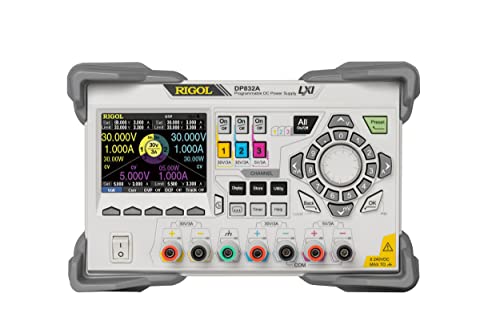
The DP832A is the pick for benches where measurement quality matters as much as raw output. Its page lists standard OVP, OCP, and OTP protection functions, isolated channels, and built-in voltage, current, and power measurement with waveform display, so one instrument can source three rails and record what they actually did during a run. High precision of 1mV and 1mA from the title suits sensitive analog work, and the standard LAN, RS232, and digital IO interfaces on this A model fit straight into an automated laboratory setup without add-on modules.
Specs
- 3 outputs: 30V/3A, 30V/3A, 5V/3A; total power up to 195W
- Low output ripple and noise below 350uVrms/2mVpp
- Transient response time under 50 microseconds
- Standard OVP/OCP/OTP protection functions
- Built-in voltage, current, and power measurements with waveform display
- 3.5-inch TFT display
- Interfaces: USB Host and Device standard; LAN, RS232, and Digital IO standard
- Connector type: banana jack
Best for: Research benches running precision analog and digital rails from one programmable instrument.
Watch out for: The listing warns stock is limited, and the page says only some channels are isolated, so confirm the grouping matches your grounding plan.
Rigol DP832 Programmable Linear DC Power Supply

The DP832 covers the same three-channel layout as its A sibling but at the everyday laboratory end of the range, and its Amazon page is unusually explicit about safety: it states that built-in OVP, OCP, and OTP hardware protections safeguard delicate prototypes. The linear design keeps ripple and noise low for noise-sensitive measurements, the large color display shows real-time voltage and current curves while an experiment runs, and programming over USB, LAN, or RS232 with standard commands makes it a natural fit for scripted test sequences.
Specs
- 3 channels: 30V/3A, 30V/3A, 5V/3A; 195W total power
- Linear design with ripple and noise below 350uVrms
- Built-in OVP, OCP, and OTP hardware protections
- Programmable via USB, LAN, or RS232 using SCPI commands
- 3.5-inch color display with real-time voltage and current curves
Best for: Mixed-signal laboratories that want hardware OVP stated plainly on the listing and full remote programming.
Watch out for: It shares its channel layout with the DP832A, so choose between them on interface and precision needs rather than output ratings.
MATRIX MPS-3005H-3C Triple Linear DC Power Supply

The MATRIX is the high-current option here: two adjustable channels rated to 5A each give it more headroom for power-hungry loads than the 3A Rigol channels, and its page lists a multi-protection function that names overvoltage protection alongside overheat, overcurrent, and short-circuit protection. Channels can be switched into series or parallel internally when one rail needs more range, sense connections help hold voltage steady at the load, and USB plus RS232/485 interfaces cover remote control. A four-digit display and 10mV/1mA setting resolution keep adjustments readable.
Specs
- CH1 and CH2: 0 to 30V, 0 to 5A adjustable; CH3: fixed 5V/3A; 315W total
- Overvoltage protection, plus overheat, overcurrent, and short-circuit protection
- Setting resolution 10mV/1mA with four-digit display
- Voltage accuracy 0.03 percent plus 10mV; current accuracy 0.1 percent plus 5mA
- Interfaces: USB and RS-232/485, with standard sense connections
- Series and parallel modes switched inside the unit
- Smart cooling fan and pure copper terminals
Best for: Experiments whose main rails draw up to 5A and need series or parallel channel combining.
Watch out for: The third channel is a fixed 5V/3A output rather than adjustable, so it will not serve designs that need a third variable rail.
Which One Fits Your Situation
You Run Precision Analog Experiments
Choose the Rigol DP832A. Its 1mV and 1mA precision, low ripple and noise figures, waveform display, and built-in measurements suit work where the quality of the rail shows up directly in your data. Standard LAN and digital IO on this model also make it the easiest of the three to fold into an existing automated rig, and its standard OVP, OCP, and OTP functions guard the samples connected to it.
You Automate Tests With Scripts
Pick the Rigol DP832. It programs over USB, LAN, or RS232 using SCPI commands, so a Python script or an existing test executive can step its three channels through a sequence and log the results without new driver work. The page states its OVP, OCP, and OTP hardware protections in plain language, which matters when a script, rather than a person watching the bench, is in control of the outputs overnight.
Your Loads Draw Serious Current
Take the MATRIX MPS-3005H-3C. With 5A available on each adjustable channel it keeps rails steady under loads that would push a 3A supply into current limiting, and its internal series and parallel switching extends the range further when a single channel is not enough. Its listed overvoltage protection covers the higher-energy wiring mistakes that hurt most, and sense connections help the set voltage survive long cable runs to the experiment.
You Need a Fixed Logic Rail Beside Two Variable Rails
Any of the three fits, because all pair two adjustable channels with a fixed 5V/3A channel for logic. Decide on the surrounding features instead: the DP832A for measurement and display quality, the DP832 for straightforward programming and clearly stated hardware protections, or the MATRIX when the variable rails also need 5A of current. Whichever you choose, set the overvoltage limit on each adjustable channel before the first board is connected.
Common Mistakes
- Assuming overvoltage protection is included because a listing mentions short-circuit or overload protection; the two protect against different faults.
- Comparing only total wattage and missing that one channel is a fixed 5V output with no adjustment.
- Leaving the OVP limit at its default instead of setting it just above each rail’s working voltage.
- Ignoring channel isolation, then creating a ground loop by tying isolated and non-isolated rails together in the experiment.
- Buying for today’s prototype current and leaving no headroom for the inrush of motors, heaters, or charging capacitors.
Frequently Asked Questions
What does overvoltage protection actually do on a bench supply?
OVP monitors the output voltage of a channel and shuts that output down when the voltage rises past a limit you set. It guards against faults such as a failed regulator, a wrong setting applied by a control script, or a wiring error that feeds one rail into another. Current limiting and short-circuit protection react to excess current instead, so a complete specification lists both kinds of protection separately.
Why do research laboratories prefer three outputs instead of one or two?
An experiment powers analog circuitry, digital logic, and a controller or sensor at different voltages simultaneously. Three outputs run all of them from one instrument, keep the rails synchronized at switch-on, and avoid stacking separate supplies that crowd the bench and complicate grounding. With only two outputs, one rail must come from a second supply, adding cables and another place for a wiring mistake to damage the device under test.
Can the channels of a triple-output supply be combined for more voltage or current?
On some models, yes. The MATRIX MPS-3005H-3C switches its two adjustable channels into series or parallel internally, raising the available voltage or current without external jumpers. Other supplies allow series wiring at the terminals but leave details to the manual. Check the product page for an explicit series or parallel statement before planning around combined channels, and note that a fixed third channel normally cannot join the combination.
How should I set the OVP limit for a sensitive experiment?
Set the limit a margin above the highest voltage the rail should ever reach in normal operation, including any programmed ramp or start-up overshoot your circuit tolerates. Setting it at the working voltage causes nuisance shutdowns, while setting it far above the rail leaves the load exposed. Enter the limit on every adjustable channel before connecting the device under test, and recheck it whenever a script changes the output range.
Related guides
More from Amazon
Programs that pair well with the guide above. Offers and eligibility are set by Amazon and may change.
Free shipping on eligible items, Prime Video and more. Eligible new members can start with a free trial.
Start a Prime free trialAudiobooks and podcasts to listen to on the go. Eligible new members can start with a free trial.
Try Audible freeAd-free music streaming. Eligible new subscribers can start with a free trial.
Try Music Unlimited freeA free business account with business pricing and bulk-buying tools for work, shop or home office.
Create a business accountAs an Amazon Associate we earn from qualifying purchases.










Write Your Review
No reviews yet. Be the first to share your experience!