
Key takeaways
- Compare the best sealed powered subwoofers for music listening, with driver sizes, amplifier power, and app control compared for stereo systems at home.
What's inside
As an Amazon Associate I earn from qualifying purchases. This post may contain affiliate links at no extra cost to you.
Choosing a subwoofer for music is mostly a decision about control: the bass should start and stop with the note, follow a bass guitar or kick drum cleanly, and blend with your main speakers instead of drawing attention to itself. Sealed cabinets are the usual answer for that job, because the trapped air inside the enclosure keeps the driver tightly controlled. The real decision is how much driver, amplifier power, and cabinet size your room and speakers actually need.
This guide is for stereo listeners building a two-channel system around bookshelf or floorstanding speakers, for nearfield desk listeners who need a compact cabinet, and for anyone upgrading from a boomy home theater sub. Every product below was chosen from the names and specifications printed on its Amazon product page, and every model is a sealed, powered design.
Quick Picks
As an Amazon Associate we earn from qualifying purchases.
| Product | Best for | Key spec from title |
|---|---|---|
| SVS SB-1000 Pro Sealed Subwoofer (Black Ash) | Compact stereo systems in small to medium rooms | 12-in Driver, 325 Watt RMS, Sealed Cabinet |
| SVS SB-2000 Pro Sealed Subwoofer (Black Ash) | Larger rooms needing deeper extension | DSP Controlled 12″ Sealed Subwoofer |
| SVS SB-3000 Sealed Subwoofer (Black Ash) | Demanding listeners wanting maximum sealed output | 13″ Sealed Subwoofer |
| SVS 3000 Micro Sealed Subwoofer (Piano Gloss Black) | Desks and tight spaces beside furniture | Fully Active Dual 8-inch Drivers |
| KEF KC62 Subwoofer (Black) | Small rooms where the sub must stay nearly invisible | Uni-Core Compact Powered Subwoofer, Black |
How to Choose
Driver Size and Cabinet Volume
Driver diameter and cabinet volume together decide how much air a sealed subwoofer can move, and sealed designs need more driver and amplifier effort than ported ones at the lowest notes. A compact dual-driver model suits a desk or small room, while a single 12-inch or 13-inch driver in a larger sealed cabinet suits open living spaces. Measure the floor space you can actually give up before choosing, including room behind the cabinet for cables and controls, because a subwoofer that only fits in one bad corner rarely blends well with music.
Amplifier Power and DSP Control
In a sealed cabinet, amplifier power is what lets the driver reach low notes at useful volume, so compare the RMS figures printed on the product page rather than peak claims alone. Digital signal processing matters just as much for music: a low-pass filter, phase control, and parametric equalization help you flatten the one or two room peaks that make bass sound one-note. App control is more than a convenience here, because you can adjust volume, crossover, and equalization from the listening seat while a familiar track plays, instead of guessing from behind the cabinet.
Extension Versus Pitch Definition
For music, the lowest printed frequency is only half the story. A sealed subwoofer that reaches 20 Hz with a controlled roll-off usually follows double bass, piano, and electronic bass lines more clearly than a louder model that gives up control near its limit. Check the frequency response range on the product page and treat it as a guide to intended use: deeper extension suits large-scale orchestral and electronic music, while a slightly higher limit in a small sealed cabinet can still cover acoustic jazz, folk, and rock collections completely.
Connections and Speaker Matching
Confirm the subwoofer connects the way your system needs before anything else. Most stereo amplifiers and receivers offer a subwoofer output or preamp outputs for a line-level connection, while some integrated amplifiers need speaker-level inputs instead. The product pages here list connection details such as RCA inputs, speaker-level inputs, and trigger connections on some models. Also plan the crossover around your main speakers: small bookshelf speakers usually hand over at a higher frequency than large floorstanders, so a subwoofer with a wide, finely adjustable low-pass range is easier to blend invisibly.
The 5 Best Options
SVS SB-1000 Pro Sealed Subwoofer (Black Ash)

The SB-1000 Pro is the natural starting point for a music-first stereo system in a small or medium room. Its 12-inch driver and sealed cabinet are sized for control rather than spectacle, and the smartphone app puts volume, crossover, a three-band parametric EQ, polarity, and room gain within reach from the listening chair. That combination suits listeners whose bookshelf speakers do everything well except the bottom octave, and who want to tune the blend carefully without moving the cabinet or reaching behind it repeatedly.
Specs
- Brand: SVS
- Model Name: SB-1000 Pro
- Item model number: SB-1000PRO-BLACKASH
- Subwoofer Diameter: 12 Inches
- Amplifier: Sledge STA-325D, 325 Watts RMS and 820+ Watts Peak Power
- Frequency Response: 20-270 Hz ±3 dB
- Control Method: App, via Bluetooth
- Product Dimensions: 14″D x 13″W x 13.5″H
- Item Weight: 31.9 pounds
- Color: Premium Black Ash
- Material: Mdf
Best for: Bookshelf-speaker stereo systems in small to medium listening rooms.
Watch out for: Confirm your amplifier or receiver has a subwoofer or preamp output, and leave floor space for the roughly 13-inch square footprint.
ASIN: B08X51FVZS
SVS SB-2000 Pro Sealed Subwoofer (Black Ash)

The SB-2000 Pro steps up to a stronger amplifier and deeper extension while keeping the same sealed, app-controlled approach, which makes it a good fit for larger rooms and bigger main speakers. Its 12-inch driver is driven by the Sledge STA-550D, and the 50 MHz DSP with smartphone control covers volume, crossover, three-band parametric EQ, polarity, and custom presets. Listeners who play bass-heavy electronic music, full orchestral recordings, or rock at higher volumes in an open-plan space will use the extra headroom this model offers over the smaller SVS.
Specs
- Brand: SVS
- Model Name: SB-2000 Pro
- Item model number: SB-2000 Pro -Black Ash
- Subwoofer Diameter: 12 Inches
- Amplifier: Sledge STA-550D, 550 Watts RMS, 1,500+ Watts peak power
- Frequency Response: 19-240 Hz
- Control Method: App, via Bluetooth
- Product Dimensions: 14.2″D x 15.6″W x 14.6″H
- Item Weight: 38.5 pounds
- Color: Premium Black Ash
- Material: Wood
Best for: Medium to large rooms with floorstanding speakers or bass-demanding music.
Watch out for: The cabinet is close to 15 inches on every side and noticeably heavier, so check the intended spot and shelving clearances first.
ASIN: B082LNQZ1L
SVS SB-3000 Sealed Subwoofer (Black Ash)
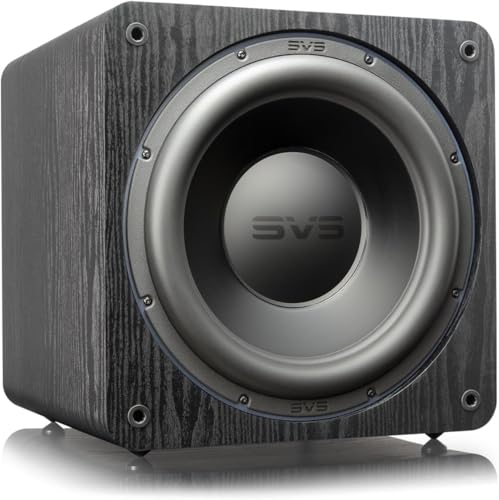
The SB-3000 is the heavyweight sealed option in this group, built around a 13-inch driver and the strongest amplifier listed here. It suits listeners with large rooms, demanding material, or main speakers that stay composed at high volume and need a subwoofer that can keep up without strain. The DSP control app keeps setup manageable from the listening seat, which matters on a cabinet of this size and weight. Choose it when the smaller sealed models would be working near their limits for most of your listening, not as a default upgrade for a small room.
Specs
- Brand: SVS
- Model Name: SB-3000
- Item model number: SB-3000
- Driver: 13-inch driver
- Amplifier: 800W RMS, 2,500W Peak Power
- Control: DSP Control App
- Frequency Response: 18-270Hz
- System Size with Grille: 15.6″ x 15.2″ x 17.8″
- Weight: 54.5 lbs
- Grille: Steel Mesh
- Color: Premium Black Ash
Best for: Large listening rooms and high-volume music with demanding low bass.
Watch out for: At 54.5 lbs this is a two-person lift for many people, and its depth needs real floor space, so measure before ordering.
ASIN: B07K6VN8G1
SVS 3000 Micro Sealed Subwoofer (Piano Gloss Black)

The 3000 Micro takes a different route to sealed bass: two fully active 8-inch drivers face outward from opposite sides of a compact sealed cabinet, so their motion cancels cabinet vibration while the pair moves air together. That makes it a strong choice for a desk system, a bedroom stereo, or a living room where a conventional subwoofer cabinet simply will not fit beside the furniture. The piano gloss black finish also helps it sit discreetly next to a media console. Output expectations should match its size, but for nearfield and small-room music it covers the range bookshelf speakers miss.
Specs
- Brand: SVS
- Model Name: 3000 Micro
- Item model number: 3000MICROPIANOBLK
- Drivers: Fully Active Dual 8-inch Drivers
- Amplifier: 800 Watt RMS
- Cabinet: Sealed Cabinet
- Speaker Size: 8 Inches
- Color: Piano Gloss Black
- Number of Items: 1
Best for: Desk systems, bedrooms, and small rooms with very limited floor space.
Watch out for: Dual side-firing drivers need clearance on both sides of the cabinet, so it cannot sit flush between tightly packed furniture.
ASIN: B08ZQRL7JR
KEF KC62 Subwoofer (Black)

The KC62 is the smallest subwoofer in this guide, a football-sized sealed cabinet using KEF Uni-Core technology to place two 6.5-inch force-cancelling drive units back to back in the space a single driver would normally occupy. A combined 1,000W RMS of Class D amplification drives them, giving this compact unit the control that small sealed cabinets usually lack. It suits design-conscious listening rooms, smaller stereo systems, and anyone who wants the subwoofer to disappear visually while still underpinning the music. Its included components are simple: the subwoofer itself, a power cable, and the product manual.
Specs
- Brand: KEF
- Model Name: KC62
- Item model number: KC62
- Drive Units: Two 6.5inch force cancelling drive units, Uni-Core technology
- Amplifier: 1,000W RMS of specially designed Class D amplification
- Speaker Maximum Output Power: 1000 Watts
- Subwoofer Diameter: 6.5 Inches
- Input Voltage: 120 Volts
- Color: Black
- Included Components: 1 KC62 Subwoofer, 1 Power Cable, 1 Product Manual
Best for: Small, design-conscious listening rooms and compact stereo systems.
Watch out for: Check the connection and placement controls on the rear panel against your amplifier, and give the side drive units room to breathe.
ASIN: B098R57TPV
Which One Fits Your Situation
A Bookshelf Stereo in a Small or Medium Room
Start with the SVS SB-1000 Pro. Its 12-inch sealed design covers the bottom octave that bookshelf speakers leave out, the cabinet fits beside most media furniture, and the app-based parametric EQ helps tame the single bass peak that small rooms almost always produce. The KEF KC62 is the alternative when even that footprint is too much to give up.
A Desk or Nearfield Listening Setup
Choose the SVS 3000 Micro. The dual opposing drivers keep the compact sealed cabinet from vibrating against nearby furniture, and its output is aimed at exactly the modest distances and volumes of nearfield listening. Place it with clearance on both sides, set the crossover where your desktop speakers roll off, and adjust the level until kick drums gain weight without thickness.
A Large Room With Floorstanding Speakers
Look at the SVS SB-2000 Pro first, and step up to the SVS SB-3000 if the room is open-plan or you listen loudly. Both keep the sealed control that music needs while adding the amplifier headroom and extension that big spaces absorb. The SB-3000’s 13-inch driver and stronger amplifier suit the most demanding collections and playback levels.
A Living Room Where the Subwoofer Must Stay Hidden
Pick the KEF KC62. Its football-sized sealed cabinet tucks beside a sofa or inside an open media unit far more easily than a conventional cube, and the force-cancelling drivers limit cabinet vibration against furniture. The SVS 3000 Micro in piano gloss black is the next choice when you want a slightly larger compact cabinet with a furniture-like finish.
Common Mistakes
- Buying the biggest sealed subwoofer for a small room, then fighting the excess bass with the volume control instead of choosing a cabinet sized for the space.
- Setting the crossover by guesswork rather than matching it to where the main speakers actually roll off, which leaves either a gap or a thick overlap in the upper bass.
- Placing the subwoofer in the only available corner and never trying other positions, even though a move of a foot or two can change how evenly bass notes play.
- Turning the subwoofer level up until every track sounds impressive, which masks pitch detail in bass lines and makes acoustic recordings sound heavy and slow.
- Forgetting to check connections before buying, then discovering the amplifier has no subwoofer output or that the subwoofer lacks the speaker-level inputs the system needs.
Frequently Asked Questions
Why choose a sealed subwoofer for music instead of a ported one?
A sealed cabinet keeps the air behind the driver working as a controlled spring, so notes start and stop cleanly and pitch stays easy to follow. Ported designs trade some of that control for extra output near their tuning point. For most stereo music listening, especially in smaller rooms, the sealed approach blends more discreetly with the main speakers.
How big a sealed subwoofer does a stereo system need?
Match the subwoofer to the room and the main speakers rather than to a driver-size rule. A compact sealed model covers a desk or small room with bookshelf speakers, while a 12-inch or 13-inch sealed cabinet suits larger spaces and floorstanding speakers. If bass disappears at your seat or the subwoofer sounds strained on loud passages, the next size up is justified.
Where should a sealed subwoofer go in a listening room?
Start near a front corner or along the front wall beside a main speaker, then move the subwoofer in small steps while a familiar bass-heavy track repeats. Keep the spot where bass notes sound most even in level and pitch. Side-firing and dual-driver models also need clearance around the cabinet, so leave space on the sides rather than wedging the unit between furniture.
Can one sealed subwoofer serve both music and movies?
Yes, and the models here are all described for music and home theater use on their product pages. Set the system up for music first, with a careful crossover and level match, because a subwoofer that blends invisibly for stereo will usually sound controlled on film soundtracks too. App-controlled models let you save separate presets, which makes switching between the two uses straightforward.
Related guides
More from Amazon
Programs that pair well with the guide above. Offers and eligibility are set by Amazon and may change.
Free shipping on eligible items, Prime Video and more. Eligible new members can start with a free trial.
Start a Prime free trialAudiobooks and podcasts to listen to on the go. Eligible new members can start with a free trial.
Try Audible freeAd-free music streaming. Eligible new subscribers can start with a free trial.
Try Music Unlimited freeA free business account with business pricing and bulk-buying tools for work, shop or home office.
Create a business accountAs an Amazon Associate we earn from qualifying purchases.










Write Your Review
No reviews yet. Be the first to share your experience!