
Key takeaways
- Compare the best ported powered subwoofers for large living rooms, with driver size, amplifier power, port design and placement guidance for big spaces.
What's inside
As an Amazon Associate I earn from qualifying purchases. This post may contain affiliate links at no extra cost to you.
A large living room changes the subwoofer decision completely. A compact sealed unit that sounds full in a bedroom can disappear in an open plan space with high ceilings, hard floors and a sofa sitting twelve feet from the screen. The real choice is not which subwoofer sounds best in a showroom, but which one can pressurize a big room without distortion when a film soundtrack drops to its lowest notes.
This guide is for home theater owners with large living rooms, for people replacing a small subwoofer that never kept up, and for anyone building a first serious surround setup in an open plan space. Every model below was picked from the name and specifications shown on its Amazon product page, with ported powered designs only, so the comparisons rest on what the listing actually states.
Quick Picks
As an Amazon Associate we earn from qualifying purchases
| Product | Best for | Key spec from title |
|---|---|---|
| SVS PB-1000 Pro Ported 12-Inch Subwoofer | Deep movie bass with app control in a large room | 12-inch ported subwoofer |
| Klipsch SPL-120 Powered Subwoofer 12 inches | Punchy theater bass with wireless placement flexibility | 12-inch powered subwoofer |
| Klipsch R-120SW Subwoofer | Budget-friendly bass for a first large-room setup | 12-inch powered subwoofer |
| BIC America F12 12-Inch 475-Watt Front Firing Powered Subwoofer | Low-cost room-filling bass for movies and games | 12-inch 475-watt powered subwoofer |
How to Choose
Match the driver and cabinet to the size of the room
A large living room holds far more air than a bedroom, so the subwoofer has to move more of it to create the same sense of pressure. A 12-inch driver in a ported cabinet is a sensible starting point for rooms with open floor plans, high ceilings or a seating position well away from the screen. Smaller drivers can work in a closed room of modest size, but in a big space they reach their limits sooner and the bass starts to sound thin at the volumes movies demand. Measure the longest dimension of the room and the distance from the planned subwoofer spot to the sofa before choosing.
Read the port design, not just the driver size
Ported subwoofers use a tuned vent to reinforce low frequencies, which is why they suit large rooms, but the port layout still matters for placement. A front-firing port gives more freedom near a wall, while a rear or floor-firing port needs breathing room behind or beneath the cabinet or the bass turns boomy. The BIC F12 uses a rear Venturi vent designed to reduce port noise, the Klipsch SPL-120 uses a front-firing port slot, and the SVS PB-1000 Pro uses dual front ports. Check the listing description for the port position and leave the clearance it implies.
Compare amplifier power honestly
Amplifier ratings tell you how much headroom the subwoofer has before distortion, and headroom is what a large room consumes first. Compare RMS figures against RMS figures, not one model’s RMS against another’s peak, because peak numbers are always larger and describe short bursts rather than sustained output. The SVS PB-1000 Pro lists 325 watts RMS with over 820 watts peak, the Klipsch SPL-120 lists 300 watts RMS with 600 watts peak, and the Klipsch R-120SW lists 200 watts RMS with 400 watts peak. A bigger RMS figure generally means cleaner bass at the same volume in a big space.
Plan placement and tuning before you buy
Even the strongest subwoofer sounds uneven in a large room if it sits in the wrong corner, so plan for placement and tuning as part of the purchase. A single subwoofer near a front wall usually works well, but a corner can exaggerate some notes and leave others weak, and a long rectangular room often benefits from a second subwoofer later. App control, like the SVS subwoofer app on the PB-1000 Pro, makes volume, crossover and preset changes easy from the sofa. Models with only rear-panel knobs, such as the R-120SW and the F12, need you to reach the cabinet each time you adjust them.
The 4 Best Options
SVS PB-1000 Pro Ported 12-Inch Subwoofer

The PB-1000 Pro is the strongest all-round pick here for a large living room that doubles as a home theater. Its 12-inch high-excursion driver and dual-port cabinet are built to reach the deep notes that make action films feel physical, while the Sledge amplifier keeps output clean at the volumes a big space demands. The SVS app adds DSP control, volume adjustment and custom presets from a phone, which matters when the subwoofer sits across the room and fine-tuning by hand would mean repeated trips behind the cabinet.
Specs
- 12-inch high-excursion driver
- Sledge STA-325D amplifier, 325 watts RMS and over 820 watts peak
- Dual ported cabinet design
- Frequency response 17 Hz to 300 Hz
- SVS subwoofer DSP smartphone app for volume, DSP functions and presets
- Front-firing driver with dual front ports
- Black Ash finish
Best for: Home theater owners who want deep, clean movie bass and app control in a large living room.
Watch out for: The cabinet is large and heavy for its class, so measure the planned spot and the route through doorways before ordering.
Klipsch SPL-120 Powered Subwoofer 12 inches

The SPL-120 sits a step above the Klipsch Reference line and suits a large living room where placement flexibility matters as much as output. Its front-firing 12-inch Cerametallic woofer and front port slot let it sit close to a wall without choking the vent, and the optional WA-2 wireless kit means the subwoofer can live in the best-sounding corner even when no cable run reaches it. The Class D amplifier delivers strong output for films, while the low pass crossover and variable phase controls help blend the subwoofer with the main speakers.
Specs
- 12-inch Cerametallic front-firing woofer
- Class D amplifier, 300 watts RMS and 600 watts peak
- Frequency response 24 Hz to 125 Hz
- Front-firing port design with proprietary internal-flare geometry
- Low pass crossover and variable phase control
- Line level and LFE RCA inputs
- Compatible with optional Klipsch WA-2 wireless subwoofer kit
- Ebony finish
Best for: Large living rooms where the subwoofer must sit near a wall or in a corner without a long cable run.
Watch out for: The WA-2 wireless kit is sold separately, so confirm it is in stock if wireless placement is part of the plan.
Klipsch R-120SW Subwoofer

The R-120SW is the budget entry point in this group, and it makes sense for a first large-room setup where the rest of the system still needs attention. Its 12-inch spun-copper IMG woofer and all-digital amplifier deliver the kind of weight that fills a living room during films, with a frequency response reaching down to 29 Hz. The front-firing driver keeps placement straightforward, and the low pass crossover and phase controls on the rear panel cover the basics of blending with a receiver and a set of bookshelf or floorstanding speakers.
Specs
- 12-inch spun-copper IMG front-firing woofer
- All-digital amplifier, 200 watts RMS and 400 watts peak
- Frequency response 29 Hz to 120 Hz
- Maximum acoustic output 116 dB
- Bass-reflex ported enclosure
- Low pass crossover and phase control
- Line and LFE inputs
- Black textured wood-grain vinyl finish
Best for: Buyers building a first home theater in a large living room on a tighter budget.
Watch out for: With 200 watts RMS it has less headroom than the other models here, so very large open plan rooms may still leave it working hard at reference volumes.
BIC America F12 12-Inch 475-Watt Front Firing Powered Subwoofer
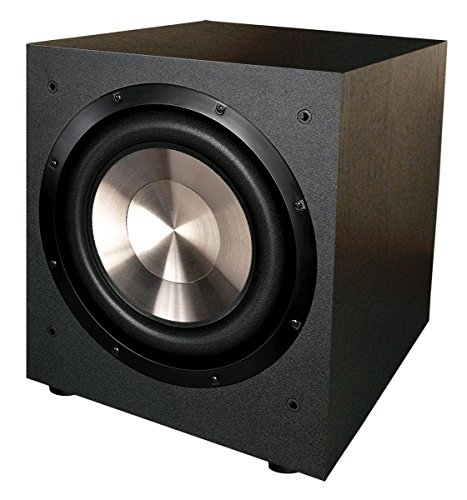
The F12 has been a long-running budget favorite, and it earns its place here as the lowest-cost way to add real low-end weight to a large living room. Its 12-inch injection-molded long-throw woofer reaches down to 25 Hz, and the 475-watt peak BASH amplifier gives it enough muscle for films and games without the cabinet taking over the room. The patented Venturi vent is designed to cut port noise, and automatic signal sensing switches the unit on when the receiver starts playing, so daily use stays simple.
Specs
- 12-inch injection-molded long-throw front-firing woofer
- BASH amplifier, 150 watts RMS and 475 watts peak
- Frequency response 25 Hz to 200 Hz
- Ported enclosure with patented Venturi vent
- Adjustable crossover and volume control
- Automatic signal sensing with on and off switching
- Speaker level and RCA inputs, plus Dolby Pro Logic and Dolby Digital and DTS inputs
- Maximum output up to 116 dB
Best for: Movie and game nights in a large living room where budget matters more than app control or fine tuning.
Watch out for: The rear vent needs space behind the cabinet, and the styling and build feel plain next to the Klipsch and SVS models in this guide.
Which One Fits Your Situation
You want the deepest movie bass and easy tuning from the sofa
Choose the SVS PB-1000 Pro. Its dual-port cabinet reaches lower than anything else here, its amplifier has the most headroom, and the app lets you change volume, presets and DSP settings without walking to the cabinet. It is the best fit for a large living room that serves as the main home theater.
Your subwoofer has to sit in an awkward corner or near a wall
Choose the Klipsch SPL-120. The front-firing driver and front port slot tolerate wall placement better than rear-ported designs, and the optional WA-2 wireless kit removes the cable problem entirely when the best corner has no nearby outlet or receiver connection. It is the practical pick for rooms where layout decides the outcome.
You are building a first theater system and watching the budget
Choose the Klipsch R-120SW. It covers the fundamentals for a large living room, a 12-inch driver, a ported cabinet and enough output for films, without paying for app control or a larger amplifier you may not need yet. Spend the savings on the receiver or the main speakers first, then upgrade the subwoofer later if the room still asks for more.
You want the most bass for the least money
Choose the BIC America F12. It reaches down to 25 Hz, puts out strong volume for its size, and costs less than the other models here while still filling a large room during films and games. Accept the plain styling and the rear vent clearance it needs, and it delivers where it counts.
Common Mistakes
- Buying a small sealed subwoofer for a large open plan room, then running it at maximum volume to compensate for the missing output.
- Pushing a rear-ported subwoofer hard against the wall, which blocks the vent and turns the bass boomy instead of deep.
- Comparing one model’s peak power against another model’s RMS power, which makes a weaker amplifier look stronger than it is.
- Skipping the crossover and phase settings after setup, so the subwoofer and the main speakers overlap or leave a gap in the bass.
- Placing the subwoofer where it looks tidy instead of where it sounds best, then judging its performance before trying a corner or a front-wall position.
Frequently Asked Questions
Is a ported subwoofer better than a sealed one for a large living room?
A ported subwoofer is usually the better choice for a large living room because the tuned vent reinforces low frequencies and produces more output at the deep end. Sealed models can sound tighter and take up less space, but they need more amplifier power and often a larger driver to match a ported design in a big open room.
What size subwoofer driver works best in a large living room?
A 12-inch driver is a solid starting point for most large living rooms, and every model in this guide uses one. Larger drivers move more air and reach deeper with less strain, but they also need bigger cabinets. A 10-inch ported model can work in a smaller closed room, yet it will struggle to pressurize a large open plan space.
Where should I place a ported subwoofer in a large living room?
Start with a front-wall position near a corner, a few inches away from the wall so the port can breathe. Corners reinforce bass, which helps a large room, but they can also exaggerate certain notes. Try the front wall first, then a corner, and listen to the same film scene in each spot before settling.
Do I need two subwoofers for a large living room?
One strong ported subwoofer is enough for most large living rooms, especially when it is placed well and tuned carefully. A second subwoofer helps mainly with even coverage across several seats, because two sources smooth out the peaks and dips that a single subwoofer leaves in a long room. Add the second unit later if some seats still sound thin.
Related guides
More from Amazon
Programs that pair well with the guide above. Offers and eligibility are set by Amazon and may change.
Free shipping on eligible items, Prime Video and more. Eligible new members can start with a free trial.
Start a Prime free trialAudiobooks and podcasts to listen to on the go. Eligible new members can start with a free trial.
Try Audible freeAd-free music streaming. Eligible new subscribers can start with a free trial.
Try Music Unlimited freeA free business account with business pricing and bulk-buying tools for work, shop or home office.
Create a business accountAs an Amazon Associate we earn from qualifying purchases.










Write Your Review
No reviews yet. Be the first to share your experience!