
Key takeaways
- Compare moving-magnet phono preamps for hi-fi playback, from MM-only stages to MM/MC models with adjustable gain, loading, and balanced outputs.
What's inside
As an Amazon Associate I earn from qualifying purchases. This post may contain affiliate links at no extra cost to you.
The real decision with a moving-magnet phono preamp is not whether your records will play, but how much of what the cartridge retrieves actually survives the trip to your amplifier. A phono stage sets the gain, applies RIAA equalization, and fixes the electrical load the cartridge works into, and small differences in noise floor and loading show up as hiss, dull treble, or thin bass during quiet passages.
This guide serves listeners building a first serious vinyl setup around an integrated amplifier with no phono input, owners replacing a noisy built-in stage, and collectors who may move between MM cartridges or add a moving-coil model later. Every product here supports moving-magnet cartridges, and each was chosen from the names and specifications printed on its Amazon product page.
Quick Picks
As an Amazon Associate we earn from qualifying purchases.
| Product | Best for | Key spec from title |
|---|---|---|
| Cambridge Audio Alva Solo | Dedicated MM systems that stay MM | 39 dB fixed gain, MM only |
| iFi ZEN Phono | Balanced connections and future MC plans | 36 to 72 dB gain range |
| Schiit Mani 2 | Tuning gain and loading per cartridge | Four gain and four loading options |
| Pro-Ject Phono Box S2 | Compact shelves needing switchable loading | Capacitance settings up to 420 pF |
| Fluance PA10 | Simple MM setups with rumble-prone records | Selectable 20 Hz high-pass filter |
How to Choose
MM-Only Focus or MM/MC Flexibility
Decide first whether your system will stay with moving-magnet cartridges. An MM-only stage such as the Alva Solo or PA10 spends its whole design budget on one job: a fixed 47k ohm load, moderate gain, and the quietest possible circuit for that cartridge family. An MM/MC switchable stage adds gain steps and low-impedance loading for moving-coil cartridges you may not own yet. That flexibility is worth having if a cartridge upgrade is genuinely planned, but it is not automatically better sound for an MM cartridge today, so buy for the cartridges you will actually use.
Gain That Matches Cartridge Output
Gain decides how loudly and how cleanly the tiny cartridge signal reaches line level. Most moving-magnet cartridges output roughly 3 to 6 millivolts and pair well with phono stages offering about 36 to 43 dB of gain. Too little gain leaves the amplifier straining and raises the relative noise floor, while too much can overload the input on loud pressings and compress dynamics. Fixed-gain MM stages remove the guesswork entirely. Adjustable models, such as the Mani 2 and Phono Box S2, let you pick a lower setting for a high-output cartridge or a higher one for a quieter model.
Loading and Capacitance Settings
A moving-magnet cartridge expects a 47k ohm resistive load, but the capacitive load it sees, the cartridge, cable, and phono stage combined, shapes the treble response. Many cartridges are specified for a total load in the 100 to 300 pF region, and excess capacitance can push a presence peak into the upper midrange. Stages with switchable input capacitance, like the Phono Box S2 with its 100 to 420 pF steps, let you compensate for long or high-capacitance cables. If your turntable has short, low-capacitance leads, a fixed 100 pF input is usually close enough.
Noise Floor and RIAA Accuracy
Two figures predict how clean a phono stage will sound with MM cartridges. The first is signal-to-noise ratio or equivalent input noise: figures above roughly 85 to 90 dB, or a very low input-noise number, point to quiet backgrounds between tracks, which matters most with efficient speakers and quiet music. The second is RIAA accuracy, stated as a deviation across the frequency range; tighter figures, around half a decibel or better, mean the bass and treble correction tracks the cutting curve closely. Treat both as printed specifications to compare, not as guarantees of a particular sound.
The 5 Best Options
Cambridge Audio Alva Solo
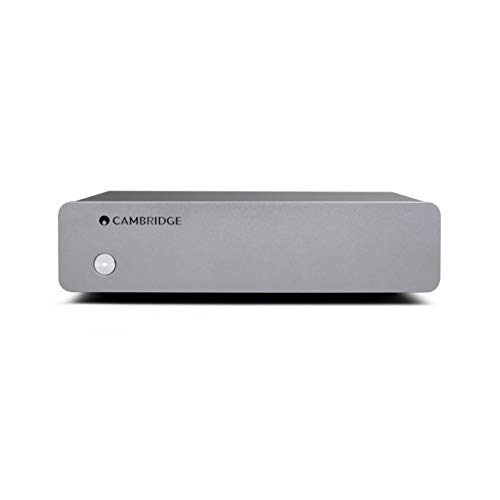
The Alva Solo is the purist option in this group: a moving-magnet-only stage with fixed 39 dB gain, a fixed 47k ohm and 100 pF input, and nothing to adjust after installation. That simplicity suits listeners whose systems will stay with MM cartridges and who value a low noise figure, quoted here as an equivalent input noise of about 0.09 microvolts with a signal-to-noise ratio above 90 dB. Its switch-mode power supply and surface-mounted board are chosen for low noise, and the slim case fits easily beside a turntable or under a shelf.
Specs
- Cartridge type: Moving magnet (MM) only
- Gain: 39 dB at 1 kHz
- Nominal output: 300 mV
- Sensitivity for nominal output: 3.35 mV
- RIAA curve accuracy: +/- 0.65 dB, 30 Hz to 20 kHz
- Signal-to-noise ratio: >90 dB
- Input impedance: 47k ohms
- Input capacitance: 100 pF
- Max power consumption: 10 W
- Dimensions: 6.9 x 5.2 x 1.9 inches
- Weight: 1.5 lbs
- Model: C11026
Best for: MM-only systems where quiet playback matters more than adjustability.
Watch out for: It cannot drive a moving-coil cartridge at all, so an MC upgrade means replacing the stage.
ASIN: B0793363RG
iFi ZEN Phono
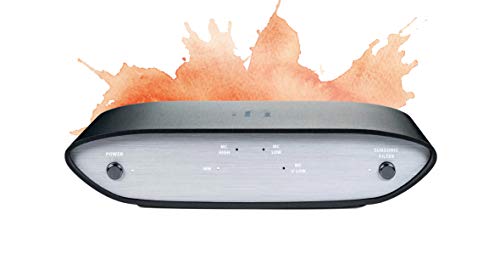
The ZEN Phono covers the widest cartridge range here, with four gain settings running from a 36 dB moving-magnet setting up to a 72 dB very-low-output MC setting, so one box can follow a system through several cartridge changes. Its headline figure is an equivalent input noise of -151 dBV, and the balanced design extends to a 4.4 mm balanced output alongside the usual RCA pair, which suits amplifiers and headphone setups with balanced inputs. For MM listening, loading is fixed at 47k ohms with 110 pF, a sensible match for most cartridges and typical turntable cables.
Specs
- Cartridge types: MM and MC
- Gain settings: 36 dB (MM), 48 dB (MC High), 60 dB (MC Low), 72 dB (MC V-Low)
- Equivalent input noise: -151 dBV
- MM loading: 47k ohms, 110 pF
- Outputs: RCA and balanced 4.4 mm
- Power: DC 5 V
- Item dimensions: 16 x 11.2 x 3.6 cm
- Model: 311003
Best for: Listeners who want balanced output now and MC headroom later.
Watch out for: The balanced output uses a 4.4 mm connector, so check your amplifier’s input type before relying on it.
ASIN: B08H2GPD7F
Schiit Mani 2

The Mani 2 is built around adjustment: underside switches select four gain settings, four resistive loads, and four capacitance values, plus a passive low-frequency filter with two slopes. For moving-magnet users, the useful range is the 47k ohm load with 47 to 200 pF of capacitance and the lower gain settings, which together cover nearly any MM or moving-iron cartridge. The same switches also serve MC cartridges, so it doubles as a long-term stage. Note the power requirement before ordering: the listing specifies 115 VAC only with a USA plug, and the unit is designed and built in Texas.
Specs
- Cartridge types: MM, MC, and MI
- Gain: 33, 42, 48, or 60 dB, selectable
- Loading: 47k ohms, 200 ohms, 47 ohms, or 38 ohms
- Capacitance: 47, 100, 150, or 200 pF
- Low-frequency filter: Passive, 6 or 12 dB per octave at 15 Hz
- Power: 115 VAC only, USA plug
- Designed and built in Texas, USA
- Part number: SCH-18-2B-FA
Best for: Owners who swap cartridges and want to tune gain and loading each time.
Watch out for: The setting switches sit on the underside, so plan access if the stage lives in a closed rack.
ASIN: B09S5H9MP6
Pro-Ject Phono Box S2

The Phono Box S2 packs its adjustments into a very small aluminium and metal sandwich case: four gain settings, four input impedance values, and four capacitance steps up to 420 pF, all set by switches, plus a switchable subsonic filter cutting 12 dB at 20 Hz. The dual mono layout and the wide capacitance range make it a strong fit for MM cartridges on turntables with longer or higher-capacitance cables, where fixed-input stages can sound bright. An outboard 18 V power supply is included, and at 103 mm wide the unit tucks into crowded equipment shelves without dominating them.
Specs
- Cartridge types: MM and MC
- Gain settings: 40, 43, 60, or 63 dB
- Input impedance: 10 ohms, 100 ohms, 1 kohm, or 47 kohms
- Input capacitance: 100, 200, 320, or 420 pF
- Subsonic filter: Switchable, -12 dB at 20 Hz
- Design: Dual mono, aluminium/metal sandwich housing
- Power supply: Outboard 18 V / 500 mA DC, included
- Dimensions: 103 x 36 x 115 mm
- Weight: 570 g
- Finish: Silver
Best for: Space-limited racks and MM cartridges that need higher capacitive loading.
Watch out for: This listing is the silver finish; confirm the color before ordering if your system is all black.
ASIN: B073WDKJ8Y
Fluance PA10

The PA10 keeps the formula deliberately simple for moving-magnet systems: fixed 38 dB gain, a 47 kohm input with 100 pF of load capacitance, and passively equalized RIAA correction rated at plus or minus 0.5 dB. Separate Texas Instruments op amps for the left and right channels target clean stereo separation, and the signal-to-noise ratio is quoted above 90 dBA. Its most practical feature for everyday collections is the selectable high-pass filter, which rolls off content below 20 Hz to calm rumble and woofer movement on warped or worn records without touching the music band.
Specs
- Cartridge type: MM only
- Gain: 38 dB
- RIAA accuracy: +/- 0.5 dB
- Input impedance: 47 kohms
- Input load capacitance: 100 pF
- Signal-to-noise ratio: >90 dBA
- High-pass filter: Selectable, 20 Hz cutoff
- Output voltage: 2.2 V
- Power supply: 24 V DC
Best for: Straightforward MM systems and older records that benefit from rumble filtering.
Watch out for: Gain and loading are fixed, so it cannot adapt to an MC cartridge or an unusual MM load.
ASIN: B07NGNZZQ6
Which One Fits Your Situation
Your Amplifier Has No Phono Input
Any model here will work, because all five take a turntable from phono level to line level for a standard RCA input. The Fluance PA10 is the least complicated route, with fixed settings that suit most MM cartridges out of the box. Choose the Cambridge Audio Alva Solo instead if your speakers are efficient and quiet passages matter, since its published noise figures are the strongest of the fixed-gain pair.
You Play Warped or Rumble-Prone Records
Look for a filter that removes subsonic energy without trimming audible bass. The PA10’s selectable 20 Hz high-pass filter and the Phono Box S2’s switchable subsonic filter both target woofer pumping from warps and bearing rumble, and the Mani 2 offers a passive low-frequency filter with two slopes. Leave the filter off for flat, well-kept pressings and switch it in only when the record or the room demands it.
You Plan to Try a Moving-Coil Cartridge Later
Buy the flexibility now rather than replacing the stage twice. The iFi ZEN Phono spans 36 to 72 dB of gain, covering high-output and very-low-output MC models, while the Mani 2 and Phono Box S2 add switchable low-impedance loading for MC use. The Alva Solo and PA10 are MM-only designs, so either one closes that upgrade path and should be chosen only if you are settled on moving-magnet cartridges.
You Want the Simplest Possible Setup
Fixed-gain MM stages remove every setup decision beyond connecting cables and the ground wire. The PA10 and Alva Solo both present the standard 47 kohm load with 100 pF of input capacitance, which matches the majority of MM cartridges and factory turntable cables. Between them, the PA10 adds a rumble filter for imperfect records, while the Alva Solo concentrates on the lowest published noise figures for clean pressings.
Common Mistakes
- Buying an MC-only or fixed high-gain stage for an MM cartridge, which overloads the input and leaves no usable volume range.
- Connecting the phono preamp’s output into an amplifier’s phono input, applying RIAA equalization twice and producing boomy, distorted sound.
- Forgetting the turntable’s ground wire, which leaves a loud mains hum that no gain or filter setting can fix.
- Ignoring cable capacitance when judging treble, then blaming the cartridge for brightness caused by an excessive total capacitive load.
- Stacking the phono stage directly on a power amplifier or its transformer, where stray fields can induce hum in the sensitive input.
Frequently Asked Questions
Do I need a phono preamp if my amplifier already has a phono input?
Not for basic playback, because a built-in phono input already provides gain and RIAA equalization for MM cartridges. A separate stage is an upgrade decision: the models here publish their noise, gain, and loading figures, and several add switchable loading or filtering that most built-in stages omit. It also frees you to use amplifiers and powered speakers that have no phono input at all.
Can an MM/MC preamp work with only a moving-magnet cartridge?
Yes. An MM/MC stage simply includes extra gain and loading options alongside its MM settings. Set it to the MM position, typically 36 to 43 dB of gain into a 47k ohm load, and it behaves like a dedicated MM stage. The unused MC settings cost nothing in everyday use and keep a future cartridge change open without replacing hardware.
What gain setting suits a typical moving-magnet cartridge?
Most MM cartridges output between about 3 and 6 millivolts and pair well with roughly 36 to 43 dB of phono gain, which is why the fixed-gain models here sit at 38 or 39 dB. On adjustable stages, start at the lowest setting that reaches comfortable listening levels. Excess gain raises the risk of overload on loud pressings and shrinks the usable volume range.
Where does the phono preamp sit in the signal chain?
It goes between the turntable and the amplifier: turntable leads and ground wire into the preamp’s input, then a standard interconnect from the preamp’s output into any line-level input, such as CD or aux, never the phono input. Keep the turntable leads short, since the unamplified cartridge signal is the most hum-sensitive part of the whole chain.
Related guides
More from Amazon
Programs that pair well with the guide above. Offers and eligibility are set by Amazon and may change.
Free shipping on eligible items, Prime Video and more. Eligible new members can start with a free trial.
Start a Prime free trialAudiobooks and podcasts to listen to on the go. Eligible new members can start with a free trial.
Try Audible freeAd-free music streaming. Eligible new subscribers can start with a free trial.
Try Music Unlimited freeA free business account with business pricing and bulk-buying tools for work, shop or home office.
Create a business accountAs an Amazon Associate we earn from qualifying purchases.










Write Your Review
No reviews yet. Be the first to share your experience!