
Key takeaways
- Compare four triple-output bench power supplies for small laboratory spaces by channel ratings, printed footprint, resolution and remote interfaces.
What's inside
As an Amazon Associate I earn from qualifying purchases. This post may contain affiliate links at no extra cost to you.
On a small bench, the real decision is rarely whether you need three outputs; it is how much of your limited surface, shelf depth and attention one power supply should consume. A triple-output unit can run a main rail, a second adjustable rail and a logic line from a single case, but the wrong pick eats space with a deep chassis, a noisy fan or controls you fight every day. The models below were chosen for compact laboratory spaces first, and for headline specifications second.
This guide serves home lab builders, teaching technicians, and small product teams who share one bench among several projects. Every product was chosen from the names and specifications printed on its Amazon product page, and only models whose listings showed current availability were kept, so the shortlist reflects what can actually be ordered for a small laboratory now.
Quick Picks
As an Amazon Associate we earn from qualifying purchases.
| Product | Best for | Key spec from title |
|---|---|---|
| GW Instek GPP-3323 (LAN) | Networked benches that need waveform display and fine readback | 217W three-channel programmable output |
| GW Instek GPD-3303S | The tightest benches, thanks to the smallest printed footprint here | 195W, 0-30V/DC at 3A |
| Rigol DP832 | Timed output sequences and low ripple on mixed-signal work | 195W triple output |
| Siglent SPD3303X | Precision setting with isolated outputs and fine resolution | Programmable linear, 220W output wattage |
How to Choose
Footprint, Depth and Rear Clearance
Start with the space you actually have, not the space you wish you had. Measure shelf width, depth and the clearance behind the bench, because power cables, vents and test leads all need room the headline dimensions do not show. Where a listing prints item dimensions, compare those figures first: in this group the GPD-3303S prints the smallest case at 10.43 by 8.27 by 5.12 inches. Also plan where the unit sits relative to your oscilloscope and parts storage. A supply that fits on paper but blocks its own fan outlet or forces leads across the work area will annoy you daily.
Channel Ratings and the Third Output
Three outputs only help if the ratings match your rails. Most models here pair two adjustable channels with a third channel that offers fixed or selectable levels, so list the voltages your projects actually need before choosing. A board that runs from a main rail, a second rail and a 5 V logic line maps well onto the DP832 pattern of 30 V, 30 V and 5 V channels. If your third rail is often 3.3 V or 1.8 V instead, a selectable third channel such as the GPP-3323 offers is the better fit.
Setting Resolution and Readback Quality
Resolution decides how finely you can nudge a rail and how honestly the supply reports what it is doing. The SPD3303X and GPP-3323 list setting steps of 1 mV, with the GPP-3323 adding readback to 0.1 mV and 0.1 mA, while the DP832 lists 10 mV and 10 mA steps. For digital boards that only need a stable 5 V or 12 V rail, coarser steps are rarely a problem. For sensor front ends, battery simulation or current-limited bring-up of a new board, finer setting and readback make faults easier to spot before they damage anything.
Interfaces, Display and Everyday Noise
In a small lab the supply is usually close to where you sit, so the interface matters beyond the spec sheet. A clear multi-channel display, like the 4.3-inch TFT screens listed for the GPP-3323 and SPD3303X, reduces setup errors when three rails are live at once. Remote control over LAN or USB lets a crowded bench run scripts without reaching past hot boards. Fan behavior matters too: linear supplies move heat with fans, so check the listing details, leave the vents unobstructed, and avoid enclosing any of these units in a closed cabinet.
The 4 Best Options
GW Instek GPP-3323 (LAN)

The GPP-3323 (LAN) is the most modern control package in this group, and it suits a small bench that is run from a PC or a lab network. Its listing describes two 0 to 32 V channels at up to 3 A each, a third channel with selectable 1.8 V, 2.5 V, 3.3 V and 5.0 V levels at 5 A, and a 4.3-inch TFT screen that can show settings, measurements and output waveforms. Channels 1 and 2 also carry a load function with CC, CV and CR modes, which can save swapping in a separate load during quick checks.
Specs
- Channels: CH1 0-32 V / 0-3 A, CH2 0-32 V / 0-3 A, CH3 selectable 1.8 V, 2.5 V, 3.3 V or 5.0 V at 5 A
- Maximum output power: 217 W
- Display: 4.3-inch TFT LCD with setting, measurement and waveform display
- Setting resolution: 1 mV / 0.1 mA
- Read back resolution: 0.1 mV / 0.1 mA
- Load function: CC, CV and CR modes on channels 1 and 2
- Interface: LAN included on this listing
- Model number: GPP-3323 (LAN)
Best for: small benches that are driven from a PC or lab network and want waveform display plus a built-in load function.
Watch out for: the third channel offers selectable levels rather than full adjustment, so confirm those levels cover your logic rail before ordering.
ASIN: B0B7G2ZG74
GW Instek GPD-3303S

The GPD-3303S is the footprint pick of this group: its listing prints item dimensions of 10.43 by 8.27 by 5.12 inches and a weight of 7 kg, the smallest case dimensions shown for any model here. The title and description describe a programmable linear supply with three outputs, adjustable 0 to 30 V DC, up to 3 A and 195 W maximum, with a USB connector for remote control. That mix suits a teaching or service bench that needs three rails in the space a single-output unit used to occupy, without a large display or network features adding depth.
Specs
- Outputs: 3
- Output voltage: adjustable 0-30 V DC
- Output current: up to 3 A
- Maximum power: 195 W
- Connector type: USB
- Item dimensions: 10.43 x 8.27 x 5.12 inches
- Item weight: 7 kg
- Enclosure material: Aluminum
- Model number: GPD-3303S
Best for: tight teaching and service benches that need three rails in the smallest printed case in this group.
Watch out for: the listing shows a marketplace seller with a handling time of several days, so factor that in if the bench is needed urgently.
ASIN: B003A6F9MU
Rigol DP832

The DP832 is the established mid-range option here, built around three outputs rated 30 V and 3 A, 30 V and 3 A, and 5 V and 3 A, with 195 W total. Its listing highlights low ripple noise, a timer that can run up to 2048 output groups, and remote communication over USB, LAN and RS232, which fits development benches that repeat the same power-up sequences every day. At 9.15 kg printed weight it is not the lightest unit in this group, so it rewards a permanent home on the bench rather than regular moving.
Specs
- Channels: 30 V / 3 A, 30 V / 3 A and 5 V / 3 A
- Total power: up to 195 W
- Resolution: 10 mV / 10 mA
- Display: 3.5-inch TFT
- Ripple and noise: below 350 µVrms and 2 mVpp
- Settling time: under 50 µs after a load change
- Timer: up to 2048 output groups
- Interfaces: USB, LAN and RS232, with GPIB available as an option
- Item weight: 9.15 kg
- Model number: DP832
Best for: development benches that repeat timed power-up sequences and want broad remote-control options.
Watch out for: digital IO is listed as standard on the A model, so check the exact interface set on this listing if your setup depends on it.
ASIN: B00ENX02GC
Siglent SPD3303X
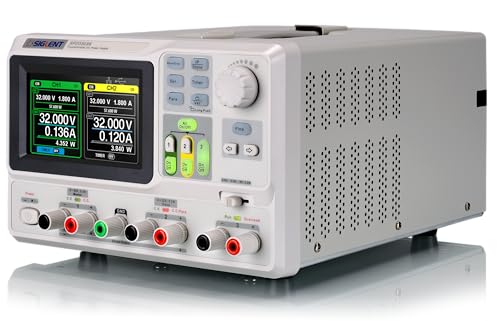
The SPD3303X is the precision-leaning pick: its listing describes a programmable linear supply with three independently controlled and isolated outputs, a setting resolution of 1 mV and 1 mA, and a display with five-digit voltage and four-digit current readouts. Channels 1 and 2 are adjustable, while channel 3 offers fixed selections, and the description names selectable 2.5 V, 3.3 V and 5 V levels plus a 4.3-inch TFT-LCD with real-time wave display. It suits analog and mixed-signal work where small, repeatable adjustments matter more than saving the last few centimeters of shelf.
Specs
- Outputs: 3, independently controlled and isolated
- Output wattage: 220 W
- Resolution: 1 mV / 1 mA
- Display: 5-digit voltage and 4-digit current readouts
- Screen: 4.3-inch TFT-LCD with real-time wave display
- Channel 3: selectable 2.5 V, 3.3 V or 5 V
- Protection: output short and overload protection
- Remote: supports remote programming
- Model number: SPD3303X
Best for: precision analog and mixed-signal work that benefits from isolated outputs and fine, repeatable adjustments.
Watch out for: its listing prints the largest item dimensions of this group, so measure shelf depth carefully before committing.
ASIN: B017266CKQ
Which One Fits Your Situation
A Teaching Bench Shared by Several Students
Pick the GW Instek GPD-3303S. Its printed case dimensions are the smallest in this group, so more of the bench stays free for student boards and meters, and its programmable linear design with a USB connector keeps remote setup straightforward. Three outputs let one bench power a main rail, a second adjustable rail and a logic line at the same time, which keeps multi-rail coursework on a single instrument instead of a row of separate supplies.
A Home Lab Corner or Spare-Desk Setup
Start with the GW Instek GPP-3323 (LAN). The waveform display and fine readback help when the same corner desk handles both quick repairs and longer experiments, and LAN control means the supply can sit on a shelf while you drive it from the desk PC. Check the listing stock before planning the whole corner around it, because availability on this model was down to the last unit when the listing was checked.
Scripted Checks on a Crowded Development Bench
Choose the Rigol DP832. Its listing describes remote communication over USB, LAN and RS232 with SCPI control through Rigol PC software, plus a timer that runs up to 2048 output groups, so repeated power-up sequences do not need anyone standing at the bench. The trade-off is size and weight: at 9.15 kg printed, give it a fixed spot with clear rear access for cables and test leads.
Precision Analog Work With Little Shelf Depth
Choose the Siglent SPD3303X. The 1 mV and 1 mA setting resolution, five-digit voltage readout and isolated outputs suit careful analog bring-up, and the real-time wave display on its 4.3-inch screen helps spot a rail sagging under load. Its listing prints item dimensions of 16 by 14 by 11 inches, the largest here, so measure your shelf carefully and keep the vents clear on all sides.
Common Mistakes
- Judging a supply by total wattage alone, then discovering that one channel cannot deliver the current a single rail needs.
- Assuming the third output is fully adjustable, when many triple-output models offer only fixed or selectable levels on that channel.
- Measuring only the bench width and forgetting depth, rear cable bend room and fan clearance in a small room.
- Buying the wrong interface variant, such as ordering a USB-only model when the bench plan depends on LAN control.
- Stacking other instruments directly on top of the supply, blocking vents and trapping heat in a compact setup.
Frequently Asked Questions
How much space does a triple-output supply save over separate supplies?
One triple-output case replaces up to three separate single-output units, so the saving is roughly two extra power cords, two extra sets of vents to keep clear and the bench width those boxes would have taken. The models here still need depth for cables and airflow, so measure the full footprint, including leads, rather than the front panel alone.
Is the third output on these supplies fully adjustable?
Usually not. In this group, the GW Instek GPP-3323 gives its third channel selectable levels of 1.8 V, 2.5 V, 3.3 V and 5.0 V, and the Siglent SPD3303X lists fixed selections for channel 3, while the first two channels are the fully adjustable ones. Check the channel details on any listing before assuming a third adjustable rail.
Can I combine two channels for more voltage or current?
Some triple-output supplies support series or parallel channel modes and others do not, and the listings here do not promise it for every model. If your work needs a combined rail, confirm the exact mode in the product description and manual for that model before ordering, and never wire channels together externally unless the maker documents that mode.
What should I check about cooling in a small laboratory?
Linear supplies turn spare energy into heat, and several listings here describe fan cooling or temperature-controlled fans. Leave open space at the vents, keep the unit out of closed cabinets, and avoid stacking gear on top. In a small room, also think about where the warm air goes, because a supply running all day can raise the temperature around nearby instruments.
Related guides
More from Amazon
Programs that pair well with the guide above. Offers and eligibility are set by Amazon and may change.
Free shipping on eligible items, Prime Video and more. Eligible new members can start with a free trial.
Start a Prime free trialAudiobooks and podcasts to listen to on the go. Eligible new members can start with a free trial.
Try Audible freeAd-free music streaming. Eligible new subscribers can start with a free trial.
Try Music Unlimited freeA free business account with business pricing and bulk-buying tools for work, shop or home office.
Create a business accountAs an Amazon Associate we earn from qualifying purchases.










Write Your Review
No reviews yet. Be the first to share your experience!