
Key takeaways
- Four compact programmable LCR meters with remote control, sorting and logging, sized for small laboratory benches where every centimetre of space counts.
What's inside
As an Amazon Associate I earn from qualifying purchases. This post may contain affiliate links at no extra cost to you.
In a small laboratory, the real question is not whether a programmable LCR meter can run a measurement routine — it is whether the instrument earns the bench space it takes up. A compact bench shared by two or three people has to hold the meter, its test fixture, the parts tray, and usually a laptop, so chassis depth and width matter almost as much as basic accuracy. The meter also has to keep working when nobody is standing over it: stored setups, limit sorting, and a remote interface that a PC script can drive.
This roundup is for teaching-lab technicians, prototype engineers working from a spare-room bench, and small inspection teams who need programmed component measurement without giving up half a worktop to a full-size rack instrument. Every pick is a programmable LCR meter with a documented remote-control interface, and each model name, feature, and specification below is taken from that product’s Amazon US listing, including dimensions and weight where the listing states them.
Quick Picks
As an Amazon Associate we earn from qualifying purchases
| Product | Best for | Key spec from title |
|---|---|---|
| GW Instek LCR-6100 | Precision work in a half-rack footprint | 10 Hz to 100 kHz precision bench meter |
| MATRIX MCR-5200 | Fast pass/fail sorting on a side bench | 40 Hz to 200 kHz with USB/RS232C |
| East Tester ET4510 | Matching exact datasheet test frequencies | 10 to 100 kHz adjustable in 1 Hz steps, SCPI |
| East Tester ET4410 | A first programmable meter for a tight corner | Desktop bridge with USB and RS-232 |
How to Choose
Remote Interface and Command Set
“Programmable” only means something if a computer can set the test conditions and pull readings back without anyone touching the front panel. Look for a named interface — RS-232C, USB device, or a handler port — plus a documented command protocol such as SCPI, which the East Tester models list explicitly. A USB host port that only saves screenshots to a flash drive is storage, not remote control. GW Instek’s LCR-6100, for example, uses RS-232C for PC commands and reserves its USB host socket for stored results, two jobs that are easy to confuse when skimming a listing.
Footprint, Depth, and Weight on a Crowded Bench
Benchtop LCR meters look similar in photos, yet their depth decides whether one fits a shallow shelf or a narrow shared bench. Measure the space with the fixture attached: four BNC terminals and a component fixture add several centimetres in front of the chassis, and cables need room behind it. The LCR-6100’s half-rack, 2U format is about 26.5 cm deep, while the ET4410’s housing measures 265 mm wide and 305 mm deep at just 2.1 kg, light enough to move between benches. If the meter will share a cart or a shelf with a power supply, weight matters as much as width.
Test Frequency and Signal Level for Your Components
Component values are only comparable at the test conditions the datasheet specifies, so the meter’s frequency plan has to cover the points you actually use. Fixed-point instruments such as the ET4410 offer 16 set frequencies up to 100 kHz, which covers common 100 Hz, 1 kHz, 10 kHz, and 100 kHz checks. The ET4510 instead adjusts continuously in 1 Hz steps, useful when a capacitor is characterised at an unusual frequency. Signal level matters too: ceramic capacitors change value with applied voltage, so a meter with several test levels, or an automatic level control feature, gives more trustworthy readings.
Sorting, List Tests, and Stored Setups
Programmed measurement pays off when the meter repeats a routine identically every time. Comparator or BIN sorting lets the instrument flag out-of-tolerance parts on its own — the MCR-5200 adds an audible alarm, and the ET4410 sorts into five bins. Stored panel setups save a complete configuration of frequency, level, and limits, so a Monday-morning inspection run starts from the same state as Friday’s. List-test functions go further, stepping through a table of frequencies or levels in one pass. In a small lab, where the same meter serves several people, these memories prevent quiet configuration drift between users.
The 4 Best Options
GW Instek LCR-6100

The LCR-6100 is the pick when a small bench still has to produce defensible numbers. Its 0.05% basic accuracy is the strongest in this group, and the half-rack 2U chassis leaves room beside it for a fixture and a parts tray. Ten stored panel setups and a 10-point list test cover repeatable routines, while RS-232C remote control lets a PC set conditions and retrieve results. A storage capacity of 10,000 measurement results means a full inspection session can be logged on the instrument itself and transferred later through the USB host port.
Specs
- Test frequency: 10 Hz to 100 kHz, adjustable, ±0.01% frequency accuracy
- Basic accuracy: 0.05% (slow/medium), 0.1% (fast)
- Test speed: FAST 25 ms, MED 100 ms, SLOW 333 ms
- Output impedance: 30 Ω, 50 Ω, or 100 Ω selectable
- Interfaces: RS-232C remote control, handler port, USB host for storage
- Memory: 10 panel setup sets; 10,000 measurement results stored
- Display: 3.5-inch color LCD
- Dimensions: 12.28 x 10.43 x 4.21 inches; weight 4 kg
Best for: a small lab that needs one precision meter shared between development and inspection work.
Watch out for: remote control runs over RS-232C only, so a modern laptop needs a USB-to-serial adapter; component fixtures are separate accessories, so confirm what the listing includes.
ASIN: B01BMCT2LC
MATRIX MCR-5200

The MCR-5200 suits a compact inspection corner where parts move quickly and verdicts must be obvious. Its test range reaches 200 kHz, the widest here, and measurements run at up to 30 readings per second behind a 32-bit core processor. A built-in comparator with an audible alarm turns the meter into a pass/fail station that one person can operate while doing something else. USB and RS-232C ports both appear in the listing title, and the data save function keeps results for later reporting. The 4.3-inch TFT screen is also the largest display in this group, readable from a step back.
Specs
- Test frequency: 40 Hz to 200 kHz
- Basic accuracy: 0.1%
- Measurement speed: up to 30 times per second
- Processor: 32-bit core
- Output resistance: 30 Ω / 100 Ω, two selectable options
- Interfaces: USB and RS-232C, with data save
- Comparator: built-in, with audible alarm for defective parts
- Display: 4.3-inch TFT LCD
- Part number: MCR-5200
Best for: a small incoming-inspection bench that sorts components against limits all day.
Watch out for: the included lead set is basic, so budget for proper Kelvin clips or a fixture if you measure low-value parts; check the listing photos to confirm exactly which cables ship.
ASIN: B07ZCJ1319
East Tester ET4510
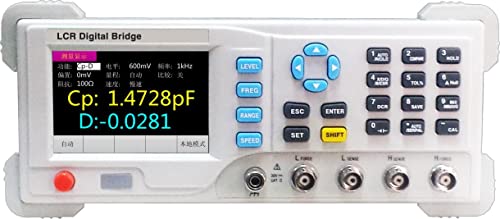
The ET4510 answers a specific frustration: a datasheet that specifies capacitance at a frequency no fixed-point meter offers. Its test frequency adjusts continuously from 10 Hz to 100 kHz in 1 Hz steps, so the programmed routine can land on the exact condition a component was characterised at. SCPI support means the same commands that drive other instruments on the bench can set frequency, level, and function here. A dedicated mode for electrolytic capacitors and a DC resistance mode round out a feature set aimed at prototype work, all in the same compact desktop housing style as its ET4410 sibling.
Specs
- Test frequency: 10 Hz to 100 kHz, continuously adjustable in 1 Hz steps
- Basic accuracy: 0.1%
- Display: 3.5-inch TFT, five-digit display
- Communication: USB and RS-232 with SCPI protocol support
- Modes: DC resistance (DCR) measurement and electrolytic capacitor measurement
- Form factor: desktop bridge meter
Best for: prototype benches that must reproduce exact datasheet test frequencies during programmed sweeps.
Watch out for: several near-identical listings exist for this model family, so verify the listing names the ET4510 and SCPI support, and that the unit offered is the 110 V US version.
ASIN: B09PHGD1C2
East Tester ET4410

The ET4410 is the most space-efficient route into programmed LCR measurement here: at 2.1 kg it can live on a shelf and come down when needed, yet it still offers the full remote-control toolkit. USB device and RS-232 ports carry SCPI commands, a handler interface supports external sorting setups, and the comparator separates parts into five bins with an alarm. Six fixed test levels and 16 frequency points cover routine component checks, and the data record function tracks maximum, minimum, and average values across a batch. For a small lab buying its first remotely controlled bridge, it leaves the least empty space behind.
Specs
- Test frequencies: 16 points from 100 Hz to 100 kHz
- Basic accuracy: 0.1%
- Test levels: six fixed levels from 0.1 V to 2 V
- Measurement ranges: L 0.001 µH to 9999 H; C 0.001 pF to 99.999 mF; R 0.0001 Ω to 99.99 MΩ
- Display: 3.5-inch TFT, five-digit
- Interfaces: USB Device, RS-232, and Handler; SCPI communication supported
- Extras: DCR and electrolytic capacitor modes, internal bias output 0 to 1500 mV, five-bin comparator with alarm, data recording
- Size and weight: 265 x 105 x 305 mm; 2.1 kg
Best for: a cramped corner bench or teaching shelf that needs scripted measurements on a modest footprint.
Watch out for: frequencies are fixed points rather than continuously adjustable, and some listings describe a 220 V supply, so confirm the 110 V US-plug version before ordering.
ASIN: B09MHSMB37
Which One Fits Your Situation
A Shared Teaching Lab Where the Bench Resets Daily
With several classes using the same bench, stored setups matter more than raw speed. The GW Instek LCR-6100 keeps ten panel configurations in memory, so each course’s measurement routine can be recalled exactly, and its 10,000-result storage captures student data even before it reaches a PC. Its half-rack width also leaves space for the shared fixture kit beside it.
A Spare-Room Bench Developing a New Product
Prototype work means checking parts at the conditions their datasheets promise, often at frequencies between the standard points. The East Tester ET4510, adjustable in 1 Hz steps and driven by SCPI from the same laptop that logs your other instruments, fits that workflow. Its electrolytic and DCR modes cover the two component families a new power or audio design leans on most.
A Small Incoming-Inspection Corner
When one person verifies deliveries between other jobs, the meter should judge parts without constant attention. The MATRIX MCR-5200’s comparator and audible alarm do exactly that at up to 30 readings per second, and its USB or RS-232C data saving keeps a record of each batch. Its 200 kHz top frequency also covers switching-supply inductors that slower bridges miss.
A Crowded R&D Bench That Logs Everything to a PC
If bench depth is the scarcest resource, the East Tester ET4410 takes the least of it while still accepting SCPI commands over USB or RS-232. Readings stream straight into your logging script, the handler port leaves a path to a future sorting fixture, and at 2.1 kg the meter can be lifted onto a shelf when the bench is needed for assembly instead.
Common Mistakes
- Treating a USB host port as remote control: on several meters it only stores screenshots and results, while actual PC control runs over a separate USB device port or RS-232C connection.
- Measuring the bench before adding the fixture: Kelvin leads and component fixtures project well beyond the front panel, so a meter that fits the shelf bare may overhang once connected.
- Assuming SCPI means identical commands everywhere: each brand implements its own command subset, so scripts written for one meter rarely run unchanged on another.
- Skipping open, short, and load calibration after moving the meter or swapping fixtures, then blaming the instrument for drift that the compensation routine would have removed.
- Buying fixed test frequencies when a key component is specified at an in-between frequency, which forces comparisons at the wrong test condition.
Frequently Asked Questions
What makes an LCR meter programmable rather than just digital?
A programmable LCR meter accepts commands from a computer or runs stored internal routines, so frequency, test level, function, and limits can be set without touching the panel. All four meters here expose a remote interface — RS-232C, USB device, or both — with documented command control. A merely digital meter only displays readings; every change still needs a person at the front panel.
Can these meters work with a laptop that has no serial port?
Yes, with the right adapter or port choice. The MATRIX MCR-5200 and both East Tester models offer USB alongside RS-232, so they run from a laptop directly. The GW Instek LCR-6100 controls remotely over RS-232C only, so a USB-to-serial adapter becomes part of its setup. Either way, confirm the meter answers a simple identification command before building a full script around it.
How much bench space does a compact benchtop LCR meter actually need?
Plan for the chassis plus roughly a hand’s width in front for the fixture and leads. The ET4410 measures 265 mm wide and 305 mm deep at 2.1 kg, while the half-rack LCR-6100 is about 31 cm wide and 26.5 cm deep. On a shallow shelf, depth is usually the binding constraint, so compare that figure first and leave ventilation room behind the unit as well.
Do stored setups remove the need to calibrate before a programmed run?
No. Stored setups recall frequency, level, function, and sorting limits, but they do not replace open, short, and load compensation for the fixture actually connected. Run the compensation routine whenever the fixture, leads, or test frequency set changes, then start the programmed sequence. Skipping it is the most common reason a careful routine produces readings that wander between sessions.
Related guides
More from Amazon
Programs that pair well with the guide above. Offers and eligibility are set by Amazon and may change.
Free shipping on eligible items, Prime Video and more. Eligible new members can start with a free trial.
Start a Prime free trialAudiobooks and podcasts to listen to on the go. Eligible new members can start with a free trial.
Try Audible freeAd-free music streaming. Eligible new subscribers can start with a free trial.
Try Music Unlimited freeA free business account with business pricing and bulk-buying tools for work, shop or home office.
Create a business accountAs an Amazon Associate we earn from qualifying purchases.










Write Your Review
No reviews yet. Be the first to share your experience!