
Key takeaways
- Compare the best tube headphone amplifiers for home audio systems, with OTL and hybrid picks, preamp outputs, tube types and impedance checks.
What's inside
As an Amazon Associate I earn from qualifying purchases. This post may contain affiliate links at no extra cost to you.
Adding a tube headphone amplifier to a home audio system is not mainly about volume. The real decision is circuit style: a pure output transformerless design suits high impedance headphones, a hybrid design drives a wider range, and preamp outputs decide whether the amplifier also feeds powered speakers or a power amplifier in the same rack. Tube types, gain settings, and shelf space matter just as much as headline output power.
This guide serves home listeners building a component style system around a turntable, CD player, streamer, or separate DAC, plus tube newcomers who want one well chosen amplifier rather than a portable dongle. Every product below is a tube or hybrid tube headphone amplifier chosen from the names and specifications printed on its Amazon product page.
Quick Picks
As an Amazon Associate we earn from qualifying purchases.
| Product | Best for | Key spec from title |
|---|---|---|
| xDuoo TA-66 | Pure tube OTL listening with high impedance headphones | 6N2 preamp tube and 6N5P buffer tube |
| Schiit Valhalla 2 | A triode preamp stage inside a main hi-fi rack | OTL pure triode tube design |
| xDuoo TA-20 Plus | Balanced headphone cables and several rack sources | Balanced in and out, output power up to 2000mW |
| xDuoo TA-26S | A second OTL option with a balanced headphone socket | 6N8P and 6N5P tubes, 500mW output |
| Little Dot MK III | Adjustable gain and long running tube rolling options | GE 5654 driver tubes and Soviet 6H6PI power tubes |
How to Choose
Tube Circuit and Tube Types
Start with the circuit, because it shapes everything else. Output transformerless, or OTL, amplifiers such as the TA-66, Valhalla 2, TA-26S, and MK III pass the signal through tubes without an output transformer and are traditionally paired with higher impedance headphones. Hybrid designs such as the TA-20 Plus combine tubes with a transistor buffer for stronger low impedance drive. Then check the tube complement printed on the product page: common types like 12AU7 are easy to replace, while single driver and buffer pairs keep tube rolling simple and affordable for a first system.
Headphone Impedance and Output Power
Match the amplifier to the headphones you already own before comparing output figures. OTL models in this guide list suitable ranges starting around 32 to 60 ohms and running to 600 ohms, with their rated power quoted at 300 or 600 ohm loads. A 300 ohm dynamic headphone is the natural partner for these circuits. Low impedance planar magnetic models draw more current, so a hybrid with a transistor buffer and a rating at low loads is usually the safer pairing. Always read which load each power figure belongs to, because a number quoted at 32 ohms cannot be compared directly with one quoted at 300 ohms.
Inputs, Preamp Outputs and Rack Fit
A home system amplifier earns its shelf by connecting well. Count your sources first: a single RCA input suits one DAC or phono stage, while the TA-20 Plus adds a second RCA input and a balanced XLR input for larger racks. Preamp outputs matter if the same amplifier should feed powered speakers or a power amplifier, and several picks here provide them. Finally, measure the shelf. These are full size components roughly ten inches deep or wide, tubes need open air above them, and a rack shelf with a closed back can trap enough heat to shorten tube life.
Gain Settings and Everyday Controls
Gain decides how much of the volume knob travel is usable with a given headphone. Fixed high gain can make sensitive headphones loud within a small turn of the knob, so switchable gain, like the Valhalla 2 rear switch or the MK III settings of 3, 4, 5, or 10 times, gives finer control across different headphones. A stepped volume potentiometer, as fitted to the TA-66, helps keep left and right channels balanced at low listening levels late at night. Also confirm where the power switch sits, since a rear mounted switch is awkward in a deep rack.
The 5 Best Options
xDuoo TA-66

The TA-66 is the clearest expression of the classic home tube amplifier in this group: a single 6N2 tube handles the preamp stage, a larger 6N5P works as the buffer, and point to point wiring replaces a conventional board layout for the tube circuit. Its RCA line output is controlled by the volume knob, so it doubles as a tube preamplifier for powered speakers or a power amplifier in the same system. With a stepped potentiometer and a heavy aluminum alloy case, it suits listeners whose main headphones are higher impedance dynamic models and who want one traditional OTL component as the center of a rack shelf.
Specs
- Tubes: 6N2 preamplifier tube, 6N5P buffer tube
- Circuit: OTL tube amplifier with point to point wiring
- Input: RCA
- Outputs: 6.35mm headphone jack, RCA line out used as preamplifier output
- Output power: 200mW at a 300 ohm load
- Frequency range: 10Hz to 30kHz
- Gain: +18dB
- Signal to noise ratio: 107dB
- Suitable headphone impedance: 60 to 600 ohms
- Power source: AC 110V or 220V ranges, manual toggle
- Size: 29 by 15.3 by 18.4 cm
Best for: Home listeners who want a pure tube OTL amplifier that can also act as the preamplifier in a speaker system.
Watch out for: The suitable impedance range starts at 60 ohms, so very low impedance headphones are outside the printed range.
ASIN: B0CXCNJG11
Schiit Valhalla 2

Valhalla 2 is a pure triode OTL design from Schiit, using two 6N1P input tubes and two 6N6P output tubes in a single ended Class A circuit with no overall feedback. It adds two features that matter in a home system: a rear gain switch with low and high settings, and preamp outputs for powered monitors or a power amplifier. The input tubes can be rolled to 6DJ8, 6922, ECC88, or 6BZ7 types, which gives owners a documented path for later experimentation. It fits listeners who want an all tube amplifier and preamp in one compact metal chassis on a hi-fi rack.
Specs
- Tubes: 2 x 6N1P input tubes, 2 x 6N6P output tubes
- Circuit: Class A single ended triode OTL, no overall feedback
- Input: RCA
- Outputs: 6.35mm headphone jack, RCA preamp outputs
- Gain: low 1.5 times, high 7 times, rear switch
- Headphone impedance range: 32 to 600 ohms
- Power consumption: 40W
- Size: 9 by 6 by 3.25 inches
- Model number: SCH-02-2-FA
Best for: Rack owners who want a pure tube headphone amplifier that also works as a triode preamp for powered monitors.
Watch out for: The gain switch and power inlet sit on the rear panel, so leave rear access room in the rack.
ASIN: B07QLHCB39
xDuoo TA-20 Plus

The TA-20 Plus is the hybrid of the group, pairing two 12AU7 tubes and a 5Z4P rectifier tube with a transistor Class A buffer stage. That structure supports balanced operation end to end: two RCA inputs and one XLR balanced input feed 6.35mm, 4.4mm balanced, and four pin XLR balanced headphone outputs, with output power up to 2000mW. For a home system with a balanced DAC, several sources, and headphones that include lower impedance or planar magnetic models, it is the most connection rich option here, while the tubes still shape the signal before the buffer stage.
Specs
- Tubes: 2 x 12AU7 amplification tubes, 5Z4P rectifier tube
- Circuit: Tube and transistor hybrid, Class A buffer
- Inputs: 2 x RCA, 1 x XLR balanced
- Headphone outputs: 6.35mm, 4.4mm balanced, 4-pin XLR balanced
- Output power: up to 2000mW
- Gain: +18dB
- Frequency response: 10Hz to 80kHz
- Suitable headphone impedance: 16 to 600 ohms
- Size: 26 by 17.7 by 15.3 cm
Best for: Systems with a balanced DAC and mixed headphone collection that need one hybrid amplifier to drive all of them.
Watch out for: Confirm your balanced headphone cable termination matches either the 4.4mm or the four pin XLR output before ordering.
ASIN: B0CH8CYB6L
xDuoo TA-26S
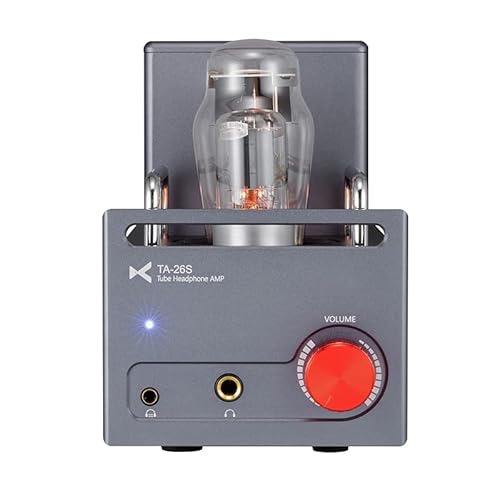
The TA-26S follows the same two tube OTL recipe as the TA-66 but in a different chassis and tube pairing: a 6N8P preamp tube and a 6N5P buffer tube, gold plated RCA ports, and 500mW of output quoted at 300 and 600 ohm loads. It adds a 4.4mm balanced headphone socket alongside the standard 6.35mm output, and its RCA line output is volume controlled, so it can serve as a tube preamplifier for active speakers. It suits home listeners who want strong drive for 300 ohm class headphones and a preamp output, in a narrower footprint than the TA-66.
Specs
- Tubes: 6N8P preamp tube, 6N5P buffer tube
- Circuit: OTL tube amplifier, capacitive coupling output
- Input: RCA, gold plated ports
- Outputs: 6.35mm and 4.4mm headphone sockets, RCA line out preamp output
- Output power: 500mW at 600 or 300 ohm loads
- Frequency response: 10Hz to 30kHz
- Gain: +16dB
- Signal to noise ratio: 110dB
- Suitable headphone impedance: 60 to 600 ohms
- Size: 25 by 11 by 16 cm
- Weight: 3.9 kg
Best for: Owners of 300 ohm dynamic headphones who want an OTL amplifier with a volume controlled preamp output.
Watch out for: Like most OTL designs it is not aimed at low impedance headphones, since the printed range starts at 60 ohms.
ASIN: B0BV6S3HHH
Little Dot MK III

The MK III is a long running Class A SEPP OTL design that uses two GE 5654 driver tubes and two Soviet 6H6PI power tubes, and it doubles as a preamplifier whose circuit includes both the driver and power tubes. Its standout feature for a home system is flexibility: gain switches provide 3, 4, 5, or 10 times gain, and an internal jumper widens driver tube rolling options across the EF95 family and equivalents. Gold plated RCA input jacks and a gold plated quarter inch headphone output keep connections simple for a single source rack shelf.
Specs
- Tubes: 2 x GE 5654 driver tubes, 2 x Soviet 6H6PI power tubes
- Circuit: SEPP OTL in Class A
- Frequency response: 12Hz to 100kHz
- Power output: 350mW at 300 or 600 ohms, 300mW at 120 ohms, 100mW at 32 ohms
- Variable gain: 3, 4, 5, or 10 times
- Recommended load impedance: 32 to 600 ohms
- Input impedance: 50K ohms
- Preamplifier output impedance: 600 ohms
- Preamplifier voltage: 10V RMS
- Power consumption: 30W
- Size: 270 by 175 by 123 mm
- Weight: 3 kg
Best for: Listeners who enjoy tube rolling and want gain settings that adapt one amplifier to several different headphones.
Watch out for: Check the voltage version before ordering, since the listing covers different regional power standards.
ASIN: B00CHIKIDM
Which One Fits Your Situation
Your Main Headphones Are 300 Ohm Dynamic Models
Choose the TA-66 or the TA-26S. Both are OTL designs whose rated power is quoted at 300 and 600 ohm loads and whose suitable ranges run to 600 ohms. The TA-66 adds point to point wiring and a stepped volume control, while the TA-26S is narrower and adds a 4.4mm socket. Either gives a high impedance headphone the voltage swing this circuit style is built to deliver.
One Amplifier Must Also Feed Powered Speakers
Look at the models with preamp or line outputs. The Valhalla 2 provides RCA preamp outputs beside its headphone jack, and the TA-66 and TA-26S provide volume controlled line outputs that pass the tube stage. The MK III also works as a preamplifier with a stated 10V RMS preamp voltage. Any of these lets one shelf position cover headphone listening and speaker duty in the same system.
Your Rack Has a Balanced DAC and Several Sources
The TA-20 Plus is the natural fit. It is the only pick here with a balanced XLR input, it adds two RCA inputs for additional sources, and it offers three headphone outputs including two balanced formats. Its hybrid buffer also covers the widest printed impedance range, from 16 to 600 ohms, so a mixed headphone collection does not force a second amplifier purchase later.
You Want to Experiment With Different Tubes
Start with the MK III or the Valhalla 2. The MK III documents a wide driver tube family through its internal jumper settings and offers four gain steps for comparing results, while the Valhalla 2 lists several input tube substitutes for its 6N1P sockets. Both keep the tube count low, so a matched pair purchase stays manageable when you decide to try an alternative set.
Common Mistakes
- Pairing an OTL amplifier with low impedance planar magnetic headphones without checking the printed suitable impedance range and the load used for the power rating.
- Blocking the ventilation space above the tubes by sliding the amplifier into a closed rack shelf with no air gap.
- Comparing output power figures that were quoted at different loads, such as 32 ohms against 300 ohms, as if they were the same measurement.
- Buying replacement tubes by appearance alone instead of matching the exact tube types printed on the product page.
- Forgetting that a tube amplifier is not a DAC, so a digital only source still needs a separate converter or a player with analog outputs.
Frequently Asked Questions
Does a tube headphone amplifier need a separate DAC?
Only if your source is digital only. These amplifiers accept analog line level signals through RCA or, on the TA-20 Plus, balanced XLR inputs. A CD player, turntable with a phono stage, or streamer with analog outputs can connect directly. A computer or digital transport without analog output needs a DAC placed before the amplifier in the chain.
Why do OTL amplifiers suit high impedance headphones?
OTL circuits deliver strong voltage swing but limited current compared with transformer coupled or hybrid designs. High impedance headphones need voltage more than current, which is why the OTL models here quote their power at 300 and 600 ohm loads and list upper limits of 600 ohms. Low impedance headphones draw more current and are usually better matched to a hybrid buffer design.
Can these amplifiers drive speakers directly?
No. None of these products is a speaker power amplifier. Several can feed powered speakers or a separate power amplifier through their preamp or line outputs, which is the correct way to include them in a speaker system. Passive speakers still need a power amplifier between the preamp output and the speaker terminals, plus suitable speaker cable.
How long do the tubes last and are replacements available?
Tube life depends on hours of daily use and operating conditions, and sellers do not print a single guaranteed figure on these product pages. The practical safeguard is choosing common tube types: the 12AU7 pair in the TA-20 Plus, the 6N1P family in the Valhalla 2, and the 5654 family in the MK III are all widely stocked types with documented substitutes.
Related guides
More from Amazon
Programs that pair well with the guide above. Offers and eligibility are set by Amazon and may change.
Free shipping on eligible items, Prime Video and more. Eligible new members can start with a free trial.
Start a Prime free trialAudiobooks and podcasts to listen to on the go. Eligible new members can start with a free trial.
Try Audible freeAd-free music streaming. Eligible new subscribers can start with a free trial.
Try Music Unlimited freeA free business account with business pricing and bulk-buying tools for work, shop or home office.
Create a business accountAs an Amazon Associate we earn from qualifying purchases.










Write Your Review
No reviews yet. Be the first to share your experience!