
Key takeaways
- Upgrade a turntable with a dedicated moving-magnet phono preamp: five MM stages with gain, loading and subsonic options compared from their listed specs.
What's inside
As an Amazon Associate I earn from qualifying purchases. This post may contain affiliate links at no extra cost to you.
Upgrading a turntable usually stalls at the phono stage. The built-in stage in a budget deck or receiver applies the RIAA curve with cheap parts and fixed loading, so a better cartridge often sounds smaller than the one it replaced. The real decision is how much control the new stage should give you: fixed and simple, switchable gain and capacitance for cartridge matching, or a tube stage you can tune later.
This guide is for listeners replacing a built-in phono stage, adding a turntable to an amplifier with no phono input, or matching a new moving-magnet cartridge to a stage that loads it correctly. Every pick is a moving-magnet phono preamp chosen from the names and specifications printed on its Amazon product page, and the five options run from a compact fixed-gain stage to a fully switchable dual-mono design.
Quick Picks
As an Amazon Associate we earn from qualifying purchases.
| Product | Best for | Key spec from title |
|---|---|---|
| Cambridge Audio Alva Solo Moving Magnet Phono Preamplifier | A simple MM-only upgrade with a subsonic filter | Moving Magnet Phono Preamplifier |
| Pro-Ject Phono Box S2 (Black) | Cartridge matching with switchable gain and loading | Switchable gain, capacitance and impedance settings |
| Fosi Audio Box X2 Phono Preamp | Tube sound with three gain settings and replaceable tubes | Mini Stereo Audio Hi-Fi Preamplifier with Gain Gear |
| ART DJPRE II Phono Preamplifier | Adjustable gain and switchable input capacitance on a budget | Switchable input capacitance, 100pF or 200pF |
| Pyle PP999 Phono Turntable Preamp | The smallest, simplest way to add a phono input | Mini Electronic Audio Stereo Phonograph Preamplifier |
How to Choose
Match the Gain to Your Cartridge Output
Moving-magnet cartridges vary in output, and the phono stage has to lift that small signal to line level without adding noise or running out of headroom. A fixed-gain stage around 39 to 40dB suits most mainstream MM cartridges and keeps setup simple. Quieter cartridges, or amplifiers with low input sensitivity, benefit from switchable gain such as the 39, 42 and 45dB steps on the Fosi Audio Box X2 or the 40 and 43dB MM settings on the Pro-Ject Phono Box S2. Too much gain raises the noise floor and risks overload on loud pressings, so pick a stage whose gain range brackets your cartridge rather than one that simply offers the highest number.
Get the Cartridge Loading Right
An MM cartridge is designed to work into a load of 47k ohms with a total capacitance figure quoted by its maker, and the phono stage sets most of that capacitance. Too much capacitance dulls the treble and shifts the response peak; too little can leave the top end thin. Fixed stages such as the Cambridge Audio Alva Solo use a standard 47k ohm, 100pF input that suits the majority of cartridges. If you own or plan to try several cartridges, a switchable stage helps: the ART DJPRE II toggles between 100pF and 200pF, and the Phono Box S2 offers four capacitance values. Remember the tonearm cable adds capacitance too, so the stage setting is only part of the total.
Decide Whether You Need a Subsonic Filter
Warped records and footfall send very low frequency energy through the stylus, and a phono stage passes it straight to your amplifier and woofers unless something filters it out. A switchable subsonic or low-cut filter removes that energy below the audible band while leaving the music alone. The Alva Solo includes a subsonic filter, the Phono Box S2 rolls off at 20Hz, and the DJPRE II has a switchable low-cut filter for the same job. If your speakers sit on a suspended floor, your records are less than flat, or you see woofer cones pumping between tracks, treat a filter as a requirement rather than a bonus feature.
Check Connections, Power and Placement
Every stage here takes RCA inputs from the turntable and feeds a line-level RCA output, so the output must go into a line input on your amplifier, never into another phono input. Confirm the stage has a ground terminal for the turntable earth wire, since a floating ground is the most common source of hum after an upgrade. Power supplies differ: most use an external wall adapter, and keeping that adapter away from the low-level phono cables reduces hum pickup. Finally, measure the shelf space you have, because these boxes range from the pocket-size Pyle PP999 to the wider Cambridge chassis, and short turntable leads limit how far away the stage can sit.
The 5 Best Options
Cambridge Audio Alva Solo Moving Magnet Phono Preamplifier
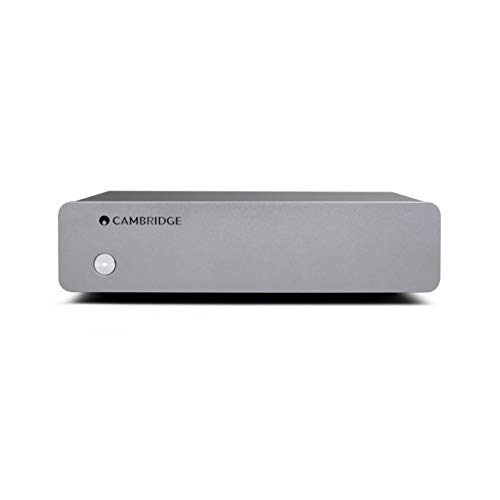
The Alva Solo is the upgrade for listeners who want a dedicated moving-magnet stage and nothing else to manage. Because it is built for MM cartridges only, there are no cartridge-type switches or loading menus to set wrong: gain is fixed at 39dB, the input is the standard 47k ohm load, and a subsonic filter handles warped records quietly in the background. Its balance control and auto power-down suit a tidy stereo system where the phono stage should disappear into daily use, and the solid Cambridge chassis feels like a permanent part of the rack rather than a stopgap accessory.
Specs
- Cartridge support: moving magnet only
- Gain at 1kHz: 39dB
- Nominal output: 300mV
- Input impedance: 47k ohms
- Input capacitance: 100pF
- Subsonic filter: built in
- Maximum power consumption: 10W
Best for: Listeners who want a fit-and-forget MM stage from a hi-fi brand.
Watch out for: There is no moving-coil input, so a future low-output MC cartridge would need a different stage.
ASIN: B0793363RG
Pro-Ject Phono Box S2 (Black)

The Phono Box S2 suits the listener who treats the phono stage as a tuning tool. DIP switches on the underside set gain, input capacitance and input impedance, so an MM cartridge can be loaded at 47k ohms with 100, 200, 320 or 420pF to match its specification, and the MM gain steps of 40 and 43dB cover standard and lower-output designs. A switchable subsonic filter, dual-mono layout and a metal enclosure complete a stage that stays relevant through several cartridge changes, and its moving-coil settings leave a door open that the MM-only stages here close.
Specs
- Cartridge support: MM and MC, switchable
- Input gain: 40 and 43dB for MM cartridges
- Input capacitance: 100, 200, 320 and 420pF at 47k ohms
- Input impedance settings: 10 ohms, 100 ohms, 1k ohm and 47k ohms
- Noise floor: 94dB, A-weighted, at MM gain settings
- THD: under 0.01 percent at MM gain settings
- Subsonic filter: at 20Hz with 12dB per octave rolloff
- Power supply: 18V, 500mA DC adapter
- Dimensions: 103 x 37 x 119 mm
- Weight: 340g without power supply
Best for: Owners planning cartridge changes who want loading and gain they can set precisely.
Watch out for: The DIP switches sit underneath the unit, so note your settings before placing it in a rack.
ASIN: B073WD4J1C
Fosi Audio Box X2 Phono Preamp

The Box X2 is the pick for listeners curious about tube sound in a phono stage that stays compact and affordable. Two replaceable tubes sit on top of the chassis, and the front knob selects power plus three gain settings, 39, 42 and 45dB, which covers the output range of typical moving-magnet cartridges. A grounding post protects the MM input from hum, and a separate 3.5mm AUX input lets the same box work as a tube preamp for a phone or streamer between record sessions. Tube rolling with the listed compatible types gives this stage a second life as a small hobby in itself.
Specs
- Cartridge support: moving magnet
- Gain settings: 39, 42 and 45dB, switchable
- Signal-to-noise ratio: 98dB or better
- THD: 0.1 percent or less
- Output level: 600mV at 3mV, 1kHz
- Inputs: MM turntable RCA input and 3.5mm AUX input
- Tubes: two replaceable tubes, compatible types include 6K4, 6J1, 6J4, GE5654 and 6AK5
- Power supply: DC 12V, 1.5A adapter included
- Dimensions: 4.66 x 3.85 x 1.29 inches
Best for: Listeners who want tube character, gain flexibility and an AUX input in one small box.
Watch out for: A cable plugged into the AUX input takes priority, so unplug it before playing records.
ASIN: B07XNTHHBP
ART DJPRE II Phono Preamplifier

The DJPRE II has been the working musician’s phono stage for years, and its control set explains why. A front gain trim with a signal and clip LED lets you set the level precisely for recording or playback, the input capacitance switches between 100pF and 200pF to suit the cartridge, and a switchable low-cut filter strips out rumble. The published figures are honest ones, with a 45dB maximum gain and a frequency response held within half a decibel across an unusually wide band. The all-aluminium case and flexible power options make it equally at home in a hi-fi rack or a digitising setup.
Specs
- Input impedance: 47k ohms in parallel with either 100pF or 200pF
- Maximum gain: 45dB at 1kHz
- Frequency response: 10Hz to 50kHz, within 0.5dB
- THD: 0.01 percent typical at 1kHz
- Maximum input level: 40mVrms at 1kHz
- Maximum output level: +6dBu (1.4Vrms)
- Filter: switchable low cut, -3dB at 22Hz
- Power requirements: 7-12V DC or 9-12V AC at 150mA
- Dimensions: 1.85 x 4.6 x 4.5 inches
- Weight: 1.25 lbs
Best for: Listeners who want direct gain control and capacitance switching without a hi-fi price tag.
Watch out for: The gain trim is easy to knock, so set it with the clip LED and leave it alone afterwards.
ASIN: B000AJR482
Pyle PP999 Phono Turntable Preamp
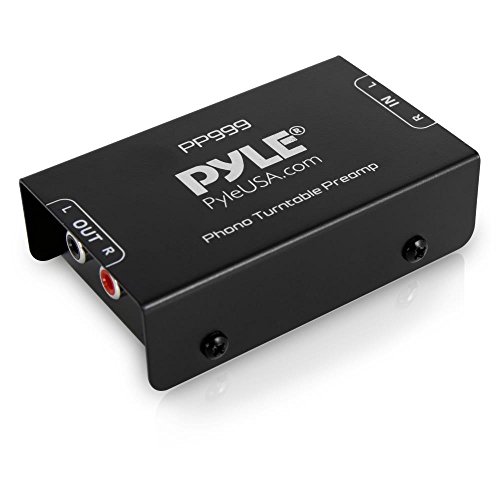
The PP999 is the simplest route from a turntable with no phono stage to an amplifier with no phono input. It converts the phono signal to line level with a fixed circuit designed for magnetic cartridges, runs from the included 12V DC adapter, and fits almost anywhere at under four inches wide. There is nothing to configure, which is exactly the point for a second system, a bedroom deck or a first turntable bought without a matching amplifier input. Its published noise and distortion figures are modest next to the stages above, but as a functional bridge between turntable and amplifier it covers the job completely.
Specs
- Input sensitivity and impedance: 3mV, 50K ohms
- Output level: 2V
- Load impedance: 10K ohms
- Signal-to-noise ratio: 70dB, A-weighted
- THD: 0.08 percent at 1kHz with 3mV input
- Frequency response: 20Hz to 20kHz, within 2dB
- Power: 12V DC adapter included
- Dimensions: 3.54 x 2.13 x 1.02 inches
Best for: A first turntable or spare system that simply needs a working phono input.
Watch out for: Gain and loading are fixed, so high-output cartridges and very quiet amplifiers leave no room to adjust.
ASIN: B00025742A
Which One Fits Your Situation
Your Amplifier Has No Phono Input
Any stage here solves the missing-input problem, but the Cambridge Audio Alva Solo is the calmest long-term answer, with fixed MM gain, a subsonic filter and no settings to revisit. On a tighter budget the Pyle PP999 adds the same basic connection in a much smaller box. Choose the Alva Solo if this is your main system, and the PP999 if the turntable is a secondary source you play occasionally.
You Keep Changing Cartridges
Frequent cartridge swaps reward a stage with switchable loading, and the Pro-Ject Phono Box S2 is built for exactly that habit, with four capacitance values, several impedance settings and two MM gain steps set by DIP switches. The ART DJPRE II covers lighter experimentation with its two capacitance settings and front gain trim. Pick the Pro-Ject if you already own more than one cartridge or plan to buy a second within the year.
You Want Tube Sound Without a Big Chassis
The Fosi Audio Box X2 is the only tube stage in this guide, and its three gain settings, replaceable tubes and grounding post make it a genuine phono upgrade rather than a novelty. Its AUX input also warms up digital sources through the same tubes. Choose it if you listen on headphones or a nearfield desktop system where tube character is easy to appreciate at modest volumes.
Your Records Are Warped or Your Floor Bounces
Low-frequency energy from warps and footfall needs a filter, and three stages here provide one: the Alva Solo has a subsonic filter built in, the Phono Box S2 rolls off at 20Hz, and the DJPRE II offers a switchable low-cut filter. Pick the DJPRE II if you also want a gain trim for recording, or the Alva Solo for a main listening system where the filter should simply stay on.
Common Mistakes
- Plugging the phono stage output into the amplifier’s phono input, which applies the RIAA curve and gain twice and overloads the input.
- Forgetting the turntable ground wire, then blaming the new stage for the hum that follows.
- Choosing gain by the highest number rather than by cartridge output, which raises noise and eats headroom on loud records.
- Ignoring cable capacitance when setting a switchable stage, even though the tonearm lead adds to the total the cartridge sees.
- Stacking the phono stage on top of a power amplifier or its adapter, inviting hum into the lowest-level signal in the system.
Frequently Asked Questions
Does a moving-magnet phono preamp work with any turntable?
It works with any turntable fitted with a moving-magnet cartridge, or a high-output moving-coil design that expects an MM input. The turntable needs a phono-level output: if the deck has a built-in phono stage with a line output, switch it to phono mode or use a different output, because feeding line level into a phono stage overloads it badly.
What gain setting suits a typical MM cartridge?
Most moving-magnet cartridges output between roughly three and six millivolts, and stages offering 39 to 43dB of gain bring that to a healthy line level for most amplifiers. Use the lower settings for high-output cartridges and the higher ones only when playback is clearly too quiet, since extra gain also amplifies surface noise and reduces overload headroom.
Can I use one of these stages with a moving-coil cartridge later?
Only the Pro-Ject Phono Box S2 in this guide accepts low-output moving-coil cartridges, with gain settings up to 63dB and low impedance loading options. The Cambridge, Fosi, ART and Pyle stages are moving-magnet designs, and a low-output MC cartridge into an MM input plays far too quietly, so plan the stage purchase around the cartridge family you expect to keep.
Where should the phono preamp sit in the system?
Place it close to the turntable, because the cable between cartridge and stage carries the smallest, most interference-prone signal in the chain and should stay short. Run a longer line-level cable from the stage to the amplifier instead. Keep the stage and its power adapter away from power amplifiers and transformers, and connect the turntable ground wire to the stage terminal.
Related guides
More from Amazon
Programs that pair well with the guide above. Offers and eligibility are set by Amazon and may change.
Free shipping on eligible items, Prime Video and more. Eligible new members can start with a free trial.
Start a Prime free trialAudiobooks and podcasts to listen to on the go. Eligible new members can start with a free trial.
Try Audible freeAd-free music streaming. Eligible new subscribers can start with a free trial.
Try Music Unlimited freeA free business account with business pricing and bulk-buying tools for work, shop or home office.
Create a business accountAs an Amazon Associate we earn from qualifying purchases.










Write Your Review
No reviews yet. Be the first to share your experience!