
Key takeaways
- Five balanced desktop DACs with XLR outputs for two-channel stereo systems, compared on output level, inputs, format support and preamp modes.
What's inside
As an Amazon Associate I earn from qualifying purchases. This post may contain affiliate links at no extra cost to you.
Many stereo amplifiers now ship with balanced XLR inputs that sit unused while a DAC feeds them over RCA. Running that link balanced rejects the hum and interference a cable picks up along its run, which matters in racks full of power cords and long stretches to a power amplifier. The real decision is matching the DAC to your system: its XLR output level, whether it can act as the preamp, and whether it has the inputs your sources actually need.
This guide is for two-channel listeners in three common situations: a computer or streamer feeding an integrated amplifier, a DAC driving a power amplifier directly, and a television or CD transport sharing the same speakers. Every pick below is a desktop DAC whose Amazon listing publishes balanced XLR line outputs, and the specifications quoted come from those product listings rather than from reviews or manufacturer brochures.
Quick Picks
As an Amazon Associate we earn from qualifying purchases.
| Product | Best for | Key spec from title |
|---|---|---|
| Topping D90 III Sabre | Flagship two-channel systems | Dual ES9039SPRO chips, balanced XLR output |
| SMSL SU-9n | DAC-as-preamp duty with a remote | ES9038PRO, XLR 4.8 Vrms in pre mode |
| SMSL DO100 Pro | Stereo systems that also serve a TV | Dual ES9039Q2M, HDMI ARC input |
| SMSL RAW-MDA1 | Speakers and headphones from one box | Dual ES9039Q2M, XLR line out at 5.2 Vrms |
| Schiit Modius E | A simple, affordable balanced source | ES9028, balanced XLR output at 4.0 Vrms |
How to Choose
Output level and preamp mode come first
Balanced outputs are not standardized at one voltage. The DACs here publish XLR levels from 4.0 Vrms up to 5.2 Vrms, and a hot output can overload an amplifier input that expects the classic 4 V, causing harsh peaks long before the volume knob feels loud. Decide who owns volume control. Into an integrated amplifier, a fixed line output is cleanest. Driving a power amplifier directly, you need a variable (pre) mode and a remote, which the SU-9n, DO100 Pro, RAW-MDA1 and D90 III Sabre provide and the fixed-output Modius E does not.
Balanced sockets are not the same as a balanced design
An XLR connector on the rear panel only guarantees the cable is balanced, not the circuitry behind it. Listings that take the topology seriously say so: the D90 III Sabre runs one DAC chip per channel, the Modius E lists separate, DC-coupled output stages for its balanced and single-ended outputs, and the SMSL models use dual DAC chips. A single-ended design with an added XLR socket still works, but it cannot reject noise generated inside the box, and it often shares one output stage between both connector types.
Count the inputs your rack actually uses
A two-channel system usually gathers more sources than expected. USB serves a computer or streamer, optical and coaxial suit CD transports and older televisions, and AES appears on the D90 III Sabre and Modius E for pro-style transports. The DO100 Pro is the only pick here with HDMI ARC, which makes it the natural partner for a modern TV. Bluetooth on the SMSL and Topping models covers casual phone listening. Remember that optical and coaxial top out at 24-bit/192 kHz on these units, while USB carries the highest rates.
Format ceilings, filters and where cheaper DACs cut back
The SMSL models and the D90 III Sabre decode PCM to 32-bit/768 kHz and native DSD512 over USB, with full MQA decoding, while the Modius E stops at 24-bit/192 kHz and skips DSD entirely, which only matters if your library goes there. Adjustable PCM filters, DPLL settings and sound-color modes on the SMSL units are fine-tuning, not essentials. The visible savings on simpler DACs are a missing remote, no display, fixed output and an external power brick instead of an internal supply, so rank those against your habits before paying for conversion numbers alone.
The 5 Best Options
Topping D90 III Sabre

This is the flagship route for a stereo system built around balanced amplification. Two ES9039SPRO chips, one per channel, feed a fully balanced output stage with selectable XLR level, so it pairs as comfortably with a sensitive integrated amplifier as with a power amp in preamp mode, where the Bluetooth remote handles volume. AES and I2S inputs suit serious streamers and CD transports, and the 12 V trigger can wake the rest of the rack. There is deliberately no headphone socket: this is a single-purpose stereo component.
Specs
- DAC chips: 2 x ESS ES9039SPRO, one per channel
- Outputs: balanced XLR (4 V or 5 V) and single-ended RCA (2 V or 2.5 V)
- Inputs: USB, coaxial, optical, AES, I2S, Bluetooth 5.1 (LDAC, aptX Adaptive)
- USB formats: PCM up to 32-bit/768 kHz, native DSD512, full MQA decoding
- THD+N: below 0.000045% (XLR); SNR: 135 dB (XLR)
- Preamp function with Bluetooth remote control and 12 V trigger
Best for: A stereo system built around a power amplifier or a high-end integrated amp with balanced inputs.
Watch out for: There is no headphone output at all, and the 5 V XLR setting can overload sensitive amplifier inputs, so start with the 4 V setting.
ASIN: B0CQJYWMJZ
SMSL SU-9n
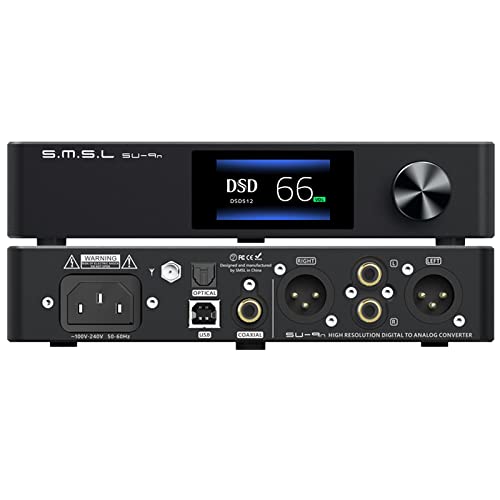
The SU-9n suits listeners who want the DAC to run the system. Its ES9038PRO converter, backed by an ES9311 low-noise regulator, offers a pre mode with remote volume control or a fixed line output, and both the XLR and RCA outputs stay active at the same time, which is handy if a headphone amplifier or a second zone hangs off the RCA pair. PCM and DSD filter choices plus sound-color settings give some shaping control from the listening chair, and the compact case leaves room on the shelf for the amplifier to breathe.
Specs
- DAC chip: ESS ES9038PRO with ES9311 low-noise regulator
- Outputs: XLR balanced and RCA single-ended, both always active
- Output level: XLR 4.8 Vrms (pre mode) or 4.3 Vrms (fixed); RCA 2.3 or 2.0 Vrms
- Inputs: USB, optical, coaxial, Bluetooth
- USB formats: PCM up to 32-bit/768 kHz, native DSD512
- THD+N: 0.000065%; dynamic range: 130 dB (XLR); SNR: 130 dB
- Output impedance: 207 ohms (XLR); weight: 0.79 kg; remote control included
Best for: Listeners who want the DAC to double as the system preamp in front of a power amplifier.
Watch out for: Neither output can be muted independently, and there is no HDMI or AES input, so check your source list before committing.
ASIN: B09JC6BQ21
SMSL DO100 Pro

Where the stereo system shares a room with a television, the DO100 Pro earns its place with the input the others lack: HDMI ARC, which lets the TV feed the same amplifier and speakers as your music sources. Dual ES9039Q2M chips and an XMOS XU316 USB section handle high-resolution files from a computer, full MQA decoding covers streaming duties, and the XLR and RCA outputs can run simultaneously for a main system plus a secondary amp. A USB 1.1 mode also makes it friendly to game consoles that dislike driver-based audio.
Specs
- DAC chips: dual ESS ES9039Q2M; USB processor: XMOS XU316
- Inputs: USB (Type-C), optical, coaxial, HDMI (ARC), Bluetooth 5.1
- Outputs: RCA single-ended and XLR balanced
- USB formats: PCM up to 32-bit/768 kHz, DSD512; full MQA decoding via USB, optical and coaxial
- Bluetooth codecs: LDAC (24-bit/96 kHz), aptX HD, SBC, AAC
- Case: full aluminum, CNC machined; about 189 x 186 x 45 mm; weight: 1.45 kg
- Remote control included
Best for: A living-room stereo that must handle TV sound over HDMI ARC alongside music sources.
Watch out for: The ARC input accepts PCM only, so set the television’s audio output to PCM; switching between USB modes requires restarting the unit.
ASIN: B0CZ8YZH65
SMSL RAW-MDA1

The RAW-MDA1 is the pick when one box has to feed the stereo amplifier and drive headphones after hours. Its rear XLR pair is a true line output published at a healthy 5.2 Vrms, while the front panel adds 6.35 mm and 4.4 mm headphone sockets with enough power for demanding headphones. Doubled coaxial and optical inputs are unusual at this level and let a CD transport and a streamer both stay connected digitally, and the color display plus remote keep daily use simple from across the room.
Specs
- DAC chips: dual ESS ES9039Q2M; USB interface: XMOS XU-316
- Inputs: USB, 2 x optical, 2 x coaxial, Bluetooth (LDAC, aptX HD)
- Line outputs: XLR at 5.2 Vrms and RCA at 2.5 Vrms
- Dynamic range: 132 dB (XLR), 127 dB (RCA); THD+N: 0.00005%
- USB formats: PCM up to 32-bit/768 kHz, DSD512; MQA and MQA-CD decoding
- Headphone outputs: 6.35 mm and 4.4 mm, up to 2.5 W x 2 at 16 ohms
- Remote control included
Best for: A combined system where one unit feeds the stereo amplifier over XLR and drives headphones directly.
Watch out for: The 5.2 Vrms XLR output is hotter than the 4 V norm, so confirm your amplifier’s input headroom; the front 4.4 mm socket is a headphone output, not a line out.
ASIN: B0DFCFHQ2W
Schiit Modius E

The Modius E is the straightforward way into balanced connection: no display, no remote, no menus, just an ESS ES9028 converter with Unison USB and a proper balanced output stage. Unusually at this level it includes an AES input alongside USB, optical and coaxial, and its balanced and single-ended outputs are independent and live simultaneously, so it can feed an amplifier over XLR and a headphone amp over RCA at once. Output is fixed at line level, which keeps it honest as a source component and nothing more.
Specs
- DAC chip: ESS ES9028
- Inputs: USB (Unison USB), Toslink optical, coaxial, AES
- Outputs: XLR balanced (4.0 Vrms) and RCA single-ended (2.0 Vrms), both active simultaneously
- Sample rates: 16-bit/44.1 kHz to 24-bit/192 kHz
- SNR: over 118 dB; THD+N: 0.0003%
- Output stages: separate balanced (LME49724) and single-ended (OPA1656), DC-coupled
- Output impedance: 75 ohms
Best for: A simple, affordable balanced source for an integrated amplifier, with nothing extra to configure.
Watch out for: The output is fixed with no volume control, so it cannot drive a power amplifier on its own; format support stops at 24-bit/192 kHz with no DSD.
ASIN: B0B36QGLWR
Which One Fits Your Situation
Your sources sit across the room from the amplifier
Long cable runs are where balanced connection proves itself, because interference picked up along the way is cancelled at the amplifier’s input. Either the Topping D90 III Sabre or the SMSL SU-9n fits here; choose the Topping for its selectable 4 V or 5 V output and trigger control, or the SU-9n if its always-active RCA pair will feed a second component at the same time.
One box feeds both speakers and headphones
If the rack serves late-night headphone sessions as well as the main speakers, the SMSL RAW-MDA1 avoids a second purchase. Its XLR line output drives the stereo amplifier while the built-in headphone stage handles 6.35 mm and 4.4 mm plugs, and the doubled digital inputs mean a transport and a computer never fight over a socket.
The television shares your stereo system
Routing TV sound through real speakers transforms films and sport, and the SMSL DO100 Pro is the only DAC here with HDMI ARC to do it over one cable. Set the TV to PCM output, and the same XLR feed that carries your music handles dialogue, with the remote keeping volume control in one hand.
You want balanced sound without feature overload
Not every system needs a display, an app or a filter menu. The Schiit Modius E simply converts and outputs a fixed balanced signal, which is exactly right when an integrated amplifier already handles volume and source switching. It is also the natural choice when your sources are conventional PCM files and streams rather than DSD downloads.
Common Mistakes
- Using XLR-to-RCA adapter cables and expecting balanced noise rejection; the signal is single-ended from the adapter onward, so the benefit disappears.
- Running a DAC in variable pre mode while also using the amplifier’s volume control, which stacks two volume controls and wastes resolution at low levels.
- Selecting the hottest output setting, such as 5 V or 5.2 Vrms, without checking the amplifier’s maximum input level, inviting clipping on loud passages.
- Assuming any DAC with XLR sockets is balanced inside; check the listing for dual DAC chips or a separate balanced output stage before paying a premium.
- Connecting a fixed-output DAC such as the Modius E straight into a power amplifier with no volume control anywhere in the chain.
Frequently Asked Questions
Does balanced cabling improve sound on short runs?
The main benefit is rejection of hum and interference, which matters most on long runs or in racks crowded with power supplies. Across a one-metre link the audible difference may be negligible, but the higher 4 V balanced level also changes gain staging, often letting the amplifier run in a quieter part of its volume range.
Can I use one of these DACs with an amplifier that only has RCA inputs?
Yes. Every DAC in this guide also provides RCA outputs, so it will work with a single-ended amplifier today and a balanced one later. You simply give up the noise rejection of the balanced link; the conversion quality, format support and input selection stay exactly the same over the RCA pair.
Should I choose fixed or variable output into an integrated amplifier?
Choose fixed. The amplifier’s volume control becomes the single control point, and the DAC runs at its full output level, which keeps its signal-to-noise performance intact. Variable mode is for driving a power amplifier that has no volume control of its own; using both controls together only complicates gain staging.
What does fully balanced mean beyond having XLR sockets?
It means the signal stays differential through the output stage, and ideally through conversion itself, as with the D90 III Sabre’s chip-per-channel layout or the Modius E’s separate balanced stage. A DAC that converts single-ended and adds XLR connectors afterwards still sends a balanced signal down the cable, but internal noise and distortion are not reduced by the topology.
Related guides
More from Amazon
Programs that pair well with the guide above. Offers and eligibility are set by Amazon and may change.
Free shipping on eligible items, Prime Video and more. Eligible new members can start with a free trial.
Start a Prime free trialAudiobooks and podcasts to listen to on the go. Eligible new members can start with a free trial.
Try Audible freeAd-free music streaming. Eligible new subscribers can start with a free trial.
Try Music Unlimited freeA free business account with business pricing and bulk-buying tools for work, shop or home office.
Create a business accountAs an Amazon Associate we earn from qualifying purchases.










Write Your Review
No reviews yet. Be the first to share your experience!