
Key takeaways
- Four 15-inch powered subwoofers that bring real cinema bass to multichannel home theater systems, chosen for output, extension, and receiver integration.
What's inside
As an Amazon Associate I earn from qualifying purchases. This post may contain affiliate links at no extra cost to you.
A 15-inch powered subwoofer changes what a multichannel system can do, because the low end stops sounding like an effect added on top of the film and starts feeling like part of the room itself. The real decision is not simply how loud a cabinet can play, but how cleanly it reaches the lowest notes in action scenes, how evenly it fills a large seating area, and how easily it blends with the main speakers so dialogue and music stay clear while explosions still carry weight.
This guide is for home theater owners building or upgrading a surround system, for listeners with a large living room or a dedicated media room, and for anyone whose current subwoofer runs out of depth during demanding film soundtracks. Every model below is a powered 15-inch subwoofer selected from the driver size, amplifier rating, enclosure type, and connection options shown on its Amazon listing, with the emphasis on LFE input and integration with an AV receiver.
Quick Picks
As an Amazon Associate we earn from qualifying purchases
| Product | Best for | Key spec from title |
|---|---|---|
| Klipsch SPL-150SW 15 Inch Powered Subwoofer, Ebony | A polished living room theater that needs deep, controlled bass | 15-inch powered subwoofer with 400W RMS and 800W peak |
| Monolith by Monoprice M-15 V2 THX Ultra Certified 1000-Watt Powered Subwoofer | A large dedicated theater that needs maximum output and extension | 15-inch THX Ultra certified subwoofer with 1000-watt amplifier |
| Monoprice SW-15 600 Watt RMS Powered Subwoofer, 15-Inch, Ported Design | A large room on a tighter plan that still needs strong movie impact | 15-inch ported powered subwoofer with 600W RMS and 800W peak |
| Rockville Rock Shaker 15 Powered Subwoofer, 1000W Peak, 500W RMS, Class-D | A flexible setup that needs simple receiver and speaker-level hookups | 15-inch powered subwoofer with 1000W peak and 500W RMS |
How to Choose
Match Output to Room Size and Seating Distance
A 15-inch driver moves far more air than a compact subwoofer, yet room volume still decides how much output matters. A sealed or open-plan living room, a high ceiling, and seats placed away from the corner all absorb low-frequency energy, so a model with a stronger amplifier and a lower frequency response earns its place there. In a smaller enclosed room, the same subwoofer can sound overwhelming if the gain is left high, so check the dimensions and weight before ordering and leave space for the cabinet to breathe. Measure the longest listening distance, note whether doors and hallways stay open during films, and choose output headroom that covers the whole seating area rather than only the nearest chair.
Decide Between Ported Depth and Sealed Control
Ported cabinets use a tuned opening to reinforce the lowest notes, which suits film soundtracks that rely on sustained rumble, distant thunder, and long low-frequency sweeps. Sealed cabinets and passive-radiator designs tend to start and stop more quickly, which can suit music-heavy multichannel listening and rooms where a ported cabinet sounds loose near a wall. The models in this guide lean toward ported and passive-radiator designs because multichannel systems usually ask for depth first, yet placement still matters. A front-firing port gives more freedom near a back wall, while a down-firing port needs clear floor space. Read the enclosure description on the listing and picture the cabinet in its real corner before committing.
Check the LFE Input and Receiver Controls
A multichannel system works best when the AV receiver handles bass management, so the subwoofer needs a clear path for that signal. Look for an LFE input or a line-level RCA input that bypasses the internal crossover, plus a variable low-pass filter and a phase control for fine tuning after room calibration. Speaker-level inputs add flexibility for older receivers and stereo amplifiers, and a wireless input option can solve a long cable run across a finished room. Confirm that the rear panel controls are reachable in the planned position, because a subwoofer pushed tight against a wall turns every later adjustment into a furniture-moving exercise.
Weigh Amplifier Power Against Real Listening Habits
Amplifier ratings describe headroom, not a promise that film will sound better at full volume. A 1000-watt amplifier gives a large room more clean output before distortion appears, while a 400-watt or 500-watt amplifier can fill a medium room when the cabinet and driver are efficient. Pay attention to the RMS rating rather than the peak figure alone, and pair it with the stated frequency response to judge whether the model reaches the notes that matter for cinema. If most viewing happens at moderate volume with neighbours nearby, control and blend matter more than headroom. If the room is large and the system plays action films often, choose the stronger amplifier and accept the larger cabinet that comes with it.
The 4 Best Options
Klipsch SPL-150SW 15 Inch Powered Subwoofer, Ebony

The Klipsch SPL-150SW suits a living room theater where the subwoofer must look settled beside furniture while still delivering the deep notes that carry a film soundtrack. Its copper spun cerametallic driver and front-firing internal flare port give placement flexibility near a wall or corner, and the Class D amplifier keeps the cabinet efficient during long viewing sessions. Line-level and LFE RCA inputs connect directly to an AV receiver, and the optional wireless port helps when a cable run across the room is impractical. This is the pick for listeners who want strong cinema bass without a cabinet that dominates the room visually.
Specs
- 15-inch long-throw copper spun cerametallic front-firing woofer
- Class D amplifier with 400 watts RMS and 800 watts peak
- Frequency response of 18 Hz to 125 Hz
- Bass reflex enclosure with front-firing internal flare port
- Maximum acoustic output of 122 dB
- Inputs include L/R line-level and LFE RCA jacks plus a wireless WA-2 port
- MDF enclosure with ebony vinyl finish and woven cloth grille
- Dimensions of 21.5 inches high by 19.5 inches wide by 22.3 inches deep
- Weight of 75.4 pounds
Best for: A living room multichannel system that needs deep bass, a tidy cabinet, and easy receiver integration.
Watch out for: Check the cabinet depth against the planned spot, since the ported enclosure and rear panel need clearance for cables and airflow.
Monolith by Monoprice M-15 V2 THX Ultra Certified 1000-Watt Powered Subwoofer

The Monolith M-15 V2 is built for a dedicated theater where output and extension matter more than compact size. Its 15-inch high-excursion woofer pairs with a 1000-watt RMS Class D amplifier and a Texas Instruments DSP path, a combination aimed at clean, high-volume playback in large rooms. THX Ultra certification signals that the design targets reference-level output for a large home theater, and the stated frequency response reaches down to 16 Hz, which covers the deepest notes in modern film mixes. This model makes sense when the room is large, the seating distance is long, and the rest of the system can keep up with a genuinely powerful low end.
Specs
- 15-inch high-excursion woofer designed for output, accuracy, dynamics, and linearity
- 1000 watts RMS Class D amplifier with Texas Instruments 48-bit DSP
- Frequency response of 16 Hz to 200 Hz
- Maximum output of 118.2 dB at 31 Hz under CEA-2010 measurement
- THX Ultra certified for large home theater rooms
- HDF cabinet construction with black ash finish
- Weight of about 133 pounds
Best for: A large dedicated multichannel theater that needs reference-level output and very deep extension.
Watch out for: Confirm floor strength, doorway width, and a second pair of hands for delivery, because this is a very heavy cabinet to move and position alone.
Monoprice SW-15 600 Watt RMS Powered Subwoofer, 15-Inch, Ported Design
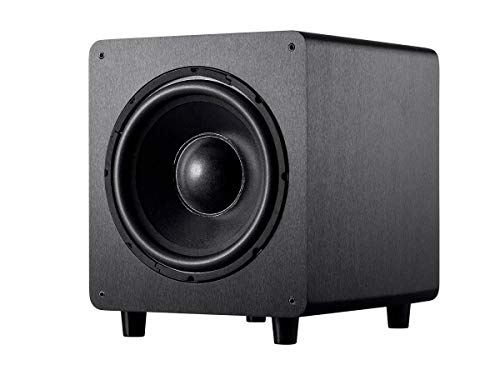
The Monoprice SW-15 gives a large room movie bass from a ported design, with controls that make it easy to tune after the rest of the system is in place. Its 15-inch front-firing long-throw woofer works with a 600-watt RMS Class D amplifier, and the variable low-pass filter and variable phase control help the subwoofer blend with main speakers of different sizes. RCA and speaker-level inputs cover both modern AV receivers and older amplifiers, so the model fits a system that is being upgraded in stages. It is a practical choice when the goal is room-filling impact for films without stepping into the largest and heaviest class of subwoofer.
Specs
- 15-inch front-firing long-throw woofer
- 600 watts RMS Class D amplifier with 800 watts peak
- Frequency response of 30 Hz to 150 Hz
- Ported MDF enclosure design
- Variable low-pass filter from 40 Hz to 150 Hz
- Variable phase control at 0 degrees or 180 degrees
- Inputs include RCA line-level and speaker-level connections
- Dimensions of about 20 inches by 20 inches by 20 inches
Best for: A large living room or media room that needs strong, punchy film bass and flexible tuning controls.
Watch out for: Measure the cube-shaped cabinet carefully, since its near-equal height, width, and depth can surprise buyers who expect a slimmer tower shape.
Rockville Rock Shaker 15 Powered Subwoofer, 1000W Peak, 500W RMS, Class-D

The Rockville Rock Shaker 15 fits a multichannel setup where simple connections and adjustable controls matter as much as raw size. Its 15-inch driver pairs with a built-in Class D amplifier rated at 500 watts RMS, and the MDF enclosure is built to keep cabinet vibration from colouring the low end. RCA line inputs and outputs sit alongside speaker-level inputs and outputs, so the subwoofer can join a receiver-based system or an older amplifier setup without extra adapters. Phase and crossover controls on the rear panel let the owner shape the blend with the main speakers after the cabinet is placed, which is useful in rooms with awkward corners.
Specs
- 15-inch dynamic driver with foam surround and paper cone
- Class D amplifier with 500 watts RMS and 1000 watts peak output
- Frequency response of 35 Hz to 200 Hz
- MDF enclosure with removable foam grille
- RCA line input and output plus speaker-level inputs and outputs
- Phase control and adjustable crossover from 35 Hz to 200 Hz
- Woofer impedance of 4 ohms and signal-to-noise ratio of 86 dB
- Dimensions of 18.5 inches wide by 15.75 inches high by 22.05 inches deep
- Unit weight of 46.08 pounds
Best for: A mixed receiver or amplifier setup that needs RCA and speaker-level hookups with manual tuning.
Watch out for: Check the stated low-frequency limit against the room, since this model gives up some of the deepest extension found in the larger THX-certified cabinet above.
Which One Fits Your Situation
A Large Dedicated Theater With a Powerful Receiver
Choose the Monolith M-15 V2 when the room is large, the seating distance is long, and the receiver and speakers are already capable of high-volume playback. Its stronger amplifier and deeper frequency response give action soundtracks the headroom they need, and THX Ultra certification matches the ambitions of a dedicated space. Plan the delivery route first, because the cabinet is far heavier than the other models in this guide.
A Living Room Theater That Must Blend In
Choose the Klipsch SPL-150SW when the subwoofer shares a living room with furniture, decor, and everyday family use. The front-firing port allows placement closer to a wall, the ebony finish looks settled beside a media console, and the LFE input keeps receiver setup simple. It delivers deep cinema bass while remaining easier to live with than a dedicated-theater cabinet.
A Large Room With a Practical Upgrade Plan
Choose the Monoprice SW-15 when the room is large but the system is being improved step by step. Its ported design and 600-watt RMS amplifier give films real impact, while RCA and speaker-level inputs keep it compatible with the receiver already in place. The variable phase and low-pass controls help the owner tune the blend without replacing the rest of the system first.
A Flexible Setup With Older Equipment
Choose the Rockville Rock Shaker 15 when the system mixes a modern receiver with older amplifiers or speakers that need speaker-level connections. Its RCA and speaker-level inputs and outputs cover both routes, and the phase and crossover controls make it easier to integrate in a room with limited placement options. It is the most adaptable hookup choice in this guide.
Common Mistakes
- Placing a 15-inch subwoofer tight in a corner without listening first, then blaming the cabinet when room gain makes the bass boomy and uneven.
- Setting the gain high and the crossover wide at the same time, which lets the subwoofer overlap the main speakers and muddy dialogue.
- Skipping receiver calibration after moving the subwoofer, even though a small shift in position can change the blend across the seating area.
- Choosing on peak power alone while ignoring the RMS rating, frequency response, and enclosure type that decide real output.
- Forgetting to measure doorways, stair turns, and the final cabinet position before ordering a heavy ported model.
Frequently Asked Questions
Is a 15-inch powered subwoofer too large for a living room?
A 15-inch model can work in a living room when the cabinet fits the planned spot and the gain is set with care. Measure height, width, and depth, leave clearance for the port and rear panel, and run receiver calibration after placement. In a small enclosed room, a lower gain setting and a corner position away from the main seat often give a smoother result than maximum output.
What connection should I use with an AV receiver?
Use the LFE input or a line-level RCA input from the receiver subwoofer output whenever the receiver offers bass management. That route lets the receiver set the crossover and level for the whole system. Speaker-level inputs remain useful for older receivers and stereo amplifiers that lack a dedicated subwoofer output, but they need careful level matching.
Do I need one subwoofer or two for a multichannel system?
One capable 15-inch subwoofer can fill many rooms, yet two subwoofers often smooth bass across several seats and reduce dead spots caused by room shape. Start with one well-placed model, calibrate the system, and listen from each seat. Add a second matching subwoofer only when some seats still sound thin while others sound heavy.
How do ported and sealed designs differ for movies?
Ported designs reinforce the lowest notes and suit film soundtracks with sustained rumble and deep effects, while sealed designs tend to start and stop more quickly for tighter music playback. Most multichannel owners favour ported depth for cinema, but room size and placement can change the result. A front-firing port usually allows closer wall placement than a rear port.
Related guides
More from Amazon
Programs that pair well with the guide above. Offers and eligibility are set by Amazon and may change.
Free shipping on eligible items, Prime Video and more. Eligible new members can start with a free trial.
Start a Prime free trialAudiobooks and podcasts to listen to on the go. Eligible new members can start with a free trial.
Try Audible freeAd-free music streaming. Eligible new subscribers can start with a free trial.
Try Music Unlimited freeA free business account with business pricing and bulk-buying tools for work, shop or home office.
Create a business accountAs an Amazon Associate we earn from qualifying purchases.










Write Your Review
No reviews yet. Be the first to share your experience!