
Key takeaways
- Add tight, musical bass to a stereo system without overwhelming the room with these five 10-inch powered subwoofers for music listening at home.
What's inside
As an Amazon Associate I earn from qualifying purchases. This post may contain affiliate links at no extra cost to you.
A bookshelf or floorstanding pair can sound thin on acoustic bass, kick drums, and the low notes of a piano, even when the midrange sounds clear and open. Adding a subwoofer is the direct fix, yet the wrong one can smear timing, boom on every bass note, and draw attention to itself instead of supporting the music. A well chosen 10-inch powered model fills in the bottom octave, stays out of the way of vocals, and lets the main speakers do what they already do well.
This guide is for stereo listeners who want fuller music in a living room, a dedicated listening room, or a small apartment setup, and for people pairing a subwoofer with an integrated amplifier or a receiver that has a subwoofer output. Every model below was selected from the name and specifications shown on its Amazon listing, with the driver size, amplifier details, enclosure type, and connection options taken from that listing.
Quick Picks
As an Amazon Associate we earn from qualifying purchases
| Product | Best for | Key spec from title |
|---|---|---|
| Klipsch R-100SW | A lively stereo setup that needs punchy, front-firing bass | 10-inch powered subwoofer with all-digital amplifier |
| Polk Audio PSW10 | A compact first subwoofer for a small music room | 10-inch powered subwoofer with Power Port technology |
| Dayton Audio SUB-1000 | A stereo system without a dedicated subwoofer output | 10-inch powered subwoofer with RCA and speaker-level inputs |
| Klipsch RP-1000SW | A larger room where bass must stay controlled at higher volume | 10-inch high-excursion subwoofer with Class D amplifier |
| Monoprice SSW-10 | A room where a normal subwoofer box has nowhere to go | 10-inch powered slim ported subwoofer, 150 watt |
How to Choose
Match the crossover to your main speakers
The crossover decides where the subwoofer takes over from the main speakers, and that handover shapes everything you hear. Small bookshelf speakers often need a higher crossover, while larger floorstanding speakers blend better with a lower setting that only fills in the deepest notes. A continuously variable low-pass control gives far more room to tune that blend than a fixed switch, because room acoustics and speaker placement shift the ideal point by a noticeable amount. Start low, raise the crossover slowly while playing familiar bass lines, and stop as soon as the bass sounds like part of the speakers rather than a separate source. If male vocals start sounding thick or chesty, the crossover is set too high.
Choose the enclosure with timing in mind
Music rewards a subwoofer that starts and stops cleanly, so enclosure design matters more here than it does for film effects. A sealed cabinet usually sounds tighter and more controlled, while a ported cabinet can reach deeper with less amplifier effort and often works well in a larger room. All five models in this guide use ported designs, so placement and tuning carry extra weight: keep the port clear of walls and furniture, avoid corners when the bass sounds boomy, and use the gain control sparingly. A ported subwoofer that is set up with care can still sound quick on jazz, rock, and acoustic music, while one pushed too loud will blur the rhythm section.
Check the inputs before you buy
Connection options decide whether a subwoofer fits your amplifier at all, so read them before ordering. An amplifier or receiver with a subwoofer output works with a line-level RCA or LFE input, which is the simplest route for most stereo systems. If your integrated amplifier has no subwoofer output, speaker-level inputs become essential, because they let the subwoofer take its signal from the same speaker terminals that feed the main speakers. Some models also offer a high-level output that passes the signal onward. Confirm the cable length you need as well, since a subwoofer often sits in a different spot from the amplifier.
Size the amplifier and driver for the room
A 10-inch driver suits small and medium rooms because it can move enough air for music without dominating the floor space or the sound. Amplifier power matters mainly as headroom: a stronger amplifier holds bass notes together during dynamic passages instead of compressing them when the music gets loud. In a small apartment, modest power with careful gain setting is usually enough, and excess output only creates problems with neighbours and room modes. In a larger open-plan room, a higher-powered model keeps the low end composed at normal listening levels. Measure the floor space first, including the depth needed for cables at the rear panel.
The 5 Best Options
Klipsch R-100SW

The Klipsch R-100SW suits listeners who want bass with energy and presence, without moving up to a large cabinet that dominates the room. Its front-firing 10-inch spun-copper IMG woofer is designed to stay rigid under load, which helps bass guitar and kick drum notes keep their shape instead of turning soft at higher volume. Gain, low-pass crossover, and phase controls on the rear panel make it straightforward to blend with bookshelf speakers, and the line-level and LFE RCA inputs cover most receivers and integrated amplifiers with a subwoofer output.
Specs
- 10-inch front-firing spun-copper IMG woofer
- All-digital amplifier with 300 watts peak power
- Gain, low-pass crossover, and phase controls
- Line-level and LFE RCA inputs
- Recommended for music players and surround sound systems
Best for: A lively stereo setup in a small or medium room that needs punchy bass with simple controls.
Watch out for: Check the cabinet depth against your planned spot, since the rear panel needs clearance for cables and the port area needs breathing room.
Polk Audio PSW10
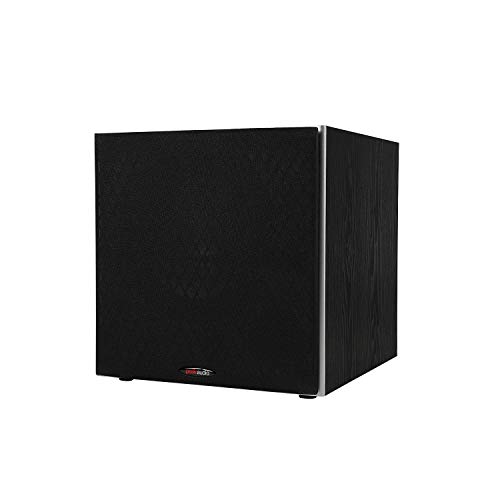
The Polk Audio PSW10 is a sensible starting point for a first music subwoofer, especially in a compact room where a large cabinet would be impractical. Its 10-inch driver sits in a non-resonant cabinet with Power Port technology, a design intended to smooth airflow and reduce distortion at the port. The built-in amplifier delivers 50 watts RMS and 100 watts dynamic power, which is enough for moderate listening levels when the gain is set to match the main speakers. A continuously variable low-pass filter from 80 to 160 Hz helps the subwoofer hand over cleanly to smaller speakers.
Specs
- 10-inch powered subwoofer driver
- High-current amplifier, 50 watts RMS and 100 watts dynamic power
- Power Port technology for smoother bass response
- Continuously variable low-pass filter, 80 to 160 Hz
- RCA and speaker-level inputs for flexible connection
Best for: A compact first subwoofer for a small music room or a bedroom stereo system.
Watch out for: Confirm that the low-pass range suits your main speakers, since very large floorstanding speakers may need a lower crossover than this model provides.
Dayton Audio SUB-1000

The Dayton Audio SUB-1000 earns its place here through flexibility, which matters when an older stereo amplifier has no dedicated subwoofer output. It offers both RCA line-level inputs and speaker-level inputs, plus speaker-level outputs, so it can sit between an amplifier and a pair of speakers without extra equipment. The ported bass-reflex design uses a bottom-firing flared port intended to reduce port noise, and the variable low-pass filter runs from 40 to 140 Hz. An auto on and off switch and a phase switch round out a practical rear panel for everyday music listening.
Specs
- 10-inch long-throw woofer
- Ported bass-reflex design with bottom-firing flared port
- Frequency response, 30 to 140 Hz
- RCA line-level inputs and speaker-level inputs and outputs
- Variable low-pass filter, 40 to 140 Hz, with phase switch and auto on and off
Best for: A stereo system built around an integrated amplifier without a subwoofer output.
Watch out for: The bottom-firing port needs clearance above the floor, so check that rugs, thick carpet, or a low plinth do not block airflow underneath the cabinet.
Klipsch RP-1000SW

The Klipsch RP-1000SW is the strongest choice in this group for a larger room, where a smaller subwoofer can run out of composure during loud dynamic passages. Its redesigned 10-inch Cerametallic woofer is built for long excursion with low distortion, and the built-in Class D amplifier with an analog preamp stage is rated at 300 watts RMS and 600 watts peak. Frequency response reaches from 19 to 131 Hz, and the front-firing Aerofoil slot port is shaped to reduce turbulence. A continuously variable low-pass crossover from 40 to 160 Hz and a phase switch help it blend with capable main speakers.
Specs
- 10-inch front-firing ultra-long-throw Cerametallic woofer
- Class D amplifier with analog preamp stage, 300 watts RMS and 600 watts peak
- Frequency response, 19 to 131 Hz
- Bass-reflex enclosure with front-firing Aerofoil slot port
- Continuously variable low-pass crossover, 40 to 160 Hz, with 0 and 180 degree phase switch
- Dual RCA and LFE line inputs, with optional wireless adapter port
Best for: A larger listening room where bass must stay tight and controlled at higher volume.
Watch out for: Measure the cabinet depth carefully, since this model is considerably deeper than a typical compact subwoofer and needs space for rear cables.
Monoprice SSW-10

The Monoprice SSW-10 solves a placement problem that stops many people from adding a subwoofer at all. Its slim, low-profile cabinet measures 25 inches deep by 15.7 inches wide by 7 inches high, so it can slide under a sofa, sit behind a television stand, or mount on a wall with the included brackets. Inside that shallow cabinet sits a 10-inch driver with a 150-watt amplifier, and the ported design is tuned to reach down to 25 Hz. Stereo line-level and speaker-level inputs, a variable low-pass filter from 50 to 150 Hz, and a phase control give enough adjustment to blend it with a stereo pair.
Specs
- 10-inch woofer in a slim ported cabinet
- 150-watt amplifier
- Frequency response, 25 to 150 Hz
- Variable low-pass filter, 50 to 150 Hz, with phase control
- Stereo line-level and speaker-level inputs
- Dimensions, 25 inches deep by 15.7 inches wide by 7 inches high, with on-wall mounting brackets included
Best for: A living room or listening room where a standard subwoofer box has no sensible place to stand.
Watch out for: Check the under-furniture clearance and the cable route before ordering, since the slim shape still needs a clear path for power and signal cables.
Which One Fits Your Situation
You have a small room and a first stereo system
Choose the Polk Audio PSW10 or the Dayton Audio SUB-1000, depending on your amplifier. The Polk model keeps the setup simple when a subwoofer output is available, while the Dayton model is the better fit when only speaker terminals are available. Both are compact enough for a small room, and both reward a low gain setting that lets the main speakers stay in charge of the music.
You want bass that stays tight at higher volume
Choose the Klipsch RP-1000SW, because its larger amplifier headroom and long-excursion Cerametallic driver hold bass lines together when the music gets dynamic. Set the crossover low enough that only the deepest notes come from the subwoofer, then raise the gain slowly until the bass feels full without pulling attention away from the main speakers.
You have no good floor space for a subwoofer
Choose the Monoprice SSW-10, since its slim cabinet fits under furniture or on a wall where a normal box cannot go. Plan the cable route first, because a hidden location is only useful when power and signal can reach it neatly. Use the low-pass filter and phase control to blend it with the main speakers, and avoid pushing the gain to compensate for a poor position.
You want an energetic sound for rock and pop
Choose the Klipsch R-100SW, which pairs a front-firing 10-inch driver with a 300-watt peak amplifier for punchy bass on drums and bass guitar. Keep the crossover moderate and the gain restrained so that the energy stays musical rather than boomy, and move the cabinet away from a corner if the low end starts to sound thick.
Common Mistakes
- Setting the gain too high so the subwoofer dominates every track instead of supporting the main speakers.
- Choosing a crossover that is too high, which lets male vocals and mid-bass leak into the subwoofer.
- Placing the subwoofer hard into a corner without listening first, then blaming the model for boomy bass.
- Buying a model without checking whether the amplifier has a subwoofer output or needs speaker-level inputs.
- Ignoring cabinet depth, port clearance, and cable space, then finding the subwoofer does not fit the planned spot.
Frequently Asked Questions
Is a 10-inch subwoofer enough for music listening?
A 10-inch powered subwoofer is enough for music in most small and medium rooms, because music rarely demands the extreme output of film effects. It fills in bass guitar, kick drum, piano, and organ notes that small speakers miss, while staying compact enough to place well. Larger open rooms may need a more powerful model or careful placement to keep the bass even.
Should I choose a sealed or ported subwoofer for music?
A sealed cabinet often sounds tighter, while a ported cabinet reaches deeper with less effort and can still sound musical when set up well. All five models here use ported designs, so placement, crossover, and gain matter more than the enclosure label alone. Keep the port clear, start with a low crossover, and listen for clean timing on familiar tracks.
Where should I place a subwoofer for music?
Start with the subwoofer near the main speakers, roughly on the same wall, and move it in small steps while playing familiar music. Avoid jamming it into a corner unless the bass sounds thin elsewhere, since corners can exaggerate certain notes. The best spot is the one where bass notes sound even and the subwoofer disappears into the stereo image.
Do I need speaker-level inputs on a subwoofer?
You need speaker-level inputs when your amplifier has no dedicated subwoofer output, which is common with older or simpler integrated amplifiers. The Dayton Audio SUB-1000 and the Monoprice SSW-10 both provide them, along with RCA inputs. If your amplifier does have a subwoofer output, a line-level RCA or LFE input is the simpler connection to use.
Related guides
More from Amazon
Programs that pair well with the guide above. Offers and eligibility are set by Amazon and may change.
Free shipping on eligible items, Prime Video and more. Eligible new members can start with a free trial.
Start a Prime free trialAudiobooks and podcasts to listen to on the go. Eligible new members can start with a free trial.
Try Audible freeAd-free music streaming. Eligible new subscribers can start with a free trial.
Try Music Unlimited freeA free business account with business pricing and bulk-buying tools for work, shop or home office.
Create a business accountAs an Amazon Associate we earn from qualifying purchases.










Write Your Review
No reviews yet. Be the first to share your experience!