
Key takeaways
- Compare triple-output bench power supplies for electronics laboratories, covering channel ratings, isolated outputs, remote control and buying checks.
What's inside
As an Amazon Associate I earn from qualifying purchases. This post may contain affiliate links at no extra cost to you.
A laboratory board rarely runs from a single rail: an analog front end may need a positive and negative supply while a microcontroller and its logic sit on a separate low-voltage rail. A triple-output bench supply puts all three rails in one chassis, and the real decision is how those outputs are arranged. Buyers have to compare the voltage and current rating of each channel, whether the third output is adjustable or a fixed logic rail, how much total power the chassis can deliver at once, and whether the outputs are isolated enough to combine or float independently.
This guide is for electronics laboratories that prototype, debug and service mixed-signal boards: university teaching labs, research and development benches, and repair benches that power several rails at the same time. The supplies below were chosen from the product names and specifications printed on their Amazon product pages, and every model here provides exactly three outputs.
Quick Picks
As an Amazon Associate we earn from qualifying purchases.
| Product | Best for | Key spec from title |
|---|---|---|
| Siglent Technologies SPD3303X-E Triple Output Power Supply | Mixed analog and digital boards that need isolated rails | 220W total power |
| Rigol DP832 Programmable Linear DC Power Supply, 3 Channels | Programmable three-channel work with two equal main channels | 195W total power |
| Tekpower TP-3005D-3 Digital Variable Triple Outputs Linear-Type DC Power Supply | Teaching and service benches that need more current per channel | 0-30 Volts @ 0-5 Amps |
How to Choose
Channel Ratings and Total Power
Start with the rails your boards actually draw. Most laboratory work sits comfortably inside two main channels of roughly 30 volts, but current demand varies widely: a sensor board may sip milliamps while a motor driver or power stage pulls several amps from one rail. Check the per-channel current rating first, then the total power figure, because a chassis cannot always run every channel at its maximum simultaneously. A supply rated around 200 watts in total suits mixed prototyping, while higher-current channels matter more for power electronics and actuator work. Match the supply to the hungriest rail you realistically expect, not the average board.
Third Output: Adjustable Channel or Fixed Logic Rail
The third output is where triple-output models differ most. Some supplies give a third fully adjustable channel, while others provide a fixed or selectable logic rail, commonly 5 volts or a choice of 2.5, 3.3 and 5 volts. A selectable rail is convenient for digital work because logic levels are standardized and the rail is set once and forgotten. An adjustable third channel helps when a board needs an unusual bias voltage or a second analog rail. Decide which style your laboratory uses more often, because this single difference changes daily workflow more than small gaps in resolution or display size.
Isolation, Series and Parallel Modes
Isolated outputs let each channel float, so rails can be stacked, offset or referenced to different points in a circuit without creating ground loops through the supply. That isolation is what makes split analog rails practical: two channels can be wired as a positive and negative pair around a common ground. Many triple-output supplies also offer series and parallel modes that combine the two main channels into one higher-voltage or higher-current output for occasional jobs. Confirm that the listing states the outputs are isolated and names the combination modes you need, since look-alike models with shared grounds cannot do the same tricks.
Remote Interfaces and Display Readability
Laboratories that log data or run repeated test sequences should look for remote control: a USB or LAN interface with command support lets a PC set voltages, step through test points and record behavior without touching the front panel. Supplies without interfaces still suit manual bench work, where a clear display matters more. Check how many digits the readouts show and whether voltage and current appear together for every channel, because a display that forces channel-by-channel toggling slows debugging. A timing or memory function is a bonus for benches that repeat the same power-up sequence across many identical boards.
The 3 Best Options
Siglent Technologies SPD3303X-E Triple Output Power Supply
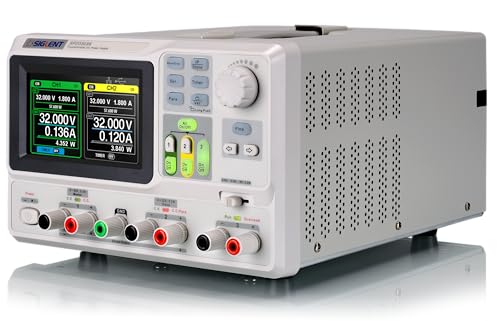
This Siglent unit suits laboratories that power mixed analog and digital sections of one board at the same time. Its two main channels each deliver up to 32 volts and 3.2 amps, and the third output is a selectable 2.5, 3.3 or 5 volt rail, covering the common logic levels without using an adjustable channel. The listing states that all three outputs are independent, controlled and isolated, and that the main channels can run in independent, series or parallel modes. A timing output function, trending graphs and USB plus LAN interfaces round it out for benches that document or automate test routines.
Specs
- 3 independent controlled and isolated outputs
- 32V/3.2A x 2, 2.5V/3.3V/5V/3.2A x 1, total power: 220W
- Output modes: independent, series, parallel
- Timing output function and trending graphs
- USB and LAN interfaces
- Model: SPD3303X-E; Manufacturer: Siglent Technologies
Best for: Laboratories powering split analog rails plus a logic rail from one chassis.
Watch out for: The third output is selectable among fixed voltages rather than fully adjustable, so confirm your logic rail is one of the three listed values.
ASIN: B01410O424
Rigol DP832 Programmable Linear DC Power Supply, 3 Channels

Rigol’s DP832 fits laboratories that want a programmable linear supply with two equal main channels and a straightforward channel layout. The listing title rates the outputs at 30 volts and 3 amps on each of the first two channels and 5 volts at 3 amps on the third, for 195 watts of total power. That symmetry makes it easy to run a matched pair of rails for analog circuitry while the third output feeds a digital section. At 22.8 pounds it is a substantial bench instrument, so it suits a fixed laboratory position rather than a supply that gets carried between rooms or shared across buildings.
Specs
- 3 channels, 195W total power
- Maximum output range: 30V/3A, 30V/3A, 5V/3A
- Item model number: DP832
- Manufacturer: RIGOL TECHNOLOGIES USA INC
- Item weight: 22.8 pounds
Best for: Fixed laboratory benches running two matched rails plus a 5 volt logic output.
Watch out for: Check bench depth and shelf strength before ordering, since the listed weight makes this the heaviest style of unit in this guide.
ASIN: B09S3GQ24H
Tekpower TP-3005D-3 Digital Variable Triple Outputs Linear-Type DC Power Supply

The Tekpower TP-3005D-3 is the pick for laboratories that need more current from the main channels and prefer simple digital controls over remote programming. Its two variable outputs each run from 0 to 30 volts at up to 5 amps, and the seller describes a third output of 5 volts at up to 3 amps for logic circuits. The listing highlights constant voltage and constant current modes, a back-lit LCD display, and a cooling fan that switches on automatically through a built-in thermo-sensor. For teaching labs and service benches that power boards by hand all day, that feature set keeps the front panel easy to teach and quick to set.
Specs
- Triple outputs, 0-30 volts and 0-5 amps on the variable channels
- Third output: 5 volts at up to 3 amps
- Two operational modes: constant voltage and constant current
- Back-lit LCD display with 0.1V and 0.01A resolution
- Cooling fan with automatic activation by built-in thermo-sensor
- Model number: TP-3005D-3; Dimensions: 14.17 x 6.5 x 10.43 inches
Best for: Teaching and service laboratories that set rails manually and need 5 amps per main channel.
Watch out for: The listing centers on manual front-panel operation, so confirm it meets your needs if your laboratory requires PC-based remote control.
ASIN: B00HX0UYBK
Which One Fits Your Situation
Powering a Mixed Analog and Digital Prototype
Choose the Siglent SPD3303X-E when one board needs split analog rails and a logic rail together. Its two isolated main channels can feed the positive and negative sides of an analog section while the selectable third output covers 2.5, 3.3 or 5 volt logic, and the series and parallel modes stay available when a prototype briefly needs a single taller or stronger rail.
Running Matched Rails on a Fixed Bench
Pick the Rigol DP832 when the laboratory bench is a permanent setup and most work uses two equal rails. The two 30 volt, 3 amp channels are rated identically, which keeps dual-rail analog circuits simple to configure, and the separate 5 volt output handles the digital side. Its weight matters little once the unit has a dedicated place on the bench.
Equipping a Teaching or Service Bench
The Tekpower TP-3005D-3 suits benches where several people set voltages by hand throughout the day. Five amps per main channel covers hungrier boards and small power stages, the constant voltage and constant current modes are the two states students and technicians actually use, and the back-lit display keeps readings visible under ordinary laboratory lighting without any software setup.
Feeding a Higher-Current Load on One Rail
When a single rail must drive a motor, heater or power stage, the Tekpower’s 5 amp main channels give the most headroom of the three supplies here. If the load instead needs more voltage than one channel offers, the Siglent’s series mode, which combines its two main channels, is the better route, so decide whether your heavy loads are current-hungry or voltage-hungry before choosing.
Common Mistakes
- Adding the three channel ratings together and assuming the chassis can deliver all of them at once, without checking the total power figure in the listing.
- Buying a supply whose third output is a fixed 5 volt rail when the laboratory regularly needs an adjustable third channel for bias or reference voltages.
- Ignoring isolation and discovering later that the outputs share a ground, which blocks split-rail wiring and can create ground loops between instruments.
- Setting a current limit carelessly high for a first power-up, so a wiring fault damages the board before the supply’s constant current mode can protect it.
- Forgetting bench logistics: heavy programmable units need shelf space, ventilation room for their fans, and enough outlets near the working area.
Frequently Asked Questions
Why choose a triple-output supply over separate single-output units?
One chassis gives three coordinated rails with a shared front panel, so power-up sequencing, current limiting and shutdown happen in one place. It also saves bench space and mains outlets compared with stacking separate supplies. For boards that always need the same group of rails, a triple-output unit is simpler to set up, simpler to teach, and easier to move between benches as a single instrument.
Can the two main channels be combined for higher voltage or current?
On models whose listings name series and parallel modes, yes: series wiring adds the channel voltages for a taller rail, and parallel wiring adds the available current. The Siglent in this guide lists independent, series and parallel output modes explicitly. Always confirm the mode is a built-in feature of the exact model rather than improvising connections on a supply that does not support it.
Is a fixed or selectable third output enough for logic circuits?
Usually, yes. Most digital sections run on standard levels, and the supplies here offer 5 volts or a selectable 2.5, 3.3 and 5 volt rail at up to 3.2 amps, which covers microcontrollers, logic families and interface boards. An adjustable third channel only becomes important when a design needs an unusual voltage, a variable bias, or a second analog rail that must track a precise value.
What should be checked before a board is powered for the first time?
Verify the voltage set on every channel against the board’s requirements, set the current limit just above the expected draw, and confirm polarity at the terminals before switching the output on. Check that unused outputs are off or set safely, and make sure the board’s ground arrangement matches how the supply’s isolated channels are wired for that particular test setup.
Related guides
More from Amazon
Programs that pair well with the guide above. Offers and eligibility are set by Amazon and may change.
Free shipping on eligible items, Prime Video and more. Eligible new members can start with a free trial.
Start a Prime free trialAudiobooks and podcasts to listen to on the go. Eligible new members can start with a free trial.
Try Audible freeAd-free music streaming. Eligible new subscribers can start with a free trial.
Try Music Unlimited freeA free business account with business pricing and bulk-buying tools for work, shop or home office.
Create a business accountAs an Amazon Associate we earn from qualifying purchases.










Write Your Review
No reviews yet. Be the first to share your experience!