
Key takeaways
- Five analog watches in the under-100 class compared on movement, case size, water resistance and straps, from a 200M diver to a classic field watch.
What's inside
As an Amazon Associate I earn from qualifying purchases. This post may contain affiliate links at no extra cost to you.
An analog watch in the under-100 class asks you to make one real decision: which compromises you accept in exchange for a dial with hands instead of a screen. At this level you choose between quartz accuracy and a self-winding automatic, between a case built for swimming and one built for a shirt cuff, and between straps you can swap in seconds and bracelets that need a tool and patience. None of the five watches below does everything, so the right pick depends on how the watch will spend most of its days on your wrist.
This guide suits first-time buyers, gift shoppers, and anyone replacing a worn-out daily watch with something that has moving hands and no charging cable. Every model here was chosen from its Amazon listing name and published specifications: movement type, case diameter, water resistance depth, strap material, and extras such as a date window or a backlight. If a detail does not appear in the listing, it does not appear in this guide.
Quick Picks
As an Amazon Associate we earn from qualifying purchases.
| Product | Best for | Key spec from title |
|---|---|---|
| Casio MDV106-1AV | Swimming and rough daily wear | 200M water resistance, screw-down crown |
| Invicta Pro Diver 8926OB | A first automatic | NH35A automatic movement, 24 jewels |
| Timex Weekender 38mm | Easy everyday style | 38mm case, slip-thru nylon strap |
| Timex Expedition Scout 40 | Field and outdoor use | 50M water resistance, INDIGLO dial |
| Casio MQ24-1E | The simplest possible watch | Three-hand analog, 3-year battery |
How to Choose
Movement: quartz or automatic
Quartz models run on a battery and keep time with very little attention, which suits a watch you grab without thinking. The trade is a ticking seconds hand and a battery change every few years. An automatic winds itself from wrist motion, needs no battery, and shows a sweeping seconds hand, but it stops after a day or two unworn and drifts more over a month. In the under-100 class, one automatic makes this list; the rest are quartz. Pick by habit: wear it daily and an automatic stays alive; rotate watches and quartz waits patiently.
Case size and wrist fit
Diameter decides how a watch reads on the wrist more than any styling detail. Cases here run from a compact resin body to a broad 44 millimeter diver, and the same watch can look tidy on one wrist and oversized on another. Measure across your wrist bone and favor a case that leaves a small margin on both sides. Thickness matters under a cuff: a slim nine millimeter case slides under sleeves, while a tall automatic case catches on them. If you fall between sizes, the lighter watch usually wears better across a long day.
Water resistance in plain terms
Printed depth numbers describe lab conditions, not a license to push buttons underwater. A 30 meter marking covers hand washing and rain. Fifty meters handles showering and brief swims for most makers. A 200 meter case with a screw-down crown is the one built for regular swimming and snorkeling. Whatever the dial says, keep crowns pushed or screwed in before water, and remember that heat, soap, and aging seals reduce protection over time. If swimming is the main job, choose the diver and treat the others as splash-proof daily wear.
Straps, bracelets, and upkeep
The strap decides comfort before the movement gets a chance to impress. Nylon slip-thru straps weigh little, dry fast, and swap without tools, which makes one watch feel like several. A steel link bracelet adds presence and durability but needs links removed for a proper fit and shows scratches sooner. Resin straps shrug off water and sweat yet can crack with age. Check the band width in the listing before ordering a spare strap, since every model here uses its own width, and plan on a battery change for quartz models every few years.
The 5 Best Options
Casio MDV106-1AV

The Casio MDV106-1AV is the pick when water is part of the routine. Its stainless steel case measures 44 millimeters across, the crown and case back screw down, and the listing gives a water resistance depth of 660 feet, the strongest figure in this group. A date window sits at three o’clock, the black dial keeps large luminous markers, and the resin band keeps weight sensible at 92 grams. Diver styling without a digital screen is the whole point here: it reads as a tool watch at the pool, at work, and everywhere between.
Specs
- Movement: Japanese quartz, battery powered
- Case: stainless steel, 44 mm diameter, 12 mm thick
- Crystal: mineral
- Band: black resin, 20 mm width, buckle clasp
- Water resistance depth: 660 feet
- Extras: date display, screw-down crown and case back
- Weight: 92 grams
Best for: swimmers and anyone who wants diver styling with quartz ease.
Watch out for: the 44 mm case is the widest here and can overhang slim wrists.
ASIN: B009KYJAJY
Invicta Pro Diver 8926OB

The Invicta Pro Diver 8926OB is the one automatic in this group, built around a Japanese NH35A movement with 24 jewels that winds from wrist motion. The 40 millimeter stainless steel case pairs a black dial and luminous hands with a link bracelet, and an exhibition case back shows the movement working. Water resistance depth matches the Casio at 660 feet. At 14.1 millimeters thick and 155 grams on the bracelet, it wears with real presence, so expect a watch that feels substantial rather than something you forget is on your wrist.
Specs
- Movement: NH35A Japanese automatic, 24 jewels
- Case: stainless steel, 40 mm diameter, 14.1 mm thick
- Case back: exhibition
- Dial: black with luminous hands
- Bracelet: stainless steel link, 205 mm band length
- Water resistance depth: 660 feet
- Weight: 155 grams
- Warranty: 3-year limited manufacturer warranty
Best for: a first automatic with a bracelet and a view of the movement.
Watch out for: it stops after a day or two off the wrist and needs the time reset.
ASIN: B000JQFX1G
Timex Weekender 38mm

The Timex Weekender 38mm is the easygoing classic of the group. A slim brass case, nine millimeters thick, carries a black dial with full numerals and a 24-hour inner track, and the INDIGLO backlight lights the whole dial at a press of the crown. The black nylon slip-thru strap slides off in seconds, so one case becomes several looks with spare straps. There is no date window, and water resistance depth is 30 meters, which means rain and hand washing only. For a light, quiet, everyday analog watch, this remains the reference shape.
Specs
- Movement: quartz
- Case: brass, 38 mm diameter, 9 mm thick
- Crystal: mineral
- Strap: black nylon slip-thru, 20 mm width
- Dial: black with 24-hour markings and INDIGLO backlight
- Water resistance depth: 30 meters
- Calendar: no date function
Best for: a light everyday watch with straps you can swap in seconds.
Watch out for: no date window, and 30 meters means splashes only.
ASIN: B004VR9GCQ
Timex Expedition Scout 40
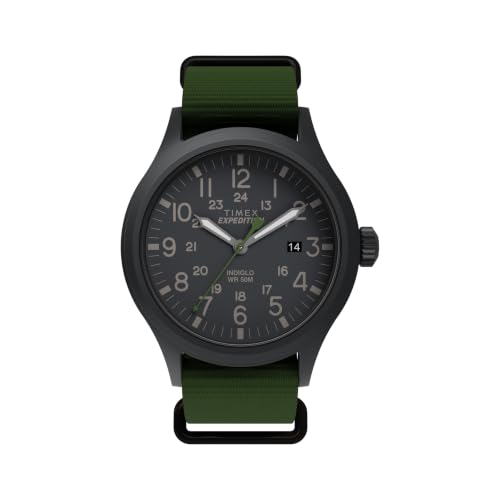
The Timex Expedition Scout 40 is the field watch of the group, with a matte brass case, full Arabic numerals, and a 24-hour inner scale for quick conversion. A date window sits at three o’clock, luminous hands pair with the INDIGLO light-up dial after dark, and water resistance depth reaches 50 meters, enough for showering and short swims. The green nylon slip-thru strap fits wrists up to eight inches and suits the outdoor styling. It runs two millimeters wider than the Weekender and wears noticeably more rugged, which is exactly its appeal.
Specs
- Movement: quartz
- Case: brass with matte finish, 40 mm diameter, 11 mm thick
- Crystal: mineral glass
- Strap: green nylon slip-thru, 20 mm width, fits up to 8-inch wrist
- Dial: black with date window, full Arabic numerals, INDIGLO light-up dial
- Water resistance depth: 50 meters
Best for: field styling with a date window and a backlight for camp or commute.
Watch out for: the nylon strap holds water after a swim and dries slowly.
ASIN: B0194LW5BM
Casio MQ24-1E

The Casio MQ24-1E strips the analog watch down to its essentials: three hands, a clean dial, and nothing else asking for attention. The resin case, resin band, and resin glass keep it featherweight and unbothered by knocks, and the listing notes a three-year battery, so upkeep is nearly zero. There is no date window, no backlight, and water resistance is basic splash protection rather than a swimming figure. Choose it when the goal is a watch that disappears on the wrist, costs very little effort, and simply tells the time every single day.
Specs
- Movement: quartz, three-hand analog
- Case: resin
- Band: resin
- Glass: resin
- Battery: 3-year battery per listing
- Water resistance: water resistant, splash level
- Model: MQ24-1E
Best for: the lowest-effort watch in the group, light enough to forget.
Watch out for: resin glass marks more easily than a mineral crystal.
ASIN: B000GAWSHM
Which One Fits Your Situation
You swim, shower, and forget to take your watch off
Take the Casio MDV106-1AV. Its screw-down crown, 660-foot depth figure, and resin band are built for water that would ruin the others, and the date window keeps it useful on dry land. The Invicta matches the depth number on paper, but its steel bracelet and automatic movement ask for more care, so the Casio is the calmer choice for daily swimming, showering, and beach days without a second thought.
Your first mechanical watch
Choose the Invicta Pro Diver 8926OB. The NH35A automatic winds itself while you wear it, the exhibition back shows the balance wheel working, and the steel bracelet gives it a grown-up feel the fabric straps cannot match. Accept the rituals that come with it: set the time after quiet weekends, expect small drift over a month, and enjoy owning a machine rather than a battery with hands.
One watch, many straps
Pick the Timex Weekender 38mm first. Its slip-thru strap removes without tools, the 20 millimeter width is widely supported, and the plain black dial pairs with nylon, canvas, or leather in most colors. The Expedition Scout shares the same strap system with a field look, so pick the Weekender for town wear and the Scout when the dial needs numerals you can read at a glance outdoors.
You want the lightest, simplest option
Take the Casio MQ24-1E. A resin case and band keep it close to weightless, three hands keep the dial honest, and a three-year battery means years between services. It gives up the date window, the backlight, and any real swimming ability, and in return it asks for nothing. For a backup watch, a work watch, or a first analog for a younger wearer, that trade is hard to argue with.
Common Mistakes
- Reading a 30-meter marking as permission to swim; it covers splashes and rain, and only the 200-meter class here is built for regular swimming.
- Buying the widest case on the page without measuring your wrist, then wondering why the lugs hang past the bone.
- Ordering spare straps before checking the band width printed in the listing; widths differ between models in this group.
- Letting an automatic sit unworn for days and then treating the stopped time as a defect rather than how the movement works.
- Pressing the crown or buttons while the watch is wet, which invites moisture past the seals on any watch in this class.
Frequently Asked Questions
Is quartz or automatic better in this class?
Quartz suits most buyers here: it keeps tighter time, asks only for a battery every few years, and waits ready after a week in a drawer. Automatic suits buyers who enjoy the mechanism itself and wear the watch most days, since wrist motion keeps it running. Neither is fragile; the honest difference is habit, not quality, so match the movement to how often the watch will be worn.
Can I swim with a watch marked 30 meters?
No. That marking comes from a static lab test and covers hand washing, rain, and brief splashes in daily life. Showering adds heat and soap, which stress seals, and swimming adds pressure spikes the test never models. In this group, only the two 660-foot divers are built for regular swimming; the 50-meter Scout handles short swims, and everything else should stay on the towel.
How long do the quartz batteries last in these models?
The Casio MQ24 listing states a three-year battery, and the MDV106 series listing also cites three years. The two Timex models do not print a figure in their listings, so expect a similar span and plan for a change every few years. A backlight used many times a day shortens that span, since the lamp draws far more power than the hands do.
What case size should a smaller wrist choose?
Look at the 38 millimeter Weekender first, then the MQ24 in resin. Both sit close, weigh little, and keep their lugs inside the width of most slim wrists. The 40 millimeter pair still works if you like a bolder face, but the 44 millimeter Casio will likely overhang. When a listing gives case diameter, compare it with a ruler against your wrist before ordering.
Related guides
More from Amazon
Programs that pair well with the guide above. Offers and eligibility are set by Amazon and may change.
Free shipping on eligible items, Prime Video and more. Eligible new members can start with a free trial.
Start a Prime free trialAudiobooks and podcasts to listen to on the go. Eligible new members can start with a free trial.
Try Audible freeAd-free music streaming. Eligible new subscribers can start with a free trial.
Try Music Unlimited freeA free business account with business pricing and bulk-buying tools for work, shop or home office.
Create a business accountAs an Amazon Associate we earn from qualifying purchases.










Write Your Review
No reviews yet. Be the first to share your experience!